
On this page
Start here
Quick answer
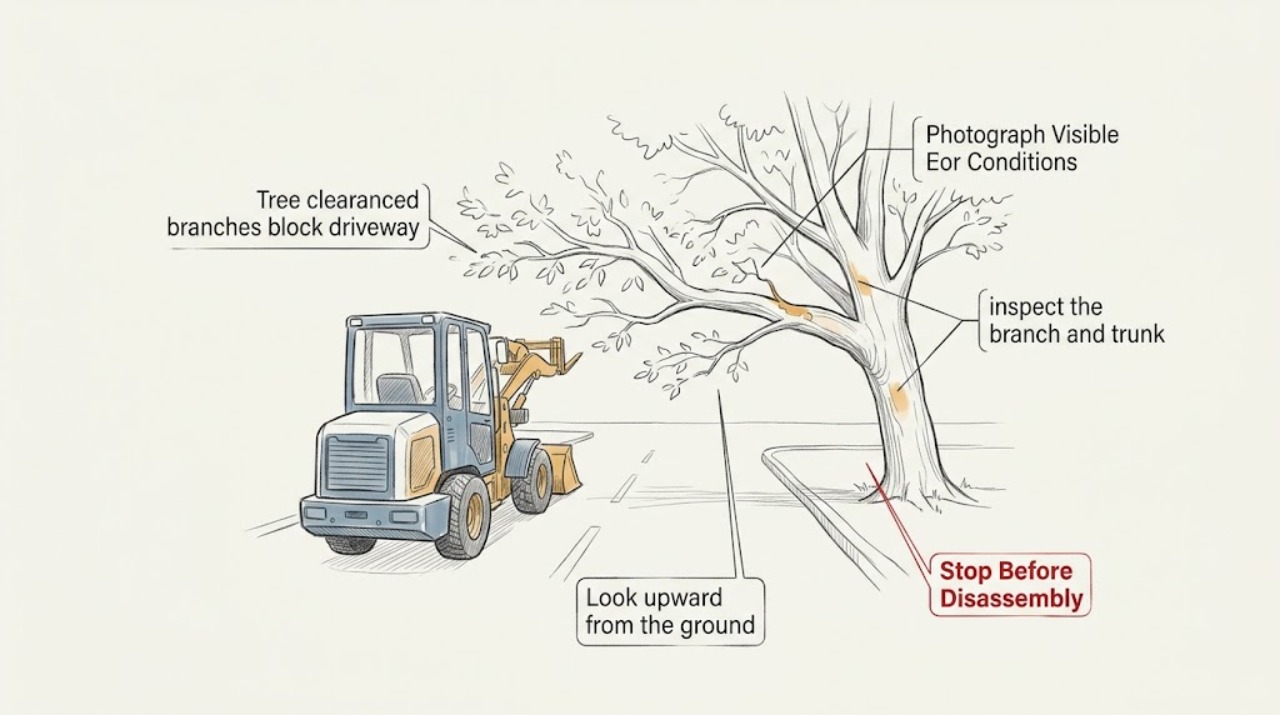
A low branch blocking a driveway is a clearance problem, but the safe next step depends on whether it is live and stable, broken after wind, close to utility lines, or on public or neighboring property. From a parked vehicle and a safe ground position, photograph the branch, check for cracks or hanging pieces, identify any overhead lines, and note whether it blocks only your parking space or also the roadway sight line. Do not climb, use a ladder or chainsaw, pull on a hanging limb, or cut near a power line. Keep people and vehicles out of the fall area. For a branch that cannot be reached with both feet safely on the ground, is storm-damaged, affects a public right-of-way, or is near a line, call a qualified arborist or line-clearance tree professional; contact the utility or local authority first when their infrastructure or property is involved.
Work through in order
Diagnostic checks
Use only checks that match the exact appliance or system and its official guide.
-
Check 1
Park well away from the branch and photograph the driveway from both directions, including the branch, trunk, nearby structures, roadway edge, and any point where vehicles or pedestrians must pass; do not stand beneath a hanging limb.
Expected result: The branch blocks only a parking position, extends over the driveway entrance or roadway, or creates a sight-line obstruction for drivers or pedestrians.
Next step: Keep vehicles and people out of the conflict area and give the photos to an arborist or the relevant road or property authority. Do not solve a sight-line problem by cutting from a vehicle, ladder, or roadway.
Why this matters
Why: A private parking obstruction is mainly a tree-clearance decision. A branch over the entrance or roadway adds traffic and public-safety consequences, while a blocked sight line can make entering or leaving the driveway hazardous even if the branch is not visibly damaged.
-
Check 2
From a stable ground position, inspect the branch and trunk visually for a hanging or detached limb, fresh break, deep crack, split union, unusual lean, exposed roots, dead wood, or movement in ordinary wind; do not shake, brace, or touch the branch.
Expected result: The branch is intact and flexible-looking, or it is cracked, hanging, freshly broken, dead, or attached at a visibly weak union.
Next step: For any broken, hanging, cracked, or leaning tree, close the driveway and keep people away until a qualified arborist assesses it. Do not attempt to lower or cut the limb yourself.
Why this matters
Why: An intact low branch may be a routine clearance project. A crack, hanging piece, dead branch, or weak attachment increases the chance of an uncontrolled fall and makes the work storm or hazard mitigation rather than simple driveway pruning.
-
Check 3
Look upward from the ground for electrical, communication, or service lines crossing or approaching the branch, and note whether the branch, trunk, tools, or a ladder could enter their space; do not measure by reaching toward the line.
Expected result: No line is nearby, a line is visible near the canopy, or a branch is touching or appears close to an overhead power line.
Next step: Keep everyone and all equipment away, assume the line is energized, and contact the utility or a qualified line-clearance tree professional. Do not prune, climb, use a pole tool, or ask an unqualified person to de-energize the line.
Why this matters
Why: No visible line removes one major hazard but does not make elevated cutting safe. A nearby or contacted power line changes the job to utility line-clearance work; branches and equipment can conduct or move unexpectedly even when the cut is below the line.
-
Check 4
Check the tree's location relative to your property line, sidewalk, street edge, drainage area, and any public right-of-way; review local tree or street-tree rules before scheduling work.
Expected result: The trunk is clearly on private property, sits in a right-of-way or verge, crosses a boundary, or ownership is uncertain.
Next step: Document the location and ask the local authority, utility, landlord, or neighboring owner who controls the tree and whether a permit or approved arborist is required. Do not remove a limb while ownership or authorization is unclear.
Why this matters
Why: Private-tree clearance may be arranged by the owner subject to local rules. A street or right-of-way tree may be controlled by a municipality, and a boundary tree may require coordination with the neighboring owner; cutting first can create a legal, safety, or maintenance dispute.
-
Check 5
Decide whether the branch can be addressed from the ground without a ladder, climbing, power equipment, traffic exposure, or work in adverse weather, and note the branch size and whether the driveway can remain closed during service.
Expected result: The branch is small and reachable from stable ground with no lines or damage, or it requires elevated access, power equipment, traffic control, rigging, or work near a structure.
Next step: For anything beyond a simple, permitted ground-level task, hire a qualified arborist and keep the driveway closed during the work. Never top the tree or shorten a branch indiscriminately just to gain clearance.
Why this matters
Why: A truly ground-reachable, low-risk branch may be within ordinary light-pruning scope where local rules allow it, but a branch requiring elevation, equipment, or control of a fall zone is professional tree work. The absence of a ladder does not remove hazards from branch weight or tree structure.
-
Check 6
After wind or a storm, inspect only from a safe distance for additional broken limbs, a shifted trunk, hanging branches, soil lifting, or debris that has fallen into the driveway; postpone all tree work while high winds, lightning, ice, or unstable ground remain.
Expected result: The low branch is the only stable obstruction, or the tree has multiple damaged limbs, a new lean, uprooted soil, or limbs resting on structures or lines.
Next step: Close the driveway and keep clear of the tree until a qualified arborist assesses storm damage. If a line is down or involved, stay away and contact the utility or emergency service; do not move the limb or debris.
Why this matters
Why: An isolated, stable branch can be scheduled as a clearance job. Multiple defects or a changed lean indicate a larger failure risk, and a limb on a line or structure may require utility, emergency, or specialized response rather than ordinary pruning.
Use your observations
Decision map
Find the observation that best matches what you see, then follow the next safe action.
-
PATH 01Next step
What you see
Do this next
Confirm property and local-rule status, then schedule an arborist or a permitted ground-level pruning service. Keep vehicles out of the drop area and do not use a ladder or power saw to reach higher limbs.
-
PATH 02Next step
What you see
Do this next
Close the driveway, keep people and vehicles well away, and call a qualified arborist for storm-damage assessment. Use emergency or utility procedures if the branch contacts a structure, roadway, or line.
-
PATH 03Next step
What you see
Do this next
Stay away, assume the line is energized, and contact the utility or a qualified line-clearance tree professional. Do not prune, climb, use a pole saw, or move a limb that may be contacting the line.
-
PATH 04Next step
What you see
Do this next
Photograph the obstruction and contact the local authority, utility, landlord, or neighboring owner to establish responsibility and authorization. Keep the sight-line conflict closed or marked safely until the responsible party responds.
-
PATH 05Next step
What you see
Do this next
Hire a qualified arborist to plan the work, establish a drop zone, and select the pruning method. Do not improvise a ladder, climb the tree, or park beneath the branch while waiting.
Helpful context
Understand the symptom
Clearance is a tree-structure and access question
Removing lower limbs is commonly called raising or low limbing and can provide room for vehicles, pedestrians, and sight lines. A branch that looks like a simple obstruction may instead be cracked, weakly attached, storm-loaded, or part of a larger tree that is leaning. Proper pruning preserves the branch collar and the tree's structure; indiscriminate shortening or topping can create weak regrowth and decay. First decide whether the obstruction is routine clearance or a hazard that needs an arborist.
Power lines, weather, and ownership change the answer
Treat overhead electrical lines as energized and keep the entire tree-work area out of the line-clearance zone unless qualified utility tree workers are handling it. High winds, lightning, ice, wet ground, and storm-damaged limbs increase the chance of an uncontrolled fall. A tree beside a driveway may also be in a street right-of-way or on a neighbor's property, where permits or a utility or municipal request may be needed before work begins.
When checks do not resolve it
Need a professional?
Call a qualified arborist for a branch that is cracked, hanging, dead, storm-damaged, attached to a leaning tree, over a vehicle or structure, or not safely reachable with both feet on the ground. Contact the utility or a qualified line-clearance tree professional before any work near overhead power lines, and contact the local authority or neighboring owner when the tree is in a right-of-way or on a boundary. Keep the driveway closed during hazardous conditions and tree work. Do not climb, use a ladder or chainsaw, pull on a hanging limb, cut from a vehicle, top the tree, or work in high winds, lightning, ice, or unstable ground.
Common questions
FAQ
Can I cut a low branch that blocks my driveway?
Only a simple, permitted, ground-level task with no electrical, storm, traffic, property, or falling-limb hazard may be within ordinary light-pruning scope. If a ladder, power equipment, climbing, a drop zone, or judgment about a damaged tree is involved, use a qualified arborist.
What should I do if the branch is near a power line?
Do not prune, climb, use a pole tool, or move a limb that may contact the line. Assume the line is energized and contact the utility or a qualified line-clearance tree professional before anyone approaches the work area.
How do I know whether a low branch is dangerous after wind?
From a safe distance, look for a fresh break, crack, hanging or detached limb, split branch union, new lean, lifted soil, or additional broken limbs. Close the driveway and keep clear if any are present; do not pull or cut the branch to test it.
What if the branch blocks the driveway entrance or roadway view?
Treat it as a sight-distance and access issue, not only a parking inconvenience. Keep the conflict area controlled, document the obstruction, and contact the responsible property or road authority if the tree is in a right-of-way or affects drivers entering the road.
Read the exact guide
Official sources
- Access Management (Driveways)Federal Highway Administration, U.S. Department of Transportation · Supports treating branches that block a driveway entrance or roadway sight line as an access and traffic-safety issue, not just a private parking obstruction.
- Pruning TreesInternational Society of Arboriculture, TreesAreGood.org · Supports low-branch clearance as raising, the need for purposeful pruning, avoiding topping, and professional help for climbing or uncertain pruning work.
- Tree trimming and removal safety: Plan the work. Protect the crew.Texas Department of Insurance, Division of Workers' Compensation · Supports the ground-level hazard survey, storm and weather stop guidance, power-line boundary, drop-zone reasoning, and qualified-arborist escalation.
- How to Prune ProperlyPortland Parks & Recreation Urban Forestry · Supports the low-branch clearance branch, public-tree and permit check, utility-only work near high-voltage wires, and the no-topping boundary.
- eTool: Electric Power Generation, Transmission, and Distribution - Overhead Line Work - Line-Clearance Tree Trimming OperationsOccupational Safety and Health Administration, U.S. Department of Labor · Supports the electrical-boundary branch for low driveway branches near overhead lines, including treating lines as energized and using qualified line-clearance personnel.
Community feedback
Share a repair observation
Share a plain-text repair observation. Accepted observations are published automatically; this page may take a moment to update.