
On this page
Start here
Quick answer
Treat branches blocking a driveway as a clearance and hazard assessment, not a do-it-yourself cutting task. From a safe position outside the driveway and tree-fall area, record the obstruction's location, apparent clearance, branch stability, utility-line proximity, and effect on vehicles, pedestrians, and emergency access. Do not climb, use a ladder, cut, pull, shake, brace, or approach a branch that touches or may reach a power line, and do not inspect during high wind, lightning, ice, or other dangerous weather. Keep people and vehicles away from hanging or unstable branches, isolate an obstructed route from a safe location, and call a qualified arborist or tree service; contact the utility or emergency service through the appropriate channel for a line contact, fallen tree, fire, or blocked emergency access.
Before you begin
Safety first
- The professional must handle tree climbing, ladder or aerial work, cutting, rigging, branch removal, traffic control, utility coordination, and work near power lines. The reader should not climb, use a ladder, cut, pull, shake, brace, approach a line, or work in dangerous weather or an unsafe roadway.
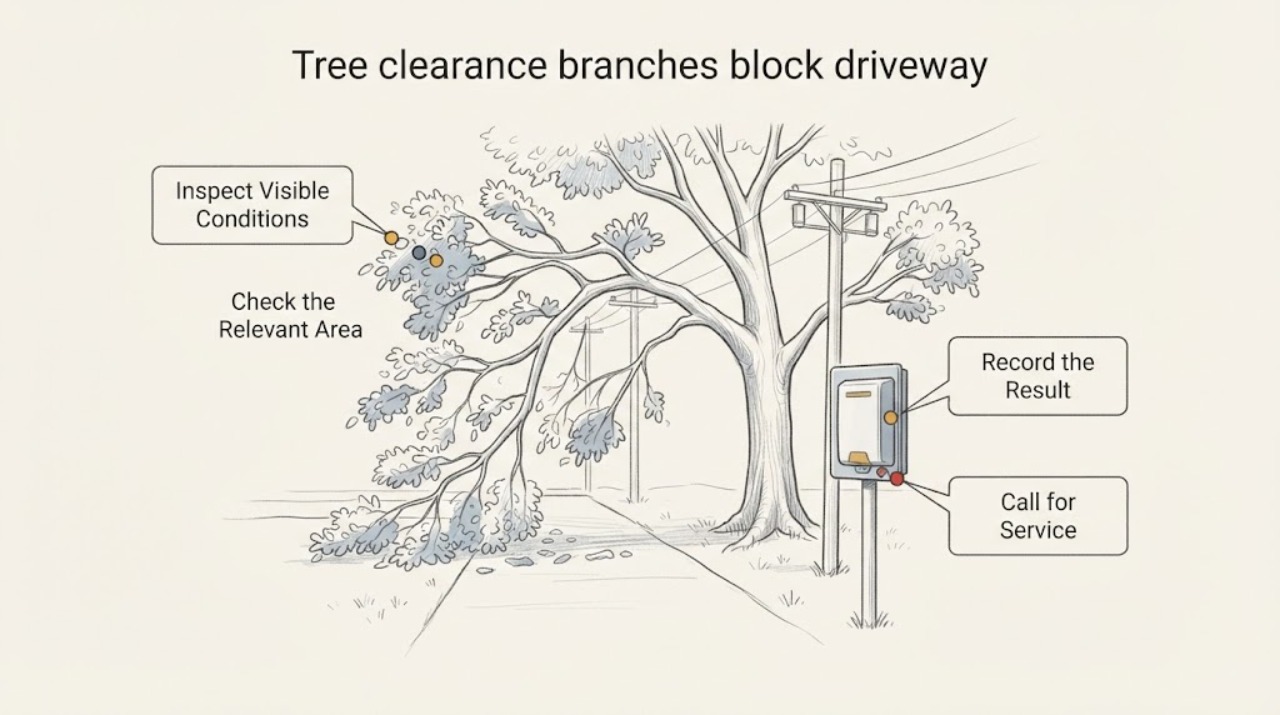
Work through in order
Diagnostic checks
Use only checks that match the exact appliance or system and its official guide.
-
Check 1
From a safe position at the side of the property or street, photograph the branch and driveway without entering beneath the canopy, standing in an active traffic lane, or approaching the obstruction.
Expected result: Record whether the branch is low, fallen, hanging, leaning, or spread across the driveway; note the apparent location relative to the garage, street, sidewalk, and vehicle path without trying to drive under it.
Next step: Send dated photos and the location to a qualified arborist or tree service and arrange an assessment before normal vehicle access resumes.
Stop if: Stop and keep everyone away if the branch is suspended, moving, cracked, partially fallen, or likely to fall into the driveway, street, or walkway.
Why this matters
Why: The view helps a professional understand the clearance problem and traffic-control need, but it does not establish a safe height, load, or fall direction.
-
Check 2
From outside the branch's potential fall area, visually inspect the trunk and accessible canopy for dead limbs, cracks, split unions, uprooting, broken hangers, fresh damage, or movement in ordinary breeze without touching or shaking anything.
Expected result: Record whether the branch appears stable, visibly broken, freshly split, suspended by another limb, or moving more than nearby branches; note recent storm, ice, impact, or construction history.
Next step: Keep the driveway and fall area isolated and tell the professional the visible stability signs and event history; do not attempt to lower, tie, brace, or remove the branch.
Stop if: Stop immediately for a hanging limb, trunk lean, root lifting, cracking sound, movement overhead, or changing weather.
Why this matters
Why: A broken, suspended, or unusually moving branch raises the urgency and requires a professional hazard assessment. A still-looking branch can remain loaded or weakened and is not cleared for approach.
-
Check 3
From a safe ground-level position well away from the tree and any line corridor, look for overhead utility lines that pass near, behind, above, or through the branches without approaching, touching, or using a ladder or tool.
Expected result: Record whether a branch touches a line, appears close to a line, has fallen across a line, or has no visible line nearby; do not assume a line is safe because it looks insulated or inactive.
Next step: Keep people and vehicles away and contact the utility or qualified line-clearance provider through the appropriate channel; share the location and safe-view photographs.
Stop if: Stop immediately for line contact, a fallen line, sparking, smoke, buzzing, or a branch that could move into a line; do not approach or touch the tree, line, fence, vehicle, or pooled water nearby.
Why this matters
Why: Any contact or uncertain proximity changes the job to utility or line-clearance work and makes ordinary tree service access unsafe. No visible line does not remove fall or traffic hazards.
-
Check 4
From the edge of the property, note whether the obstruction affects the garage entrance, driveway width, sight lines, sidewalk, street edge, delivery route, or emergency access without attempting a vehicle passage or standing in an unsafe roadway.
Expected result: Record whether vehicles or pedestrians can safely use an alternate route, whether the branch blocks visibility, and whether emergency responders could be delayed; note the safest boundary for keeping people out.
Next step: Use an alternate route and place a visible warning or barrier only from a safe location if it can be done without approaching the branch; request prompt professional clearance and appropriate local traffic assistance when needed.
Stop if: Stop if managing the route would require entering traffic, walking under the branch, moving the branch, or approaching a utility line.
Why this matters
Why: A blocked emergency route or unsafe vehicle and pedestrian path raises the response priority even when the branch is not visibly broken.
-
Check 5
Review recent weather, dated photographs, prior tree work, and any changes in the driveway or nearby structures without returning to the hazard area during dangerous weather.
Expected result: Record whether the obstruction appeared after wind, lightning, ice, heavy rain, vehicle impact, disease signs, or gradual growth, and whether it has shifted or worsened since first noticed.
Next step: Give the history and photographs to the arborist, utility, or emergency contact as appropriate and wait for a qualified assessment before clearance work.
Stop if: Stop all observation if weather worsens, new cracking or movement appears, or the branch threatens a structure, line, roadway, or emergency route.
Why this matters
Why: Timing and change help the professional prioritize instability, access, and utility coordination, but a calm appearance after a storm does not prove the branch is safe.
Use your observations
Decision map
Find the observation that best matches what you see, then follow the next safe action.
-
PATH 01Safety boundary
What you see
A branch or tree contacts a power line, a line is down, or sparking, smoke, buzzing, or electrical uncertainty is present.
Do this next
Keep everyone away, do not approach the tree, line, fence, vehicle, or water nearby, and contact the utility or emergency responders as appropriate.
Why this path and its safety boundary
Safety stop: Stop all inspection until the utility or emergency personnel declare the area safe.
-
PATH 02Safety boundary
What you see
The branch is hanging, cracked, moving, uprooted, partially fallen, or otherwise unstable without visible utility contact.
Do this next
Isolate the driveway and fall area from a safe position and request prompt qualified arborist or tree-service assessment.
Why this path and its safety boundary
Safety stop: Stop if the branch shifts, the trunk leans, cracking is heard, or weather makes the area unsafe.
-
PATH 03Safety boundary
What you see
The branch obstructs vehicle, pedestrian, sight-line, delivery, or emergency access even though it appears stable from the ground.
Do this next
Use an alternate route and request professional clearance planning; seek local traffic or emergency coordination if an emergency route is blocked.
Why this path and its safety boundary
Safety stop: Stop if route control requires entering a roadway, standing below the canopy, or approaching the tree or a power line.
-
PATH 04Safety boundary
What you see
The branch looks still from a safe viewpoint, does not appear near a utility line, and an alternate route is available.
Do this next
Keep the driveway clear of people and vehicles until a qualified professional confirms a safe clearance plan.
Why this path and its safety boundary
Safety stop: Stop if the branch moves, breaks, contacts a line, or the weather changes.
Helpful context
Understand the symptom
Clearance is more than the visible branch tip
A branch can obstruct a driveway because of its height, sideways spread, movement in wind, fall path, or position at a garage or street transition. A ground-level view cannot establish the branch's strength, tension, weight, or safe removal plan, so the observation is for scoping a professional visit rather than approving access.
Power lines change the response
Treat every overhead power line as energized and do not approach a branch that contacts or may contact it. Utility-line clearance requires trained personnel and specialized work practices. Keep the driveway and surrounding area clear while the utility or qualified line-clearance professional assesses it.
What to give the tree professional
Provide safe-view photographs, the driveway and branch location, whether the branch is hanging or moving, nearby lines or structures, weather timing, and the access problem. The professional can determine equipment, traffic control, clearance, and whether utility coordination is required.
When checks do not resolve it
Need a professional?
Request a qualified arborist or tree service for any branch that blocks driveway clearance, affects visibility or access, or shows instability. Contact the utility or emergency responders for line contact, a fallen line, sparking, fire, a hanging limb over a route, or blocked emergency access.
Safety scope: The professional must handle tree climbing, ladder or aerial work, cutting, rigging, branch removal, traffic control, utility coordination, and work near power lines. The reader should not climb, use a ladder, cut, pull, shake, brace, approach a line, or work in dangerous weather or an unsafe roadway.
Common questions
FAQ
Can I trim a low branch blocking my driveway?
Do not climb, use a ladder, cut, pull, or shake it. Photograph the obstruction from a safe position and ask a qualified arborist or tree service to assess clearance and stability.
What if the branch is close to a power line?
Do not approach it or assume the line is safe. Keep people and vehicles away and contact the utility or a qualified line-clearance professional through the appropriate channel.
Should I drive under the branch if there is enough apparent space?
No. A ground-level estimate cannot establish branch movement, strength, or safe clearance. Use an alternate route until a qualified professional assesses it.
When is a blocked driveway an emergency?
Escalate promptly for a hanging or unstable branch, line contact, a fallen line, sparking, fire, a blocked emergency route, or a hazard that could fall into a roadway or onto people or structures.
Read the exact guide
Official sources
- Line-Clearance Tree Trimming OperationsOccupational Safety and Health Administration, U.S. Department of Labor · Supports treating line-adjacent tree work as specialized line-clearance work, maintaining approach distances, using trained personnel, and avoiding hazardous weather; it is not a homeowner work procedure.
- Be Prepared for AnyFederal Emergency Management Agency · Supports staying away from fallen trees and power lines, reporting hazards, and avoiding unsafe routes after severe weather.
- Tree Trimming & Removal SafetyOccupational Safety and Health Administration, U.S. Department of Labor · Supports assuming power lines are energized, avoiding dangerous weather, performing hazard assessment, and using trained tree workers; it does not authorize DIY cutting or access.
Community feedback
Share a repair observation
Share a plain-text repair observation. Accepted observations are published automatically; this page may take a moment to update.