
On this page
Start here
Quick answer
Treat a price change as a plan-comparison problem before treating it as an internet fault. Put the current bill, the renewal or promotion notice, and the proposed plan side by side. Compare the regular price after any promotion, every recurring fee and tax, modem or router rental, speed and data allowance, bundle discount, contract length, and early-termination or equipment-return terms. If the provider cannot explain the difference or the written offer does not match the bill, keep the records and ask the provider for a written correction before switching; the FCC also identifies advertised rates, fees, taxes, equipment, and speed as separate internet-service issues.
Before you begin
Safety first
- This article covers account records and comparison of written plan terms. The provider handles account changes, activation, cancellation, equipment returns, and billing corrections; do not disclose credentials or payment details through an unverified contact.
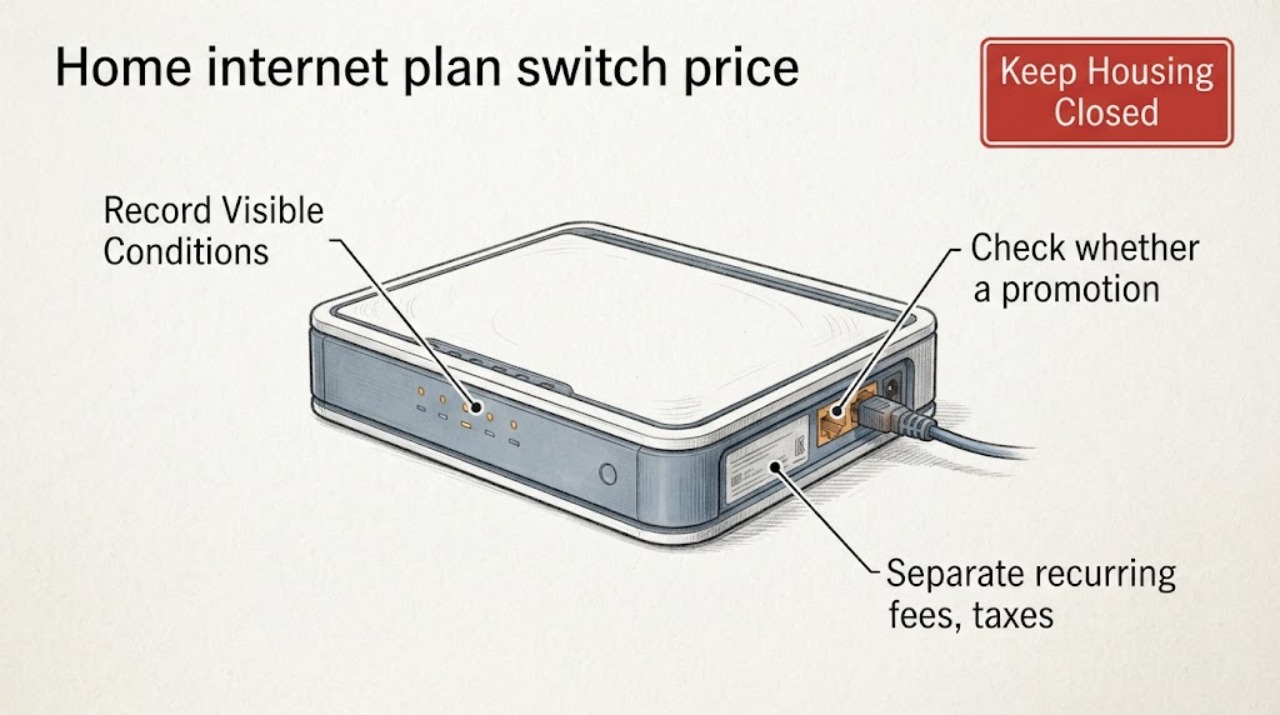
Work through in order
Diagnostic checks
Use only checks that match the exact appliance or system and its official guide.
-
Collect the two price records
Open the bill before the change and the first bill or notice showing the new amount. Copy the service period, base internet charge, credits, discounts, equipment line, one-time charges, taxes, and total without relying on memory.
Expected result: If the base rate is unchanged but a credit disappeared, the price change may be promotion or discount related. If a new line appears, classify it before comparing plans.
Next step: Use the identified line as the question to resolve with the provider and continue to the offer comparison.
Stop if: Stop the switch decision if the bill or notice is unavailable, inconsistent, or asks for payment through an unverified message; use a known provider account channel instead.
Why this matters
Why: The bill lines determine whether this is a promotion ending, an added fee, a tax, equipment rental, a bundle change, or a different service plan.
-
Check whether a promotion or discount ended
Read the offer terms and renewal notice for the introductory period, post-promotion rate, end date, and conditions for autopay, paperless billing, bundle, or other discounts.
Expected result: If a dated promotion or conditional discount ended, the higher amount can be explained without changing the connection. If no end date or qualifying condition explains it, the price change remains unresolved.
Next step: Record the regular rate and the next date it can change, then compare that rate with the candidate plan rather than its temporary headline price.
Stop if: Do not accept a new term or provide payment details from an unexpected renewal message; verify the offer through the provider's known website or account.
Why this matters
Why: A promotion-ending increase calls for a renewal comparison, while an unexplained increase calls for a written billing explanation before cancellation or switching.
-
Separate recurring fees, taxes, and equipment
List every recurring charge and one-time charge separately, including modem or gateway rental, installation or activation, data-related charges, government taxes, and provider fees. Mark which items would remain, change, or disappear after the switch.
Expected result: A new equipment rental or one-time fee can make a lower base rate more expensive at first. A tax or government assessment may vary by location and is not the same as a provider-discretionary fee.
Next step: Ask the provider to identify any line that is not named clearly and save the explanation with the offer.
Stop if: Do not assume a modem is included, free, or returnable until the written terms say so.
Why this matters
Why: The comparable price is the documented total for the same billing period and assumptions, not just the largest advertised number.
-
Compare speed and data with actual needs
Write down the current plan's advertised download and upload speeds, data allowance, and any stated overage or service consequence. Compare those fields with the proposed plan's broadband label, not just its plan name.
Expected result: If the proposed plan has a different speed tier, upload performance, data allowance, or usage consequence, it is not a price-only change. If those fields match, cost and terms carry more weight.
Next step: Keep a copy of both labels and choose only after confirming the speed and data tradeoff is acceptable.
Stop if: Do not infer real-world performance or availability from a plan name alone; confirm the provider's written offer for the service address.
Why this matters
Why: A lower price may buy less capacity, while a higher price may include a feature that matters to the household; the decision depends on the changed service as well as the bill.
-
Check contract and bundle consequences
Read whether the new rate requires a contract, bundle, autopay, or other commitment. Note the term, early-termination charge, bundle components that would change, and what happens if the internet plan is canceled or changed later.
Expected result: A lower introductory rate with a term or early-termination charge is a different commitment from a month-to-month price. A bundle can hide a change to television, voice, or other services.
Next step: Compare the documented total over the period you expect to keep service and ask for a standalone internet price when the bundle prevents a fair comparison.
Stop if: Do not agree to a contract or bundle when its length, cancellation cost, or included services are unclear.
Why this matters
Why: The switch decision must account for the commitment and the services being traded, not only the first monthly total.
-
Decide whether the provider has reconciled the change
Contact the provider through a known account channel with the bill lines, offer, dates, and comparison. Ask for the exact reason for the change and request written confirmation of the corrected amount or the new plan terms.
Expected result: If the provider explains the charge and the written terms match, decide between keeping, renegotiating, or switching. If the explanation conflicts with the bill, offer, equipment terms, or contract, the record is unresolved.
Next step: Save the response and final bill. If the provider does not resolve a documented issue, use the FCC's internet complaint path that matches the issue.
Stop if: Do not share account credentials or payment information through an unsolicited call, email, or text, and do not cancel the old service until the new activation and equipment-return obligations are clear.
Why this matters
Why: An unresolved advertised-rate, fee, tax, equipment, or speed dispute needs documentation and escalation rather than an unrecorded verbal promise.
Use your observations
Decision map
Find the observation that best matches what you see, then follow the next safe action.
-
PATH 01Safety boundary
What you see
The bill increased because a dated introductory rate or conditional discount ended.
Do this next
Compare the post-promotion rate with a new offer, including the promotion end date and qualifying conditions, then ask the provider about available terms.
Why this path and its safety boundary
Why it matters: This is a renewal-price decision, not proof of an internet outage or equipment failure.
Safety stop: Do not compare a temporary teaser rate with a permanent rate or accept an offer whose renewal price is missing.
-
PATH 02Safety boundary
What you see
A new rental, activation, installation, return, provider fee, or tax line explains some or all of the increase.
Do this next
Request the written name, amount, duration, and condition for each charge and include it in the total comparison.
Why this path and its safety boundary
Why it matters: The change is in charges or equipment terms and may not be fixed by choosing a faster or slower speed.
Safety stop: Do not assume equipment is included or customer-owned without written terms.
-
PATH 03Safety boundary
What you see
The proposed plan changes speed, upload performance, data allowance, usage consequences, or bundled services.
Do this next
Save both broadband labels and decide whether the changed service meets the household's needs at the documented total cost.
Why this path and its safety boundary
Why it matters: The plans are not equivalent, so a lower or higher price must be weighed against the service tradeoff.
Safety stop: Do not switch based on a plan name or download speed alone when data, upload, bundle, or equipment terms differ.
-
PATH 04Safety boundary
What you see
The new rate requires a contract, autopay condition, bundle commitment, or has an early-termination charge.
Do this next
Record the term and cancellation cost and compare them with a month-to-month alternative before agreeing.
Why this path and its safety boundary
Why it matters: The apparent monthly saving carries a commitment that can change the cost of leaving.
Safety stop: Do not accept a commitment that is not clearly stated in the written offer.
-
PATH 05Safety boundary
What you see
The provider cannot reconcile the bill, offer, promotion, equipment charge, or written service terms.
Do this next
Keep the bills, labels, offer, dates, and provider response; request correction through a known account channel and use the applicable FCC complaint category if the issue remains unresolved.
Why this path and its safety boundary
Why it matters: The amount is an unresolved billing or service dispute, not a reason to guess at a plan or immediately discard records.
Safety stop: Do not submit payment credentials through an unverified renewal message or cancel service before activation, final billing, and equipment return are documented.
Helpful context
Understand the symptom
Separate a real price change from a different plan
Start with the bill that changed and the bill before it. Mark the service period, base internet price, promotional credit, autopay or paperless-billing discount, equipment charge, one-time charge, taxes, and any bundled service. A higher total can come from a promotion ending, a missing discount, a rental or installation fee, a tax change, or a plan switch rather than a change in the advertised base rate.
Use a broadband label for an apples-to-apples comparison
For each candidate plan, save the provider's broadband label or written offer. Compare the regular monthly price as well as any introductory rate, the date or period when that rate ends, download and upload speeds, data allowance, additional charges, and contract terms. Do not compare a headline promotional price from one plan with the post-promotion price of another.
Include equipment and switching costs
Record whether the modem or gateway is included, rented, or customer-owned, and whether the change adds activation, installation, delivery, or equipment-return obligations. A lower monthly rate can cost more in the first bill or after a promotional period. Keep the offer, chat transcript, and cancellation or return instructions until the final bill is settled.
Choose the next step from the comparison
If the difference is only an expired promotion or removable discount, ask the provider to explain the renewal rate and available terms. If the new plan changes speed, data, equipment, bundle, or contract, decide whether those changes are worth the total cost. If the provider cannot reconcile the written offer and bill, contact the provider using a known account channel, preserve the records, and escalate a documented billing or service complaint only after giving the provider a chance to respond.
Safety boundary
Stop conditions
- Pause the switch when the promotion end date, regular price, recurring fees, taxes, equipment rental, speed or data terms, or contract length is missing.
- Do not treat an unexpected renewal message as authentic; use a known provider account channel and do not provide payment details through unsolicited links or phone numbers.
- Keep the old bill, new bill, broadband labels, offer, provider correspondence, and equipment-return instructions until the final account balance is settled.
- If an advertised-rate, fee, equipment, or speed issue remains unresolved after contacting the provider, preserve the record and use the applicable official complaint path.
When checks do not resolve it
Need a professional?
Request provider assistance when the bill and written offer do not match, a promotion or equipment charge is unexplained, or the plan cannot be compared because speed, data, fees, or contract terms are missing. Use the official complaint process only after preserving the record and giving the provider a chance to respond.
Safety scope: This article covers account records and comparison of written plan terms. The provider handles account changes, activation, cancellation, equipment returns, and billing corrections; do not disclose credentials or payment details through an unverified contact.
Common questions
FAQ
Is a higher internet bill always a new plan price?
No. It may be an expired promotion, a missing autopay or bundle discount, equipment rental, a one-time charge, a tax, or a different service plan. Compare the line items and service period before deciding.
What should I compare besides the monthly price?
Compare the regular and promotional rates, promotion end date, recurring and one-time charges, taxes, modem or gateway terms, download and upload speeds, data allowance, bundle contents, contract length, and any early-termination or return obligation.
How do I compare a promotional internet offer fairly?
Write down the introductory amount, the regular amount after the promotion, the date or period when it ends, and every condition for the discount. Compare that documented post-promotion cost with the other plan's corresponding terms.
What if the provider cannot explain the price change?
Keep the bills, offer, labels, dates, and provider correspondence. Ask through a known account channel for a written explanation or correction. If an advertised-rate, fee, equipment, or speed issue remains unresolved, use the applicable official complaint path.
Read the exact guide
Official sources
- Federal Communications Commission FCC 22-86Federal Communications Commission · The opened FCC order supports comparing the post-introductory rate, discount conditions, taxes and fees, equipment rental, one-time charges, data allowances, contract length, and early-termination terms.
- CONSUMER FACT SHEET: BROADBAND CONSUMER LABEL REQUIRED FOR MOST INTERNET SERVICE PROVIDERSFederal Communications Commission · The opened FCC fact sheet identifies the consumer-facing label fields for broadband prices, introductory rates, data allowances, speeds, discounts, and bundles.
- Internet Form - Descriptions of Complaint IssuesFederal Communications Commission · The opened FCC complaint guidance distinguishes internet issues involving advertised rates, service charges, taxes, fees, equipment, and speed, which informs the escalation branch when a provider does not reconcile the records.
- Getting In and Out of Free Trials, Auto-Renewals, and Negative Option SubscriptionsFederal Trade Commission · The opened FTC consumer guidance supports checking renewal cost, promotion end timing, cancellation terms, and records for recurring service charges; it is used here for account decision hygiene, not provider-specific contract claims.
Community feedback
Share a repair observation
Share a plain-text repair observation. Accepted observations are published automatically; this page may take a moment to update.