
On this page
Start here
Quick answer
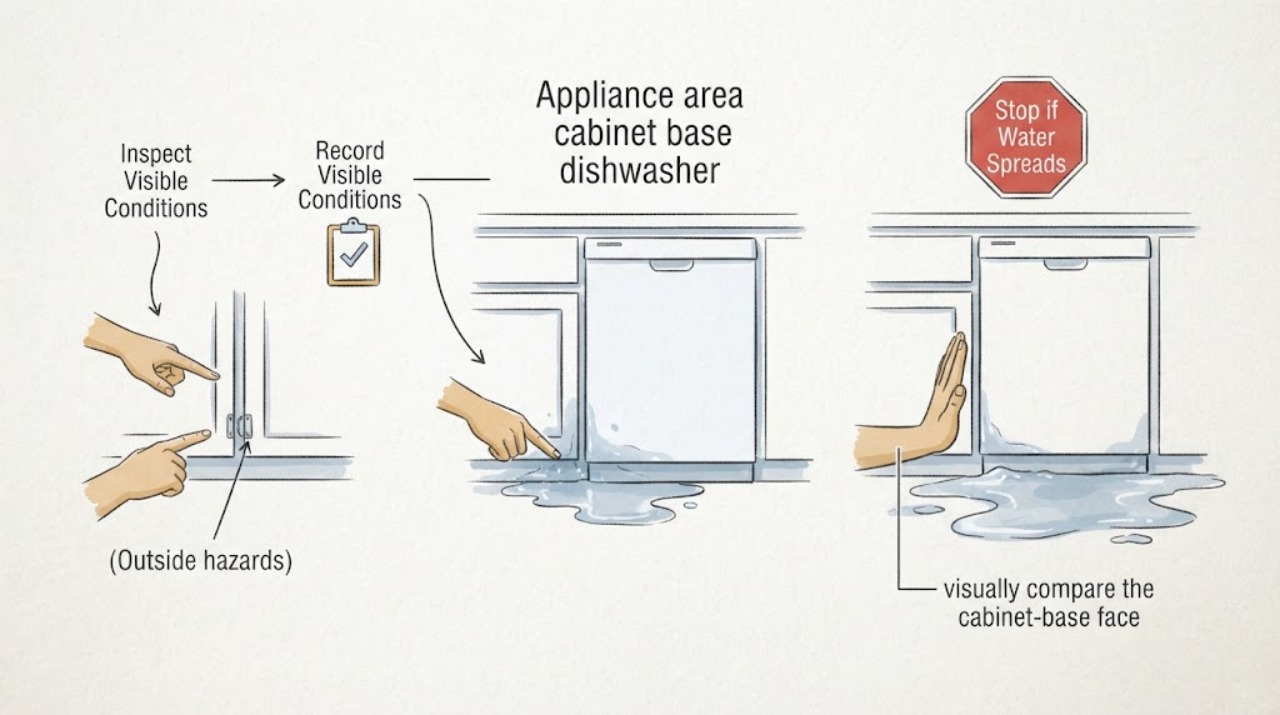
Treat water at the cabinet base beside a dishwasher or sink as an active water-damage question, not just a cabinet stain. From a dry, safe position, document where the water is visible, whether it followed dishwasher or sink use, how far swelling or discoloration extends, and whether there is a mold-like odor or nearby electrical hazard. Do not stand in water, move the appliance, open the cabinet around wet wiring, remove the cabinet, disconnect plumbing, or attempt do-it-yourself mold remediation. Keep people and pets away, stop using the suspected fixture when safe to do so, and arrange qualified water-damage and appliance or plumbing service for active overflow, contaminated water, electrical proximity, or softened cabinetry.
Work through in order
Diagnostic checks
Use only checks that match the exact appliance or system and its official guide.
-
Check 1
From a dry, stable position, look at the visible floor and cabinet-base area without stepping into water or touching wet materials; record the location of puddling, dampness, staining, or a water trail.
Expected result: Water is still appearing, or the area is damp but no longer visibly flowing; the wet area is limited to the cabinet front or extends under the appliance, sink, or adjacent flooring.
Next step: Keep people and pets out, stop using the suspected dishwasher or sink if it is safe to do so, photograph the area from dry ground, and arrange prompt plumbing, appliance, or water-damage service.
Stop if: Stop immediately if you would need to stand in water, touch wet material, move an appliance, or approach a wet electrical connection.
Why this matters
Why: Continuing water suggests the source may still be active. A trail or spread beneath an appliance or cabinet can conceal a larger affected area, so the visible edge is not a safe estimate of the damage boundary.
-
Check 2
Write down what happened immediately before the condition appeared, such as dishwasher use, sink filling or draining, a backed-up drain, a spill, or an unknown event; do not run another cycle or deliberately add water to reproduce it.
Expected result: The water followed dishwasher operation, sink use, a drain backup, or no identifiable event.
Next step: Leave the suspected fixture out of service and provide the sequence, recent repairs, and any error or overflow indication to the appliance, plumbing, or restoration professional.
Stop if: Do not perform a test cycle, remove a drain connection, or continue fixture use when water may reach the cabinet base or nearby electrical equipment.
Why this matters
Why: The timing gives the professional a starting branch: appliance leak, sink or drain overflow, or an intermittent or concealed source. A repeatable timing clue is useful, but it does not prove which hose, seal, drain, or cabinet surface failed.
-
Check 3
From outside the cabinet and without opening panels or removing contents, visually compare the cabinet-base face, toe-kick, side panels, and adjacent floor for swelling, peeling, bowing, softened-looking material, or changes in finish.
Expected result: The visible change is confined to a small face or edge, or swelling, staining, and finish separation continue across the base, side, toe-kick, or neighboring floor.
Next step: Photograph the boundaries without probing or pulling the toe-kick. Ask the professional to assess the cabinet base, adjacent flooring, subfloor or wall as applicable, and the water source together.
Stop if: Keep the area isolated if the cabinet or floor appears unstable, collapses, exposes sharp material, or creates a trip hazard; do not dismantle it to inspect further.
Why this matters
Why: A localized finish change may be superficial, while broad swelling or softened-looking material suggests water entered absorbent components or migrated beyond the first point of observation. Only a professional assessment can establish what can be dried, repaired, or replaced.
-
Check 4
From a dry position, note any mold-like appearance, musty or sewage-like odor, and whether the affected water appears associated with a clean supply, a sink or drain backup, or an unknown source; do not touch, scrape, sample, sweep, or apply cleaning chemicals.
Expected result: There is no unusual odor or visible growth, or there is a persistent odor, visible mold-like material, or possible wastewater involvement.
Next step: Keep occupants and pets away and tell the restoration or environmental professional exactly what was observed. Mention health sensitivities before anyone plans cleanup.
Stop if: Stop all cleanup and do not disturb the material when wastewater, visible mold-like growth, a strong odor, or respiratory or other health concerns are present.
Why this matters
Why: A visible sign cannot identify a mold species or the source of contamination. Wastewater and suspected mold change the work boundary because absorbent cabinet materials may need controlled assessment and professional remediation.
-
Check 5
Look from a safe, dry position for outlets, cords, switches, power strips, or other electrical equipment near the wet cabinet base; do not touch, unplug, reset, or test any item that may be wet.
Expected result: No electrical item is near the affected area, or an electrical item, appliance connection, or wall opening may have been exposed to water.
Next step: Keep clear of the area and request qualified electrical and water-damage assistance. Tell the service provider where the water and electrical items are located and whether power behavior changed.
Stop if: Do not enter the wet area or handle electrical equipment. Leave and seek urgent help for sparks, smoke, burning odor, heat, or a tripped circuit associated with the water.
Why this matters
Why: Water near electrical equipment adds an immediate shock and fire concern that cannot be resolved by cabinet observation. The appliance or circuit may require assessment by a qualified professional.
Use your observations
Decision map
Find the observation that best matches what you see, then follow the next safe action.
-
PATH 01Next step
What you see
Water is still appearing or returns after dishwasher or sink use.
Do this next
Stop using the suspected fixture, isolate the area from dry ground, and arrange prompt appliance or plumbing service together with water-damage assessment.
-
PATH 02Next step
What you see
The cabinet base is swollen, softened-looking, bowing, or visibly unstable.
Do this next
Keep weight and people away from the area and have a qualified professional assess the cabinet, adjacent flooring, and concealed moisture before any cosmetic repair or replacement.
-
PATH 03Next step
What you see
The water may be from a sink or drain backup, or has a sewage-like odor.
Do this next
Treat it as potentially contaminated water, avoid contact and cleanup, and call a water-damage professional with experience handling contaminated sources.
-
PATH 04Next step
What you see
Mold-like material or a persistent musty odor is visible or present.
Do this next
Do not scrape, sample, or apply a home treatment. Keep the area isolated and arrange qualified moisture and remediation assessment, especially if occupants have health concerns.
-
PATH 05Next step
What you see
Water reached an outlet, cord, switch, appliance connection, or other electrical equipment.
Do this next
Do not touch the wet equipment or enter standing water. Request qualified electrical and water-damage help, and leave the area for urgent hazards such as smoke, sparks, heat, or burning odor.
-
PATH 06Next step
What you see
The area is dry and the change appears limited to a stable cabinet finish with no odor or recurring water.
Do this next
Still document the condition and have the source and cabinet material checked before choosing a finish repair; a dry surface does not prove that concealed moisture is absent.
Helpful context
Understand the symptom
Why cabinet-base damage needs more than a surface fix
An appliance-area cabinet base can be affected by water from a dishwasher door or drain path, a sink basin or drain connection, an overflowing fixture, or a spill that migrated behind the visible edge. Water can also travel farther than the first stain. A swollen or softened base therefore does not identify the source or the full extent by appearance alone. The first useful step is safe documentation so a qualified professional can coordinate source control, drying, cabinet assessment, and any needed repair.
Protect the area while help is arranged
Stay on a dry surface and keep the cabinet and appliance area isolated. Do not use a wet appliance or touch an outlet, cord, switch, or other electrical item that may have been exposed to water. If wastewater, sewage-like odor, visible mold, or a large wet area is involved, avoid cleanup and tell the restoration professional what you observed. Keep photos, the timing of the event, and any appliance or plumbing history together for the service visit.
Only after diagnosis
Potential parts
- water-leak-alarm
Consider only as a future monitoring accessory after the source is repaired and a professional confirms a safe, dry placement away from electrical hazards.
Confirm the alarm's intended location, power method, water exposure limits, and the appliance or cabinet layout before selecting one. - wet-dry-vac
Consider only when a qualified professional confirms the water is safe to handle and the area can be accessed without standing water or wet electrical contact.
Match the equipment to the water type, electrical conditions, and professional cleanup plan; it is not appropriate for unknown or contaminated water without suitable controls. - cabinet-moisture-meter
Consider only as an assessment aid after a professional identifies a safe, accessible surface and the suspected source has been controlled.
Readings depend on material and instrument limits, so a professional should interpret them rather than treating one reading as proof that the cabinet or subfloor is dry.
When checks do not resolve it
Need a professional?
Arrange prompt service for active or recurring overflow, cabinet swelling or softening, water beneath an appliance, drain-backup or wastewater concerns, visible mold-like material, or any water near electrical equipment. Use urgent assistance for sparks, smoke, burning odor, heat, or an unsafe floor or cabinet.
Have this ready
- Provide photos from dry ground, the affected cabinet and floor boundaries, the event timeline, whether dishwasher or sink use preceded it, the apparent water type, prior repairs, visible electrical proximity, and any odor or occupant health concern.
Common questions
FAQ
Should I run the dishwasher again to find where the cabinet leak starts?
No. Do not create another overflow or expose the cabinet and electrical area to more water. Record what happened before the first event and have the appliance or plumbing source assessed.
Can a swollen cabinet base be dried and painted?
Do not cover it before the source and moisture extent are assessed. Swelling can mean an absorbent material or concealed area remains affected, and paint does not correct a leak or softened material.
What if the overflow water came from the sink drain?
Avoid contact and cleanup if the water may be contaminated or has a sewage-like odor. Isolate the area and tell a qualified plumbing or water-damage professional what occurred.
When is cabinet-base water an electrical emergency?
Treat water near an outlet, cord, switch, appliance connection, or other electrical item as a serious hazard. Do not touch or test wet equipment; leave the area and seek qualified help, especially for smoke, sparks, heat, or burning odor.
Read the exact guide
Official sources
- Dishwasher Leaking Troubleshooting GuideWhirlpool · Whirlpool's dishwasher-specific guidance is used only for dishwasher-side source clues; it does not diagnose a sink overflow or authorize work on an unidentified model.
- A Brief Guide to Mold, Moisture and Your HomeU.S. Environmental Protection Agency · General home moisture and mold guidance; it does not determine the source or repairability of a particular cabinet base.
- Flood Cleanup to Protect Indoor Air and Your HealthU.S. Environmental Protection Agency · Flood guidance used here for the safety boundary around water-damaged cabinets and possible contamination; a small appliance overflow may have a different scope.
Community feedback
Share a repair observation
Share a plain-text repair observation. Accepted observations are published automatically; this page may take a moment to update.