
On this page
Start here
Quick answer
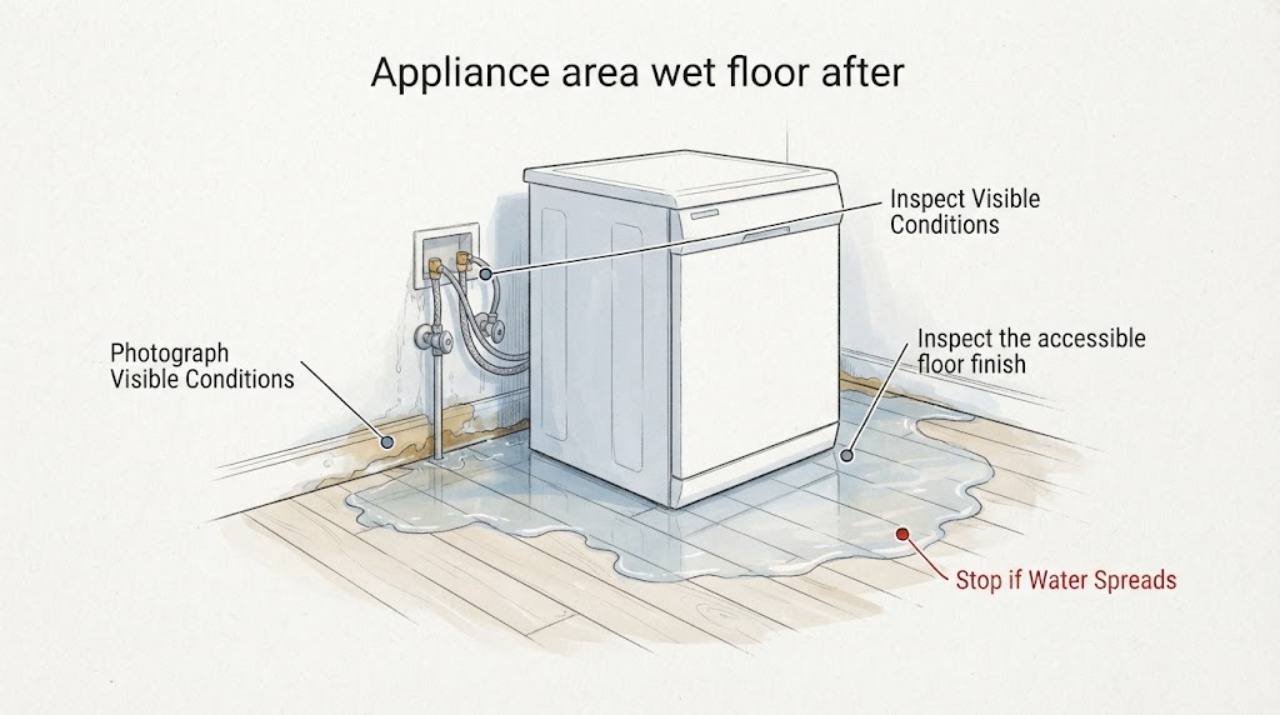
Keep people out of a wet appliance area until you know it is safe, especially if water may have reached an outlet, cord, appliance base, or electrical equipment. From a dry position, photograph the wet boundary, floor swelling or staining, nearby wall and baseboard changes, and the suspected source without moving or opening the appliance. The visible floor cannot show whether the subfloor or insulation is wet. If water is recurring, contaminated, near electricity, has been present beyond a short drying window, or has produced musty odor or visible mold, stop DIY cleanup and call a qualified water-damage professional.
Work through in order
Diagnostic checks
Use only checks that match the exact appliance or system and its official guide.
-
Check 1
From a dry, stable position outside the wet boundary, photograph the water's visible edge, direction of travel, pooling, floor seams, baseboards, and nearby wall or cabinet surfaces. Do not step into the water or reach behind the appliance.
Expected result: A contained wet patch, a spreading edge, a swollen seam, buckled finish, or damp baseboard gives different clues about duration and extent. No visible water does not prove that the subfloor or concealed cavity is dry.
Next step: Mark the date and time of the photo, keep people and pets away, and identify the suspected appliance area without moving the appliance.
Stop if: Stop immediately for standing water near electricity, a sagging floor, an unstable appliance, sewage or contaminated water, or any need to enter the wet area.
Why this matters
Why: The map helps a restoration professional decide what to inspect and protect. It does not justify pulling up flooring, opening a wall, or declaring the area dry from its surface appearance.
-
Check 2
From outside the wet area, look at the appliance cord, outlet face, nearby power strip, water line, drain area, and visible shutoff or connection only if they can be seen without touching or moving anything. Note wetness, drips, staining, corrosion, a tripped device, or a damaged cord.
Expected result: Moisture at an outlet, cord, or electrical device is an electrical-safety issue; a dry electrical area with a wet floor may still have a plumbing or appliance-source problem. A leak path that begins behind the appliance cannot be confirmed visually from the front.
Next step: Photograph what is visible and report whether the water was clean supply water, drain water, or an unknown source. Wait for qualified direction before touching a switch or appliance.
Stop if: Stop for shock or tingling, sparks, heat, smoke, a wet outlet or cord, active water flow, or any instruction that would require moving or opening the appliance.
Why this matters
Why: Source and electrical observations determine whether an electrician, plumber, appliance technician, or restoration professional must be involved first. Do not operate a wet appliance or manipulate a hidden connection.
-
Check 3
Inspect the accessible floor finish and adjacent wall materials from the dry side for swelling, delamination, soft trim, discoloration, bubbling paint, peeling covering, or a musty odor. Do not press hard, drill, cut, pry, or remove flooring or baseboards.
Expected result: Hard, unchanged surfaces after a brief clean-water event differ from swollen seams, soft materials, persistent odor, or visible mold. The visible finish may hide wet underlayment, subfloor, insulation, or framing.
Next step: Record which materials changed and whether the area remains damp or odor-producing. Keep the room ventilated only when doing so is safe and do not improvise mold cleanup.
Stop if: Stop for visible mold, strong persistent odor, soft or collapsing materials, respiratory symptoms, or any need to disturb concealed building materials.
Why this matters
Why: Material and odor changes increase the need for moisture mapping and professional drying or remediation. Painting over a damaged or moldy surface can conceal the problem and make later assessment harder.
-
Check 4
Record the leak timeline without restarting the appliance: when the floor was first noticed wet, whether the source was clean supply water or drain water, how long the area may have stayed damp, and whether the floor or wall changed after drying began. Take follow-up photos from the same safe location.
Expected result: A leak stopped quickly with a shrinking dry boundary is different from recurring dampness, a spreading boundary, or material that remains wet. Wet materials that do not dry promptly can carry mold and material-damage risk.
Next step: Provide the timeline, photos, source description, room location, and appliance type to a water-damage professional and any source-repair professional.
Stop if: Stop if the source is unknown or recurring, water is contaminated, the area has remained wet, or continuing would require appliance movement, demolition, or mold treatment.
Why this matters
Why: The timeline helps a restoration professional select drying and inspection priorities, but it cannot establish that the subfloor is dry or that mold is absent.
Use your observations
Decision map
Find the observation that best matches what you see, then follow the next safe action.
-
PATH 01Next step
What you see
Water is near an outlet, cord, appliance control, or other electrical equipment, or the person would need to stand in water to reach the source.
Do this next
Stay out of the area and arrange qualified electrical and water-source assessment. Do not turn switches on or off, operate the appliance, or move it through the wet area.
-
PATH 02Next step
What you see
The floor, baseboard, or wall is swollen, soft, odorous, visibly moldy, or still damp after the leak stopped.
Do this next
Call a water-damage restoration professional for moisture mapping and a drying or remediation plan. Do not paint, remove flooring, or perform DIY mold cleanup.
-
PATH 03Next step
What you see
The water is sewage, drain backup, floodwater, chemically contaminated, or of unknown quality.
Do this next
Keep people and pets out and request a qualified restoration professional with contaminated-water procedures. Do not use fans, vacuums, cleaners, or bleach as an improvised response.
Helpful context
Understand the symptom
A wet floor is both a source and an extent question
The first question is whether the leak has stopped; the second is how far moisture traveled below or beside the visible floor. A swollen seam, lifted finish, damp baseboard, or odor can be evidence of a larger wet assembly, but none proves the exact source or depth. Keep the appliance in place and document the area before a professional evaluates the connections and flooring.
Stay out of electrical and contaminated water
Do not stand in water while touching a plug, outlet, appliance control, or switch, and do not move or disassemble the appliance to reach a connection. If the water may be sewage, drain backup, floodwater, or chemically contaminated, avoid cleanup and arrange appropriate professional assessment. Do not paint over water damage or attempt mold remediation as a cosmetic repair.
Only after diagnosis
Potential parts
- moisture-meter
Consider this category only as a professional-selected aid for comparing accessible materials after the source is controlled; a consumer reading cannot certify a dry subfloor or rule out hidden moisture.
Use only as directed and treat readings as comparative clues. Do not probe flooring, walls, or wet electrical areas. - dehumidifier
Consider this category only for a qualified professional's clean-water drying plan in a safe, dry electrical environment; it is not a substitute for source repair or moisture mapping.
Confirm the unit's electrical and placement requirements, keep it out of standing water, and do not use it before a professional determines the water is clean and the area is safe. - air-mover
Consider this category only when a restoration professional confirms that controlled air movement is appropriate for the material, water class, and electrical conditions.
Do not direct air at suspected mold or contaminated materials or use equipment in a wet electrical area. Follow the professional drying plan.
When checks do not resolve it
Need a professional?
Call a water-damage restoration professional for a wet appliance-area floor, recurring moisture, swelling, soft or odorous materials, visible mold, unknown or contaminated water, or any uncertainty about the subfloor. Add a qualified electrician or appliance/plumbing professional when the source or electrical equipment is involved.
Have this ready
- Provide dry-side photos of the wet boundary, floor seams, baseboards, walls, visible cord or outlet condition, suspected source, water quality, leak timeline, and material changes. State that the appliance was not moved or opened and that no flooring, wall, or mold remediation work was attempted.
Common questions
FAQ
Should I pull the appliance out to find the leak?
No. Moving an appliance through water can worsen damage and expose electrical or plumbing hazards. Photograph what is visible from a dry position and have a qualified source-repair or restoration professional access it safely.
Can a dry-looking floor still have a wet subfloor?
Yes. Surface appearance cannot confirm the condition below the floor or inside a wall. Swelling, odor, recurring dampness, or a long wet period calls for professional moisture mapping and drying assessment.
Can I use bleach or paint to handle possible mold after the leak?
Do not improvise mold remediation or paint over water-damaged material. If mold, contaminated water, or persistent odor is present, keep people out and call a qualified restoration professional who can select containment and remediation methods.
Read the exact guide
Official sources
- Water Damage - Cleanup and Mold PreventionU.S. Environmental Protection Agency · The EPA table distinguishes flooring, underflooring, wood, wallboard, and contaminated-water conditions and recommends professional consultation when materials are not drying or water quality is uncertain; it is used here for escalation boundaries, not DIY demolition instructions.
- Safety Guidelines: Returning Home After a Natural DisasterCenters for Disease Control and Prevention · CDC advises staying out of water near electrical equipment, not using wet appliances, keeping out of floodwater, and using professional or protected procedures for mold cleanup; the safety principles apply to a wet appliance area.
- Mold, Testing, and RemediationCDC/NIOSH · NIOSH explains that dampness supports mold, visual inspection and musty odors are useful assessment clues, and wet materials should be dried or professionally remediated rather than painted over; it does not authorize DIY mold removal.
Community feedback
Share a repair observation
Share a plain-text repair observation. Accepted observations are published automatically; this page may take a moment to update.