
On this page
Start here
Quick answer
A sump pump that stops during a power outage is not automatically a failed pump. First establish whether the utility is out, a dry accessible protection device has tripped, or a battery backup or alarm is responding. From a dry position, record the basin level, alarm, controller lights, utility status, and whether water is rising. Never stand in water or touch wet electrical equipment, use temporary wiring, run a generator indoors, or remove the pump. Rising water, sewage, an unreachable breaker, a failed backup, or a repeated trip needs urgent pump, electrical, or water-mitigation service.
Before you begin
Safety first
- Dry, safe observation only, with at most one label-directed reset from a completely dry accessible point when no hazard is visible. No wading, wet electrical contact, panel opening, pump removal, temporary wiring, indoor generator use, or basin work.
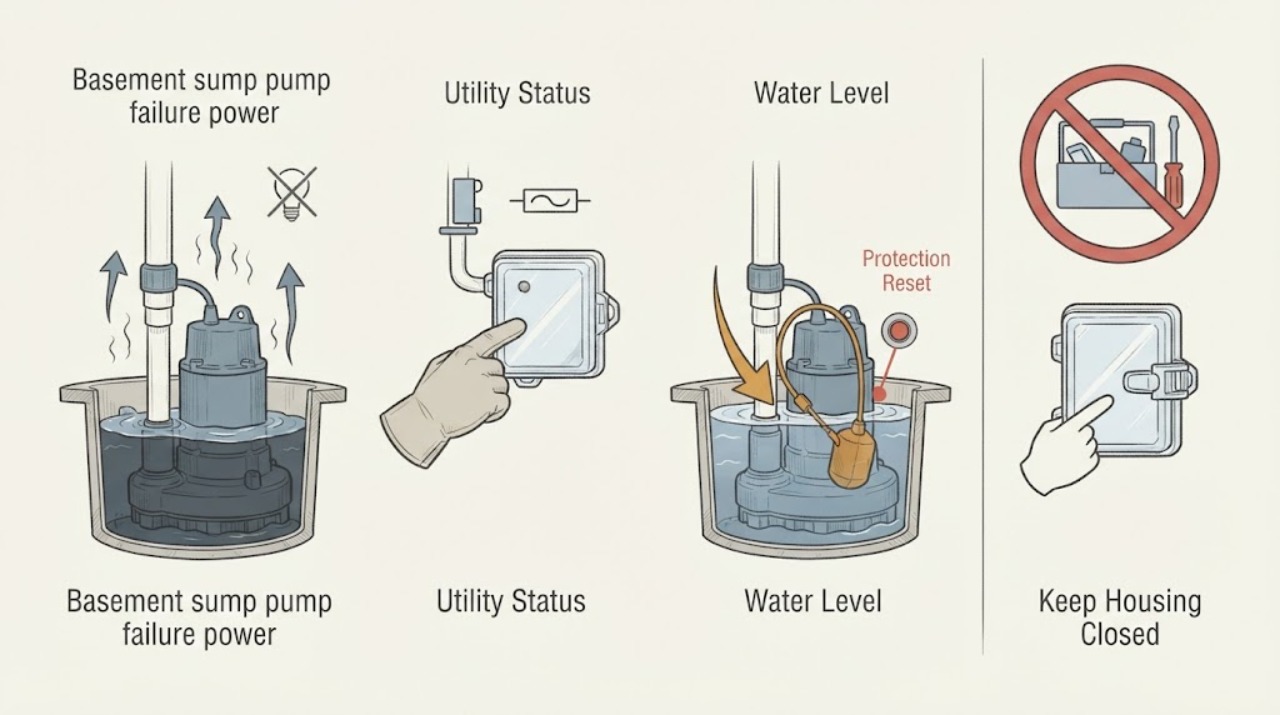
Work through in order
Diagnostic checks
Use only checks that match the exact appliance or system and its official guide.
-
Check 1
From a dry location, compare the home's visible power status with the utility's outage information and note when the outage began and whether nearby homes or common areas are also without power.
Expected result: Record whole-home outage, one-circuit outage, flickering or restored service, weather event, and any utility estimate; do not infer a pump failure from silence during a confirmed outage.
Next step: Keep the timeline and utility reference for the electrician or pump technician; do not run an improvised extension cord or open electrical covers.
Stop if: Do not enter a wet basement to check the panel, touch service equipment, or approach downed lines.
Why this matters
Why: A broad utility outage points first to loss of pump power. Power elsewhere with only the pump circuit unavailable points toward a local protection device, wiring, or equipment issue.
-
Check 2
Observe the sump basin area and basement floor from a dry threshold without stepping in water, opening the basin, or reaching toward the pump.
Expected result: Record water level as stable, slowly rising, rapidly rising, or overflowing; note seepage, sewage or foul water, and whether water is approaching outlets, appliances, furnaces, stored goods, or the electrical panel.
Next step: Keep people and pets out, move nothing through water, and call urgent water-mitigation or pump service while preserving the time and level observations.
Stop if: Never wade, touch the water, enter the pit, move a pump, or use an electric tool or appliance in or near standing water.
Why this matters
Why: A rising level during an outage is a flooding escalation regardless of whether the pump itself is healthy. Contaminated or sewage water requires a different safety and restoration response than clean groundwater.
-
Check 3
From a dry standing position, check only the visible status of a labeled GFCI, breaker, or pump protection indicator; consider one label-directed reset only when the device and surrounding area are fully dry and no hazard is visible.
Expected result: Answer yes if a protection device is visibly tripped and the reset point is dry and safely reachable; answer no if it is not tripped, the area is damp, the panel is unreachable without water, or any odor, smoke, spark, damage, or uncertainty exists.
Next step: If yes, follow the device label once from the dry area and observe only from safety; if it trips again or the pump remains inactive, leave it off and call an electrician or pump technician. If no, escalate without attempting a reset.
Stop if: Do not reset through water, remove a panel cover, touch wet wiring, repeatedly cycle a breaker, or bypass protection.
Why this matters
Why: A dry, permitted single reset can distinguish a tripped protection device from a confirmed outage, but a repeat trip or no response is not a reason to reset again or open the pump system.
-
Check 4
Read visible battery-backup, controller, and water-alarm indicators without opening the enclosure, handling terminals, or testing the pump in the basin.
Expected result: Record alarm sounding or silent, battery-fault or low-charge indication, backup-ready status, recent test date if posted, and whether the backup appears to respond as the water level rises; do not force a test during active flooding.
Next step: Photograph the indicators and labels and ask a qualified technician to test the backup, float, alarm, and charger safely.
Stop if: Do not open the battery box, add water or chemicals, jump terminals, silence a persistent alarm, or handle wet connectors.
Why this matters
Why: A healthy-looking primary circuit with a failed or absent backup explains outage exposure without proving the primary pump is bad. An alarm without a rising level may indicate a power, battery, sensor, or communication condition needing service.
-
Check 5
From a dry location, note any visible pump sound or discharge behavior only if the system is already operating normally; do not force a cycle, lift a float, or touch the discharge pipe or check valve.
Expected result: Record pump silent, humming, running without discharge, cycling and stopping, or unknown; note whether the discharge outlet is visibly blocked, frozen, disconnected, or returning water toward the foundation.
Next step: Give the observation and discharge photos to the technician; keep clear of the basin and leave any blocked or frozen line for qualified service.
Stop if: Do not remove the pump, clear a line, lift the float, loosen fittings, or reach into the basin.
Why this matters
Why: Power available without discharge can point to pump, float, blockage, or check-valve service rather than an outage. No sound during a confirmed outage cannot distinguish those causes and should not be used to condemn the pump.
-
Check 6
Check whether water is rising or overflowing, the backup is unavailable, power cannot be safely restored, a protection device trips again, or the water is contaminated or near electrical equipment.
Expected result: Answer yes if any condition is present or cannot be ruled out from the dry safe view; answer no only when water is stable, the area is dry, power status is known, and the pump and backup indicators show normal status.
Next step: If yes, keep clear and call qualified electrical, pump, and water-mitigation help as indicated. If no, record the system status and schedule a professional inspection of the primary and backup arrangement.
Stop if: Do not pump, vacuum, wire, connect a generator, or enter the basement water to slow the rise.
Why this matters
Why: Yes makes this an urgent flooding and safety response, not a parts-selection exercise. No permits documentation and planned service, but does not prove the pump will handle the next storm.
Use your observations
Decision map
Find the observation that best matches what you see, then follow the next safe action.
-
PATH 01Next step
What you see
Nearby power is out or the home has a confirmed utility outage while the pump and protection indicators cannot be safely tested.
Do this next
Treat the pump as unavailable, monitor water only from a dry safe position, keep clear of electrical hazards, and request urgent pump or water-mitigation service if the level rises.
-
PATH 02Next step
What you see
Other household power works but a dry, visibly tripped GFCI or breaker protects the pump circuit and no water or electrical hazard is present at the reset point.
Do this next
Follow the device label for one safe reset only; if it trips again or the pump does not respond, leave it off and call an electrician or pump technician.
-
PATH 03Next step
What you see
A battery backup or water alarm shows low battery, fault, no-ready status, or persistent alarm during the outage.
Do this next
Keep the basin closed and call qualified service to assess the battery, charger, float, alarm, and pump capacity; do not jump, recharge, or replace connections yourself.
-
PATH 04Next step
What you see
Power is confirmed available and protection is not tripped, but the pump remains silent, runs without moving water, or the visible discharge route is abnormal.
Do this next
Request pump, float, intake, discharge, and check-valve diagnosis; do not remove the pump or clear the line yourself.
-
PATH 05Next step
What you see
Water is stable below the floor, the source and power status are known, no electrical hazard is present, and indicators appear normal.
Do this next
Document the event and arrange planned professional testing of the primary pump, backup power, alarm, discharge, and check valve before the next outage.
-
PATH 06Next step
What you see
Water is rising or overflowing, contaminated or sewage water is suspected, electrical equipment is wet or unreachable, or the basement is unsafe to enter.
Do this next
Keep people and pets out, do not enter or energize the area, and call urgent electrical, pump, and water-mitigation professionals as applicable.
Helpful context
Understand the symptom
Why the outage changes the first check
During an outage, the pump may be healthy but unable to run. A tripped ground-fault or circuit protection device, a failed battery backup, a dead alarm, a blocked discharge, or a true pump fault can produce the same rising-water symptom. Separate utility status and protection status from pump behavior before anyone selects a replacement.
Safe observation and reset boundary
Observe from a dry, stable location outside the sump basin and away from standing water. You may read a utility outage notice and visible controller or alarm indicators. A reset is only within scope when the reset device and surrounding floor are completely dry, there is no odor, smoke, sparking, or visible water near electrical equipment, and the device label permits it; make no repeated attempts and stop at any trip. Never enter water to reach a panel, improvise a connection, or use a generator in a basement, garage, or other enclosed space.
Escalate before flooding spreads
If water is rising, the outage is prolonged, the backup does not start, the alarm is silent or persistent, or the power status cannot be separated from a pump fault, keep people and pets out and call qualified electrical, sump-pump, or water-mitigation service. The service scope may include safe power restoration, pump and float inspection, discharge and check-valve assessment, backup sizing, and drying or cleanup.
Safety boundary
Stop conditions
- Never stand or work in basement water, touch wet electrical equipment, or enter water to reach a breaker, outlet, alarm, or pump.
- Do not use temporary wiring, improvised connections, extension cords through wet areas, or a gasoline generator inside a basement, garage, or enclosed space.
- Do not open the sump basin, remove the pump, lift the float, handle terminals, clear the intake or discharge, or replace a check valve during the outage.
- Do not repeatedly reset a breaker or GFCI, bypass protection, silence a persistent alarm, or re-energize equipment after water exposure.
- Stop and call urgent qualified service for rising water, sewage or unknown water, electrical exposure, repeated trips, failed backup behavior, unsafe footing, or any uncertain condition.
Only after diagnosis
Potential parts
- water-alarm
Consider only after the immediate outage and flooding risk is controlled and the monitoring gap is confirmed.
Choose a device suitable for the location and keep it away from standing water and electrical hazards; an alarm does not restore pumping capacity. - sump-pump-battery-backup
Consider only after a qualified technician confirms that backup power addresses the exposure and can be installed safely.
Capacity, battery type, charger, float arrangement, discharge routing, permits, and compatibility must be assessed for the specific sump system. - check-valve
Consider only after professional diagnosis separates backflow from loss of power or pump failure.
A check valve addresses confirmed discharge backflow and must match the pump and pipe arrangement; do not open or replace it during flooding.
When checks do not resolve it
Need a professional?
Call qualified pump and electrical service immediately for rising or overflowing water, a tripped protection device that repeats, unavailable or faulty backup power, wet or unreachable electrical equipment, contaminated water, an abnormal discharge path, or an unsafe basement. Arrange planned inspection even when power returns after a contained outage.
Safety scope: Dry, safe observation only, with at most one label-directed reset from a completely dry accessible point when no hazard is visible. No wading, wet electrical contact, panel opening, pump removal, temporary wiring, indoor generator use, or basin work.
Common questions
FAQ
Does a power outage mean the sump pump has failed?
No. The pump may simply have no utility power. First separate utility outage, a local tripped protection device, backup-power behavior, and a true pump or discharge fault from safe observations.
Can I reset the pump breaker?
Only one label-directed reset is within scope when the reset point and surrounding area are completely dry and there is no water, odor, spark, smoke, damage, or uncertainty. Never enter water to reach it, remove covers, bypass protection, or keep resetting after a trip.
What if the backup alarm is sounding?
Record the visible alarm pattern and battery or controller indication without opening it. A persistent alarm or failed backup during a rising-water event needs qualified pump or electrical service; do not silence, jump, or recharge terminals yourself.
How can I tell a pump fault from no power?
If nearby power is out, silence is not diagnostic. If power is confirmed available and protection is normal but the pump is silent, runs without discharge, or the route is abnormal, request pump and discharge diagnosis rather than replacing parts by guesswork.
Can I use a generator in the basement?
No. Never operate a gasoline generator or other fuel-burning engine inside a basement, garage, or enclosed or partially enclosed space. A qualified person must determine any safe, code-compliant temporary power arrangement.
When is sump-pump outage flooding urgent?
Treat rising or overflowing water, sewage or unknown water, wet or unreachable electrical equipment, a failed backup, repeated protection trips, or unsafe footing as urgent. Keep people and pets out and call qualified service.
Read the exact guide
Official sources
- Prepare for FloodingSeattle City Light · Official utility guidance connecting outages with basement flooding and recommending sump-pump backup and water alarms.
- Safety Guidelines: Reentering Your Flooded HomeCenters for Disease Control and Prevention · Official CDC safety guidance used for no-entry, electrician, generator, and wet-equipment boundaries.
- Flood RetrofitsCity of Boston · Official municipal guidance used for backup sump-pump and professional installation boundaries.
Community feedback
Share a repair observation
Share a plain-text repair observation. Accepted observations are published automatically; this page may take a moment to update.