
On this page
Start here
Quick answer
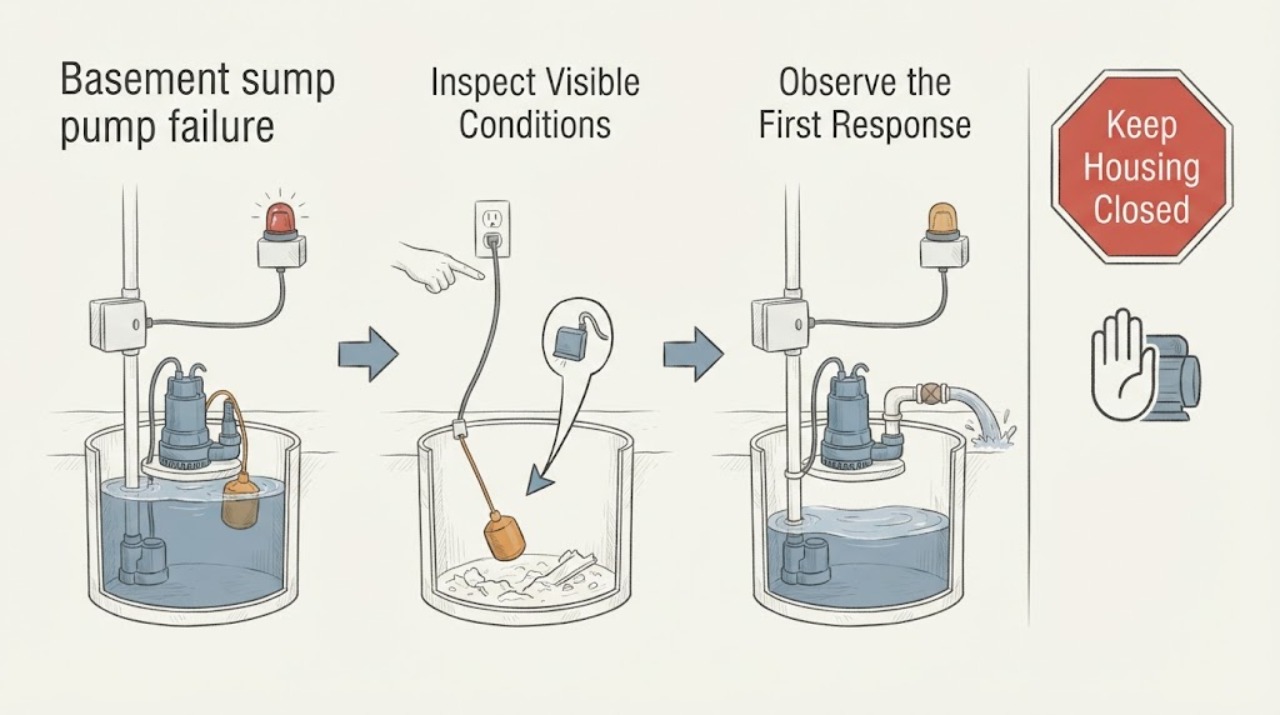
Treat a failed sump pump as an urgent water and safety issue. From a dry, stable location, observe the water level without entering the pit or standing water, note visible power or alarm indicators without touching wet equipment, and record whether the discharge outlet is visibly flowing or blocked. A high level, active alarm, no discharge, storm-related inflow, or an unavailable backup calls for prompt pump and water-mitigation service. Do not enter standing water, touch wet electrical equipment, test live wiring, open the pump or discharge assembly, force the float, pump sewage, or expose yourself to flooding.
Work through in order
Diagnostic checks
Use only checks that match the exact appliance or system and its official guide.
-
Check 1
From a dry, stable location, observe the sump water level and the surrounding floor without entering the pit, stepping into water, leaning over the opening, or moving the cover. Note whether the level is low, rising, near the pump assembly, or already overflowing.
Expected result: The level is stable and below the pump area, rising, at a high-water mark, or water is spreading onto the floor.
Next step: Keep people away from the wet area, record the level and time, and move directly to professional water and pump service when the level is high or rising.
Stop if: Stop immediately if the route is wet, the floor is flooded, the pit cover is unstable, or you would need to enter standing water or reach over the pit.
Why this matters
Why: A rising or high level means the protective system is not keeping up and needs prompt service. Spreading water adds an exposure and electrical hazard; a stable low level does not prove the pump is healthy if an alarm or recent outage occurred.
-
Check 2
From a dry position, look at any controller, alarm, or backup-system indicators and listen from a safe distance for an alarm or unusual sound. Do not touch a wet receptacle, cord, controller, battery, breaker, or pump and do not perform a live electrical test.
Expected result: A ready indicator is visible, an alarm is active or silent, an indicator is dark, or the status cannot be read safely.
Next step: Photograph the display from a dry location and tell the service provider which indicators or sounds were present, when they changed, and whether a storm or outage preceded the failure.
Stop if: Stop if any electrical equipment is wet, sparking, hot, damaged, or inaccessible without crossing water; leave the area and request qualified electrical or water-emergency help.
Why this matters
Why: An alarm or dark controller narrows the service request toward high water, power, control, or backup-system attention, but an indicator alone cannot confirm safe operation. An unreadable status should be treated as unknown rather than tested.
-
Check 3
From the same safe location, note whether the pump is silent, humming, cycling repeatedly, or running without an apparent reduction in water. Do not force the float, activate the pump, reach into the pit, or open the pump housing.
Expected result: There is no sound, repeated cycling, a continuous sound with no visible level change, or an uncertain response.
Next step: Give the technician the sound pattern, water-level trend, and whether the event followed weather or an outage; keep the area isolated until the system is assessed.
Stop if: Stop if the pump or controls vibrate violently, smell hot, spark, or require contact or disassembly to identify the cause.
Why this matters
Why: Silence with a rising level can involve power, switch, control, or pump failure. Repeated cycling can involve a float, leak, or check-valve condition. Running without visible lowering can involve the discharge path, capacity, or an internal fault; the observation does not identify which repair is safe.
-
Check 4
From inside a dry location or another safe ground-level vantage point, note whether the exterior discharge outlet is visibly flowing, blocked by snow or debris, disconnected, or inaccessible. Record recent heavy rain, snowmelt, freezing weather, or a power interruption; do not approach a flooded outlet or handle the pipe.
Expected result: There is visible flow, no visible flow while the pump sounds active, a blockage or disconnection is visible from a distance, or the outlet cannot be checked safely.
Next step: Send the location and observation to a pump or water-mitigation professional and state whether the basement level is still rising; do not attempt to clear, cut, reconnect, or open the discharge assembly.
Stop if: Stop if checking the outlet requires entering water, climbing, approaching unstable ground, touching a pipe under load, or working during active storm conditions.
Why this matters
Why: No visible flow during an apparent run can point to a discharge restriction, check-valve issue, loss of capacity, or another fault. Weather can exceed the system's inflow capacity or freeze the discharge, while an inaccessible outlet remains an unresolved professional check.
-
Check 5
From a dry position, note whether a separate backup pump, battery enclosure, water alarm, or generator indicator is visibly present and whether it shows ready, alarm, or unknown status. Also note the location of stored items or utilities that water could reach, without moving anything through water.
Expected result: A backup is absent, visibly alarming, apparently ready, or its status is unknown; water is approaching contents or utilities, or the exposure is not immediate.
Next step: Report the backup status, water trend, weather, and nearby exposure to the service provider and follow local emergency guidance while staying out of the wet area.
Stop if: Stop and leave the basement if water is rising toward electrical, heating, gas, or structural systems, if sewage is present, or if safe exit is threatened.
Why this matters
Why: A missing or alarming backup increases the urgency of professional pumping and mitigation. Water near utilities or valuable contents changes the priority to life safety and qualified electrical or water-emergency response; a ready indicator is not proof that the primary system is working.
Use your observations
Decision map
Find the observation that best matches what you see, then follow the next safe action.
-
PATH 01Next step
What you see
The sump level is rising, overflowing, or spreading across the basement floor.
Do this next
Treat this as urgent water mitigation. Keep people and pets out, do not touch wet electrical equipment, and request pump and water-emergency service immediately.
-
PATH 02Next step
What you see
Water has reached electrical equipment, the area may contain sewage, or the route to the sump is not dry and clear.
Do this next
Leave the area and request qualified emergency help. Do not enter water, disconnect equipment, pump sewage, or attempt live electrical work.
-
PATH 03Next step
What you see
The water is high or rising and the pump is silent or the controller has no visible ready indication.
Do this next
Provide the water trend, indicator status, and outage or storm timing to a pump technician and electrician as appropriate; the cause may involve power, controls, the float, or the pump.
-
PATH 04Next step
What you see
The pump sounds active but the water does not lower or the discharge has no visible flow.
Do this next
Request professional inspection of the discharge path, check valve, pump capacity, and pump condition. Do not open or clear the assembly yourself.
-
PATH 05Next step
What you see
The failure began during heavy rain, snowmelt, freezing conditions, or a power interruption.
Do this next
Tell the service provider the event and whether a backup or alarm was present. Inflow, frozen discharge, or lost power may need a different remedy from a failed primary pump.
-
PATH 06Next step
What you see
The level is low but the pump recently failed, an alarm occurred, or the system status is unknown.
Do this next
Arrange a non-emergency system inspection before the next storm. A low pit does not establish that the switch, pump, alarm, discharge, and backup are ready.
Helpful context
Understand the symptom
Start with distance and water safety
A sump can rise because the primary pump stopped, power or controls are unavailable, the discharge path is restricted, or inflow exceeds the system's capacity. Look from a dry, stable location and use photos or notes instead of leaning over an open pit. If water has reached electrical equipment or the route to the pump is wet, leave the area and request emergency help.
Separate a pump problem from a storm or discharge problem
Record whether the failure began during heavy rain, snowmelt, a power event, or without a weather change. A pump that is silent with a rising level is a different service path from a pump that runs but does not lower the level. A check valve or discharge restriction can also cause repeated cycling or little visible flow, but inspecting that assembly is not a safe homeowner task when the pit or pipe is wet.
Do not turn observation into live repair
Manufacturer safety guidance calls for qualified electrical work and warns against servicing a pump while standing in water. This page is limited to dry-location observations and escalation. It does not instruct you to activate a float, disconnect wiring, remove the pump, open the discharge, or pump sewage.
Only after diagnosis
Potential parts
- water alarm
Consider this category only after a professional confirms that an independent high-water alert is missing or failed and the alarm location is appropriate for the basement layout.
Confirm the sensing method, alert behavior, and environmental suitability for the installation location; an alarm does not replace a working pump or safe electrical service. - sump-pump battery backup
Consider this category only after the inflow, discharge arrangement, primary pump condition, and power needs have been assessed by a qualified installer.
Confirm pump capacity, discharge routing, controls, battery requirements, and local installation requirements for the specific sump system before ordering. - sump-pump check valve
Consider this category only when a professional identifies backflow, rapid cycling, or a failed valve as the cause and confirms the pipe arrangement.
Confirm discharge size, flow direction, material, and system fitment with the installer; do not cut or open a pressurized or wet discharge line.
When checks do not resolve it
Need a professional?
Call pump and water-mitigation service immediately for a rising or overflowing level, active alarm, no discharge, a pump that runs without lowering water, a failed backup, water near utilities, sewage, or any condition that prevents a dry safe inspection. Add a qualified electrician when electrical equipment or service may be wet or damaged.
Have this ready
- Provide the basement location, water-level trend, pump sound pattern, visible controller or alarm status, backup status, discharge observation, recent weather or outage timing, photos taken from a dry location, and any nearby utility or sewage exposure.
Common questions
FAQ
What should I do first when the sump pump stops during a storm?
Stay in a dry, stable location and observe the water trend, alarm or controller status, and any visible discharge without touching wet equipment. If the level is rising or the floor is flooding, keep people out and request urgent pump and water-mitigation help.
Can I reach into the sump pit to move the float?
No. Do not reach into the pit or force the float. Water, electrical equipment, and moving pump parts create hazards; report the observed level and pump behavior to a qualified technician.
What does it mean if the pump runs but the basement water stays high?
The discharge path, check valve, inflow, pump capacity, or pump condition may be involved. Do not open or clear the discharge assembly; record the sound, water trend, weather, and visible outlet condition for professional service.
Is a battery backup enough to prevent every basement flood?
No. Backup systems can address some power or primary-pump failures, but inflow, discharge, capacity, installation, and maintenance still matter. Have the complete system assessed and do not assume a ready indicator proves the pit can handle a storm.
Read the exact guide
Official sources
- Products - Zoeller Pump CompanyZoeller Pump Company · Supports the existence of distinct basement-sump, backup, alarm, and check-valve system components; it does not identify the reader's model or prescribe a repair.
- Zoeller Pump Installation, Operation, and Troubleshooting ManualZoeller Pump Company · Used for general pump-system safety and diagnostic categories only; model-specific electrical and service work remains for qualified professionals.
Community feedback
Share a repair observation
Share a plain-text repair observation. Accepted observations are published automatically; this page may take a moment to update.