
On this page
Start here
Quick answer
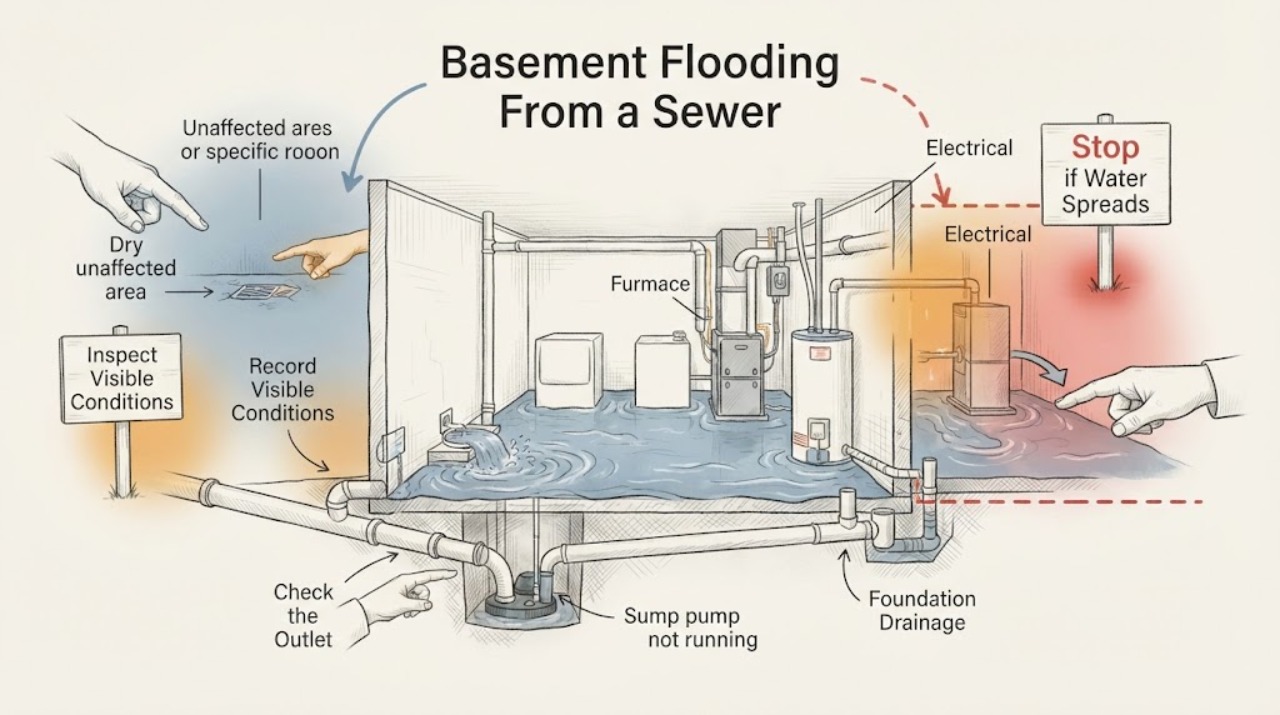
Treat basement floodwater as contaminated until its source is known. Keep people and pets out, and never step into water to reach a breaker, outlet, appliance, or pump. From a dry location, note whether water came from a floor drain, toilet, or laundry fixture (which makes a sewer backup more likely) versus a foundation wall, window, sump, or supply pipe. If power can be shut off without entering water, shut it off; otherwise call an electrician. Stop using water if a sanitary drain is backing up, and arrange a plumber plus qualified water-damage cleanup when sewage, solids, odor, soaked drywall or insulation, or wet electrical/HVAC equipment is present.
Work through in order
Diagnostic checks
Use only checks that match the exact appliance or system and its official guide.
-
Check 1
From the doorway or another completely dry position, establish an exclusion zone and look for standing-water depth, sparks, arcing, gas odor, smoke, fuel or chemical containers, shifting walls or shelves, and unusual structural noises. Keep children and pets away; do not enter the water or touch a wet appliance, outlet, panel, or pump.
Expected result: There is gas odor, smoke, sparking, a hot or damaged electrical component, a shifting structure, or any route to the main switch that requires wading; or the area appears stable and can be viewed without entering water.
Next step: For gas odor or suspected leak, leave without operating switches and contact emergency or gas authorities. For structural or fire danger, leave and seek emergency help. Otherwise call an electrician from a dry location to isolate power. If none of these hazards is present, continue observing from dry ground only.
Stop if: Stop immediately for gas odor, smoke, sparks, energized-water concern, shifting or collapsing materials, or any need to wade or climb.
Why this matters
Why: A gas, fire, electrical, or structural warning takes priority over identifying the leak. Requiring wading to reach power means the safe shutdown cannot be a homeowner action.
-
Check 2
Without touching the water, trace its apparent entry point and record photos from the dry area: floor drain, toilet, laundry sink, cleanout, foundation wall or window well, sump pit or discharge, or a burst supply pipe. Note sewage odor, solids, toilet-paper residue, discoloration, whether several fixtures are slow, and whether rain or a neighbor's plumbing event preceded it.
Expected result: An opening connected to sanitary fixtures has overflowed or the water has sewage odor or solids; water instead enters through the wall or window, rises from the sump area, or comes from one visible pipe; or the source remains uncertain.
Next step: For a likely sewer backup, stop nonessential water use and do not flush toilets or run laundry until a plumber or utility confirms the path is clear. For a pipe leak, use the main water shutoff only if it is reachable from dry ground; otherwise call a plumber. For wall, sump, or uncertain water, arrange water-damage and plumbing assessment without entering the water.
Stop if: Do not taste, handle, stir, chemically treat, or pump the water to identify it; do not open a cleanout or buried line while the area is flooded.
Why this matters
Why: Fixture-linked overflow makes a sewer or building-drain restriction more likely. Wall or window seepage makes stormwater or foundation drainage more likely; sump-area water makes pump capacity, discharge, or groundwater more likely. A source that cannot be classified should be treated as contaminated until assessed.
-
Check 3
If the main electrical disconnect is visible and reachable without stepping in water, turn off power as directed by the electrical service instructions; if reaching it requires standing water, leave it off and call an electrician. Do not reset a tripped breaker, use a corded pump or vacuum, or reconnect a flooded furnace, water heater, outlet, or appliance.
Expected result: Power is safely isolated from a dry location, the disconnect is in or beyond the water, circuits or equipment are wet or near water, or power appears normal but water has reached electrical equipment.
Next step: Have an electrician check the electrical system and any affected equipment before power is restored. Keep flooded HVAC off until a qualified mold-cleanup or HVAC professional evaluates it. Use no gasoline-powered equipment indoors or near openings.
Stop if: Stop all electrical testing, pumping, and appliance operation if water is present near electrical components or if a dry shutdown is not possible.
Why this matters
Why: Wet circuits and equipment can remain an electrocution or fire hazard even when a display or light is off. Power restoration is a professional inspection decision, not evidence that the water problem is solved.
-
Check 4
From a dry location, document the highest water line and every affected material or system: drywall, insulation, carpet, stored food, furnace or air handler, water heater, outlets, panels, sump equipment, and floor drains. Do not move heavy wet objects alone or remove wall coverings, insulation, or electrical covers just to inspect behind them.
Expected result: Sewage or floodwater touched porous materials, water reached HVAC or electrical equipment, the structure has swelling or movement, or only cleanable hard surfaces are wet and no unsafe equipment is involved.
Next step: Give the photos and waterline to a qualified remediation professional and the relevant plumber, electrician, or HVAC technician. Keep food and other porous goods out of use when contaminated. Do not energize or clean affected equipment until the responsible professional clears it.
Stop if: Stop handling contaminated materials, chemicals, heavy objects, or damaged building components if PPE, ventilation, lifting help, or professional containment is not available.
Why this matters
Why: Sewage-contaminated porous material and wet HVAC or electrical equipment create health and safety work that may exceed ordinary cleanup. Hard surfaces can be treated differently only after electrical safety and water-source control are established.
-
Check 5
After the source, electrical system, and access are made safe by the appropriate professionals, decide whether the remaining work is hard-surface cleaning and drying or a sewage/mold remediation job. Use protective gloves, boots, eye protection, and respiratory protection as appropriate; never mix bleach with ammonia or another cleaner.
Expected result: Sewage, solids, or sewage-contaminated drywall or insulation is present; visible mold is present; the material cannot be cleaned and dried quickly; or only hard, nonporous surfaces remain and no mold is visible.
Next step: Use a qualified remediation professional for sewage, extensive contamination, visible mold, HVAC involvement, or uncertain materials. If professionals confirm a limited hard-surface cleanup is safe, follow their procedure and the product label, ventilate, dry promptly, and discard items that cannot be cleaned and dried.
Stop if: Do not clean while standing in water, use fans on visible mold, mix cleaning products, or let vulnerable household members participate.
Why this matters
Why: Sewage and materials that cannot be cleaned or dried require qualified remediation and disposal decisions. EPA advises that fans can spread existing visible mold; ordinary ventilation and drying guidance applies only when the area and equipment are safe.
-
Check 6
Once the immediate loss is contained, give the plumber or drainage professional the entry-point pattern, timing, rainfall or fixture-use context, photos, waterline, and any prior recurrence. Ask them to distinguish a building drain or sewer lateral restriction from sump discharge, foundation drainage, or municipal-system surcharge before selecting a repair or prevention device.
Expected result: The event tracks with fixture use or multiple basement drains, follows heavy rain with no fixture use, repeats when the sump runs, or has no repeatable pattern.
Next step: Have the responsible professional inspect the relevant path and confirm local requirements before considering a backwater valve, sump-pump replacement, backup pump, discharge change, or foundation-drain work. Do not install a device as a substitute for finding the entry path.
Stop if: Do not dig, open a buried sewer, alter a backwater device, or change a sump discharge while the basement remains unsafe or the cause is unverified.
Why this matters
Why: A fixture-linked pattern supports investigation of the sanitary drainage path; a rainfall-linked wall or sump pattern supports stormwater, grading, foundation, or sump investigation. An unclear pattern requires site diagnosis rather than a guessed part.
Use your observations
Decision map
Find the observation that best matches what you see, then follow the next safe action.
-
PATH 01Next step
What you see
Gas odor, smoke, sparking, exposed or wet electrical equipment, shifting building materials, or a power disconnect that can only be reached through water is present.
Do this next
Leave the affected area. Do not operate switches or create sparks when gas is suspected; call emergency or gas authorities. Otherwise arrange an electrician or building professional from a dry location.
Why this path and its safety boundary
Why it matters: This is an emergency or professional safety response, not a sewer-diagnosis step.
-
PATH 02Next step
What you see
Water or solids came from a floor drain, toilet, laundry fixture, or cleanout, with sewage odor or multiple slow/overflowing fixtures.
Do this next
Stop nonessential water use and flushing, keep people and pets away, and call a plumber or the responsible utility plus a qualified remediation professional. Treat the area and porous contents as contaminated.
Why this path and its safety boundary
Why it matters: A building-drain, sewer lateral, or municipal surcharge is more likely than simple foundation seepage, but the exact restriction still needs plumbing diagnosis.
-
PATH 03Next step
What you see
Water entered at a foundation wall, window well, floor joint, or sump area without visible sewage signs and follows rain or groundwater conditions.
Do this next
Keep power and affected equipment isolated until cleared, arrange drainage and water-damage assessment, and have the professional inspect gutters, discharge, sump operation, grading, and foundation pathways after the emergency is safe.
Why this path and its safety boundary
Why it matters: Stormwater, foundation drainage, grading, or sump capacity is more likely, but standing water can still carry contaminants and remains an electrical hazard.
-
PATH 04Next step
What you see
Water reached the furnace, air handler, outlets, panels, water heater, or other electrical equipment, or visible mold is already present.
Do this next
Keep equipment off, have an electrician and the relevant HVAC or remediation professional assess it, and do not use fans where visible mold may be spread.
Why this path and its safety boundary
Why it matters: The affected equipment and air/material contamination need professional evaluation; powering up or blowing air can spread hazards or mold.
-
PATH 05Next step
What you see
The water source is uncertain, the event recurs, or the basement cannot be dried and cleared safely within the initial response window.
Do this next
Leave the area controlled and obtain coordinated plumbing, electrical, structural/HVAC, and water-damage assessment as applicable. Preserve photos and the waterline for the responders.
Why this path and its safety boundary
Why it matters: Uncertainty and recurrence leave both contamination and source failure unresolved; repeated pumping or cleaning can conceal the problem and increase exposure.
Helpful context
Understand the symptom
Sewer backup and rain seepage need different follow-up
Water entering at a floor drain, toilet, laundry sink, or cleanout—especially with sewage odor, solids, or a nearby drain overflow—points toward a sanitary drainage problem. Water appearing at a foundation wall, window well, floor joint, or sump discharge points more toward groundwater, stormwater, or sump capacity. These clues guide the next call but do not justify opening a buried line or assuming the water is clean. Until tested or confirmed, keep standing water and wet materials out of contact with skin and food.
The first boundary is electrical and structural safety
A basement can hide energized circuits, damaged furnaces or water heaters, unstable shelves, and gas or fuel containers. Use a battery flashlight from a dry position. Do not wade in, touch wet electrical equipment, operate a pump or shop vacuum, or restart flooded HVAC equipment until qualified personnel have cleared it. A gasoline engine never belongs in the basement, garage, or near a door, window, or vent.
Sewage changes the cleanup decision
If sewage may be involved, cleanup is not the same as drying a little clean rainwater. Porous drywall, insulation, carpet pad, upholstered items, and other materials that cannot be cleaned and dried should be handled according to qualified remediation guidance. If visible mold is already present, do not use fans that could spread it. Children, pregnant people, and people with weakened immune systems or chronic breathing problems should stay out of the cleanup area.
Safety boundary
Stop conditions
- Do not enter standing water to reach a breaker, outlet, pump, appliance, or gas control.
- Never use an electric tool or appliance in water, and never operate a gasoline-powered engine in the basement, garage, or near a door, window, or vent.
- Do not restore power to wet circuits, appliances, or HVAC equipment until the appropriate professional checks them.
- Do not handle sewage-contaminated porous materials or visible mold without the required protection and a safe cleanup plan.
- Do not open buried plumbing, alter a backwater device, or install a pump or prevention part before the entry path and fit are professionally confirmed.
Only after diagnosis
Potential parts
- sump pump or backup sump pump
Consider only when a drainage professional confirms that sump capacity or pump failure caused the event and specifies the required capacity, discharge arrangement, and electrical protection.
Confirm pit dimensions, pump capacity, discharge configuration, power requirements, and local installation rules with the exact system and a qualified installer. - backwater valve
Consider only after a plumber confirms that sanitary sewer surcharge or reverse flow is the entry path and that a backwater valve is appropriate for the building drain and local rules.
Confirm pipe size, cleanout and access conditions, maintenance needs, permitted installation, and exact building-drain layout before selection.
When checks do not resolve it
Need a professional?
Arrange professional help immediately for sewage, a recurring event, wet electrical or HVAC equipment, visible mold, gas odor, structural movement, or any task requiring wading, concealed access, or utility isolation.
Have this ready
- Photos from dry locations showing the waterline and entry pattern
- Whether water came from a drain, fixture, wall, window, sump, or pipe
- Odor, solids, discoloration, rainfall, fixture-use, and recurrence details
- Which electrical, HVAC, plumbing, or stored materials were reached
- What was isolated or left untouched and any gas, electrical, or structural warning
Common questions
FAQ
Is basement floodwater from a sewer backup dangerous?
It can carry sewage and other harmful substances. Keep people and pets out, avoid skin and food contact, and use qualified cleanup guidance when sewage, solids, odor, or contaminated porous materials are present.
Can I turn off the basement power myself?
Only if the main disconnect is reachable from a completely dry location. If reaching it requires entering standing water, call an electrician; never operate a switch or electric tool while standing in water.
Should I run a sump pump or shop vacuum right away?
Not while water or wet equipment creates an electrical hazard. An electrician must clear the power and equipment first; do not use gasoline-powered equipment in the basement or near openings.
What details help a plumber find the cause?
Provide the entry point, odor or solids, which fixtures were slow or overflowing, rainfall and fixture-use timing, the waterline, prior events, and dry-position photos. Those details help separate sanitary backup from sump, foundation, or stormwater intrusion without guessing at a part.
Read the exact guide
Official sources
- Guidelines for Cleaning Safely After a DisasterCenters for Disease Control and Prevention · Supports sewage-contamination, PPE, porous-material, mold, bleach, vulnerable-person, structural, generator, and electrical safety decisions.
- Flood Cleanup: Tips for a Healthy HomeU.S. Environmental Protection Agency · Supports contamination, hard-surface and porous-material cleanup, visible-mold fan boundary, vulnerable-person exclusion, electrical, generator, drying, and professional-help decisions.
- Safety Guidelines: Reentering Your Flooded HomeCenters for Disease Control and Prevention · Supports contamination, gas, electrical, generator, HVAC, drying, and professional-inspection boundaries for a flooded basement.
Community feedback
Share a repair observation
Share a plain-text repair observation. Accepted observations are published automatically; this page may take a moment to update.