
On this page
Start here
Quick answer
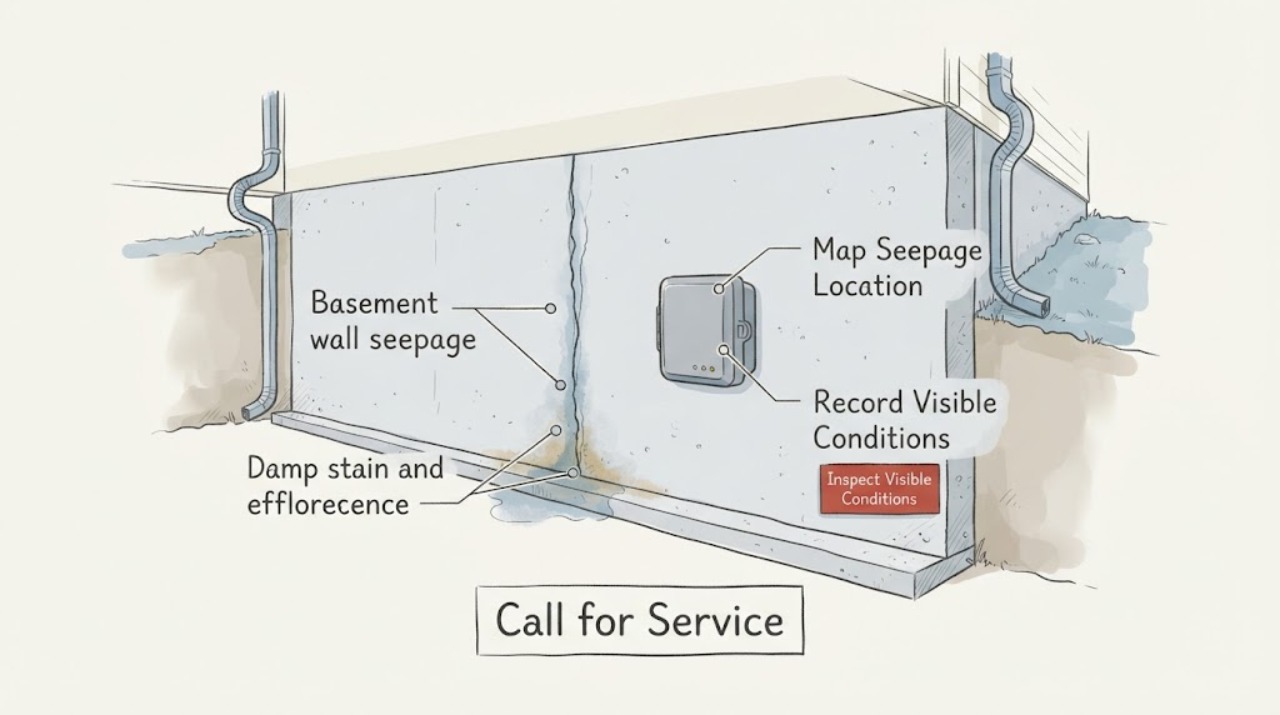
Treat basement wall seepage as a water-source and safety assessment, not a wall-coating project. From a dry, stable area, photograph where dampness or water appears, note whether it follows a crack, joint, window, pipe, floor edge, or broad wall area, and record whether it starts after rain, snowmelt, plumbing use, or without a clear event. Look from a safe position for wet flooring, soft materials, staining, efflorescence, mold-like growth, and nearby outlets or appliances, but do not enter standing water or touch wet electrical equipment. Do not drill, coat, seal, excavate, demolish, or disturb mold to find the source. A small dry-weather mark can still need investigation, while active seepage, recurring water, foundation movement, water near electricity, or hidden-damage signs require prompt water-intrusion, plumbing, building, or electrical assessment.
Work through in order
Diagnostic checks
Use only checks that match the exact appliance or system and its official guide.
-
Check 1
From a dry, stable position, photograph the whole affected wall and a close view of the damp area without touching the wall, floor, or material.
Expected result: Record whether moisture appears at a crack, mortar or floor-to-wall joint, window or door opening, pipe penetration, single spot, or broad wall area. Note staining, white mineral deposits, peeling finish, soft materials, or mold-like growth only as visible observations.
Next step: Save wide and close photographs and provide the location to a water-intrusion or plumbing professional. If the wall or nearby contents are wet, keep people away and stop before touching or moving materials.
Stop if: Stop if the observation requires entering standing water, touching wet finishes, opening the wall, drilling, scraping, spraying, or disturbing mold-like growth.
Why this matters
Why: The location helps distinguish a possible joint, opening, plumbing, surface-condensation, or broader foundation question. It does not prove the source or make a wall coating appropriate.
-
Check 2
Write down when dampness or water first appears in relation to rain, snowmelt, thawing, irrigation, plumbing use, or a period with no known event; do not create water or perform a hose test.
Expected result: Classify the pattern as after rain, after snow or thaw, during or after plumbing use, persistent in dry weather, seasonal, or unknown. Note whether the pattern is limited to one wall or appears in several areas.
Next step: Add the dates and weather or plumbing context to the photo record and request the appropriate professional inspection. Do not excavate outside, redirect buried drainage, or open the wall to test a theory.
Stop if: Stop if water is actively entering, weather conditions make the area unsafe, a test would require hose water or excavation, or the suspected source is near energized equipment.
Why this matters
Why: Weather-linked timing directs questions toward roof runoff, gutters, grade, drainage, and foundation conditions, while plumbing-linked or persistent timing may require plumbing, condensation, or building-envelope assessment. Timing is a clue, not a diagnosis.
-
Check 3
From a dry standing area, compare the wall, floor edge, and nearby contents around the seepage without moving furniture, carpet, boxes, insulation, or finishes.
Expected result: Record a dry floor versus a wet floor, a narrow track versus spreading dampness, a raised or soft material, puddling, staining, efflorescence, or water traveling along a joint. Note whether the wall appears bowed, cracked, or otherwise changed, without making a structural judgment.
Next step: Photograph the pattern from a safe distance, keep contents out of the affected area if they can be moved without entering water, and arrange water-damage or building assessment. Leave finishes and wall surfaces intact.
Stop if: Stop for standing water, a soft or collapsing surface, a bowed wall, rapidly spreading water, unstable contents, or any need to move heavy items or touch wet materials.
Why this matters
Why: A floor-edge track, spreading dampness, soft materials, or visible wall change can indicate a wider water or building condition than a single surface mark. A dry floor does not rule out concealed moisture or a recurring seepage path.
-
Check 4
From the threshold or another dry location, note the distance between the seepage and outlets, electrical panels, appliances, cords, heating equipment, and stored materials without touching any wet system.
Expected result: Record no nearby electrical or combustion equipment, nearby but dry equipment, water approaching equipment, or wet electrical components. Note whether an outlet, cord, appliance, or panel is in the affected area and whether access to it would require stepping into water.
Next step: Keep away from wet electrical equipment and arrange qualified electrical and water-intrusion assessment. If a safe, accessible disconnect is available without entering water or touching wet equipment, follow the home's emergency plan; otherwise leave the area and obtain professional help.
Stop if: Stop immediately for water near energized equipment, sparking, burning odor, a wet electrical panel or outlet, standing water, or any need to touch, unplug, move, or access electrical equipment.
Why this matters
Why: Water near electrical equipment changes the priority from routine observation to electrical safety and water-source control. A dry nearby system still needs monitoring if seepage continues; distance from a visible outlet does not rule out concealed wiring.
-
Check 5
Decide whether the seepage is fully visible from a dry area and whether there is no active water, wall movement, recurring moisture, mold disturbance, or electrical proximity concern.
Expected result: Answer yes only when the area is dry and stable, the visible pattern is limited, weather and plumbing timing are recorded, no wet electrical or structural concern is present, and no invasive access would be needed. Answer no for active or recurring seepage, standing water, wall or floor change, uncertain source, hidden-damage signs, or electrical proximity.
Next step: For yes, keep the photo and timing record and arrange a non-invasive water-intrusion review if the condition persists. For no, keep people away, protect the area only from a dry safe position, and contact the appropriate water-damage, plumbing, building, or electrical professional.
Stop if: Do not drill, coat, seal, excavate, demolish, clean mold, touch wet electrical equipment, or enter standing water when the answer is no or any fact is unknown.
Why this matters
Why: Yes supports a planned inspection and moisture-control conversation; it does not prove the wall is watertight or make a coating safe. No means prompt professional assessment and source correction, not an interior patch or DIY remediation.
Use your observations
Decision map
Find the observation that best matches what you see, then follow the next safe action.
-
PATH 01Safety boundary
What you see
A small, visible mark is dry at the time of observation, stable, and not near standing water, electrical equipment, wall movement, or mold-like growth.
Do this next
Keep a dated photo record and request a non-invasive water-intrusion assessment if it returns. Ask a professional to confirm the source before considering any moisture meter, sealant, or coating.
Why this path and its safety boundary
Safety stop: Stop if dampness returns, the mark spreads, a wall or floor changes, or the proposed fix requires drilling, coating, or opening the assembly.
-
PATH 02Safety boundary
What you see
Dampness appears after rain, snowmelt, thaw, or roof runoff and follows a wall, floor joint, window, or foundation area.
Do this next
Request a combined roof-runoff, grading, drainage, and foundation water-intrusion assessment. Provide weather timing, exterior observations that can be made safely, and interior photographs.
Why this path and its safety boundary
Safety stop: Do not excavate, regrade, open the wall, apply an interior coating, or perform an outdoor storm inspection as a homeowner diagnostic.
-
PATH 03Safety boundary
What you see
Water appears without weather, follows a pipe or utility opening, persists in dry conditions, or returns after apparent drying.
Do this next
Arrange plumbing and building-moisture assessment, and address any active water source through the appropriate professional. Keep contents and finishes undisturbed for evaluation.
Why this path and its safety boundary
Safety stop: Do not open walls, remove insulation, drill, coat, or use a cosmetic seal to conceal ongoing water.
-
PATH 04Safety boundary
What you see
Water is near an outlet, electrical panel, appliance, cord, combustion equipment, standing water, unstable wall, or soft floor.
Do this next
Leave the area and arrange qualified electrical, plumbing, water-damage, or building assessment based on the observed hazard. Keep people and pets out until the area is safe.
Why this path and its safety boundary
Safety stop: Do not enter water, touch wet electrical equipment, unplug appliances, move soaked materials, disturb mold, or continue wall inspection.
Helpful context
Understand the symptom
Record the location before trying to stop it
Water can reach a basement from outside grade and roof runoff, plumbing, condensation, floor or wall joints, or a more localized opening. The first useful record is the exact location and pattern from a dry, stable position. Do not prove the source by drilling, coating, opening the wall, or removing finishes.
Weather timing is evidence, not a diagnosis
Seepage that appears after rain or snowmelt points the assessment toward roof runoff, grading, drainage, and foundation conditions; seepage unrelated to weather can still involve plumbing or condensation. Timing narrows the questions for a professional but cannot identify a hidden path by itself.
Keep wet electrical areas and mold out of the inspection
A wet basement can contain energized outlets, appliances, extension cords, or hidden damage. Keep away from wet electrical equipment and standing water. Do not scrape, spray, bleach, brush, or otherwise disturb mold-like growth; arrange the appropriate professional assessment instead.
Only after diagnosis
Potential parts
- moisture meter
Consider this category only as an optional trend aid after a professional or careful dry-area plan identifies a safe place to compare readings; a reading does not identify the water source.
Confirm the meter's intended material, limitations, and safe use; do not press it into wet, damaged, moldy, or electrically hazardous areas or treat one reading as a diagnosis. - water leak alarm
Consider this category only for monitoring a dry, accessible location where a professional or homeowner wants an alert for future water presence; it does not prevent seepage or make a wet area safe.
Place only according to the device instructions in a dry, non-hazardous location away from energized water-contact risks; confirm connectivity and battery limitations. - dehumidifier
Consider this category only as supplemental humidity control after active leaks or seepage are being addressed; it cannot replace source correction or remediation.
Confirm capacity, drainage, electrical safety, clearance, and placement for the basement conditions; do not operate equipment in standing water or near wet electrical hazards.
When checks do not resolve it
Need a professional?
Call a water-intrusion or building professional for recurring or active wall seepage, water after rain or snowmelt, dampness without a clear source, a crack or joint pattern, wall or floor change, efflorescence or soft materials, or any need to inspect outside drainage or hidden cavities. Call plumbing professionals for suspected pipe leakage and a qualified electrician for water near electrical equipment.
Have this ready
- Provide dry-area photographs, exact wall and floor location, weather and plumbing timing, whether seepage recurs, visible wall or floor pattern, nearby outlets, panels, appliances or cords, basement contents and finish condition, and a statement that no standing-water entry, drilling, coating, demolition, electrical contact, or mold disturbance was attempted.
Common questions
FAQ
What should I check first when water seeps through a basement wall?
From a dry and stable position, photograph the exact location and note whether the pattern follows a crack, joint, opening, pipe, floor edge, or broad wall area. Record weather and plumbing timing, and do not drill, coat, open the wall, or enter standing water.
Does seepage after rain mean the foundation needs excavation?
Not necessarily. Rain-linked timing directs attention to roof runoff, grading, drainage, and foundation conditions, but it does not identify the repair. Request a qualified assessment before any excavation, regrading, coating, or sealant decision.
Can I use a moisture meter to find the leak?
A meter may help compare dry-area trends when used within its instructions, but it cannot identify the source or make a wet or electrically hazardous area safe. Do not use it to justify drilling, coating, or opening the wall.
When is basement wall seepage urgent?
Treat it as urgent when water is active or near electrical equipment, there is standing water, a soft floor, a bowed wall, rapid spread, recurring hidden-moisture signs, or mold-like growth. Leave the area and contact the appropriate water-damage, plumbing, building, or electrical professional.
Read the exact guide
Official sources
- Remodeling Your Home and Indoor Air QualityU.S. Environmental Protection Agency · EPA basement remodeling guidance used here for inspection boundaries and moisture-source context; conditions vary and require site-specific professional assessment.
- What are the main ways to control moisture in your home?U.S. Environmental Protection Agency · General EPA homeowner moisture-control guidance; it does not diagnose this basement or authorize excavation, coatings, or remediation work.
- Mold and Your HomeU.S. Environmental Protection Agency · General EPA moisture information; visible mold and health or remediation decisions require appropriate professional guidance.
Community feedback
Share a repair observation
Share a plain-text repair observation. Accepted observations are published automatically; this page may take a moment to update.