
On this page
Start here
Quick answer
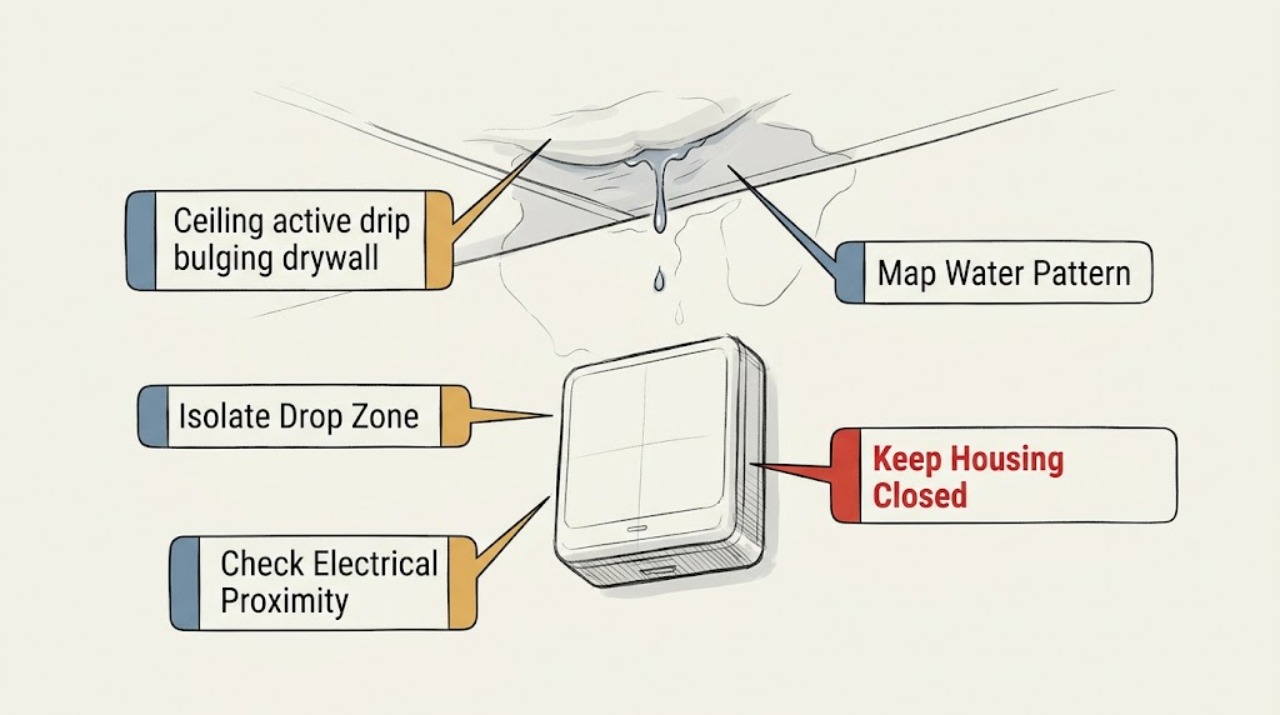
An active drip with bulging drywall is first a falling-material and possible electrical hazard, not a stain to poke or patch. Keep people and belongings out from under the bulge, do not touch, puncture, scrape, or stand beneath it, and do not operate a wet light or switch. From a safe doorway or floor position, document the drip and whether it tracks rain, an upstairs fixture, a supply line, or HVAC cooling. A bulge that grows, sags, cracks, exposes wiring, or drips near a fixture needs urgent water-mitigation and electrical or plumbing help; the source should be isolated by the appropriate professional before the ceiling is opened or dried.
Before you begin
Safety first
- This article covers only non-contact observation from a safe floor position. Qualified professionals should isolate utilities, assess the ceiling and hidden cavity, trace the source, remove wet porous material, dry the assembly, and address electrical, plumbing, roofing, HVAC, or contamination hazards.
Work through in order
Diagnostic checks
Use only checks that match the exact appliance or system and its official guide.
-
Check 1
From outside the area beneath the bulge, keep people, pets, and movable belongings clear and photograph the ceiling from a doorway or other stable floor position. Do not enter the drop zone to place a container or retrieve items.
Expected result: The bulge is stable; it is growing, sagging, cracking, or shedding material; water is pooling on the floor; or the area cannot be viewed without standing beneath it.
Next step: Keep the area isolated and request urgent water-mitigation assessment. If material is falling or the view is unsafe, leave the room and do not continue the checks.
Stop if: Stop immediately for movement, cracking, falling material, a loud snap, rapidly increasing water, or any need to stand under or touch the ceiling.
Why this matters
Why: Growth, sagging, cracking, or falling material indicates weakened ceiling material and raises the urgency beyond an ordinary leak stain. A stable-looking bulge can still fail without warning, and a floor-level view cannot establish what is hidden above it.
-
Check 2
From the floor and without touching a fixture or switch, note whether the drip, wet stain, or bulge is at or near a ceiling light, fan, smoke alarm, outlet, or visible wiring.
Expected result: Yes: water is at or near an electrical point; no: no electrical point is visible nearby; or the relationship cannot be seen safely.
Next step: For yes or uncertain, keep the area clear and request qualified electrical and water-damage assessment. Do not operate a wet switch or attempt to remove a light, fan, cover, or ceiling material.
Stop if: Stop for sparking, buzzing, smoke, burning odor, a wet fixture, exposed wiring, or water entering an electrical box.
Why this matters
Why: Water near electrical equipment adds shock and fire risk and cannot be evaluated by touching or switching the fixture. No visible fixture does not rule out concealed wiring above the wet drywall.
-
Check 3
From a safe floor position, photograph the stain, drip point, bulge edge, and nearby ceiling areas without contact; record whether the water is clear, discolored, or visibly contaminated and whether the pattern is expanding.
Expected result: The drip is localized; the stain spreads along a seam or framing line; several ceiling areas are wet; or the color, odor, or contamination is unusual.
Next step: Keep the photos and notes for the restoration or plumbing professional. Do not wipe, sample, vacuum, or disturb the wet drywall or water.
Stop if: Stop for sewage-like odor, visible contaminants, mold dust, falling debris, or any need to reach the ceiling.
Why this matters
Why: A localized point may still have a hidden traveling path, while a seam-following or multi-area pattern suggests broader wetting. Discolored, foul-smelling, or contaminated water may need a different protective and cleanup response than a clean supply leak.
-
Check 4
Without operating fixtures or HVAC to reproduce the leak, write down when the drip began and compare it with recent rain or snowmelt, upstairs shower or toilet use, laundry or plumbing use, and air-conditioning operation.
Expected result: The drip follows rain or snowmelt; follows an upstairs fixture or appliance; follows cooling operation; is steady regardless of use; or has no reliable timing.
Next step: Provide the timing to the appropriate professional and avoid using the suspected fixture or HVAC system until the source is assessed when continued use could add water.
Stop if: Do not enter an attic, climb onto a roof, open a ceiling, run water to test a theory, or handle HVAC condensate or electrical equipment.
Why this matters
Why: Rain-linked timing supports roof or exterior investigation. Fixture-linked timing supports an upstairs supply, drain, or appliance path. Cooling-linked timing supports an HVAC condensate or drain-pan path. A steady or unclear pattern requires broad tracing rather than a guess from the stain location.
-
Check 5
From outside the isolated drop zone, look for wet flooring, swollen trim, water tracks on walls, damaged contents, or a second stain below the same area; do not move heavy furniture or walk through contaminated water.
Expected result: Damage is confined to the ceiling; water has reached walls or flooring; contents are wet; or standing water or contamination is present.
Next step: Keep people out, photograph before moving contents, and request water-mitigation service. Let the professional determine whether electrical isolation, extraction, or porous-material removal is safe.
Stop if: Stop for standing water near outlets or equipment, contaminated water, unstable flooring, or any attempt to move heavy or wet materials.
Why this matters
Why: Wall or floor spread increases the drying and structural scope. Wet porous contents can retain moisture, and standing or contaminated water can create exposure and electrical hazards that ordinary cleanup may worsen.
-
Check 6
Prepare dated photos and a short handoff with the room and ceiling location, bulge changes, electrical proximity, water appearance, source timing, recent repairs, and any rooms or fixtures above; do not open the ceiling to improve the report.
Expected result: The source timing and location are clear; several possible sources remain; or the area cannot be safely described from the floor.
Next step: Request urgent water-damage assessment and tell the provider about any electrical risk or contaminated water. Keep the ceiling and drop zone undisturbed until the professional arrives.
Stop if: Do not perform demolition, drying behind the drywall, mold cleanup, or source testing that requires contact or access above the ceiling.
Why this matters
Why: A clear history helps route the visit to water mitigation, plumbing, roofing, HVAC, or electrical assessment. Multiple possible sources are expected when water travels through framing; uncertainty is a reason to widen the assessment, not to puncture the bulge.
Use your observations
Decision map
Find the observation that best matches what you see, then follow the next safe action.
-
PATH 01Next step
What you see
The bulge is growing, sagging, cracking, shedding material, or dripping at or near a light, fan, outlet, smoke alarm, or visible wiring.
Do this next
Leave the drop zone, do not operate the wet fixture or switch, and request urgent qualified water-mitigation and electrical assessment.
Why this path and its safety boundary
Why it matters: This combines a possible ceiling-failure hazard with shock or fire risk; the ceiling must not be touched or opened by the reader.
-
PATH 02Next step
What you see
Dripping or expansion follows rain, snowmelt, wind-driven weather, or a roof/exterior event, with no clear fixture-use trigger.
Do this next
Keep the room isolated and arrange professional roof or building-envelope and water-mitigation assessment. Do not climb, enter the attic, or patch the ceiling from below.
Why this path and its safety boundary
Why it matters: Roof, flashing, penetration, or exterior drainage is a plausible source, but water may have traveled far from the entry point.
-
PATH 03Next step
What you see
The drip follows use of an upstairs shower, toilet, tub, sink, laundry appliance, or other plumbing fixture.
Do this next
Stop using the suspected fixture or appliance, close a clearly identified local supply only if it can be done without force or exposure, and request plumbing plus water-mitigation service.
Why this path and its safety boundary
Why it matters: An upstairs supply, drain, fixture seal, or appliance connection may be feeding the ceiling; the visible bulge does not identify which one.
-
PATH 04Next step
What you see
Dripping appears during or after air-conditioning operation, or the ceiling is below an air handler, drain pan, or condensate route.
Do this next
Turn off the affected HVAC system only from a dry, safe control if continued operation could add water, keep clear of the wet ceiling, and arrange qualified HVAC and water-mitigation assessment.
Why this path and its safety boundary
Why it matters: A condensate drain, pan, or HVAC water path is possible, but the source cannot be confirmed from the ceiling stain.
-
PATH 05Next step
What you see
The drip is steady, source timing is unclear, several areas are wet, or no safe floor-level observation distinguishes roof, plumbing, and HVAC paths.
Do this next
Keep the area isolated and request urgent water-mitigation service with plumbing, roofing, HVAC, or electrical coordination as indicated by the observations.
Why this path and its safety boundary
Why it matters: The source and extent are unresolved, and opening or puncturing the drywall could release water or destabilize it.
Helpful context
Understand the symptom
Bulging drywall changes the first decision
A ceiling bulge means wet, weakened material may be holding weight overhead. The immediate question is whether it is moving or near an electrical fixture, not whether the visible stain can be cleaned. Keep the area below isolated and use only floor-level, non-contact observations. A drip may originate from a supply or drain line, roof or exterior rain entry, HVAC condensate, or an upstairs bathroom or appliance; the stain's center does not prove the source because water can travel along framing.
Keep clear of the ceiling and wet electrical points
Do not touch, press, puncture, cut, scrape, or paint the bulge. Do not stand beneath it, use a ladder, open the ceiling, or place a bucket where it requires entering the drop zone. If water is near a light, fan, outlet, or switch, do not touch the fixture or operate the switch; keep people away and have a qualified electrician make the area safe. Do not use a household fan or HVAC system to blow across suspected mold or contaminated water until a professional has assessed the area.
Trace the timing without opening the ceiling
Rain or snowmelt timing favors an exterior roof or flashing path; water after an upstairs shower, toilet, tub, or appliance use favors a fixture, drain, or supply path; and dripping after air-conditioning operation can point toward condensate or a drain pan, without proving it. A steady drip with no clear trigger needs broader professional tracing. These patterns help the right trade respond, but a bulging ceiling still warrants urgent assessment even when the source is uncertain.
Safety boundary
Stop conditions
- Keep everyone out from under a bulging, sagging, cracking, or actively dripping ceiling; do not touch, puncture, scrape, cut, or open the drywall.
- Do not operate a wet light, fan, outlet, or switch, and do not attempt electrical isolation by touching wet equipment. Have a qualified electrician make electrical areas safe.
- Do not use a ladder, enter an attic or roof, run water to reproduce a leak, move heavy wet contents, or use fans or HVAC to spread air across suspected mold or contaminated water.
- Call urgently for falling material, rapidly increasing water, standing or contaminated water, water near electricity, a ceiling over a sleeping or occupied area, or any uncertain source.
Only after diagnosis
Potential parts
- water-leak-alarm
Consider only after the professional identifies a safe, dry location where an alarm can monitor recurrence; it does not stop an active leak or make a bulging ceiling safe.
Confirm the alarm's sensing method, placement limits, power requirements, and compatibility with the intended dry monitoring location. - absorbent-pad
Consider only for protecting an already isolated, dry floor area under professional direction; never place it by standing beneath a failing ceiling or contacting contaminated water.
Match the pad's intended liquid type, capacity, and safe placement; it is not a substitute for source isolation or structural assessment. - moisture-meter
Consider only as a professional's non-invasive documentation aid after the area is safe; it cannot map hidden damage or justify puncturing the bulge.
Confirm the meter's drywall and finish limitations, safe operating conditions, and interpretation by a qualified water-damage professional.
When checks do not resolve it
Need a professional?
Call immediately for a growing or sagging bulge, falling material, water near electrical equipment, standing or contaminated water, spreading wall or floor damage, or a source that cannot be safely identified.
Safety scope: This article covers only non-contact observation from a safe floor position. Qualified professionals should isolate utilities, assess the ceiling and hidden cavity, trace the source, remove wet porous material, dry the assembly, and address electrical, plumbing, roofing, HVAC, or contamination hazards.
Have this ready
- Provide dated floor-level photos, room and ceiling location, bulge or drip changes, electrical proximity, water appearance, rain or fixture or HVAC timing, rooms and equipment above, affected flooring or contents, and any areas kept isolated.
Common questions
FAQ
Should I puncture a bulging ceiling to drain it?
No. Puncturing can release contaminated water, destabilize weakened drywall, expose wiring, and enlarge the damage. Keep people out from underneath and have a qualified water-mitigation professional assess it.
How can I tell whether the leak is from the roof or upstairs plumbing?
Record timing without reproducing the leak: rain or snowmelt points toward an exterior path, while an upstairs shower, toilet, appliance, or fixture points toward plumbing. Water can travel along framing, so neither timing nor the stain location proves the source.
What if the drip is near a ceiling light or fan?
Do not touch or operate the fixture or switch. Keep the area clear and request qualified electrical and water-mitigation help because water near electrical equipment can create shock and fire risk.
Could air-conditioning cause an active ceiling drip?
Yes, a condensate drain, pan, or HVAC water path can be involved when dripping follows cooling operation, but the ceiling stain cannot confirm it. Turn off the affected system from a dry, safe control if continued operation may add water, and arrange HVAC and water-mitigation assessment.
Can I dry or clean the bulging drywall myself?
Do not touch, cut, remove, or clean the bulge. Wet porous drywall, hidden moisture, electrical hazards, and possible contamination require a professional scope before drying, demolition, or mold cleanup.
Read the exact guide
Official sources
- Hazards in a Flooded Home InfographicU.S. Environmental Protection Agency · Supports isolating a water-damaged area, treating ceiling materials and electrical contact as hazards, and waiting for professional safety assessment; this article applies the same boundary to an active localized ceiling drip.
- Mold Clean Up Guidelines and RecommendationsCenters for Disease Control and Prevention · Supports keeping occupants away from disturbed wet or moldy drywall and leaving cleanup to appropriately protected professionals when the material or exposure is substantial.
- Text Version of the Flooded HomeU.S. Environmental Protection Agency · Supports the no-contact and professional boundary for wet drywall, hidden moisture, electrical risk, contaminated water, HVAC involvement, and porous-material handling.
Community feedback
Share a repair observation
Share a plain-text repair observation. Accepted observations are published automatically; this page may take a moment to update.