
On this page
Start here
Quick answer
Treat an active ceiling drip as urgent. From a dry, stable location, observe and record where the water appears, how the pattern changes, whether the ceiling is sagging, whether a light or other electrical fixture is nearby, and whether rain or an upstairs fixture coincided with the drip. Keep people and belongings away only if they can be moved without entering the unsafe area. Do not stand under a bulge, touch wet ceiling material or electrical equipment, puncture or open the ceiling, enter the attic, or attempt demolition or mold cleanup. If the ceiling changes shape, water is near electrical equipment, or water is spreading quickly, leave the affected area and request emergency help; otherwise arrange urgent water-mitigation and the appropriate plumbing or roofing assessment.
Before you begin
Safety first
- Remain in a dry, stable location. Do not climb, stand beneath a bulge, touch wet electrical equipment or water, puncture or open the ceiling, enter the attic, demolish finishes, or perform mold cleanup.
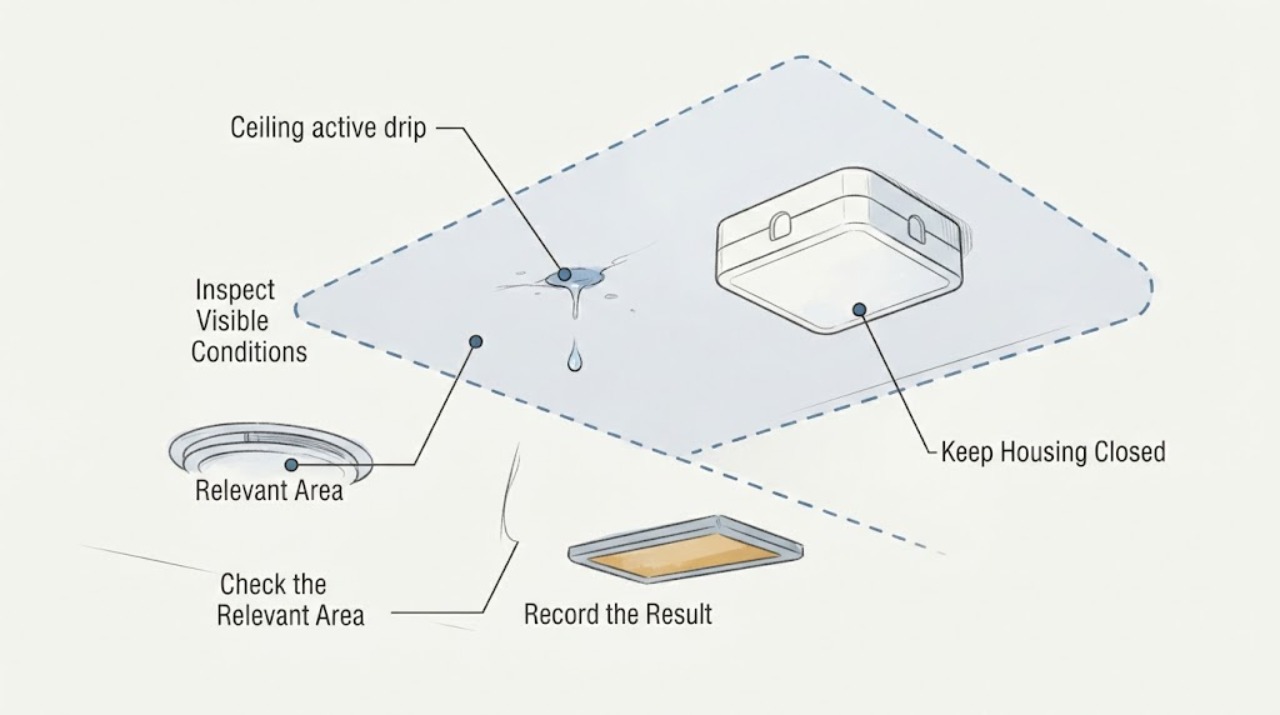
Work through in order
Diagnostic checks
Use only checks that match the exact appliance or system and its official guide.
-
Check 1
From a dry, stable location beside the affected area, observe the drip position and visible pattern without standing beneath it; note whether it is a single point, several points, a stream, or a spreading stain.
Expected result: The location and pattern are recorded in a note or photograph from a safe distance, and no ceiling material or water is touched.
Next step: Record the room, approximate ceiling position, and change over time, then use those details when requesting urgent water-mitigation or source assessment.
Stop if: Stop and leave the area if the ceiling moves, sags further, cracks open, debris falls, or the safe viewing position is no longer stable.
Why this matters
Why: A concentrated point and a spreading pattern both confirm active water movement, but appearance alone cannot identify a roof or plumbing source.
-
Check 2
Look at the ceiling from the side and from outside the wet area for visible sagging, a bulge, cracking, peeling, or a growing stain; do not touch, press, puncture, or scrape the surface.
Expected result: The surface is either visually flat and unchanged or shows a bulge, sag, crack, peeling finish, or visible change since the last observation.
Next step: If the surface is changing, clear people from the room without walking under the hazard and request urgent professional or emergency assistance; if unchanged, continue only with distant observations.
Stop if: Stop immediately and leave the room if sagging increases, a bulge enlarges, cracking spreads, or any material falls.
Why this matters
Why: A changed ceiling shape or falling finish can indicate a collapse hazard and is not a DIY opening or drainage signal.
-
Check 3
From a dry location, observe whether the drip, stain, or wet area is near a ceiling light, fan, smoke detector, outlet, switch, or visible electrical fitting; do not touch wet fixtures, switches, cords, or water.
Expected result: The drip is clearly away from electrical equipment, or it is near or contacting a fitting, with any unusual sound, odor, smoke, or sparking noted only from a safe distance.
Next step: Keep away from the affected area and request emergency help or a qualified electrician through the appropriate local route; do not operate a wet switch or attempt to isolate wiring yourself.
Stop if: Stop observing and leave immediately for smoke, sparking, burning odor, popping, visible arcing, or water entering an electrical fitting.
Why this matters
Why: Water near electrical equipment creates an escalation boundary even when the equipment appears to work; smoke, sparking, or a burning odor is an immediate emergency sign.
-
Check 4
From a safe room location, note whether the drip began after rain or snow, or after use of an upstairs bathroom, kitchen fixture, appliance, or other water source; do not enter the attic, open the ceiling, or access concealed plumbing.
Expected result: The timing coincides with weather, a nearby fixture or appliance, neither, or an uncertain event.
Next step: Tell the service provider the observed timing and affected room so the correct professional can coordinate an urgent source assessment.
Stop if: Stop if identifying the context would require climbing, reaching into a ceiling or attic, moving through standing water, or handling a wet appliance or fixture.
Why this matters
Why: Timing supplies a routing clue for a roofer, plumber, appliance or water-mitigation professional, but it does not prove the concealed source.
-
Check 5
From a dry location, record when the drip started, whether it is faster or slower, whether the stain is spreading, and whether water has reached flooring, furnishings, or another room; observe the water appearance without touching it.
Expected result: The flow is stable or changing, the affected area is contained or spreading, and the water appears clear or visibly dirty/contaminated.
Next step: Give the dated observations to an urgent water-mitigation provider and state whether people, furnishings, or additional rooms are at risk; do not attempt cleanup or mold remediation.
Stop if: Stop and leave if water spreads toward people, exits, or electrical equipment, if the floor becomes unsafe, or if the ceiling begins to fail.
Why this matters
Why: A faster flow, wider spread, or dirty-looking water raises the urgency and may require specialized professional handling; visual appearance cannot establish that water is safe.
Use your observations
Decision map
Find the observation that best matches what you see, then follow the next safe action.
-
PATH 01Safety boundary
What you see
The drip is active but the ceiling looks unchanged and no electrical fitting is nearby.
Do this next
Keep the area clear, preserve the safe observations, and arrange urgent water-mitigation plus a source assessment routed by weather or fixture context.
Why this path and its safety boundary
Safety stop: Escalate immediately if the drip accelerates, the ceiling changes, or the safe area is lost.
-
PATH 02Safety boundary
What you see
The ceiling is sagging, bulging, cracking, shedding material, or changing shape.
Do this next
Move people away without passing beneath the hazard and request emergency or urgent building-safety assistance.
Why this path and its safety boundary
Safety stop: Do not touch, puncture, drain, brace, or open the ceiling; leave if material is falling or collapse appears possible.
-
PATH 03Safety boundary
What you see
Water is near or entering a light, fan, detector, outlet, switch, cord, or other electrical fitting, or there is smoke, sparking, or burning odor.
Do this next
Leave the affected area and request emergency help and qualified electrical assessment; do not operate wet controls or handle wiring.
Why this path and its safety boundary
Safety stop: No further observation is safe once an electrical warning sign is present.
-
PATH 04Safety boundary
What you see
The onset follows rain or snow, or follows use of an upstairs fixture or appliance.
Do this next
Report the timing and location to the appropriate roofing, plumbing, appliance, or water-mitigation professional; do not infer the source from timing alone.
Why this path and its safety boundary
Safety stop: Do not climb, enter the attic, open finishes, or handle a wet fixture or appliance to confirm the source.
-
PATH 05Safety boundary
What you see
Water is spreading quickly, appears dirty, or affects flooring, furnishings, multiple rooms, or a potentially contaminated area.
Do this next
Keep people and pets away and request urgent professional water-damage response with the observed exposure details.
Why this path and its safety boundary
Safety stop: Do not touch, clean, sample, or disturb contaminated water or materials.
Helpful context
Understand the symptom
Why an active ceiling drip needs prompt attention
A ceiling drip can reflect a roof, plumbing, appliance, or fixture leak that is still supplying water. Moisture can also be hidden above a ceiling, so a dry-looking edge does not establish that the source has stopped. The safest first record is made from a dry location without disturbing the ceiling or wet electrical equipment.
Keep the inspection observational
Use notes and photographs from a stable place that is outside the wet area. Do not climb, reach, probe, puncture, remove finishes, open an attic, or try to trace the leak by touching surfaces. A professional can determine the source and the safe response after the area is isolated.
What to tell the service provider
Share the first-observed time, the room and ceiling position, changes in the drip, recent weather, nearby fixture use, visible sagging or staining, and any electrical proximity. Mention if the water looks dirty or has spread to flooring, furnishings, or another room. These observations help route the urgent call without asking you to investigate a concealed source.
Only after diagnosis
Potential parts
- water-leak alarm
Consider only after the leak source is stabilized and a professional confirms that a sensor can be placed in a dry, safe location away from electrical hazards.
Confirm the alarm's sensing method, environment rating, notification method, and placement guidance; it does not replace source repair. - absorbent pad
Consider only for a stable, accessible dry-area edge after a professional confirms it is safe; never use it as a reason to stand under or reach toward a damaged ceiling.
Confirm the pad's intended liquid type and capacity, and keep it away from energized or wet electrical equipment. - moisture meter
Consider only for post-stabilization documentation by a qualified professional or under their direction; do not probe or disturb a wet ceiling surface.
Confirm the device's material modes and limitations; readings do not identify the leak source or establish that a cavity is safe.
When checks do not resolve it
Need a professional?
Call promptly for any active ceiling drip; use emergency help when the ceiling changes, water is near electrical equipment, the floor is unsafe, or the flow is spreading rapidly.
Safety scope: Remain in a dry, stable location. Do not climb, stand beneath a bulge, touch wet electrical equipment or water, puncture or open the ceiling, enter the attic, demolish finishes, or perform mold cleanup.
Common questions
FAQ
Should I puncture a bulging ceiling to drain it?
No. Do not touch or puncture a bulge. Move people away without standing beneath it and request urgent professional or emergency assistance if it is changing.
What if the drip is near a ceiling light or fan?
Keep away from the area and do not touch the fitting, switch, water, or wiring. Smoke, sparking, popping, or a burning odor requires leaving and requesting emergency help.
Does rain prove that the roof is leaking?
No. Rain timing is a useful routing clue, not proof. Record it from a safe location and let a qualified professional assess the concealed source.
Can I clean or test the wet ceiling myself?
Do not open, probe, sample, or perform mold cleanup on an active or concealed ceiling leak. Keep people away and use an urgent water-damage professional for evaluation and safe handling.
Read the exact guide
Official sources
- Mold Cleanup in Your HomeU.S. Environmental Protection Agency · Supports prompt correction of water problems, professional handling when HVAC or porous ceiling materials are affected, and avoiding unsafe cleanup assumptions.
- A Brief Guide to Mold, Moisture and Your HomeU.S. Environmental Protection Agency · Supports documenting moisture, avoiding disturbance of hidden mold, and routing concealed ceiling conditions to qualified evaluation.
- Flood Cleanup to Protect Indoor Air and Your HealthU.S. Environmental Protection Agency · Supports treating water damage as a potential cleanup hazard and using qualified professionals when conditions are unsafe or HVAC is affected.
Community feedback
Share a repair observation
Share a plain-text repair observation. Accepted observations are published automatically; this page may take a moment to update.