
On this page
Start here
Quick answer
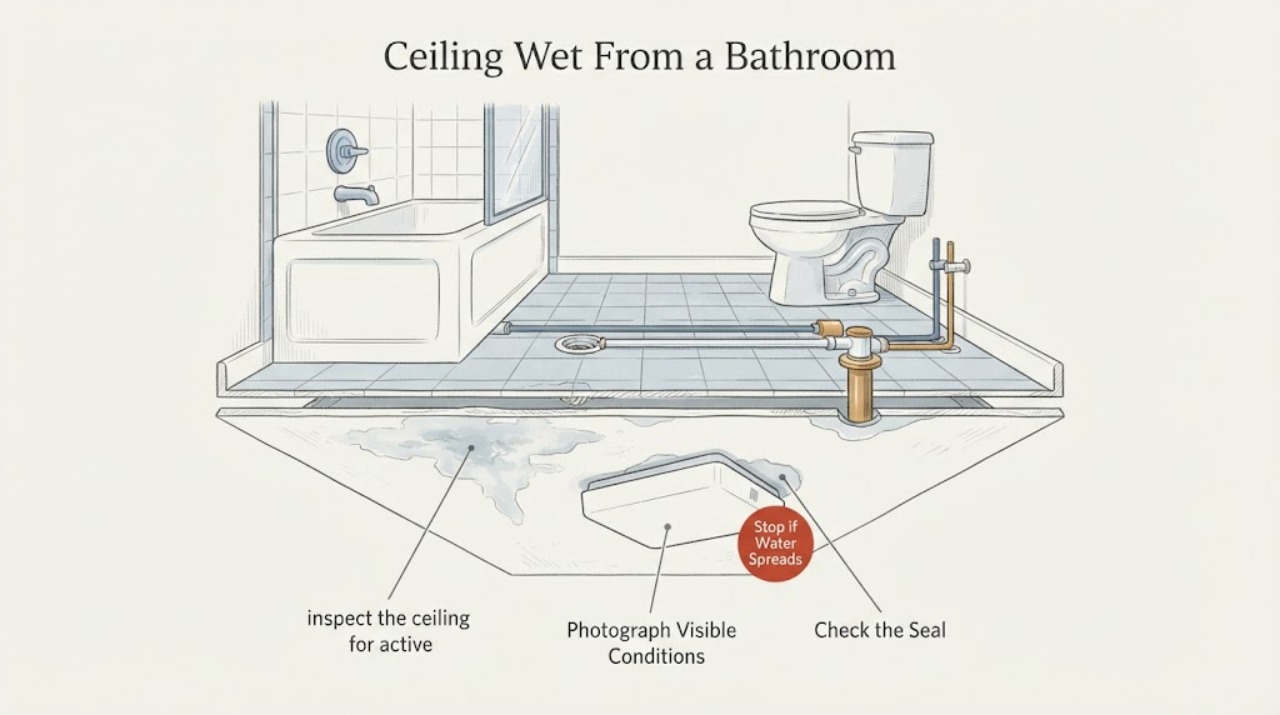
A ceiling that repeatedly gets wet below a bathroom needs source control, not just stain-blocking paint. From a dry position, document the ceiling stain, bulge, active drip, and nearby light or fan; then compare the timing with showering, tub use, toilet flushing, sink use, rain, and periods when nobody uses the bathroom. Inspect only visible bathroom fixtures, supply connections, drain edges, and floor surfaces without opening the ceiling or removing plumbing. If water is active, the ceiling is sagging, or moisture is near electrical equipment, keep people clear and isolate power only from a dry location or call an electrician. A plumber or water-damage professional should diagnose recurring wetness before drywall, insulation, or mold is disturbed.
Work through in order
Diagnostic checks
Use only checks that match the exact appliance or system and its official guide.
-
Check 1
From a dry floor and without standing beneath a bulging area, inspect the ceiling for active dripping, a growing stain, sagging or cracking drywall, soft or fallen material, musty odor, and nearby lights, fans, smoke alarms, or other electrical fixtures. Keep occupants away from the area and do not touch wet fixtures.
Expected result: Water is actively flowing, the ceiling is bulging or sagging, drywall is falling, or water is near an electrical fixture; or the stain is dry, firm, and not near electricity.
Next step: For active flow, bulging, falling material, or electrical contact, stop using the bathroom as needed, keep people clear, and call a plumber, electrician, or emergency building professional. Isolate power only from a completely dry and safe location. Otherwise photograph the area and continue with timing observations.
Stop if: Stop for a sagging or cracking ceiling, active flow, falling material, water inside a light/fan, sparks, a hot fixture, or any need to stand in water or climb.
Why this matters
Why: Active water, a failing ceiling, and wet electrical equipment are immediate safety conditions. A dry stain is not proof that the hidden cavity is dry or that the leak is resolved.
-
Check 2
Create a simple use-and-wetness log without deliberately flooding anything: note whether the ceiling changes after a shower, tub drain, toilet flush, sink use, bathroom fan operation, rain, or a period when all fixtures are unused. Photograph the ceiling before and after a naturally occurring recurrence.
Expected result: Wetness follows shower or tub use, toilet or sink use, rain, fan operation or non-operation, or appears continuously regardless of bathroom use.
Next step: Stop using the fixture associated with a recurrence until a plumber assesses it. If wetness is continuous or unrelated to use, arrange prompt plumbing and water-intrusion assessment rather than repeating the test.
Stop if: Do not pour extra water, flood the shower floor, remove a toilet, open a drain, or deliberately run fixtures under the stained ceiling to reproduce the leak.
Why this matters
Why: A repeatable fixture-use pattern makes a related supply, drain, enclosure, or floor penetration more likely. Rain or unused-bathroom wetness keeps roof, exterior wall, pressurized supply, hidden drain, or condensation paths in consideration; timing alone cannot confirm the source.
-
Check 3
From safe, dry positions in the bathroom above, inspect only visible surfaces: toilet base and supply connection, sink or tub supply lines, shower valve trim, tub or shower edges, grout or caulk joints, drain cover, and floor around fixtures. Do not remove trim, pull a toilet, unscrew a drain, or open the ceiling.
Expected result: There is visible water at a supply connection, toilet base, shower/tub perimeter, drain edge, cracked seal, or wet flooring; or all visible surfaces are dry while the lower ceiling remains damp.
Next step: Stop using the implicated fixture and call a plumber or qualified water-intrusion professional. Do not cover a wet joint with caulk or tighten a fitting as a test; the professional should confirm the source and repair boundary.
Stop if: Stop if the floor is unstable, the fixture moves, water reaches electrical equipment, sewage is present, or checking would require removing a fixture or cutting an opening.
Why this matters
Why: A visible wet connection or perimeter can guide the correct plumbing or bathroom-waterproofing assessment, but the visible point may be downstream from a concealed source. Dry visible surfaces do not rule out a hidden supply or drain leak inside the floor or ceiling cavity.
-
Check 4
If a visible, dry-accessible shutoff is clearly identified for the suspect fixture or the home's main water supply, close it only as the plumbing instructions permit; do not reach through water, remove covers, or operate an unknown valve. Do not reset electrical breakers while wet or touch a wet light, fan, junction box, or appliance.
Expected result: The leak slows or stops after a safely reachable supply shutoff, continues with the fixture isolated, or the only available shutoff requires concealed access or contact with water/electrical equipment.
Next step: Leave the affected fixture unused and call a plumber. If water is near electricity or the shutoff cannot be reached safely, call an electrician or emergency service from a dry location; do not restore power until wet equipment is assessed.
Stop if: Do not wade, reach behind a wet wall, remove electrical covers, or operate an unknown valve under pressure.
Why this matters
Why: A response to a fixture shutoff supports a pressurized supply path, while continued wetness suggests drainage, enclosure, condensation, rain, or another source. No safe shutoff means utility isolation is a professional task.
-
Check 5
Inspect bathroom ventilation only from accessible locations: confirm that the fan actually moves air outdoors rather than merely making motor noise, note whether the duct terminates in an attic or cavity if visibly known, and record whether wetness follows hot showers without a drip. Do not enter the attic or open a ceiling to trace the duct as a first check.
Expected result: Condensation or dampness follows showers, the fan is weak or does not exhaust outdoors, or the ceiling gets wet when the bathroom is unused or after fixture use.
Next step: Use the fan as designed while showering only if there is no electrical or structural hazard, and arrange a ventilation professional for a duct/termination correction. For active or recurring water, prioritize plumber and water-damage assessment over repainting or extra fan runtime.
Stop if: Stop if the fan, grille, wiring, or ceiling is wet, the duct requires unsafe access, or mold is visible around the opening.
Why this matters
Why: Poor ventilation can contribute to moisture entering ceiling cavities, but a use-independent wet stain, active drip, or soft ceiling is not explained by ventilation alone and needs plumbing or building investigation.
-
Check 6
Document the waterline, stain growth, odor, soft materials, insulation or drywall exposure, and any visible mold without scraping, sanding, painting, or cutting. Keep the room ventilated only when it is safe and do not run a contaminated HVAC system or blow air across visible mold.
Expected result: The wet area is small and limited to cleanable hard surfaces, the ceiling tile/drywall or insulation is wet or moldy, the damage is extensive or recurring, or the HVAC intake/duct may be affected.
Next step: Arrange qualified water-damage/remediation service for recurring, extensive, porous-material, sewage, or HVAC-related damage. Have the source repaired first; do not paint or caulk over mold or a damp stain.
Stop if: Do not disturb moldy drywall or insulation, use harsh cleaners in a closed space, expose vulnerable people to cleanup, or conceal wetness with paint.
Why this matters
Why: EPA says porous moldy materials may need disposal, contaminated water damage needs experienced professionals, and a contaminated HVAC system should not be run because it can spread mold. Recurrent wetness means drying alone has not controlled the source.
Use your observations
Decision map
Find the observation that best matches what you see, then follow the next safe action.
-
PATH 01Next step
What you see
The ceiling is bulging, sagging, cracking, actively dripping, shedding material, or wetness is inside or next to a light, fan, smoke alarm, or other electrical fixture.
Do this next
Keep people out from under the area, do not touch the fixture or ceiling, and call an electrician, plumber, or emergency building professional. Isolate power only from a dry safe location.
Why this path and its safety boundary
Why it matters: The immediate risk is structural or electrical, regardless of whether the bathroom source is a supply line, drain, or shower.
-
PATH 02Next step
What you see
Wetness appears after showering or tub use, with dampness near the enclosure, tub edge, shower valve, drain, or bathroom floor.
Do this next
Stop using the shower or tub and have a plumber or water-intrusion professional inspect the enclosure, drain, supply, and floor/ceiling cavity before sealing or replacing finishes.
Why this path and its safety boundary
Why it matters: The bathing-area waterproofing, drain, supply, fixture penetration, or floor assembly is more likely than a random ceiling stain, but the visible wet point may not be the hidden source.
-
PATH 03Next step
What you see
Wetness follows a toilet flush, sink use, or fixture supply, and a visible connection or base is wet; or the ceiling remains wet while the fixture is isolated.
Do this next
Leave the implicated fixture unused, close its safe shutoff if clearly accessible, and call a plumber. Do not remove the fixture or cut the ceiling to chase the line.
Why this path and its safety boundary
Why it matters: The first pattern supports a fixture supply or drain path. Continued wetness after isolation makes a hidden drain, another fixture, condensation, or a separate building source more likely.
-
PATH 04Next step
What you see
The ceiling is damp mainly after hot showers, there is no active drip, and the bathroom fan is weak, vents into an attic/cavity, or does not exhaust outdoors.
Do this next
Arrange ventilation and moisture assessment, use the fan only when its electrical condition is safe, and have any accessible duct termination corrected. Do not seal the ceiling before the moisture source is controlled.
Why this path and its safety boundary
Why it matters: Condensation and moisture-laden air entering the ceiling cavity are more likely, but a recurring stain still requires confirmation that there is no plumbing leak.
-
PATH 05Next step
What you see
Wetness occurs when the bathroom is unused, after rain, or with no repeatable fixture trigger, or the mark grows despite drying.
Do this next
Arrange coordinated plumbing and water-intrusion assessment, preserve photos and timing, and keep the area out of use if the ceiling or electrical system is affected.
Why this path and its safety boundary
Why it matters: A pressurized supply leak, hidden drain, roof/exterior intrusion, or unresolved cavity moisture remains possible; repainting or surface drying will not establish the cause.
Helpful context
Understand the symptom
The timing separates bathroom paths
Wetness that appears during a shower or tub drain points toward the bathing area, drain, enclosure, or a nearby penetration. Wetness during a toilet flush or sink use points toward that fixture's supply or drain path. A ceiling that stays damp when the bathroom is unused keeps a pressurized supply leak, hidden drain leak, rain entry, or condensation path in consideration. Timing narrows the search but does not identify the pipe or fitting behind the ceiling.
A ceiling stain can hide more damage than it shows
Paint discoloration, soft drywall, a sagging patch, musty odor, or repeated dampness can mean water is collecting in the cavity or reaching insulation, wiring, framing, or the floor above. Do not poke, cut, drill, or scrape the ceiling to find the source. Preserve the stain and waterline in photographs and let the appropriate professional open and dry the assembly safely.
Ventilation can be part of the cause, but not every wet ceiling is condensation
EPA notes that a bathroom fan should exhaust outdoors and that moisture-laden air can enter ceiling cavities even when ventilation exists. Condensation is more plausible when dampness follows hot showers, there is no active drip, and the fan is weak or vents into an attic or cavity. A recurring wet mark, water drop, soft ceiling, or wetness unrelated to bathroom use still needs plumbing and building-envelope assessment.
Safety boundary
Stop conditions
- Do not stand beneath a bulging or sagging ceiling, climb, cut, drill, poke, or scrape the stained area.
- Do not touch wet lights, fans, outlets, smoke alarms, wiring, or electrical covers; isolate power only from a dry safe location.
- Do not deliberately run fixtures or flood the shower to reproduce a leak.
- Do not remove toilets, drains, ceiling panels, drywall, or insulation as a first diagnostic step.
- Do not paint or caulk over a damp stain or mold, and do not run HVAC suspected of contamination.
Only after diagnosis
Potential parts
- bathroom supply or drain fitting
Consider only after a plumber confirms the recurring ceiling wetness comes from a specific accessible or concealed supply/drain fitting and identifies the correct connection.
Match pipe material, size, connection type, fixture model, access, and local plumbing requirements; do not select a fitting from the stain location alone. - toilet, tub, or shower seal
Consider only when testing and inspection identify a fixture base, drain, enclosure, or penetration seal as the source rather than a supply line or ceiling cavity leak.
Confirm the exact fixture, drain/enclosure design, substrate condition, and installation method; a surface bead cannot substitute for repairing wet hidden materials. - bathroom exhaust fan or duct component
Consider only when plumbing is ruled out and assessment confirms condensation or inadequate outdoor exhaust is driving the recurring ceiling moisture.
Confirm airflow, electrical requirements, duct route, exterior termination, and code requirements; do not vent into an attic or concealed cavity.
When checks do not resolve it
Need a professional?
Arrange urgent plumbing and water-damage assessment for active or recurring wetness, wet electrical fixtures, a growing stain, soft or sagging drywall, visible mold, or any source that cannot be confirmed without opening the assembly.
Have this ready
- Photos of the ceiling stain, waterline, bulge, nearby fixtures, and bathroom floor from safe positions
- The use-and-wetness timeline for shower, tub, toilet, sink, rain, fan use, and unused periods
- Visible wet connections, fixture bases, drain edges, caulk/grout damage, or condensation
- Whether power, lights, fans, HVAC, insulation, or drywall were reached
- Any safely closed shutoff and what was deliberately left untouched
Common questions
FAQ
Why is the ceiling below my bathroom wet again?
Recurring wetness can come from a shower/tub enclosure or drain, toilet or sink supply/drain, a pressurized line, rain intrusion, or condensation entering the ceiling cavity. Timing after fixture use helps narrow the path but does not prove the hidden source.
Should I cut a hole in the ceiling to find the bathroom leak?
Not as a first check. A ceiling may hide wiring, wet insulation, structural damage, or contaminated materials. Photograph the stain and have a qualified plumber or water-damage professional open and assess the assembly safely.
Can a bathroom fan cause a wet ceiling?
Poor ventilation can let moisture-laden bathroom air enter ceiling cavities, especially when the fan is weak or does not exhaust outdoors. A recurring stain, active drip, or wetness unrelated to showering still needs plumbing and building assessment.
When should I worry about mold under the ceiling?
Treat repeated dampness, musty odor, soft drywall, wet insulation, visible mold, or damage that cannot be dried promptly as a professional cleanup boundary. Fix the water source first and do not paint or caulk over mold.
Read the exact guide
Official sources
- Mold Clean Up Guidelines and RecommendationsCenters for Disease Control and Prevention · Supports the health and PPE boundary for recurring bathroom leaks, moldy drywall/insulation, and cleanup by people with respiratory or immune risks.
- Vents Drains Waste Air Sealing PipingU.S. Department of Energy Building Science Education · Supports the distinction between visible fixture clues and hidden floor/ceiling penetrations and the boundary against opening concealed assemblies as a casual test.
- Mold Cleanup in Your HomeU.S. Environmental Protection Agency · Supports fixing leaks promptly, not painting over mold, disposing of moldy porous ceiling materials when necessary, keeping suspected contaminated HVAC off, and calling experienced professionals.
- FloodsFederal Emergency Management Agency, Ready.gov · Supports keeping away from wet electrical equipment, turning off power only when safe, avoiding contaminated water, and using qualified inspections.
- Remodeling Your Home and Indoor Air QualityU.S. Environmental Protection Agency · Supports separating bathroom leak, condensation, and ventilation paths and prioritizing source control before cosmetic repair.
Community feedback
Share a repair observation
Share a plain-text repair observation. Accepted observations are published automatically; this page may take a moment to update.