
On this page
Start here
Quick answer
Standing water at or inside a crawlspace foundation vent usually means water is entering from a rain or drainage path, groundwater, plumbing leak, or flood condition; the vent itself is not proof of the source. From a dry, safe location, photograph where the water is relative to the vent, check exterior grading and downspouts, and record whether it appears after rain or plumbing use. Do not enter standing water, use electrical equipment in it, close or seal vents as a guess, or disturb mold, sewage, wiring, or the foundation. Arrange qualified water-damage or foundation service, and call an electrician if water is near electrical equipment.
Before you begin
Safety first
- Limit homeowner checks to dry, stable, ground-level observation and photographs. Do not enter standing water or a confined crawlspace, touch contaminated water or mold, operate electrical tools or a generator there, dig beside the foundation, remove the vent, or seal or close vents as an experiment.
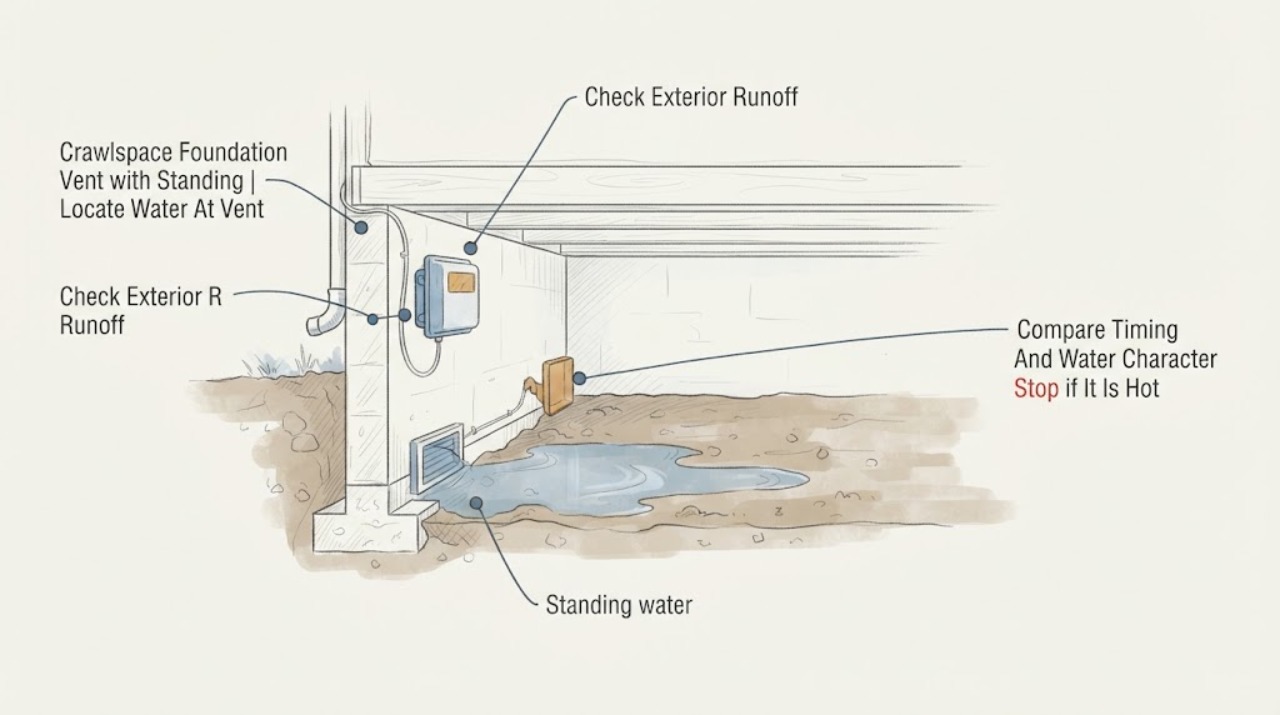
Work through in order
Diagnostic checks
Use only checks that match the exact appliance or system and its official guide.
-
Check 1
From a dry, stable location such as the crawlspace access opening or outside the foundation, photograph the vent and the surrounding floor and wall without entering water. Record whether water is directly below the vent, along the foundation wall, spread across the soil, or coming from another visible direction.
Expected result: Water is concentrated at one vent or wall joint, follows a broad low area, appears beneath plumbing, or cannot be viewed safely.
Next step: Keep the crawlspace closed to people and pets if water or contamination is present, and give the photographs and location record to a qualified professional instead of probing the vent or floor.
Why this matters
Why: A localized path can make an opening, exterior drainage detail, or wall joint worth investigating; broad pooling suggests site drainage, groundwater, or flood conditions; water near plumbing suggests a separate leak. The observation does not prove the source.
-
Check 2
After a safe weather event has passed, inspect the exterior from ground level for soil sloping toward the foundation, short or disconnected downspouts, gutter overflow, irrigation spray, splash marks, a damaged vent cover or screen, and staining below the vent. Do not dig beside the foundation, remove the vent, or apply a sealant as a test.
Expected result: Rain or irrigation drains toward the wall or vent, runoff discharges near the foundation, the vent cover is visibly open or damaged, or the exterior appears to direct water away.
Next step: Document the runoff path and request a qualified foundation or water-intrusion assessment. Use only temporary, low-risk protection that does not block drainage or ventilation; do not make a permanent vent or foundation change from this observation alone.
Why this matters
Why: Surface-water and rain-splash findings make an exterior drainage or vent-detail correction more likely; a clear exterior does not rule out groundwater, plumbing, or a concealed foundation path.
-
Check 3
Record when the standing water appears or rises relative to rain, snowmelt, irrigation, plumbing use, or a flood, and note visible color, odor, sediment, staining, or a recurring waterline from the access point. Do not touch or sample the water.
Expected result: The condition follows rainfall or snowmelt, follows plumbing use, persists during dry weather, or has sewage odor, unusual color, or debris.
Next step: Stop entry and arrange water-damage, plumbing, or foundation service according to the pattern. Report suspected sewage or contaminated floodwater and keep children and pets away.
Why this matters
Why: Weather-linked water favors surface runoff or groundwater; plumbing-linked water favors a supply or drain leak; persistent or contaminated water requires a broader professional assessment rather than a vent-only repair.
-
Check 4
From a safe position, record whether the crawlspace is vented or conditioned, whether the visible foundation vent is screened and unobstructed, and whether joists, insulation, ductwork, or stored materials show dampness, mold, rot, or condensation. Do not enter to inspect hidden areas or change the vent configuration.
Expected result: The vent is damaged or blocked, the crawlspace has widespread dampness or condensation, or the structure appears dry except for one temporary water event.
Next step: Ask a qualified professional to assess drainage, ground cover, ventilation or conditioning, framing, insulation, and the foundation before replacing the vent or sealing the space.
Why this matters
Why: A damaged opening may need a compatible repair, but widespread dampness can involve ground vapor, drainage, ventilation strategy, or moisture-control design. A dry surface after one event does not establish that the underlying assembly is sound.
Use your observations
Decision map
Find the observation that best matches what you see, then follow the next safe action.
-
PATH 01Next step
What you see
Water appears at one foundation vent or directly below it after rain, while the surrounding crawlspace is otherwise comparatively dry.
Do this next
Treat the vent, wall detail, and exterior runoff as a linked water-intrusion scope rather than assuming the vent alone is defective.
Why this path and its safety boundary
Why it matters: A concentrated rain pattern makes wind-driven rain, grading, gutter discharge, splash, or an opening detail more likely, but the exterior path must be confirmed before repair.
-
PATH 02Next step
What you see
Water spreads across the crawlspace, returns in dry weather, rises with groundwater or snowmelt, or leaves a recurring waterline.
Do this next
Request a drainage and foundation assessment instead of replacing only the visible vent.
Why this path and its safety boundary
Why it matters: Broad or persistent pooling is more consistent with site drainage, groundwater, floor vapor, or a foundation water-control problem than with a single vent opening.
-
PATH 03Next step
What you see
The water follows plumbing use, has sewage odor or unusual contamination, or entered during a flood or backup.
Do this next
Keep people and pets out and arrange plumbing or water-damage service with appropriate contamination controls.
Why this path and its safety boundary
Why it matters: Contaminated water can create health hazards, and water near wiring or equipment can create an electrical shock risk; a vent repair will not address the source.
-
PATH 04Next step
What you see
The crawlspace has condensation or widespread dampness without a clear liquid-water path, especially when the vented space is exposed to humid outdoor air.
Do this next
Request a building-moisture assessment that considers ground vapor control and the whole crawlspace ventilation or conditioning strategy.
Why this path and its safety boundary
Why it matters: Soil moisture can enter as vapor and humid outdoor air can worsen moisture in some vented crawlspaces; closing one vent or adding a fan without a plan can leave the cause unresolved.
Helpful context
Understand the symptom
A foundation vent is an opening in the crawlspace boundary, but water near it can be arriving from outside surface runoff, a damaged or poorly protected opening, groundwater, a plumbing leak, or a flood. The location and timing of the water are more useful than the vent's appearance alone.
Crawlspace moisture has both liquid-water and vapor paths. Rain and groundwater can move through gaps or soil, while moisture from the ground can evaporate and condense on cooler framing. A vented crawlspace also behaves differently in humid weather from a conditioned crawlspace, so do not close vents or add a fan without a building-specific moisture plan.
Treat the crawlspace as a restricted area when standing water, sewage, mold, unstable framing, gas equipment, or electrical equipment is present. A dry doorway or exterior inspection is enough to create a useful report; more invasive work belongs to qualified professionals.
Only after diagnosis
Potential parts
- foundation vent cover or screen
Consider only when a professional confirms that the vent cover or screen is damaged and that replacing it will not conflict with the crawlspace's required ventilation or conditioning design.
Confirm opening dimensions, wall construction, screening, drainage, pest control, climate, and local code requirements before ordering or installing. - downspout extension or surface-drainage component
Consider only when the documented water pattern shows roof runoff or surface drainage reaching the foundation and a professional confirms the site can discharge water safely.
Confirm property drainage, discharge location, slope, local requirements, and freeze or erosion conditions; do not redirect water toward another foundation or lot. - crawlspace ground vapor barrier
Consider only after liquid-water sources are controlled and a qualified professional confirms that ground vapor is part of the moisture pattern.
Match the material, wall and pier sealing, drainage, radon considerations, and local code or building-science requirements to the crawlspace design.
When checks do not resolve it
Need a professional?
Call qualified water-damage or foundation service when standing water is present, returns after weather, reaches the foundation vent, affects framing or insulation, or has no clear safe source. Add a plumber for a plumbing-linked pattern and an electrician when electrical equipment or wiring is wet or near water.
Safety scope: Limit homeowner checks to dry, stable, ground-level observation and photographs. Do not enter standing water or a confined crawlspace, touch contaminated water or mold, operate electrical tools or a generator there, dig beside the foundation, remove the vent, or seal or close vents as an experiment.
Have this ready
- Provide the property location, photos from safe positions, the vent and foundation relationship, timing after rain or plumbing use, water appearance and odor, exterior grading and downspout observations, crawlspace type, visible damp or mold damage, and any electrical or access limitation.
Common questions
FAQ
Is the foundation vent itself causing standing water in the crawlspace?
It may be part of a rain-entry path, but water can also come from grading, downspouts, groundwater, plumbing, or flooding. Record where and when the water appears and have the vent, wall, and drainage path assessed together.
Can I close the crawlspace vents to stop the water?
Do not close or seal them as a guess. Vented and conditioned crawlspaces use different moisture-control strategies, and a vent change can leave ground vapor, drainage, humidity, or code issues unresolved. Get a building-specific assessment first.
Can I pump out the standing water myself?
Do not enter standing water or use electrical equipment in it. If water is near wiring or electrical equipment, call an electrician, and use qualified water-damage service when the water may be contaminated, rising, or inside a confined crawlspace.
What outside checks can I make safely?
From ground level, look for downspout discharge, grade sloping toward the foundation, gutter overflow, irrigation spray, vent damage, and staining below the opening. Photograph the pattern and avoid digging, climbing, or applying permanent sealant before diagnosis.
Read the exact guide
Official sources
- Crawlspace: Capillary Break at Crawlspace FloorsU.S. Department of Energy Building Science Education · Vented or unvented crawlspaces where soil moisture, surface water, and foundation drainage affect the floor and framing
- Moisture Control Guidance for Building Design, Construction and MaintenanceU.S. Environmental Protection Agency · Building design, maintenance, and investigation of moisture problems in foundations, basements, and crawlspaces
- What to Do to Protect Yourself From Electrical HazardsCenters for Disease Control and Prevention · Homes and other structures with standing water, wet electrical equipment, or flood-related hazards
- Unvented, Conditioned Crawlspaces - Building America Top InnovationU.S. Department of Energy · Building America research context for crawlspace ventilation and conditioning; local code and building-specific design control the remedy
- FloodingU.S. Environmental Protection Agency · Homes and crawlspaces affected by floodwater, sewage, contaminated water, or post-flood drying and rebuilding
Community feedback
Share a repair observation
Share a plain-text repair observation. Accepted observations are published automatically; this page may take a moment to update.