
On this page
Start here
Quick answer
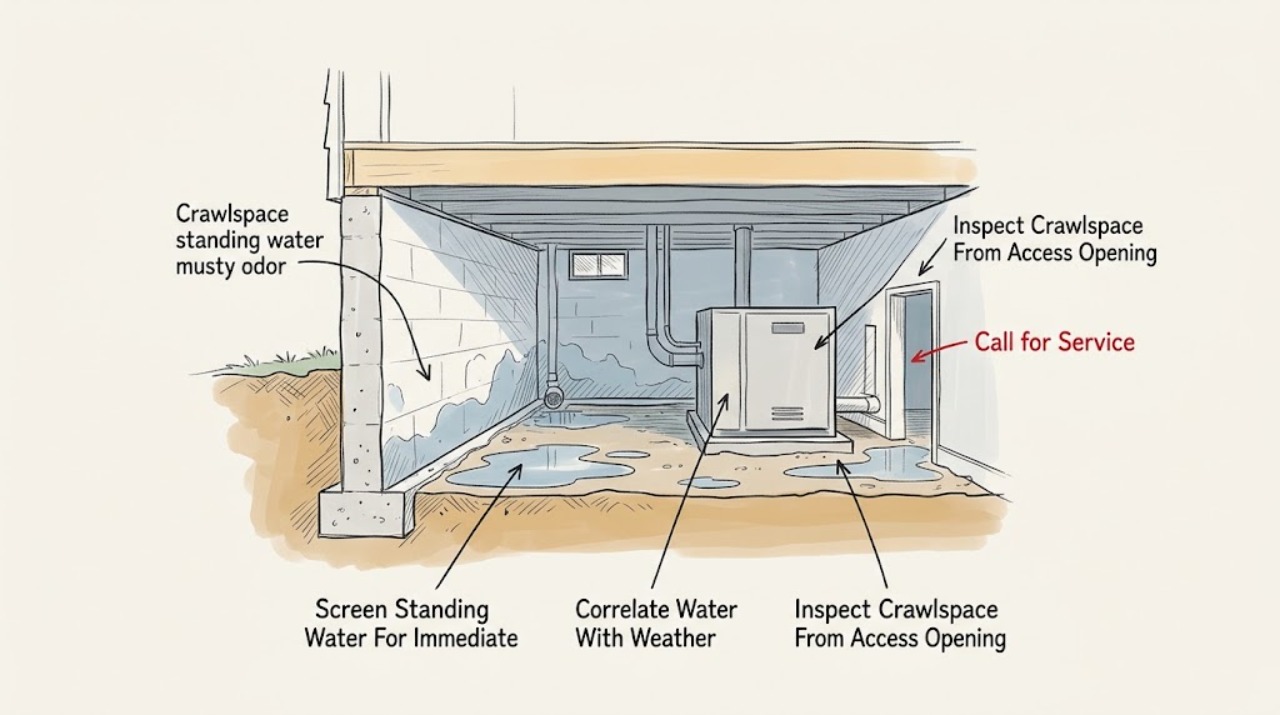
Standing water and a musty crawlspace odor usually indicate an unresolved moisture source, but the water may come from rain runoff, a plumbing leak, groundwater, condensation, or a drainage failure. Do not enter water or operate electrical equipment in it. From a dry, safe location, note the water depth and extent, inspect visible gutters and downspouts, and look from the access opening for wet insulation, mold, damaged wood, or water tracks. A musty odor suggests that water is or was present and mold may be growing, but smell alone cannot identify the source. Have a qualified water-damage or building professional assess the crawlspace when water is persistent, contaminated, inaccessible, or affecting insulation, ducts, wiring, or structure. An electrician must clear electrical hazards before pumps, fans, or other powered equipment are used; a gas odor, sewage, exposed wiring, unstable framing, or rapidly rising water is urgent.
Before you begin
Safety first
- This article supports dry-location observation and source documentation only, plus limited drying or cleanup after a qualified person confirms electrical, contamination, access, and equipment safety. Professionals must handle standing water entry, electrical or gas hazards, flooded HVAC, structural or foundation work, heavy or hidden mold, contaminated insulation, sewage or chemical water, and inaccessible crawlspaces.
Work through in order
Diagnostic checks
Use only checks that match the exact appliance or system and its official guide.
-
Check 1
From a dry location, identify whether water is entering living areas, rising, contaminated with sewage or chemicals, near an electrical panel or wiring, associated with a gas odor, or accompanied by unstable framing; do not step into the water or operate switches and tools from it.
Expected result: Water is shallow and isolated with no visible utilities, water reaches electrical equipment, sewage or chemical contamination is possible, gas is smelled, or the floor, supports, or ceiling appear unstable.
Next step: Keep people out and contact the appropriate electrician, utility, emergency, structural, or water-damage professional from a safe location. Do not enter to shut off power; an electrician must handle a switch that cannot be reached dry.
Stop if: Never stand in standing water to turn power on or off, use an electrical tool or pump, or investigate a gas, sewage, chemical, or structural hazard.
Why this matters
Why: A contained clean-water observation may permit further dry-location documentation. Water near electricity, suspected sewage or chemicals, gas odor, rising water, or structural movement is an urgent hazard and not a routine drying task.
-
Check 2
Record when the water and odor appear and whether they change after rain, snowmelt, plumbing use, HVAC operation, or a change in groundwater; photograph the accessible edge of the water without entering.
Expected result: Water follows storms, appears near a pipe or fixture, increases after plumbing use, persists through dry weather, or is concentrated on cool surfaces with no obvious inflow.
Next step: Give the timeline and photos to a roofer, plumber, drainage contractor, or water-damage professional as appropriate. Do not open walls, dig around the foundation, or disconnect pipes to reproduce the water.
Stop if: Stop if observing the source would require entering water, disturbing contaminated materials, moving insulation, or approaching utilities or unstable framing.
Why this matters
Why: Storm correlation makes roof, gutter, grading, or foundation seepage more likely; a pipe correlation makes plumbing leakage more likely. Persistent dry-weather water raises groundwater or drainage concerns, while surface condensation is another possibility when no inflow is visible. Timing narrows the source but does not prove it.
-
Check 3
From outside the crawlspace or its access opening, use a flashlight to look for wet insulation, mold, dark water tracks, rotted or bowed wood, damaged ductwork, standing water extent, and daylight at the foundation; do not crawl in or pull materials down.
Expected result: Wet insulation or mold is visible, wood is soft or distorted, ducts or wiring are wet, the water is deep or extensive, or the visible space is dry but the odor remains.
Next step: Photograph from the opening and arrange qualified water-damage, mold, structural, or HVAC service. Do not pull wet insulation, scrape mold, cut vapor barriers, or turn on a flooded HVAC system.
Stop if: Do not enter a crawlspace with standing water, sewage, chemical contamination, unsafe framing, exposed wiring, animal activity, excessive heat, or inadequate footing.
Why this matters
Why: Wet porous material, mold, structural damage, or wet building systems increases the need for professional assessment and may spread moisture or contaminants into the home. A dry view does not rule out hidden moisture, intermittent seepage, or water under a vapor barrier.
-
Check 4
Walk the exterior without entering the crawlspace and check whether gutters and downspouts discharge away from the foundation, soil slopes toward the building, drains are blocked, or recent excavation or landscaping changed runoff; do not dig beside the foundation or move heavy covers.
Expected result: Downspouts discharge at the foundation, gutters overflow, soil slopes toward the house, drains are blocked, water collects after rain, or exterior drainage appears clear.
Next step: Document the route and have a drainage or foundation professional evaluate grading, discharge, drains, and seepage. Correct only ordinary, safe debris at ground level; do not seal foundation cracks or excavate without knowing the utility and structural risks.
Stop if: Do not enter floodwater, uncover buried utilities, remove foundation material, or redirect water in a way that sends it toward another structure or the foundation.
Why this matters
Why: Runoff concentrated at the foundation can explain storm-related crawlspace water and odor. Clear-looking drainage does not rule out groundwater, plumbing, foundation cracks, or a hidden drain failure, especially when water persists during dry weather.
-
Check 5
Ask an electrician or qualified water-damage professional to confirm that power and equipment are safe before using a pump, wet-dry vacuum, fan, or dehumidifier; keep gasoline engines outside and away from openings and never run them in or near an enclosed crawlspace.
Expected result: Power has not been cleared, electrical components are wet, the water is contaminated, the crawlspace is enclosed or poorly ventilated, or safe clearance has been confirmed by a professional.
Next step: Until clearance, keep the area isolated and arrange professional water removal and drying. Once a qualified person confirms safety, follow the equipment and site plan; drying alone is not a substitute for stopping the water source.
Stop if: Never use an electrical tool while standing in water, run a gasoline engine in a home, basement, garage, porch, or crawlspace, or turn on flooded HVAC equipment before inspection and cleaning.
Why this matters
Why: Powered drying equipment can create shock, fire, or carbon-monoxide hazards when water or fuel-burning equipment is involved. Professional clearance is especially important when HVAC, wiring, or contaminated water is present.
-
Check 6
Keep dated photos and notes of the water level, odor, weather, plumbing events, exterior drainage, visible mold, material damage, and any professional drying or repair; do not paint, caulk, or cover mold or wet materials to hide the odor.
Expected result: Odor decreases as the space dries, odor persists after apparent drying, mold or wet insulation remains, or water returns after the source repair.
Next step: Have a qualified professional inspect hidden areas and verify drying, source control, material removal, and HVAC safety. Continue monitoring after rain and plumbing use rather than masking the odor with sealant or fragrance.
Stop if: Do not disturb hidden mold, remove structural materials, or reoccupy a contaminated area without the appropriate assessment and cleanup plan.
Why this matters
Why: A decreasing odor supports successful drying but does not prove hidden materials are dry. Persistent odor, remaining mold, or recurrent water means the moisture source or concealed contamination has not been resolved.
Use your observations
Decision map
Find the observation that best matches what you see, then follow the next safe action.
-
PATH 01Next step
What you see
Water rises after rain or snowmelt, exterior gutters or grading direct water toward the house, and wet tracks or seepage are visible near the foundation.
Do this next
Arrange drainage, foundation, and water-damage assessment, and keep the crawlspace out of service until safe. Correct the source before relying on pumping or ventilation.
Why this path and its safety boundary
Why it matters: Roof or surface runoff, foundation seepage, or drainage failure is more likely than odor alone being the problem; mold and material damage may persist after the water recedes.
-
PATH 02Next step
What you see
Water appears after plumbing use or near a supply, drain, HVAC condensate, or other building system, while exterior conditions are dry.
Do this next
Arrange qualified plumbing or HVAC inspection and water-damage drying. Do not crawl through water to reach a valve, cut pipes, or restart flooded equipment.
Why this path and its safety boundary
Why it matters: A plumbing or equipment leak becomes more likely than storm runoff, but water can travel and more than one source may coexist.
-
PATH 03Next step
What you see
Standing water persists during dry weather, a sump or drain is absent or not working, and no visible plumbing leak explains the water.
Do this next
Have a qualified drainage or foundation professional assess the crawlspace, perimeter, drains, and moisture controls. Keep electrical tools out of the area until clearance is given.
Why this path and its safety boundary
Why it matters: Groundwater pressure, a drainage failure, a foundation path, or water below a vapor barrier becomes more likely; a one-time pump-out will not solve the recurrence.
-
PATH 04Next step
What you see
The crawlspace appears mostly dry, but musty odor persists and wet insulation, mold, concealed wood damage, or moisture is suspected in hidden areas.
Do this next
Arrange experienced water- and mold-damage investigation. Do not open walls, disturb mold, or sample repeatedly as a substitute for fixing the water problem.
Why this path and its safety boundary
Why it matters: Hidden moisture or mold remains possible even without visible standing water; odor masking will not correct the source.
-
PATH 05Next step
What you see
Water may contain sewage or chemicals, electrical components or HVAC are wet, framing is unstable, the crawlspace is inaccessible, or an occupant is medically vulnerable to mold.
Do this next
Keep occupants out and contact the appropriate emergency, electrician, HVAC, mold-remediation, structural, or health professional from a safe location. Do not use power, fuel-burning equipment, or the HVAC until cleared.
Why this path and its safety boundary
Why it matters: The immediate health, electrical, air-quality, or structural hazard outweighs do-it-yourself drying or cleanup.
Helpful context
Understand the symptom
The odor confirms a moisture problem, not its source
A musty or damp odor is a reason to investigate moisture and possible mold, not a diagnosis by itself. Water in a crawlspace can follow roof or gutter runoff, a plumbing leak, groundwater seepage, poor grading, condensation, or a drainage system that is not working. The safest useful first step is to correlate the water with rain, plumbing use, seasonal groundwater, or HVAC operation while keeping the crawlspace undisturbed until it is safe to enter.
Standing water changes the electrical and health boundary
Floodwater and standing water may contain sewage, chemicals, sharp debris, or displaced animals. Never stand in water to operate a power switch or electrical tool. If water reaches electrical components, arrange an electrician before power is restored or powered drying equipment is used. People with asthma, chronic lung disease, allergies, or suppressed immunity should avoid mold cleanup; hidden mold and contaminated insulation are professional work.
Drying succeeds only after the entry path is controlled
Pumping or ventilating without correcting the source can leave the crawlspace wet and the odor recurring. Exterior drainage, plumbing, groundwater, vapor movement, insulation, and air-handling systems may all need review. A professional can determine whether the water is clean or contaminated, whether materials can be dried or must be removed, and whether the crawlspace needs drainage, moisture control, or mold remediation.
Safety boundary
Stop conditions
- Never enter standing water to turn power on or off, operate a pump or electrical tool, or reach a valve; have an electrician handle power that cannot be accessed from dry ground.
- Do not use a gasoline engine in or near the home, basement, garage, porch, or crawlspace, and do not turn on flooded HVAC equipment before professional inspection and cleaning.
- Do not enter an unsafe crawlspace, disturb sewage or chemical water, handle unstable framing, move wet insulation, or approach exposed wiring, gas equipment, or animal hazards.
- People with asthma, chronic lung disease, allergies, or suppressed immunity should stay away from mold cleanup; heavy mold, contaminated insulation, hidden mold, and inaccessible areas need professionals.
- Do not paint, caulk, fragrance-mask, or cover mold or wet materials before the water source is corrected, the area is dried, and the cleanup scope is assessed.
Only after diagnosis
Potential parts
- sump pump or drainage component
Consider this category only when a qualified drainage assessment confirms that a sump, discharge, drain, or related component is missing, failed, or unsuitable for the observed water source.
Confirm capacity, discharge route, power and backup needs, drainage design, local requirements, and installation conditions with the professional; do not place or power a pump in standing water yourself. - gutter downspout and surface-drainage correction
Consider this category only when rain or snowmelt and exterior observations show that roof runoff or surface drainage is reaching the foundation.
The correction depends on roof, lot grading, soil, nearby structures, and local drainage rules; have a qualified professional choose the route so water is not redirected toward the building. - vapor or moisture-control assembly
Consider this category only after standing water and leaks are corrected and a professional confirms that soil moisture or vapor movement contributes to the odor or dampness.
Material, placement, seams, drainage, ventilation, and local code depend on the crawlspace design; do not cover wet materials or install a barrier over an unresolved source. - professional drying and dehumidification equipment
Consider this category only after electrical and contamination safety are cleared and the source is controlled, especially when insulation, wood, or hidden spaces remain wet.
A professional must select equipment, power source, airflow, and monitoring for the space; do not run electrical or fuel-burning equipment in unsafe or enclosed wet conditions.
When checks do not resolve it
Need a professional?
Arrange qualified water-damage or building service when standing water persists, returns after rain or plumbing use, the source is unclear, the crawlspace is inaccessible, or wet insulation, mold, odor, ducts, or structural damage is present. Add a drainage, foundation, plumber, or HVAC professional according to the observed source. Get urgent help for sewage or chemical contamination, water near electrical equipment, gas odor, unstable framing, rapidly rising water, fire risk, or a medically vulnerable occupant exposed to mold.
Safety scope: This article supports dry-location observation and source documentation only, plus limited drying or cleanup after a qualified person confirms electrical, contamination, access, and equipment safety. Professionals must handle standing water entry, electrical or gas hazards, flooded HVAC, structural or foundation work, heavy or hidden mold, contaminated insulation, sewage or chemical water, and inaccessible crawlspaces.
Common questions
FAQ
Why does my crawlspace get standing water after rain?
Common possibilities include overflowing gutters, downspouts discharging at the foundation, grading toward the house, foundation seepage, groundwater, or a drainage failure. Photograph the timing and exterior path from a safe location and have the source assessed before relying on a pump or fan.
Does a musty crawlspace smell always mean mold?
A musty or damp odor suggests that water is or was present and mold may be growing, but odor alone cannot identify the source or extent. Look only from a safe access point for moisture and damaged materials, then have hidden or inaccessible areas evaluated professionally.
Can I pump crawlspace water out myself?
Not until a qualified person confirms that the electrical system, water contamination, access, and equipment are safe. Never stand in water to use a pump or electrical tool, never run a gasoline engine in or near an enclosed crawlspace, and do not treat pumping as a substitute for source correction.
Should I turn on the HVAC to dry a wet crawlspace?
No if the HVAC or ducts may have been flooded or contaminated. CDC guidance calls for professional inspection and cleaning before a flooded or mold-contaminated HVAC system is operated. Keep the system off until it is cleared.
What should I do with wet crawlspace insulation?
Do not pull it down or bag it from an unsafe or contaminated crawlspace. Wet insulation may conceal mold, sewage, wiring, or structural hazards. Have a qualified water-damage or mold professional assess whether it can be dried or must be removed.
When is crawlspace standing water urgent?
Get urgent help for water near electrical equipment, sewage or chemical contamination, gas odor, unstable framing, rapidly rising water, a flooded HVAC system, fire risk, or a person with significant respiratory vulnerability exposed to mold. Keep people out and contact the appropriate professional from a safe location.
Read the exact guide
Official sources
- Safety Guidelines: Reentering Your Flooded HomeCenters for Disease Control and Prevention · General U.S. public-health and flood-safety guidance; local officials and qualified trades control site-specific decisions.
- Mold Clean Up Guidelines and RecommendationsCenters for Disease Control and Prevention · General U.S. public-health mold-cleanup guidance; the extent and location of mold may require trained remediation professionals.
- Mold Course Chapter 3U.S. Environmental Protection Agency · General U.S. building moisture and mold investigation guidance; the building condition and qualified professional assessment control remediation.
- Safety Guidelines: FloodwaterCenters for Disease Control and Prevention · General U.S. floodwater safety guidance; unknown contamination, local warnings, and professional assessment control specific cleanup.
Community feedback
Share a repair observation
Share a plain-text repair observation. Accepted observations are published automatically; this page may take a moment to update.