
On this page
Start here
Quick answer
Standing water on or beneath a crawlspace ground vapor barrier means the water source and safety hazards must be assessed before the barrier is patched or replaced. From outside the crawlspace or its access opening, document the water location, apparent depth or spread without entering, barrier condition, visible plumbing or drainage clues, and any odor or structural concern. Do not enter a confined crawlspace, step into water near wiring or equipment, move the barrier, or attempt mold cleanup. Arrange urgent water-damage or crawlspace service for safe extraction, drying, source control, and barrier evaluation.
Before you begin
Safety first
- Do not enter the crawlspace, wade, touch water near equipment, lift the barrier, run electrical drying equipment, clean suspected mold, or patch or replace the vapor barrier before a qualified assessment.
Work through in order
Diagnostic checks
Use only checks that match the exact appliance or system and its official guide.
-
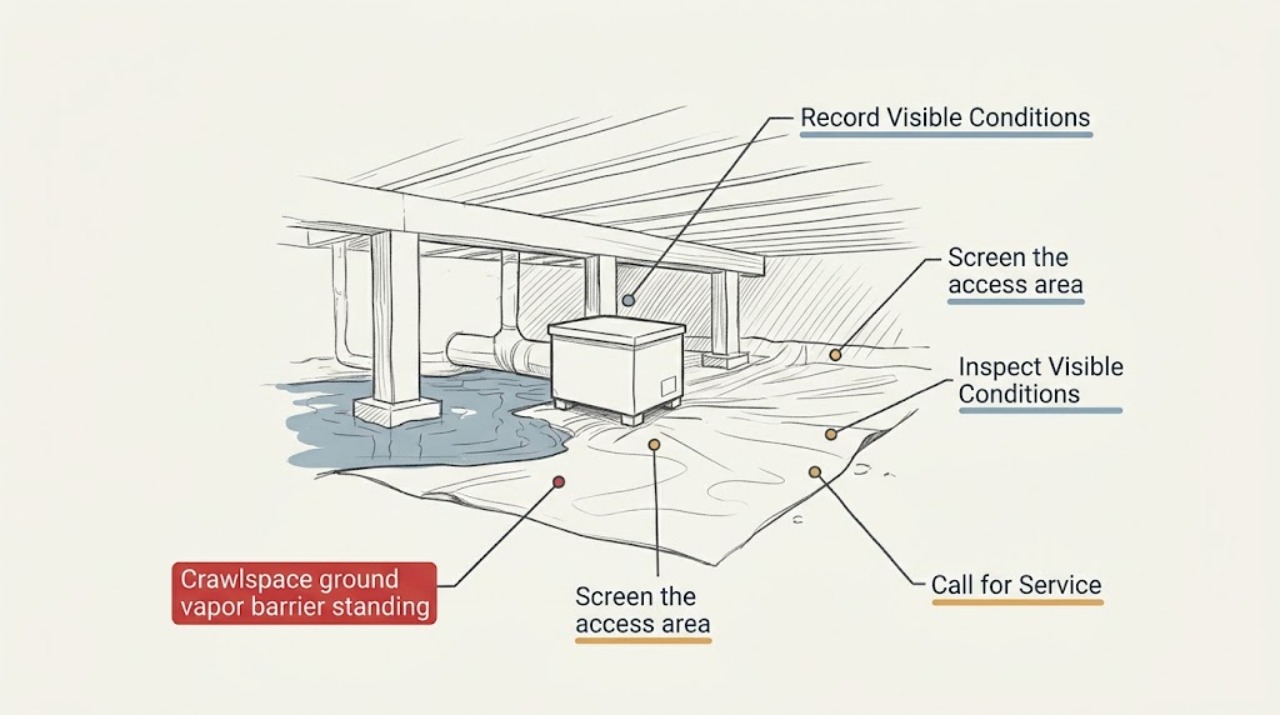
Screen the access area for immediate hazards
From outside the opening, look for water near wiring, receptacles, HVAC or fuel equipment, sagging floors or joists, sewage-like contamination, gas odor, or a blocked or unstable access path. Do not step over the threshold to get a better view.
Expected result: Water contacts or approaches electrical equipment, a structural defect or gas odor is present, contamination is suspected, or the access is unsafe; otherwise no immediate hazard is visible from outside.
Next step: Keep people away and contact emergency or qualified water-damage professionals for the hazard observed. Do not touch water, equipment, or the barrier.
Stop if: Stop all inspection immediately for gas odor, sewage, structural movement, energized equipment near water, or any unsafe access condition.
Why this matters
Why: The first outcome makes entry and ordinary drying unsafe and requires qualified hazard control; the second permits only limited external observation, not crawlspace entry.
-
Record where the water is collecting
From the access threshold or outside perimeter, note whether water is on top of the plastic, beneath a raised or wrinkled section, along a foundation wall, below a plumbing run, or spread across the lowest visible area. Use photos from a dry, stable position; do not measure by wading or moving the cover.
Expected result: Water is localized, spreading or recurring, visibly entering at a wall or penetration, or its extent cannot be seen safely.
Next step: Give the pattern and photos to the water-damage professional and ask for source control before drying and barrier work.
Stop if: Stop if a closer view requires entry, contact with standing water, or movement of the barrier.
Why this matters
Why: The pattern helps distinguish a possible plumbing or drainage source from ground or condensation moisture, but a visual pattern cannot confirm the source.
-
Observe the visible vapor-barrier condition
Without touching the sheet, note tears, open seams, missing sections, pooled water trapped beneath it, loose edges at walls or piers, or plastic that is lifted by water. Do not pull the sheet back to inspect underneath.
Expected result: The ground cover is continuous in the visible area, or it is torn, displaced, unsealed, or holding water beneath it; alternatively, its condition is hidden.
Next step: Report the exact visible condition and leave the sheet in place for professional evaluation after safe extraction and drying.
Stop if: Stop if inspection would require lifting, cutting, fastening, or walking on the barrier.
Why this matters
Why: A damaged or displaced cover may allow ground moisture or soil gases to move upward, but replacing it before water-source control can conceal ongoing bulk water.
-
Check exterior and visible source clues
From normal standing areas outside, look for downspouts discharging beside the foundation, soil sloping toward the house, recent rain or snowmelt, leaking hose connections, or visible plumbing leaks above the access area. Do not dig, enter the crawlspace, or operate equipment in the wet area.
Expected result: A recent weather event, exterior drainage path, visible plumbing leak, or no likely source is apparent.
Next step: Record the clue and timing, and request urgent water-damage assessment. Only make ordinary exterior adjustments that do not require entering the wet area or disturbing the foundation.
Stop if: Stop if source checking would require electrical contact, excavation, confined-space entry, or handling contaminated water.
Why this matters
Why: A clue can guide the professional's source-control inspection, but water can travel through soil and concealed assemblies, so the visible clue is not proof of cause.
-
Prepare the extraction and drying handoff
Provide the site identifier, first-seen date, recent weather or plumbing event, visible water pattern, barrier condition, access limitations, odor, material damage, and any equipment near water. Keep the record factual and do not start fans, pumps, or dehumidifiers in the crawlspace unless a qualified professional confirms they are safe.
Expected result: The report indicates active or recurring water, wet materials, barrier damage, an inaccessible space, or uncertainty about electrical and structural safety.
Next step: Request urgent water-damage or crawlspace service and keep the access closed to occupants until the area is assessed and released.
Stop if: Stop the homeowner process here; do not enter, pump, dry, clean, treat, or replace the barrier yourself.
Why this matters
Why: The responding professional needs these facts to coordinate source control, safe extraction, drying, structural review, and later vapor-barrier work.
Use your observations
Decision map
Find the observation that best matches what you see, then follow the next safe action.
-
PATH 01Safety boundary
What you see
Standing water is near or contacting wiring, receptacles, HVAC, fuel, or other powered equipment.
Do this next
Arrange qualified service and follow the exact model guidance.
Why this path and its safety boundary
Safety stop: Any suspected electrical-water contact ends inspection immediately.
-
PATH 02Safety boundary
What you see
Water appears to be entering now, spreading, or recurring after rain or plumbing use.
Do this next
Arrange qualified service and follow the exact model guidance.
Why this path and its safety boundary
Safety stop: Do not enter or operate drying equipment to test whether the source has stopped.
-
PATH 03Safety boundary
What you see
The visible vapor barrier is torn, displaced, unsealed, or holding water beneath it.
Do this next
Arrange qualified service and follow the exact model guidance.
Why this path and its safety boundary
Safety stop: No lifting, cutting, patching, fastening, or walking on the barrier is permitted during observation.
-
PATH 04Safety boundary
What you see
The access is confined, obstructed, contaminated, unstable, or not viewable without body entry.
Do this next
Arrange qualified service and follow the exact model guidance.
Why this path and its safety boundary
Safety stop: Any need to crawl, wade, climb, or handle contaminated material ends the homeowner process.
Helpful context
Understand the symptom
A vapor barrier limits ground moisture, but it cannot by itself remove bulk water that enters from groundwater, plumbing, drainage, or a foundation opening. DOE explains that moisture can move from soil as liquid water or vapor and that a continuous ground cover is part of a broader moisture-control strategy. EPA identifies pooled water in crawlspaces as a setting for hidden biological growth and material damage.
Treat the crawlspace as a potentially hazardous, confined area. Make observations from the access threshold or outside only, with no body entry. If water is near a receptacle, wiring, HVAC equipment, a water heater, or any other powered equipment, do not touch the water or equipment; keep people away and have qualified responders isolate the hazard.
The useful decision is whether water is active, where it is collecting relative to the barrier, and whether the space can be assessed without entry. A professional can choose extraction and drying methods, check the source, and decide whether the ground cover can be repaired or needs a planned replacement after the area is safe and dry.
Do not cover a wet problem with new plastic or run equipment in the space as a substitute for source control. HUD notes that crawlspaces should not have ponding water and that moisture problems call for appropriate vapor-barrier and building evaluation; the exact remedy depends on site conditions and construction.
When checks do not resolve it
Need a professional?
Arrange urgent water-damage or crawlspace service when standing water is present on or beneath the ground vapor barrier, especially with active entry, wet materials, odor, barrier displacement, or uncertain electrical and structural conditions.
Safety scope: Do not enter the crawlspace, wade, touch water near equipment, lift the barrier, run electrical drying equipment, clean suspected mold, or patch or replace the vapor barrier before a qualified assessment.
Have this ready
- Where water is visible relative to the access, foundation, plumbing, and barrier
- Whether water is active, recurring, or associated with rain, snowmelt, or plumbing
- Barrier tears, lifted edges, trapped water, odor, wet materials, and visible damage
- Access limits and any wiring, equipment, sewage, gas, or structural concern near the water
Common questions
FAQ
Can I pull back the vapor barrier to drain the water underneath?
No. Pulling it can expose contamination, damage the sheet, or bring you into water near wiring or equipment. Photograph what is visible from the threshold and have a qualified professional assess extraction and the barrier.
Can I enter briefly to check the standing water?
Not when entry is confined, wet, contaminated, unstable, or near electrical equipment. Treat the crawlspace as unsafe until a qualified professional evaluates access and hazards.
Does a vapor barrier cause standing water?
The sheet can make pooled water visible, but it does not identify the source. Groundwater, plumbing, drainage, rain, or condensation may contribute; the source must be assessed before the barrier is repaired.
What should I tell the water-damage professional?
Report when the water appeared, its visible location, whether it recurs, barrier tears or trapped water, recent weather or plumbing events, odors, wet materials, access limits, and any equipment near the water.
Read the exact guide
Official sources
- HUD HOC Reference Guide: Basements and Crawl SpacesU.S. Department of Housing and Urban Development · Use for recognizing ponding and dangerous or obstructed access as conditions needing professional evaluation; it is not a homeowner entry or repair instruction.
- Crawlspace: Capillary Break at Crawlspace FloorsU.S. Department of Energy Building Science Education · Use for explaining soil moisture, bulk-water control, and the role of a continuous ground cover; it is not a confined-space entry or emergency extraction procedure.
- Mold Course Chapter 2: Why and Where Mold GrowsU.S. Environmental Protection Agency · Use for recognizing pooled water, hidden moisture, material damage, and the need for prompt professional assessment; do not treat it as permission for do-it-yourself remediation.
Community feedback
Share a repair observation
Share a plain-text repair observation. Accepted observations are published automatically; this page may take a moment to update.