
On this page
Start here
Quick answer
Standing water in a crawlspace after heavy rain is a water-entry and safety problem, not just a dampness issue. Before entering, confirm the building is structurally sound, keep electricity away from standing water, and treat floodwater as potentially contaminated. From a safe position, document the water depth and extent, whether it is clear or foul-smelling, and whether it entered at the foundation, through the soil, from a plumbing or HVAC source, or after gutters and downspouts discharged near the house. Do not crawl through contaminated or electrically hazardous water, disturb mold, or pump against a suspected structural failure. Once safe, qualified water-damage or drainage professionals can remove water, dry materials promptly, and correct grading, perimeter drainage, sump, foundation, or ground-moisture causes.
Before you begin
Safety first
- This article supports safe documentation, exterior drainage observation, and limited interior observation after electrical, structural, contamination, and access screening. It does not authorize confined-space entry, pumping contaminated water, electrical or HVAC work, structural repair, excavation, mold disturbance, or foundation waterproofing.
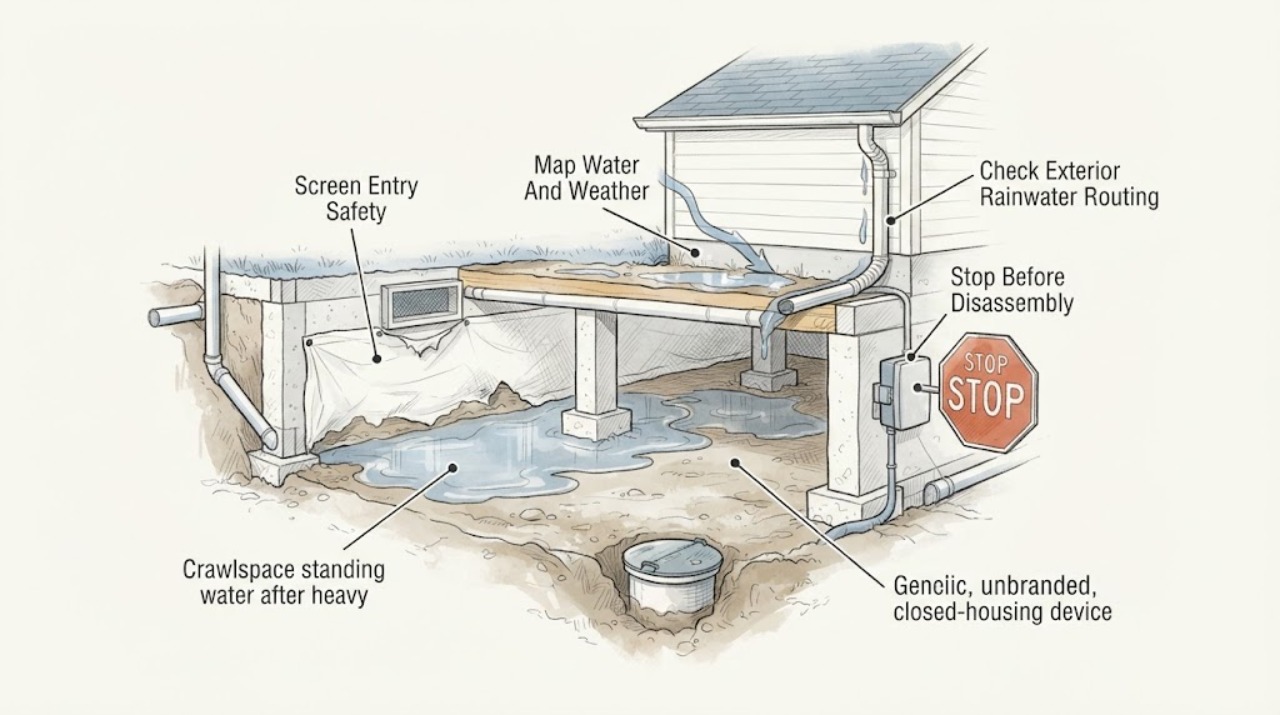
Work through in order
Diagnostic checks
Use only checks that match the exact appliance or system and its official guide.
-
Check 1
From outside the crawlspace or at its access opening, look for leaning walls or piers, new foundation cracks, shifted supports, water near electrical equipment, moving or deep water, sewage or fuel odor, and any reason the building or access route may be unsafe before entering.
Expected result: Record whether the water is clear rainwater or may contain sewage, chemicals, or flood debris; note electrical panels, outlets, pumps, HVAC equipment, or wiring at risk and any structural movement, gas odor, or confined-space concern.
Next step: Keep people and pets out, keep power away from the water, and contact appropriate qualified water-damage, electrical, structural, or emergency professionals when any hazard is present; do not enter merely to measure the puddle.
Stop if: Do not enter until electrical and structural safety are established. Do not wade through contaminated or moving water, use a generator indoors, or touch wet wiring or equipment.
Why this matters
Why: Standing water near electricity, contaminated water, or structural movement changes the task from homeowner observation to emergency or qualified assessment. A visually stable, shallow, uncontaminated area still requires protective clothing and a safe route before any entry.
-
Check 2
From a safe interior or exterior position, photograph the water extent and note the rain timing, approximate depth, low spots, foundation walls, floor drains, sump, pipe penetrations, vents, access doors, and any water trail toward the crawlspace.
Expected result: Record whether water is localized along one wall or footing, spread across the floor, rising from the soil, entering at a crack or joint, flowing from a drain or pipe, or receding quickly after rain stops.
Next step: Compare the crawlspace map with exterior roof drainage, downspouts, ground slope, window wells, and plumbing locations without excavating or opening the foundation; provide the map to a qualified drainage or water-damage professional.
Stop if: Do not dig against the foundation, remove wall finishes, enter a confined or contaminated area, or disturb support posts, ducts, or insulation to trace a hidden path.
Why this matters
Why: A storm-linked wall or floor-edge trail makes surface runoff, groundwater, grading, or perimeter drainage more likely; water at a pipe, drain, or HVAC source points toward a building-service leak. Broad or recurring water needs more than a one-time cleanup.
-
Check 3
After the rain and from safe ground-level access, inspect gutters, downspouts, discharge extensions, grading, swales, window wells, and visible foundation joints for overflow, blockage, erosion, ponding, or water directed toward the crawlspace walls.
Expected result: Record whether roof runoff spills near the foundation, a downspout is disconnected or blocked, soil slopes toward the building, a window well holds water, or exterior water marks line up with the crawlspace wet area.
Next step: Clear only safely reachable surface debris and restore a discharge path that already exists without climbing or excavating; arrange drainage or foundation service for grading, perimeter-drain, wall, window-well, or below-grade defects.
Stop if: Do not climb a wet roof, enter a flooded window well, excavate near utilities or the foundation, or redirect water toward a neighbor or another building area.
Why this matters
Why: A failed rainwater route can create bulk water at the foundation even when the crawlspace floor and vapor barrier are intact. If exterior drainage is sound but water rises through the soil or persists, groundwater, foundation drainage, sump, or a plumbing source remains possible.
-
Check 4
Only after the entry screen passes, observe the crawlspace floor, soil, ground cover, foundation walls, rim joists, insulation, ducts, sump or drain, and visible plumbing from a stable path without moving materials or disturbing suspected mold.
Expected result: Record whether the floor is bare soil, covered continuously, or torn; whether water is above or below the ground cover; whether walls or insulation are wet; whether a sump is absent, full, or not operating; and whether there is musty odor, visible mold, or a plumbing leak.
Next step: Photograph accessible findings and leave insulation, mold, ground cover, pumps, and structural components undisturbed for qualified assessment; do not install a new barrier over wet or contaminated materials before the water source is corrected.
Stop if: Do not crawl through standing or contaminated water, handle moldy insulation, disconnect a pump, cut vapor-barrier material around supports, or operate equipment in a wet electrical area.
Why this matters
Why: Water above the floor or ground cover suggests bulk entry or drainage failure; wet soil or a discontinuous ground cover can sustain moisture after the puddle is gone. Wet insulation, mold, a failed sump, or a plumbing leak may need specialized drying, repair, or remediation.
-
Check 5
After safety is confirmed and the water source is controlled or a qualified provider is engaged, document the drying plan and monitor whether standing water, damp materials, humidity, odor, or visible growth improve; do not turn on fans or HVAC in a contaminated area without appropriate guidance.
Expected result: Record whether water can be removed safely, materials dry promptly, humidity remains high, the same area wets after each storm, or mold, sewage odor, structural damage, or wet HVAC components remain.
Next step: Arrange qualified water-damage, drainage, foundation, plumbing, or mold-remediation service according to the finding; keep a dated photo record and protect occupants from the crawlspace until it is dry and safe.
Stop if: Do not use fans to spread suspected mold, run a fuel-powered generator indoors, energize wet HVAC equipment, or occupy the area while structural or contamination concerns remain.
Why this matters
Why: Rapid improvement after a small clean-water event supports a limited incident, but recurring water indicates an unresolved drainage, groundwater, foundation, or plumbing cause. Wet or contaminated materials that do not dry promptly can require professional remediation and structural assessment.
Use your observations
Decision map
Find the observation that best matches what you see, then follow the next safe action.
-
PATH 01Safety boundary
What you see
The area is structurally and electrically safe, water appears to be clean rainwater, the extent is limited, and the water recedes after the storm without wet insulation, mold, or recurring seepage.
Do this next
Use qualified or safely permitted water removal and drying, document the event, and correct the exterior source before the next heavy rain; monitor for odor, damp materials, and recurrence.
Why this path and its safety boundary
Why it matters: A short-lived surface-water event is more likely, but the exterior rainwater route still needs checking because the storm exposed a drainage weakness.
Safety stop: Do not enter if the water becomes contaminated, rises, reaches electrical equipment, or the building shifts.
-
PATH 02Safety boundary
What you see
Water appears along a foundation wall, footing, window well, access opening, or floor edge after rain, and exterior grading, gutters, downspouts, or perimeter drainage show overflow, ponding, or erosion.
Do this next
Arrange qualified drainage or foundation assessment to correct water routing, grading, perimeter drainage, sump, wall, or window-well conditions; dry the crawlspace after the source is controlled.
Why this path and its safety boundary
Why it matters: Bulk rainwater or groundwater entry is more likely than condensation alone; repeated wetting can damage materials and keep the crawlspace humid.
Safety stop: Do not excavate, seal a wall from the inside, or install a ground cover as a substitute for correcting active bulk-water entry.
-
PATH 03Safety boundary
What you see
Visible water has drained, but bare or wet soil, torn ground cover, high humidity, musty odor, or recurring dampness remains without a clear exterior leak.
Do this next
Have a qualified crawlspace or building-envelope professional assess the ground cover, drainage, humidity, ventilation or conditioning, and affected materials before installing or sealing anything.
Why this path and its safety boundary
Why it matters: Soil moisture, vapor movement, condensation, or incomplete moisture control is more likely; the problem can persist even when no puddle is present.
Safety stop: Do not cover wet materials, disturb mold, or seal vents or openings based on a generic recipe without assessing the crawlspace design and local conditions.
-
PATH 04Safety boundary
What you see
Water is foul-smelling or visibly contaminated, deep or moving, near electricity, accompanied by leaning piers, new cracks, damaged supports, wet HVAC equipment, extensive mold, or materials that cannot dry promptly.
Do this next
Keep occupants and pets out, do not energize affected systems, document conditions from a safe location, and obtain qualified emergency, structural, water-damage, electrical, and remediation assessment as applicable.
Why this path and its safety boundary
Why it matters: This is a health, electrical, structural, or remediation event rather than a routine crawlspace cleanup; ordinary fans, pumps, and household cleaners may increase risk.
Safety stop: Do not enter, pump, disturb mold or sewage, use a generator indoors, or restore HVAC or electrical service until qualified responders confirm it is safe.
Helpful context
Understand the symptom
Heavy rain helps identify the water pathway
Water appearing after a storm can arrive as surface runoff, groundwater, seepage through a foundation crack or joint, a failed window or vent well, a backed-up drain, or a plumbing leak that happened at the same time. A crawlspace floor can also stay wet from soil moisture even after visible water drains. Record the timing and direction of water rather than assuming the lowest puddle is the entry point.
Safety comes before pumping
A crawlspace is confined, dark, and close to wiring, ducts, support posts, and potentially contaminated water. EPA flood guidance says to verify safety, electricity, structural conditions, and protective clothing before entering. If the water is sewage-affected, foul-smelling, visibly contaminated, deep, moving, near electrical equipment, or accompanied by leaning piers or new cracks, leave the area and use qualified responders.
Drying is only half the fix
Fans or dehumidification can reduce moisture after the area is safe, but drying does not correct poor grading, failed perimeter drainage, foundation seepage, missing ground moisture control, or a failed sump. DOE guidance describes a continuous crawlspace ground cover as part of a moisture-control strategy, while bulk water requires site and drainage measures.
Safety boundary
Stop conditions
- Do not enter a crawlspace with standing water until structural and electrical safety are established; do not touch wet wiring, outlets, pumps, HVAC equipment, or electrical panels.
- Treat foul-smelling, sewage-affected, chemically contaminated, deep, or moving water as a professional cleanup situation; keep children and pets out.
- Do not use a fuel-powered generator indoors, pump against a suspected structural failure, disturb moldy insulation, or use fans where they could spread contamination.
- Do not excavate, seal foundation walls, install a vapor barrier over wet materials, or re-grade near utilities without qualified assessment and appropriate local requirements.
- Arrange qualified water-damage, drainage, foundation, plumbing, structural, electrical, or mold-remediation service when water recurs, materials remain wet, the source is concealed, or any health, structural, electrical, or confined-space hazard is present.
Only after diagnosis
Potential parts
- crawlspace sump pump system
Consider this category only if a qualified drainage assessment confirms that recurring bulk water needs a sump system and that the pit, power, discharge, and backup arrangement are suitable.
Confirm pit dimensions, pump capacity, electrical protection, discharge route, local requirements, and backup needs; do not install a pump in contaminated or electrically unsafe water. - crawlspace ground cover or vapor barrier
Consider this category only after bulk water is controlled and a qualified assessment confirms that soil moisture or vapor movement is contributing to the remaining dampness.
Confirm the crawlspace design, seams, piers, wall transitions, penetrations, drainage, and local requirements; do not cover wet, contaminated, or damaged materials. - crawlspace dehumidifier
Consider this category only after active water entry is corrected and humidity remains high in a suitable, safely powered crawlspace.
Confirm electrical safety, drainage, temperature range, service clearance, and the building-envelope strategy; dehumidification does not replace drainage or structural repair.
When checks do not resolve it
Need a professional?
Arrange prompt qualified service after heavy rain when standing water is contaminated, near electrical equipment, deep or moving, associated with leaning walls or piers, wet insulation or HVAC, extensive mold, or structural damage. Even clean water needs drainage or foundation assessment when it recurs, enters through walls or the floor, remains after the storm, or cannot be removed and dried safely.
Safety scope: This article supports safe documentation, exterior drainage observation, and limited interior observation after electrical, structural, contamination, and access screening. It does not authorize confined-space entry, pumping contaminated water, electrical or HVAC work, structural repair, excavation, mold disturbance, or foundation waterproofing.
Common questions
FAQ
Why does my crawlspace have standing water after heavy rain?
Possible sources include surface runoff from gutters or grading, groundwater, seepage through foundation walls or the floor, a blocked or failed drain or sump, a window well, or a plumbing leak. Map where the water appears and how it changes after the storm instead of assuming the lowest puddle is the entry point.
Is it safe to enter a flooded crawlspace?
Not until structural and electrical safety are established. Do not enter water that may be contaminated, moving, deep, near wiring or equipment, or associated with leaning piers, new cracks, gas odor, or a confined-space hazard. Use qualified responders when any of those conditions is present.
Will a vapor barrier stop crawlspace flooding?
Not by itself. A ground cover can limit soil-driven moisture and vapor, but DOE guidance pairs it with grading and perimeter drainage for bulk water. Correct active water entry first, and do not cover wet or contaminated materials without a qualified assessment.
How quickly should a wet crawlspace be dried?
Drying should begin promptly once it is safe and the water is controlled. EPA says wet buildings and materials generally need to dry within 24–48 hours to reduce mold risk, but contaminated water, wet insulation, structural damage, mold, or an affected HVAC system requires qualified cleanup and remediation guidance.
Read the exact guide
Official sources
- Text Version of the Flooded HomeU.S. Environmental Protection Agency · EPA flood cleanup guidance; follow local emergency instructions and qualified remediation requirements for contaminated or extensively damaged properties.
- Mold Course Chapter 2: Why and Where Mold GrowsU.S. Environmental Protection Agency · EPA indoor-air and mold guidance; floodwater contamination and building-specific structural decisions require the applicable professional assessment.
- Crawlspace: Capillary Break at Crawlspace FloorsU.S. Department of Energy Building Science Education · DOE building-science guidance for crawlspace moisture control; site, foundation, climate, and code conditions determine the appropriate design.
- Coming HomeU.S. Environmental Protection Agency · EPA guidance for returning to a flooded home; local emergency officials and qualified professionals control reentry after serious structural or utility damage.
Community feedback
Share a repair observation
Share a plain-text repair observation. Accepted observations are published automatically; this page may take a moment to update.