
On this page
Start here
Quick answer
Visible pooled water in a crawlspace is an active moisture problem, not normal dampness. Keep people and pets out, use only battery lighting, and do not enter water or touch a wet electrical device, pump or wiring. From a dry location, note whether the water is clear or contaminated, whether it is rising, and whether the pattern points to a leaking pipe or HVAC condensate, rain and runoff, groundwater, a failed sump or a sewage/septic backup. Correcting a gutter or downspout may help an exterior source, but water removal, wet insulation, contaminated water, structural concerns and electrical hazards should be handled by qualified professionals. Do not seal the soil or rebuild until the source is corrected and the framing and materials are dry.
Before you begin
Safety first
- This article supports safe observation from dry ground and simple, ground-level runoff checks only. Do not enter standing water, operate wet electrical equipment, handle contaminated water or septic components, excavate, or cover wet materials.
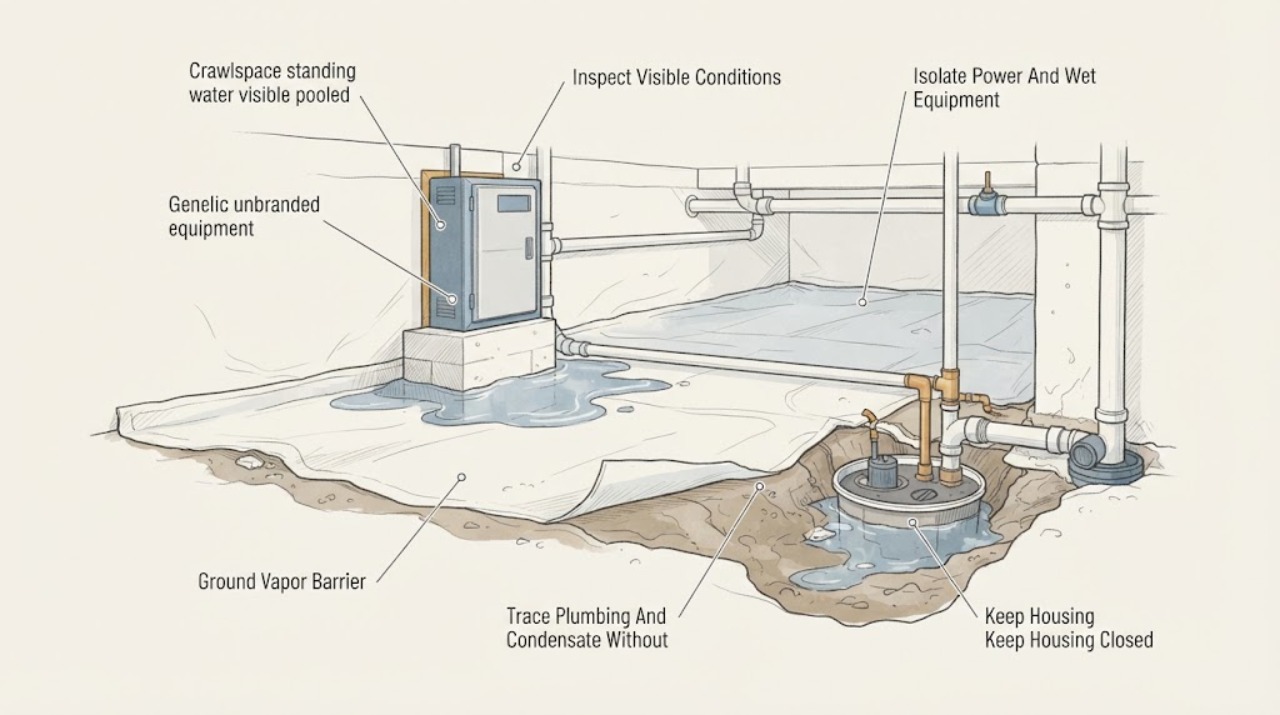
Work through in order
Diagnostic checks
Use only checks that match the exact appliance or system and its official guide.
-
Check 1
Keep the crawlspace closed to children and pets and inspect the pooled area from a dry threshold or other stable position using a battery light; do not step into the water or crawl beneath wet framing.
Expected result: Note the approximate area of the pool, whether the water is still rising or moving, its color and odor, visible debris or sewage, the condition of the floor framing and insulation, and whether the access opening or foundation appears damaged.
Next step: Keep out and arrange qualified water-damage or structural assessment for moving, contaminated, deep or structurally concerning water. If there is a gas odor, fire, active electrical arcing or an immediate collapse threat, leave the area and contact emergency services or the utility emergency line.
Stop if: Do not wade, crawl through pooled water, touch submerged wiring or equipment, move insulation to expose the floor, or prop up sagging framing.
Why this matters
Why: Clear, still water with no equipment nearby may be a clean leak or groundwater issue, but water that is rising, contaminated, foul-smelling, fuel-sheened, or near sagging framing is not a homeowner extraction task. A damaged or unstable structure adds a separate fall and collapse risk.
-
Check 2
From a completely dry location, identify whether the pool reaches outlets, junctions, HVAC equipment, water-heater controls, sump equipment or other electrical components; if the main shutoff is reachable without entering water, follow the emergency shutoff guidance, otherwise stop and call an electrician.
Expected result: Record which devices are wet, submerged, tripped, humming, sparking or inaccessible, and whether the affected circuit can be isolated without walking into water or handling a wet panel.
Next step: Have an electrician verify the electrical system and any submerged equipment before power is restored. Keep the crawlspace unpowered as needed and use only battery lighting until the area is declared safe.
Stop if: Never switch power, plug in a pump or wet-dry vacuum, reset a breaker, or use an extension cord while standing in water or while handling wet equipment.
Why this matters
Why: Water near energized equipment can cause shock, fire or hidden equipment damage. A dry-looking pump or appliance that was submerged is not proven safe to restart, and an unknown electrical state means powered extraction equipment must not be used.
-
Check 3
From a dry, reachable position, compare the pool with the plumbing, drains, water heater, HVAC air-handler or condensate line above and around it; observe only and do not remove insulation, open pipes or touch wet components.
Expected result: Look for a fresh drip or spray, wet pipe insulation, a leaking drain or supply joint, a full condensate pan, a disconnected or blocked condensate discharge, or water that appears directly below one of these systems while fixtures or cooling equipment are operating.
Next step: If a fixture or appliance can be stopped without entering the crawlspace, stop unnecessary water use and arrange plumbing or HVAC service for the leaking component. Photograph the path from a safe position and monitor whether the pool changes after water use or cooling operation.
Stop if: Do not tighten fittings, cut pipe, open a condensate pan, move a water heater, remove wet insulation or operate a wet HVAC or pump to reproduce the leak.
Why this matters
Why: A localized wet trail below plumbing or an air handler makes an internal leak or condensate failure more likely than rain alone. A dry overhead system does not rule out groundwater, an intermittent leak or water traveling along framing, so avoid declaring the cause from one dry observation.
-
Check 4
Walk the exterior in dry conditions and inspect the roof drainage, downspouts, grade, foundation wall, vents and crawlspace access without excavating or entering the pool.
Expected result: Look for downspouts discharging beside the foundation, clogged exterior drains, soil or paving sloping toward the house, a low or unsealed access opening or vent, erosion marks, damp foundation walls, or a pool that appears along the perimeter after rain.
Next step: If safe from ground level, clear leaves from a reachable gutter or redirect a loose downspout discharge away from the foundation without entering the crawlspace. Have persistent seepage assessed for grading, foundation drainage, sump discharge, access sealing and local site conditions before undertaking excavation.
Stop if: Do not dig near the foundation or utilities, seal a vent or opening as a quick fix, or direct pumped water toward a neighbor, septic field or the foundation without a suitable discharge plan.
Why this matters
Why: A rain-timed perimeter pattern makes roof runoff, surface drainage, a low opening or groundwater entry more likely. A clean exterior with water rising from below or persisting through dry weather makes subsurface drainage, a sump or a hidden internal leak more likely.
-
Check 5
After the source and electrical status have been assessed, classify the water and plan removal and drying with a qualified professional when the crawlspace is inaccessible, contaminated, electrically affected or materially wet.
Expected result: Determine whether the water is likely clean supply/condensate, rain or groundwater, or sewage/septic/floodwater; note wet insulation, mold, odor, damaged wood and whether the pool returns after temporary removal.
Next step: Only after an electrician confirms power and equipment are safe should a suitable pump or wet-dry vacuum be used according to its instructions; otherwise use a qualified water-remediation team. Ventilate and dry the assembly, then reassess moisture before installing or repairing a ground vapor barrier or insulation.
Stop if: Do not pump contaminated water into a sink, storm drain or neighboring property, run gasoline equipment in or near the house, apply biocide to an unknown contamination, or cover wet materials to hide the problem.
Why this matters
Why: Clean water still requires prompt source correction and drying. Floodwater or sewage requires protective controls and wastewater guidance, while wet porous insulation and visibly damaged framing may need removal or replacement rather than surface drying. Recurrence means the entry path or drainage has not been fixed.
Use your observations
Decision map
Find the observation that best matches what you see, then follow the next safe action.
-
PATH 01Safety boundary
What you see
The pool appears or expands after rain, follows a foundation wall or low access/vent, and no active interior drip is visible.
Do this next
Keep the crawlspace dry and have the exterior water path assessed. Correct simple ground-level runoff or a disconnected downspout only when safe, then arrange qualified evaluation for persistent seepage, foundation drainage or sump design.
Why this path and its safety boundary
Why it matters: Exterior runoff, poor grading, a low opening, foundation drainage or groundwater entry is more likely than a fixture leak. A downspout discharge beside the foundation can create a local wet path even when the roof itself is intact.
Safety stop: Do not excavate, waterproof from inside, or permanently seal an opening before the source, local drainage requirements and any flood-vent function are evaluated.
-
PATH 02Safety boundary
What you see
A wet trail or active drip is localized below a drain, supply pipe, water heater, air handler or condensate line, or the pool changes after fixture or cooling use.
Do this next
Reduce unnecessary water use or stop the affected equipment from a safe location and arrange plumbing or HVAC service. After repair, remove affected water and dry the framing, insulation and floor assembly before closing the area.
Why this path and its safety boundary
Why it matters: An internal plumbing or HVAC condensate fault is more likely, although water may travel along framing and emerge away from the original leak.
Safety stop: Do not handle wet electrical components, open sealed equipment, or use the crawlspace as a test location while the leak is active.
-
PATH 03Safety boundary
What you see
Water is concentrated around a sump or low point, returns after removal, rises during storms, or the pump discharge is blocked, disconnected or sending water back toward the foundation.
Do this next
Keep clear of the wet equipment, have power and the pump assessed by an electrician or qualified drainage professional, and verify that discharge is routed away from the foundation under local requirements.
Why this path and its safety boundary
Why it matters: The sump, check valve, discharge route, perimeter drain or site water load may be unable to manage incoming water. A pump that is silent may have a power fault, but a wet pump cannot be safely diagnosed by touching or resetting it.
Safety stop: Do not reach into the pit, reset a wet pump, bypass a float, remove a cover, or connect a second pump to an unverified wet electrical circuit.
-
PATH 04Safety boundary
What you see
The water is foul-smelling, cloudy or brown, contains sewage or debris, follows a drain or toilet problem, or occurred with flooding or a septic-system event.
Do this next
Avoid contact, reduce nonessential water use, keep occupants away and contact the local health department or qualified wastewater and remediation professionals. Restore electrical and septic equipment only after appropriate inspection and cleaning.
Why this path and its safety boundary
Why it matters: Sewage or flood contamination is possible, so the water is a health hazard rather than ordinary groundwater. A saturated septic system can also back up or be damaged by improper pumping.
Safety stop: Do not wade, vacuum, hose or pour contaminated water into household drains, handle septic components, or treat the area as clean water without a professional assessment.
-
PATH 05Safety boundary
What you see
The pool is shallow or intermittent but persists through dry weather, the crawlspace has bare soil or torn ground cover, or insulation and framing remain damp after the visible water is gone.
Do this next
Have the moisture source and building materials assessed, correct drainage first, remove or dry damaged porous material as appropriate, and then install or repair a properly sealed ground vapor barrier or humidity-control strategy.
Why this path and its safety boundary
Why it matters: Ground moisture, high humidity, a failed vapor barrier, inadequate drainage or hidden water movement may be maintaining the problem. Dry-looking soil does not prove that the floor assembly is dry.
Safety stop: Do not lay plastic over pooled water, trap wet insulation or wood behind a new barrier, or rely on ventilation alone while bulk water continues to enter.
Helpful context
Understand the symptom
First decide whether the space is safe to approach
A crawlspace is a confined, low-clearance area where pooled water can hide electrical hazards, sharp debris, unstable soil, sewage, animals or damaged framing. Look from the access opening or another dry position first. If water is deep enough to touch wiring or equipment, is moving quickly, smells like sewage or fuel, or is accompanied by a sagging floor, damaged foundation or gas odor, stop and arrange the appropriate emergency or qualified response. Do not turn a wet crawlspace into a work area just to find the leak.
Use the water pattern to separate likely sources
A fresh drip below a bathroom, kitchen, water heater or air handler points toward plumbing or condensate. A broad pool at the foundation edge after rain points toward runoff, a low access opening, a low vent, failed exterior drainage or groundwater. Water concentrated at a sump pit can indicate a pump, discharge or check-valve problem, but the pump and its wiring are not safe to handle while wet. A sewage odor, cloudy or brown water, debris, or a nearby slow drain changes the job to contaminated-water and wastewater response.
Drying is not the same as fixing
Removing the visible pool without correcting the entry path usually produces another pool and raises humidity under the floor. EPA and Department of Energy guidance connects crawlspace moisture with mold, decay and moisture migrating into the house. After safe extraction, the source, drainage, wet insulation, framing and ground cover need to be assessed; a vapor barrier or dehumidification strategy is a follow-on measure, not a substitute for stopping active water intrusion.
Safety boundary
Stop conditions
- Do not enter pooled water or use electric tools, pumps, vacuums or appliances in a wet crawlspace; have an electrician verify affected circuits and equipment before power is restored.
- Stop immediately for sewage or floodwater, foul odor, fuel sheen, animal waste, gas odor, active arcing, rapidly rising water, unstable framing or a damaged foundation; use the appropriate emergency, health-department or qualified remediation response.
- Do not reach into a sump pit, reset a wet pump, open electrical equipment, move a water heater, remove wet insulation or crawl beneath sagging framing to find the source.
- Do not excavate, seal vents, install a barrier, apply chemicals or pump water outside until the water classification, discharge route, utilities and local requirements have been assessed.
- Call qualified water-damage, plumbing, HVAC, drainage, septic or structural professionals when the source is not obvious, the pool returns, materials remain wet, or the affected area cannot be safely reached and dried.
Only after diagnosis
Potential parts
- sump pump, check valve or discharge component
Consider this only if a qualified diagnosis confirms that the sump or discharge system is failing or sending water back toward the foundation.
Match pump capacity, pit size, float arrangement, discharge diameter, check-valve orientation, electrical requirements and local discharge rules; do not select by appearance alone. - foundation drain or surface-drain component
Consider this only after the water pattern and site assessment show that exterior runoff or foundation drainage is the source and the proposed correction is appropriate.
Drainage layout, soil, grade, utilities, flood-vent requirements and discharge location are site-specific; a professional should design or verify the repair. - crawlspace vapor barrier or ground-cover material
Consider this only after active water is stopped, the ground is prepared and the moisture assessment confirms that a damaged or missing ground cover is contributing to moisture migration.
Use a material and installation detail suited to the crawlspace floor, walls, piers, radon strategy and local code; do not cover pooled water or wet structural materials. - replacement crawlspace insulation or damaged framing material
Consider this only when assessment finds insulation or wood that cannot be thoroughly cleaned and dried or has been structurally damaged by the water.
Match the floor assembly, climate, moisture-control design and required fire, pest and vapor properties; replacement should follow drying and structural review.
When checks do not resolve it
Need a professional?
Arrange qualified help promptly for any standing water that is contaminated, electrically involved, rising, recurrent, associated with a septic or sump problem, or accompanied by wet insulation, mold, damaged framing or foundation movement. A homeowner may observe from a dry position and make a simple ground-level runoff correction, but extraction, electrical isolation, plumbing/HVAC repair, contaminated-water cleanup, structural assessment and persistent drainage work require the appropriate trained professional.
Safety scope: This article supports safe observation from dry ground and simple, ground-level runoff checks only. Do not enter standing water, operate wet electrical equipment, handle contaminated water or septic components, excavate, or cover wet materials.
Common questions
FAQ
Is standing water in a crawlspace normal after heavy rain?
No. Rain can reveal an exterior drainage or groundwater problem, but visible pooling still needs a source assessment and removal. Check runoff and foundation patterns from outside without entering the water, and arrange qualified drainage or water-damage help if the pool persists or returns.
Can I pump the water out of my crawlspace myself?
Only consider powered extraction after an electrician confirms that the electrical system and equipment are safe, and only for water that is known to be clean and safely accessible. Do not enter water, use electric tools near wet wiring, pump sewage or floodwater as clean water, or run gasoline equipment inside or near the home.
How can I tell whether crawlspace water is from a pipe or groundwater?
A localized wet trail below a supply or drain line, water heater or HVAC condensate route that changes with fixture or equipment use points toward an internal leak. A broad perimeter pool that follows rain, runoff, a low vent or access door points toward exterior water or groundwater. One dry observation does not rule out an intermittent leak, so monitor safely and have uncertain sources traced.
What if the pooled water smells like sewage?
Stay out and treat it as potentially contaminated. Reduce nonessential water use, keep people and pets away, and contact the local health department or qualified septic, wastewater and remediation professionals. Do not vacuum, hose or pour it into household drains, and do not handle septic equipment while wet.
Should I put a plastic vapor barrier over the crawlspace floor now?
Not while water is pooled or materials are wet. A ground vapor barrier can limit soil moisture after active water intrusion is corrected, the floor is prepared and the installation is appropriate for the crawlspace and local requirements. Covering wet soil or insulation can trap moisture and hide a recurring leak.
When does crawlspace standing water require professional help?
Call promptly when water is contaminated, rising, recurrent, electrically involved, deep or inaccessible, or when insulation, framing, foundation, a sump, septic system, plumbing or HVAC equipment is affected. Also call when you cannot identify the source or safely dry the assembly from a dry position.
Read the exact guide
Official sources
- Guidelines for Septic and Onsite Wastewater SystemsCenters for Disease Control and Prevention · CDC guidance for heavy rain and flood threats to septic and onsite wastewater systems; local health-department requirements control response.
- Indoor airPLUS Certified Version 2 Verification RequirementsU.S. Environmental Protection Agency · EPA Indoor airPLUS construction and verification specifications; they inform drainage concepts but do not prescribe a retrofit for every existing home.
- Safety Guidelines: Reentering Your Flooded HomeCenters for Disease Control and Prevention · CDC safety guidance for flood or storm water; it establishes conservative boundaries when crawlspace water may be contaminated or electrically hazardous.
- Addressing Indoor Environmental Concerns During RemodelingU.S. Environmental Protection Agency · EPA residential moisture-control guidance; excavation, drainage design and repairs must account for site conditions and local requirements.
- Mold Course Chapter 2: Why and Where Mold GrowsU.S. Environmental Protection Agency · EPA mold and moisture guidance, including crawlspaces and clean-water drying; contaminated floodwater requires additional precautions.
- Guide to Closing and Conditioning Ventilated CrawlspacesU.S. Department of Energy, Building America · Technical crawlspace guidance for identifying and correcting moisture sources; exact site, code and professional design requirements still apply.
- HUD HOC Reference Guide -- Basements and Crawl SpacesU.S. Department of Housing and Urban Development · HUD archived housing inspection guidance; it supports the boundary against entering obstructed or dangerous crawlspaces.
Community feedback
Share a repair observation
Share a plain-text repair observation. Accepted observations are published automatically; this page may take a moment to update.