
On this page
Start here
Quick answer
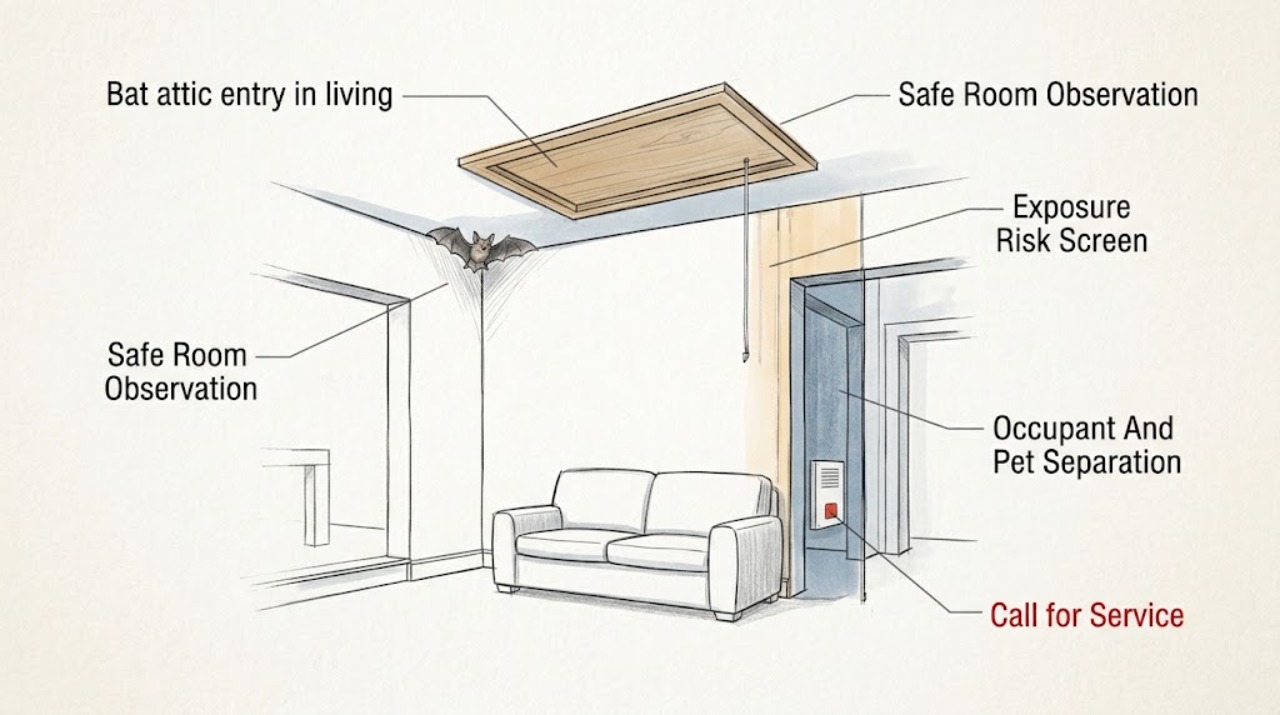
Treat a bat that has entered a living space as a safety and public-health issue, not a do-it-yourself capture or sealing job. From a safe position, keep people and pets away, note whether anyone was asleep, unattended, very young, or unable to rule out contact, and contact your local or state health department promptly for rabies-risk guidance. Contact animal control or a qualified wildlife professional for safe removal and attic exclusion. Do not touch, chase, poison, trap, clean droppings, enter the attic, or seal an opening while a bat may still be inside.
Work through in order
Diagnostic checks
Use only checks that match the exact appliance or system and its official guide.
-
Check 1
From a safe doorway or another position that does not require approaching the bat, note whether it is currently visible and which living-space room it occupies.
Expected result: Record whether it is flying, resting, grounded, unusually easy to approach, or no longer visible; do not pursue it or move furniture to find it.
Next step: Keep the room closed off from a safe side, move people and pets away, and contact local animal control, the health department, or a qualified wildlife professional for instructions.
Stop if: Stop observing immediately if the bat flies toward you, anyone is cornered, a person or pet may have touched it, or you would need to enter the room to continue.
Why this matters
Why: A bat inside the home requires controlled separation and professional or public-health guidance even when it appears calm; a grounded or easily approached bat warrants extra distance.
-
Check 2
Make a private list of everyone and every pet who could have been in the affected room, using only known circumstances and without inspecting the bat or its droppings.
Expected result: Mark whether anyone was asleep, a young child was unattended, someone was intoxicated or otherwise unable to notice contact, or there was any possible bite, scratch, saliva, or mucous-membrane contact.
Next step: Contact the local or state health department or a medical professional promptly and report the circumstances, especially for a sleeping person, child, or anyone unable to exclude contact.
Stop if: Stop all wildlife troubleshooting and seek urgent medical or public-health direction if contact, a bite, a scratch, saliva to an eye/mouth/open wound, or an uncertain sleeping-room exposure is possible.
Why this matters
Why: Direct contact or an exposure that cannot be confidently ruled out needs prompt rabies-risk assessment; the absence of a visible mark does not by itself rule out exposure.
-
Check 3
From a safe location, confirm that children, sleeping occupants, vulnerable people, and pets are outside the affected area without trying to move the animal.
Expected result: Note whether anyone cannot be accounted for, whether a pet may have interacted with the bat, and whether the affected room can remain closed without blocking an emergency exit.
Next step: Keep the area isolated, contact the appropriate health, animal-control, veterinary, or emergency service, and tell responders who may have been exposed.
Stop if: Stop and call emergency services if someone is trapped, injured, having a medical emergency, or cannot be safely separated from the animal.
Why this matters
Why: Unaccounted-for or vulnerable occupants increase the urgency of public-health advice; a pet encounter also needs veterinary guidance and should not be handled as ordinary pest control.
-
Check 4
From the living-space side only, look without touching for visible gaps at an attic hatch, ceiling joint, vent grille, or other opening where the bat may have appeared.
Expected result: Record the room and opening, visible daylight, staining, unusual sounds, or repeated sightings; do not open the hatch, reach into a gap, climb, or seal anything.
Next step: Photograph the area from a safe distance and give the location to the wildlife professional; leave any exclusion or repair work to them.
Stop if: Stop if disturbing the opening releases dust, droppings, an animal, loose material, or a fall hazard, or if further viewing would require attic entry.
Why this matters
Why: The observation can help a wildlife professional trace an attic-to-room route, but it cannot establish the colony location or prove that all bats have left.
-
Check 5
Without entering the attic or disturbing any material, note from a safe distance whether droppings, stains, odor, or dust are visible around the living-space opening.
Expected result: Record location and extent only; do not sweep, vacuum, spray, collect, sample, or touch the material.
Next step: Keep people and pets away, tell the wildlife or environmental professional what was seen, and ask whether specialized cleanup assessment is needed.
Stop if: Stop and isolate the area if anyone develops breathing or eye irritation, if dust becomes airborne, or if the material is widespread or near occupied sleeping space.
Why this matters
Why: Accumulation or airborne dust concerns should be evaluated by a qualified professional because disturbing bat roost material can create an inhalation hazard and may spread contamination.
Use your observations
Decision map
Find the observation that best matches what you see, then follow the next safe action.
-
PATH 01Safety boundary
What you see
Someone had direct contact, a bite or scratch is possible, saliva may have reached broken skin or a mucous membrane, or a bat was present with a sleeping person, unattended child, or someone unable to rule out contact.
Do this next
Keep the bat and room undisturbed, contact the local or state health department and a medical professional promptly for a rabies-risk assessment, and report the circumstances exactly.
Why this path and its safety boundary
Safety stop: Do not handle, release, or attempt to capture the bat or continue home troubleshooting.
-
PATH 02Safety boundary
What you see
The bat is visible, everyone was awake and able to observe the situation, and no contact is known.
Do this next
Keep people and pets out of the room and call animal control, the health department, or a qualified wildlife professional for safe removal instructions.
Why this path and its safety boundary
Safety stop: Do not approach, corner, chase, or use chemicals or improvised capture methods.
-
PATH 03Safety boundary
What you see
The bat is no longer visible or may have moved between the living space and attic.
Do this next
Keep the area isolated, document the last known location, and arrange professional wildlife assessment; do not assume that absence from view means the home is clear.
Why this path and its safety boundary
Safety stop: Do not reopen the room for sleeping or seal suspected openings until exposure and exclusion advice has been obtained.
-
PATH 04Safety boundary
What you see
Droppings, dust, strong odor, or widespread roost evidence is visible.
Do this next
Restrict access and ask a qualified wildlife or environmental professional about safe assessment and cleanup; keep the material undisturbed.
Why this path and its safety boundary
Safety stop: Do not sweep, vacuum, spray, sample, or perform DIY remediation.
-
PATH 05Safety boundary
What you see
No route is visible or the route appears to involve a ceiling, attic, vent, or concealed opening.
Do this next
Provide the room and sighting history to a qualified wildlife professional and let them determine exclusion timing and method without occupant attic access.
Why this path and its safety boundary
Safety stop: Do not open concealed areas, climb, or seal a suspected entry while bats may remain inside.
Helpful context
Understand the symptom
Why the first decision is exposure, not entry-point repair
A bat in a bedroom or other occupied area can create an exposure that a person may not notice. CDC guidance says bat bites can be tiny and recommends prompt medical or public-health assessment when contact may have occurred. This is especially important when a person was sleeping, a child was unattended, or anyone cannot reliably say that contact did not happen. Do not wait for a visible bite before asking the health department what to do.
Keep the scene undisturbed
Close off the affected room from a safe side if you can do so without approaching the animal, keep children and pets away, and do not disturb the bat, droppings, nesting material, ceiling surfaces, or attic access. CDC/NIOSH guidance identifies bat droppings as a potential dust and contamination concern. A qualified professional can coordinate safe removal, exclusion, and any cleanup assessment.
What to give the responders
Record the room, time, number of bats seen, whether the bat was flying or grounded, who was present, whether anyone was asleep or unattended, and any visible route from the attic or ceiling. Use only photographs taken from a safe distance. Do not use chemicals, ultrasonic devices, improvised barriers, or sealing materials as a substitute for professional assessment.
When checks do not resolve it
Need a professional?
Contact the local or state health department promptly for any possible bat exposure, especially a sleeping-room, child, pet, or uncertain-contact situation. Contact animal control or a qualified wildlife professional for the live bat, attic entry, exclusion, and any droppings assessment. Use emergency services for injury, a trapped person, or an immediate medical emergency.
Have this ready
- Share the room and time, last known bat location, number of bats, whether it was flying or grounded, who was present or asleep, possible human or pet contact, and safe photographs of openings or visible material.
Common questions
FAQ
What should I do first if a bat is in a living room or bedroom?
From a safe position, keep people and pets away, close off the area if you can do so without approaching the bat, and contact animal control, the health department, or a qualified wildlife professional. Do not touch or chase it.
Do I need rabies advice if nobody saw a bite?
Ask the health department or a medical professional promptly when contact cannot be confidently ruled out. Bites can be tiny, and a sleeping person, unattended child, or someone unable to notice contact needs particular attention.
Can I seal the attic opening after the bat leaves the living space?
Do not seal or enter the attic based only on one sighting. A qualified wildlife professional should assess whether bats remain, whether young bats could be present, and how to exclude them without trapping animals inside.
Can I clean bat droppings myself?
Do not sweep, vacuum, spray, sample, or otherwise disturb droppings or dusty roost material. Restrict access and ask a qualified wildlife or environmental professional about safe assessment and cleanup.
Read the exact guide
Official sources
- Preventing Rabies from BatsCenters for Disease Control and Prevention · Supports the article's no-contact boundary, prompt health-department escalation, and professional exclusion guidance for a bat in a home.
- Clinical Overview of RabiesCenters for Disease Control and Prevention · Supports escalation when direct contact cannot be ruled out, including sleeping-room or vulnerable-person circumstances; it is not a diagnosis for any individual.
- Elimination and Engineering ControlsNational Institute for Occupational Safety and Health, CDC · Supports leaving bat roost material undisturbed and obtaining professional assessment rather than attempting household cleanup.
Community feedback
Share a repair observation
Share a plain-text repair observation. Accepted observations are published automatically; this page may take a moment to update.