
On this page
Start here
Quick answer
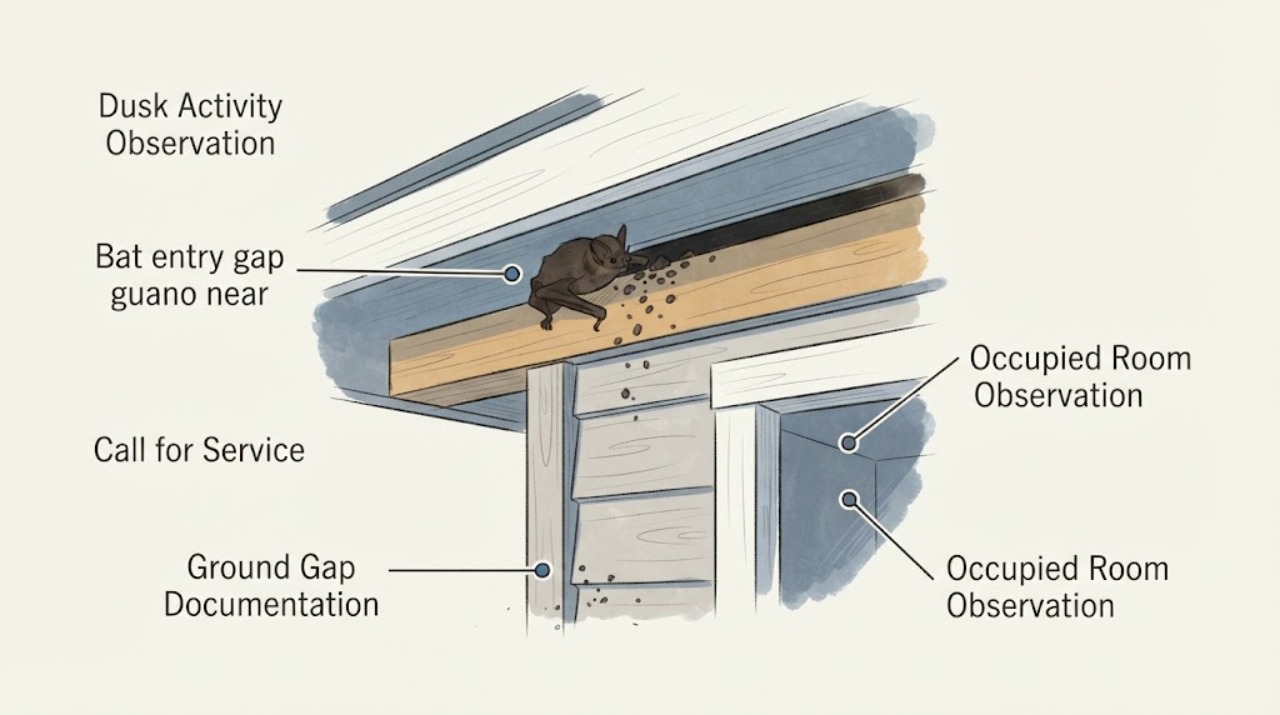
Guano near a gap is evidence that bats may be using an entry route, but it does not tell you whether the opening is active, how many bats are inside, or whether young are present. From the ground and ordinary occupied rooms, document the gap, droppings, sounds, and dusk activity without entering an attic, touching guano or bats, climbing, trapping, or sealing the opening. Keep people and pets away, then contact a qualified wildlife-removal or bat-exclusion professional to identify the species and occupancy, plan lawful exclusion, and handle guano cleanup safely.
Work through in order
Diagnostic checks
Use only checks that match the exact appliance or system and its official guide.
-
Check 1
From a stable ground-level location, photograph the exterior gap and the area below it without climbing, touching the structure, disturbing droppings, or directing a tool or spray into the opening.
Expected result: Record the gap's general location, visible staining or guano, whether droppings look fresh or weathered, and whether there are additional openings nearby at the roofline, soffit, vent, chimney, or wall.
Next step: Keep the images and date for a wildlife-removal professional. Do not apply caulk, foam, mesh, netting, or other closure material while activity is possible.
Stop if: Stop if viewing requires a ladder, roof access, moving a cover, or contact with dry guano, a bat, or an unstable surface.
Why this matters
Why: A concentrated trail or fresh-looking deposit supports repeated traffic, but the photo cannot establish occupancy, species, or whether a maternity colony is present. Multiple openings mean a professional should survey the whole exterior rather than patch one visible spot.
-
Check 2
From a safe position on the ground and away from the gap, observe the exterior around dusk only if this can be done without entering the attic or approaching the animals.
Expected result: Note whether bats emerge, enter, circle and return, or show no visible activity; record the approximate date, time window, weather, and the location used, without shining lights into the opening or trying to count at close range.
Next step: Send the observation to the wildlife professional and keep the area quiet and undisturbed. Let the professional determine whether exclusion is lawful and seasonally appropriate.
Stop if: Do not wait at the opening, block an exit, use repellents, deploy netting, or attempt to capture a bat.
Why this matters
Why: Repeated emergence or return strongly supports an active route, while no sighting does not prove the gap is unused because bats may exit elsewhere or activity may vary. An active route must be assessed before any closure.
-
Check 3
From normal occupied rooms, observe ceilings, wall edges, vents, and access doors for visible staining, droppings, scratching, squeaking, or a bat appearing inside; do not open an attic hatch or enter a crawl space.
Expected result: Classify the situation as exterior-only evidence, sounds or staining in an occupied room, a live bat inside, or a dead bat or accumulated material visible from a normal position.
Next step: Close the room to people and pets where practical and contact wildlife removal or local animal-control/public-health authorities. Do not handle the bat or sweep the material.
Stop if: Leave the area if a bat is flying close to people, if droppings are dusty or disturbed, or if anyone may have had direct contact.
Why this matters
Why: A bat inside a living area or evidence of a larger colony requires prompt professional and public-health guidance. A dead or grounded bat can still present contact concerns, and guano accumulation can create an inhalation hazard when disturbed.
-
Check 4
Ask household members whether anyone touched a bat, was scratched or bitten, woke in a room with a bat, or disturbed droppings, and record the event without attempting to recreate or inspect it physically.
Expected result: Record no known contact, possible contact that cannot be ruled out, a bite/scratch/saliva contact, or dust exposure while cleaning, sweeping, remodeling, or entering the roost area.
Next step: For possible bat contact, contact a healthcare professional and local health department promptly. For guano dust exposure or respiratory symptoms, tell the clinician about the exposure and avoid further disturbance while arranging professional assessment.
Stop if: Do not touch the bat, carcass, guano, contaminated clothing, or dusty surfaces while trying to determine what happened.
Why this matters
Why: Possible bat contact is a health decision, not a home-repair diagnosis; bat bites can be tiny and may go unnoticed. Disturbing guano can also increase inhalation exposure risk, especially for people at higher risk of severe histoplasmosis.
-
Check 5
When contacting a qualified bat-exclusion or wildlife-removal provider, provide dated gap photos, any dusk activity, room observations, the building access type, and any direct-contact or guano-disturbance history.
Expected result: A suitable provider should explain how they will confirm activity, identify all likely entry points, account for seasonal and local wildlife protections, exclude bats without trapping a colony, and assess guano cleanup separately.
Next step: Keep the opening and guano undisturbed until the provider gives a safe plan. Follow health-department or animal-control guidance for any bat contact and schedule remediation after exclusion is confirmed appropriate.
Stop if: Do not accept a plan that begins with immediate closure, attic entry, trapping, or dry cleanup without confirming occupancy, timing, and safety controls.
Why this matters
Why: A professional scope prevents sealing an active route, leaving another gap open, separating young, or exposing occupants to contaminated dust. It also keeps species handling and disposal within trained and lawful procedures.
Use your observations
Decision map
Find the observation that best matches what you see, then follow the next safe action.
-
PATH 01Next step
What you see
A bat is seen exiting or returning to the gap, or fresh activity is repeatedly observed at dusk.
Do this next
Leave the opening undisturbed and request qualified bat-exclusion service to assess occupancy and lawful timing before any closure.
-
PATH 02Next step
What you see
A colony, young bats, or seasonal maternity activity is possible or cannot be ruled out.
Do this next
Do not seal, trap, or otherwise exclude the opening; ask a wildlife professional and local authorities for a species- and season-appropriate plan.
-
PATH 03Next step
What you see
A live or dead bat is inside an occupied room, or anyone may have touched or been exposed to one.
Do this next
Keep people and pets away, avoid handling, and contact animal control/public health and a healthcare professional as appropriate.
-
PATH 04Next step
What you see
Droppings are extensive, dusty, inside an attic/crawl space, or were disturbed during cleaning or renovation.
Do this next
Stop disturbance and request a specialized professional cleanup and exposure assessment; do not sweep, vacuum, or enter the roost area.
Helpful context
Understand the symptom
What guano near a gap tells you
Fresh-looking droppings, staining, or an odor below a crack, soffit, vent, chimney, or roofline can indicate repeated animal traffic, but old guano may remain after activity has stopped. A gap that looks small can still be usable by a bat, and the visible opening may not be the only route. Treat the location as a wildlife and contamination observation, not a caulking project.
Why you should not disturb it
CDC advises avoiding activities that disturb bird or bat droppings because inhaled dust can increase histoplasmosis risk, and says large accumulations should be handled by specialized professionals. CDC also says to avoid touching bats and to seek medical advice after possible contact. Do not sweep, vacuum, dry-scrape, hose, handle, trap, or relocate anything at the gap or in an attic.
Exclusion is a professional timing decision
Sealing an active entrance can trap bats inside or separate young from a maternity colony. National Park Service guidance notes that bat colonies and seasonal protections affect when exclusion is appropriate. The right next step is a wildlife professional who can confirm activity, account for local conservation rules and timing, install an approved one-way exclusion when suitable, and complete contamination cleanup with the correct controls.
Common questions
FAQ
Does guano near a gap prove bats are still inside?
No. It indicates possible repeated animal traffic, but droppings can remain after activity stops and the visible gap may not be the active route. Document it from the ground and have a qualified wildlife professional confirm occupancy and all likely entry points.
Can I seal the gap as soon as I find guano?
No. Sealing an active entrance can trap bats or separate young from a colony. Do not caulk, foam, net, or block the opening until a professional confirms activity, timing, local protections, and an appropriate exclusion plan.
Can I clean a small amount of bat guano myself?
Do not disturb it as a first step. CDC warns that disturbing bat droppings can increase histoplasmosis exposure risk, and dry sweeping or vacuuming can spread dust. Keep the area isolated and ask a qualified remediation provider what controls are needed.
What if I see a bat inside the home?
Keep people and pets away and do not touch or chase it. Contact local animal control or public health for safe guidance. If anyone may have been bitten, scratched, touched, or exposed to saliva, contact a healthcare professional and health department promptly.
What should I tell the bat-exclusion professional?
Provide dated ground-level photos, the gap location, dusk activity or sounds, interior observations, whether there is an attic or crawl space, any guano disturbance, and any possible human or pet contact. Ask how they will confirm occupancy, avoid trapping a colony, comply with local protections, and handle cleanup.
Read the exact guide
Official sources
- Preventing Rabies from BatsCenters for Disease Control and Prevention · Bat contact avoidance, possible exposure, public-health response, and bat-proofing context
- Preventing Histoplasma Exposures at WorkNational Institute for Occupational Safety and Health, CDC · Professional controls and specialized cleanup for bat or bird droppings
- Reducing Risk for HistoplasmosisCenters for Disease Control and Prevention · Health risks from disturbing bat or bird droppings and professional cleanup
- Responding to Bats in BuildingsNational Park Service · Bat-in-building response, colony assessment, exclusion timing, and maternity-colony precautions
Community feedback
Share a repair observation
Share a plain-text repair observation. Accepted observations are published automatically; this page may take a moment to update.