
On this page
Start here
Quick answer
Do not seal a suspected bat entry gap while bats may still be inside, and do not handle a bat or climb onto a roof to investigate. From the ground, note where bats appear at dusk, whether the opening leads toward an occupied room, and whether there are droppings, staining, or repeated exits. The safe fix is a site-specific inspection and humane exclusion plan by a qualified wildlife-removal professional. Timing depends on local species, maternity activity, weather, and wildlife rules; a professional or state wildlife authority should confirm when and how exclusion may occur.
Work through in order
Diagnostic checks
Use only checks that match the exact appliance or system and its official guide.
-
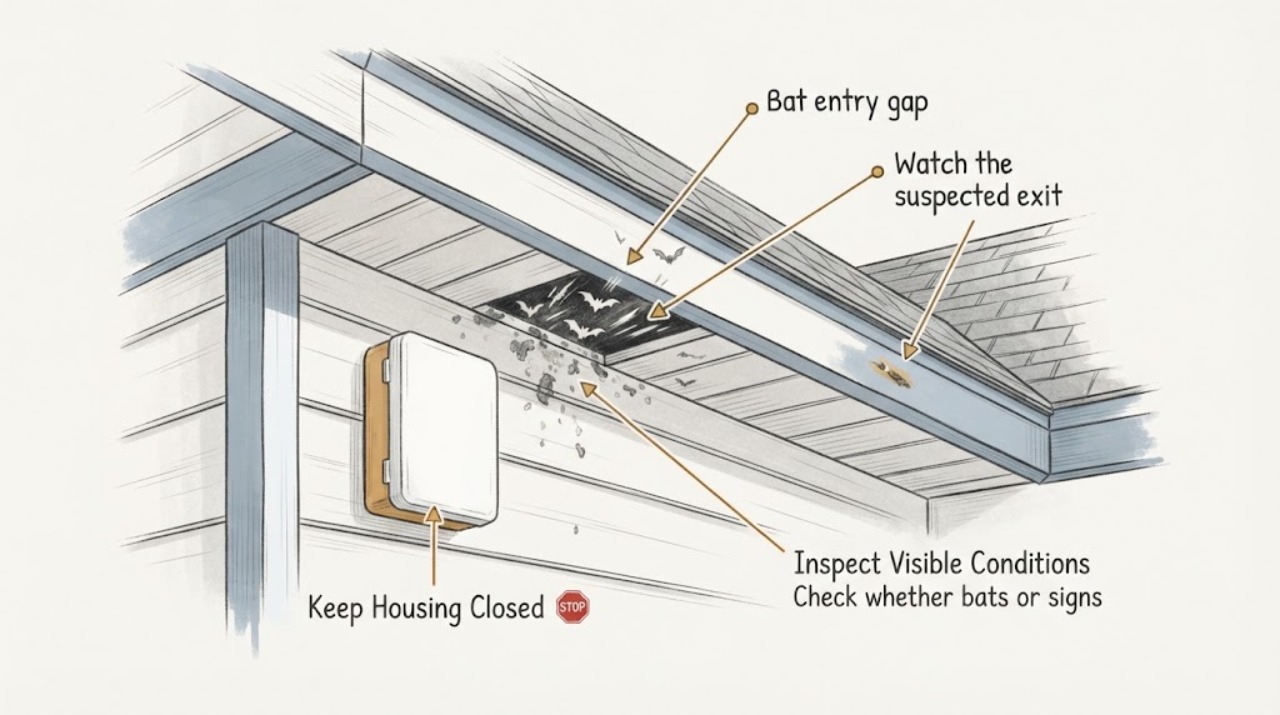
Watch the suspected exit from a safe distance
From the ground at dusk, identify where bats emerge or return without standing under the roof edge.
Expected result: One opening, several openings, or no visible activity is observed.
Next step: Share the location with a qualified wildlife-removal professional; do not block the opening.
Stop if: Stop if roof access, crawlspace entry, or approaching a bat would be required.
Why this matters
Why: The result suggests a likely entry area but cannot prove that other gaps are absent.
-
Look for safe ground-level signs of an opening
Inspect only visible roof edges and wall penetrations from a stable ground position, using zoom rather than reaching or probing.
Expected result: A gap, rubbed edge, staining, or droppings is visible, or no clear sign is visible.
Next step: Give the location to a wildlife-removal professional for a whole-structure inspection; do not seal it first.
Stop if: Stop before climbing, ladder use, roof work, or attic entry.
Why this matters
Why: A trace supports an entry hypothesis but may be old; no visible sign does not rule out a hidden gap.
-
Check whether bats or signs are reaching occupied space
Ask whether a bat entered occupied space or whether a person or pet may have contacted it, without handling the animal.
Expected result: Yes or uncertain, or no such event is known.
Next step: For yes or uncertain, contact local public-health or animal-control authorities promptly; for no, arrange qualified wildlife-removal service.
Stop if: Stop if the bat is nearby, grounded, injured, or unusually approachable.
Why this matters
Why: Yes or uncertain requires public-health or animal-control guidance in addition to gap repair; no known event leaves the focus on safe exterior assessment.
-
Ask about season, colony size, and local restrictions
Record the season, duration of activity, apparent number of bats, and any sign of a maternity colony without entering the roost.
Expected result: Colony or seasonal activity is possible, or timing and colony status are unknown.
Next step: Have a professional and, when needed, the state wildlife authority confirm the humane method and timing before any gap is closed.
Stop if: Do not close the gap or handle wildlife based only on a guessed date.
Why this matters
Why: The correct exclusion timing and method depend on local species, season, and rules; a calendar guess can trap animals or violate protections.
Helpful context
Understand the symptom
Keep people and bats separated
Keep children and pets away from the attic, roof edge, vents, and any room where a bat has appeared. Do not touch, catch, smoke out, poison, or move a bat, and do not enter an attic or crawlspace just to find the opening. If a bat is inside living space or there may have been contact with a person or pet, close off the area without cornering the bat and contact local public health or animal-control authorities for handling and exposure advice.
What a professional should evaluate
A qualified wildlife-removal professional should map all exterior entry points, determine whether bats remain inside, identify any colony or protected-species concern, and coordinate humane exclusion timing before sealing the opening. After exclusion is confirmed, the building may need repairs to multiple gaps rather than one visible hole. Ask what must remain open, how re-entry will be prevented, and how droppings or contaminated materials will be handled safely.
When checks do not resolve it
Need a professional?
Call promptly when bats are entering an attic or occupied room, activity repeats at a roof gap, droppings or staining are present, a colony may be involved, or the opening is inaccessible from the ground.
Common questions
FAQ
Can I seal the visible bat entry gap right away?
Not if bats may still be inside. A professional should identify all entry points, confirm the animals can exit safely, account for maternity activity and local rules, and then complete exclusion and sealing.
What if I only see one bat?
One visible bat does not prove there is no colony or another opening. Record where it emerged or entered from a safe distance and have the structure inspected.
What should I do if a bat enters a bedroom or living room?
Keep people and pets away, do not touch or chase it, and contact local public-health or animal-control authorities for safe handling and exposure advice, especially if anyone or any pet may have had contact.
Does bat exclusion happen in the same season everywhere?
No. Species, maternity activity, weather, and local protections vary. Ask a qualified wildlife professional or state wildlife authority to confirm the method and timing for your location.
Read the exact guide
Official sources
- Preventing Rabies from BatsCenters for Disease Control and Prevention · When bats may enter a home, an occupied room, or an opening in a structure
- How (and whether) to install bat boxesU.S. Fish and Wildlife Service · When a building gap may be used by a colony or maternity roost
Community feedback
Share a repair observation
Share a plain-text repair observation. Accepted observations are published automatically; this page may take a moment to update.