
On this page
Start here
Quick answer
Do not enter the attic, handle a bat, set a trap, poison wildlife, or close an opening yourself. Keep people and pets away from the attic access and any room where a bat appears. From the ground, note where bats emerge at dusk, whether activity is occasional or repeated, and whether anyone or any pet may have had contact with a bat. A qualified wildlife-removal professional should inspect and plan humane exclusion; timing and legal protections vary by species and location, especially when a maternity colony may be present. Contact public health or animal-control authorities promptly for any possible rabies exposure.
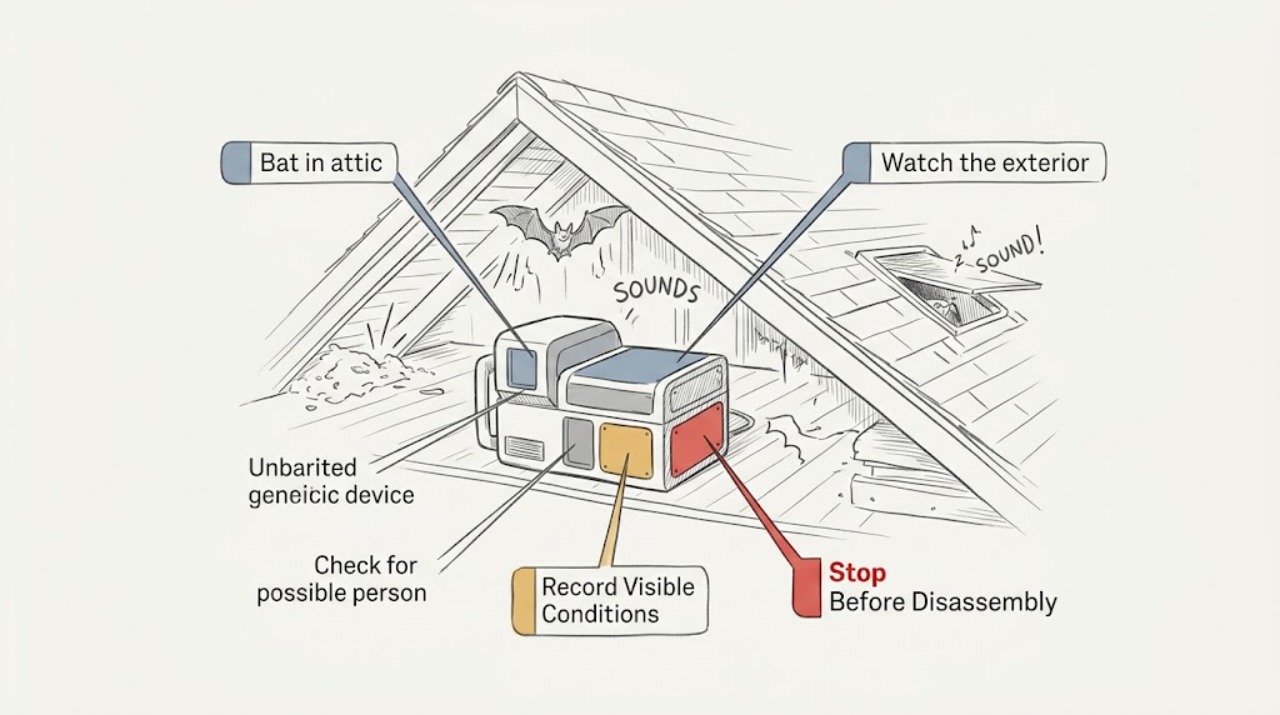
Work through in order
Diagnostic checks
Use only checks that match the exact appliance or system and its official guide.
-
Watch the exterior from the ground
From a clear ground position at dusk, watch the roofline, eaves, vents, and other visible exterior areas without standing under the roof edge or approaching a bat. Note the location and direction of any bat that leaves or returns.
Expected result: Bats repeatedly emerge from one point, several points appear active, or no activity is visible during the observation period.
Next step: Give the observations to a qualified wildlife-removal professional. Do not cover, seal, or alter the opening based on a single observation.
Stop if: Stop if a closer view would require roof access, ladder use, attic entry, or approaching a bat.
Why this matters
Why: A repeated exit can identify a likely entry area, but no activity does not prove the attic is empty or that other openings are absent.
-
Record signs without entering the attic
From occupied rooms or other safe areas, note scratching or fluttering sounds, stains, droppings, odor, or a bat appearing through a ceiling fixture, vent, or interior opening. Do not open the attic hatch, lift insulation, touch droppings, or probe a ceiling or wall.
Expected result: Signs are recurring, concentrated near one room or fixture, widespread, or absent from areas that can be observed safely.
Next step: Keep the area separated and tell the professional exactly where and when signs occur. Ask about safe assessment and cleanup; do not investigate inside the attic yourself.
Stop if: Stop if the next step would require attic entry, disturbing insulation, touching droppings, or opening a ceiling or wall.
Why this matters
Why: Recurring signs support wildlife activity but cannot show how many bats are present or whether contamination is safe to clean. No visible sign does not rule out a hidden roost.
-
Check for possible person or pet contact
Ask occupants what happened without handling the bat or searching for it. Include an uncertain overnight bedroom exposure, a bat found on the floor, or a bat that was unusually easy to approach.
Expected result: Yes or uncertain contact/exposure is possible; or no person or pet contact is known.
Next step: For yes or uncertain, contact local public-health authorities promptly and ask about medical care, pet care, and safe handling/testing. For no known exposure, continue only with distant observation and wildlife-service scheduling.
Stop if: Stop all wildlife observation if a bat is nearby, grounded, injured, active in daylight, or unusually approachable; do not touch or capture it.
Why this matters
Why: Possible exposure is a public-health question separate from attic repair. CDC advises avoiding contact and contacting a health department after possible exposure because bat bites can be tiny and unnoticed.
-
Record timing without guessing the legal window
Record the current season, how long activity has been present, whether exits suggest one bat or a group, and any sign of young bats only when visible from a safe distance. Do not infer an exclusion date from a calendar or begin exclusion work.
Expected result: Warm-season group activity or possible maternity use is suspected, winter or migration timing is suspected, or season and colony status are unknown.
Next step: Tell the professional and, when needed, the state wildlife authority what was observed. Wait for a locally appropriate humane plan before any exclusion or building repair.
Stop if: Stop if anyone proposes sealing, trapping, poisoning, or excluding bats based only on a guessed season or an unverified rule.
Why this matters
Why: Maternity timing, species, weather, and local protections can change whether and how exclusion is allowed. U.S. Fish and Wildlife Service guidance points to local laws and a state bat biologist for timing or method decisions.
Use your observations
Decision map
Find the observation that best matches what you see, then follow the next safe action.
-
PATH 01Next step
What you see
A person or pet may have contacted a bat, or a bat was in an occupied sleeping room.
Do this next
Contact local public-health or animal-control authorities promptly for exposure, medical, pet, and safe-handling guidance; do not release or handle the bat based on guesswork.
-
PATH 02Next step
What you see
The only way to inspect a suspected sign or opening is through the attic, a roof, or a ladder.
Do this next
Do not enter or climb; provide the location and safe-distance observations to a qualified professional.
-
PATH 03Next step
What you see
A group, young bats, repeated seasonal activity, or a protected species is possible.
Do this next
Have the professional and appropriate state wildlife authority confirm the lawful humane timing and method before exclusion.
-
PATH 04Next step
What you see
The bat is grounded, injured, active in daylight, unusually approachable, or repeatedly entering living space.
Do this next
Keep everyone away and contact public health, animal control, or a qualified wildlife professional for immediate guidance.
Helpful context
Understand the symptom
Keep the attic and bat off limits
Close or restrict attic access without entering the space, and keep children and pets away. Do not poke into insulation, move boxes, disturb a roost, use fumes or poison, or try to catch a bat. If a bat enters an occupied room, keep people and pets out of that room and contact local public-health or animal-control authorities for safe handling and exposure guidance.
What the professional needs
Share the date and time of sightings or sounds, safe-distance photos of suspected exterior openings, the number of bats seen, where activity is heard, any stains or droppings visible from living areas, and any contact with people or pets. Ask the professional to identify all entry points, determine whether bats remain inside, check for a colony, and explain the locally appropriate humane timing before any exclusion or building repair.
When checks do not resolve it
Need a professional?
Call promptly for repeated attic activity, bats entering living space, droppings or odors, an inaccessible entry point, possible maternity activity, or any person or pet exposure. Contact public health or animal control first for possible rabies exposure.
Common questions
FAQ
Can I go into the attic to find the bat?
No. Keep the attic and roost area off limits and have a qualified wildlife professional inspect it. Ground-level exterior observations are enough for the homeowner to report.
Should I seal the opening right away?
No. Do not close or alter a suspected entry point until a professional confirms the humane, lawful timing and that bats or young are not trapped inside.
What if I am not sure whether anyone was exposed?
Treat uncertainty seriously and contact local public-health authorities promptly. Bat bites can be tiny, and an overnight room exposure may need professional risk assessment.
Does the time of year matter?
Yes. Species, maternity activity, weather, and local protections vary. Ask a qualified wildlife professional and, when needed, the state wildlife authority to confirm the timing and method before exclusion.
Read the exact guide
Official sources
- Preventing Rabies from BatsCenters for Disease Control and Prevention · Bat activity in a home or attic and any possible person or pet exposure
- How (and whether) to install bat boxesU.S. Fish and Wildlife Service · Attic roosts and possible colony or maternity use
Community feedback
Share a repair observation
Share a plain-text repair observation. Accepted observations are published automatically; this page may take a moment to update.