
On this page
Start here
Quick answer
Keep people and pets away from the bat and do not touch, capture, release, feed, or corner it. From a safe distance, note where it is and whether anyone may have had direct contact, was asleep in the room, or is a child or otherwise unable to report contact. Contact local animal control or the health department for instructions, and contact a healthcare professional promptly for any possible exposure because bat bites can be tiny. Use a qualified wildlife professional for the bat and any entry assessment; do not attempt DIY exclusion or seal openings while a bat may remain inside.
Work through in order
Diagnostic checks
Use only checks that match the exact appliance or system and its official guide.
-
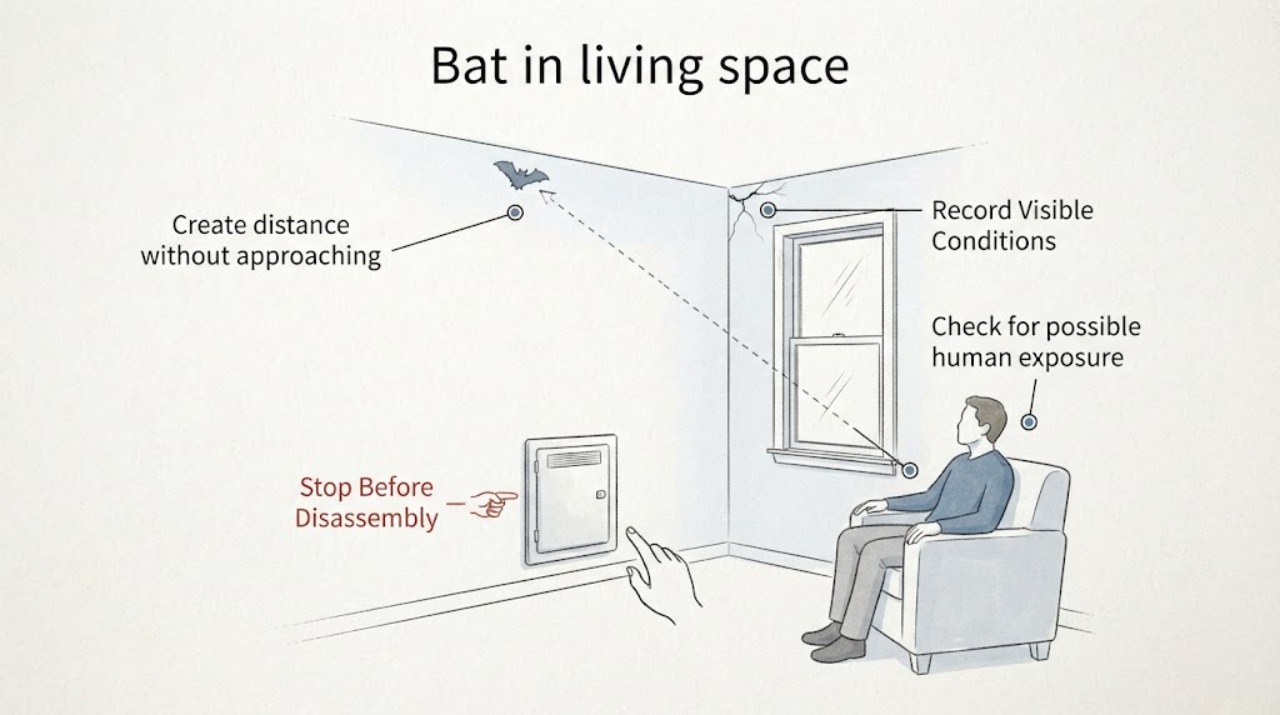
Create distance without approaching the bat
From a safe position, move people and pets away from the room or area using a route that does not pass near the bat; if a door can be closed without approaching or trapping anyone, keep the area separated and do not enter again.
Expected result: The bat may be visible and moving, resting in an elevated location, on the floor, or no longer visible while still possibly inside.
Next step: Keep people and pets out, avoid noise and movement near the area, and contact animal control or the health department for instructions. Do not try to make the bat move.
Stop if: Stop immediately if isolating the area would require approaching, touching, cornering, chasing, or passing close to the bat.
Why this matters
Why: Distance reduces the chance of an unrecognized bite, scratch, or contact. Losing sight of the bat does not establish that it has left, and a grounded or easily approachable bat needs professional/public-health guidance rather than a closer inspection.
-
Record only what can be seen from a safe distance
Without entering the bat's space or using tools, note the room or area, whether the bat is flying, resting, grounded, injured-looking, active in daylight, or no longer visible, and the time it was noticed.
Expected result: It may behave normally and remain airborne, appear unable to fly or unusually approachable, be found on the ground, or disappear from view.
Next step: Give the location and observations to the responding professional. Do not take a closer photo, touch the bat, move furniture around it, or attempt capture or release.
Stop if: Stop observing if the bat moves toward people or pets, becomes active near you, or the only view would require entering or handling the area.
Why this matters
Why: Unusual behavior or a bat found inside a home or on the ground increases the need for animal-control or public-health guidance, but behavior cannot be used to declare a bat safe.
-
Check for possible human exposure without handling the bat
Ask whether anyone was bitten, scratched, touched the bat, had bat saliva or tissue contact with eyes, mouth, or an open wound, or was asleep, unattended, very young, or otherwise unable to reliably notice contact while in the room.
Expected result: There may be a known bite or scratch, possible unnoticed contact, no known contact with everyone able to report, or uncertainty about who was present.
Next step: For a bite or scratch, wash the wound with soap and water and seek medical care right away. For any possible contact or uncertainty, contact the local or state health department promptly and follow its instructions; do not wait for a removal appointment.
Stop if: Stop all wildlife troubleshooting once possible exposure is identified; do not touch or preserve the bat yourself unless public-health authorities give specific instructions.
Why this matters
Why: Known or possible direct contact requires prompt medical and public-health risk assessment; waking with a bat in the room can be important even when no mark is found. A lack of a visible mark does not by itself rule out exposure.
-
Record pet and entry context for professionals
From outside the isolated area, note whether a pet may have had access, whether the bat was seen entering from an opening, and whether there are visible gaps or damage that a professional can assess later; do not handle the pet's mouth or attempt to inspect hidden spaces.
Expected result: There may be no pet access, possible pet contact, a visible entry route, or an unknown route.
Next step: Keep pets away and contact a veterinarian if contact is possible; provide the location and entry observations to animal control or a qualified wildlife service. Do not attempt exclusion, attic entry, capture, or release.
Stop if: Stop if inspecting the route would require climbing, entering an attic or crawlspace, disturbing a roost, moving the bat, or handling an exposed pet.
Why this matters
Why: Possible animal contact should be reported to a veterinarian or local public-health authority, while an entry observation helps a qualified wildlife professional plan an assessment. A visible gap does not justify sealing it while a bat may be inside.
Use your observations
Decision map
Find the observation that best matches what you see, then follow the next safe action.
-
PATH 01Next step
What you see
A bite, scratch, touch, saliva/tissue contact, a bat in a room with a sleeping or unattended person, or uncertainty about unnoticed contact is possible.
Do this next
Wash any known wound with soap and water and contact a healthcare professional and local or state health department promptly for a rabies risk assessment. Do not wait for wildlife removal.
-
PATH 02Next step
What you see
A pet may have touched or been touched by the bat.
Do this next
Keep the pet separated without handling the bat or putting hands near the pet's mouth, and contact a veterinarian and public-health authority for exposure guidance.
-
PATH 03Next step
What you see
Everyone can reliably rule out contact, the bat is isolated from people and pets, and no urgent injury or fire hazard is present.
Do this next
Maintain distance and contact animal control or a qualified wildlife professional for safe next steps. Do not capture, release, or attempt exclusion.
-
PATH 04Next step
What you see
The bat is grounded, unable to fly, active in daylight, unusually approachable, injured-looking, or repeatedly appears in the living space.
Do this next
Keep everyone away and request animal-control or public-health guidance urgently; do not interpret unusual behavior as permission to handle it.
-
PATH 05Next step
What you see
A person is injured, the bat cannot be safely isolated, or the situation creates an immediate danger while people try to leave.
Do this next
Move away without approaching the bat and use appropriate emergency services for the immediate danger, then report possible exposure to public health.
Helpful context
Understand the symptom
Treat the bat as a no-contact situation
A bat's appearance does not reliably show whether it carries rabies, and a bite or scratch may be difficult to notice. The safe first step is distance and separation, not a closer look. Move people and pets away using a route that does not pass the bat, and keep the area quiet and undisturbed while professional or public-health guidance is obtained.
Separate exposure decisions from removal
Health officials assess possible rabies exposure, while animal control or a qualified wildlife professional handles the animal and advises on entry conditions. Do not wait for removal before reporting possible contact. If the bat is in a room with a sleeping person, unattended child, or anyone who cannot reliably rule out contact, treat that as an urgent health-assessment question.
Do not start exclusion yourself
A bat may be part of a larger roost or may have entered through a small opening. Sealing, netting, attic entry, or other exclusion work can trap animals or create unsafe contact and may be subject to local rules. Leave entry assessment and exclusion timing to a qualified professional after the immediate incident and exposure review.
When checks do not resolve it
Need a professional?
Call urgently whenever there may have been a bite, scratch, touch, saliva or tissue contact, a bat in a room with a sleeping or unattended person, possible pet contact, or a grounded/unusually approachable bat. Call promptly for any bat inside living space even when no exposure is known so it can be handled safely.
Common questions
FAQ
What should I do if a bat is flying inside my home?
Keep people and pets away without approaching or cornering the bat, isolate the area if it can be done safely, and contact animal control or the health department. Do not capture or release it yourself.
Do I need medical advice if I do not see a bite?
If there was direct contact, a bat was in a room with someone sleeping or unable to report contact, or you are uncertain, contact a healthcare professional and the health department promptly. Bat bites can be tiny and unnoticed.
Can I remove or release the bat myself?
Do not touch, capture, or release it as a DIY task. Ask animal control or the health department for safe, locally appropriate instructions and preserve any exposure-assessment options.
Should I seal the opening where the bat entered?
Do not seal an opening while a bat may remain inside, and do not enter hidden spaces to look for it. A qualified wildlife professional should assess the entry and plan any exclusion with local timing and rules in mind.
Read the exact guide
Official sources
- Bats Lead in U.S. Rabies RiskCenters for Disease Control and Prevention · Possible unnoticed contact with a bat in a living or sleeping space
- Preventing Rabies from BatsCenters for Disease Control and Prevention · Bat found inside a home or other living space
- Clinical Overview of RabiesCenters for Disease Control and Prevention · Known or possible contact with a bat, including uncertain exposure
Community feedback
Share a repair observation
Share a plain-text repair observation. Accepted observations are published automatically; this page may take a moment to update.