
On this page
Start here
Quick answer
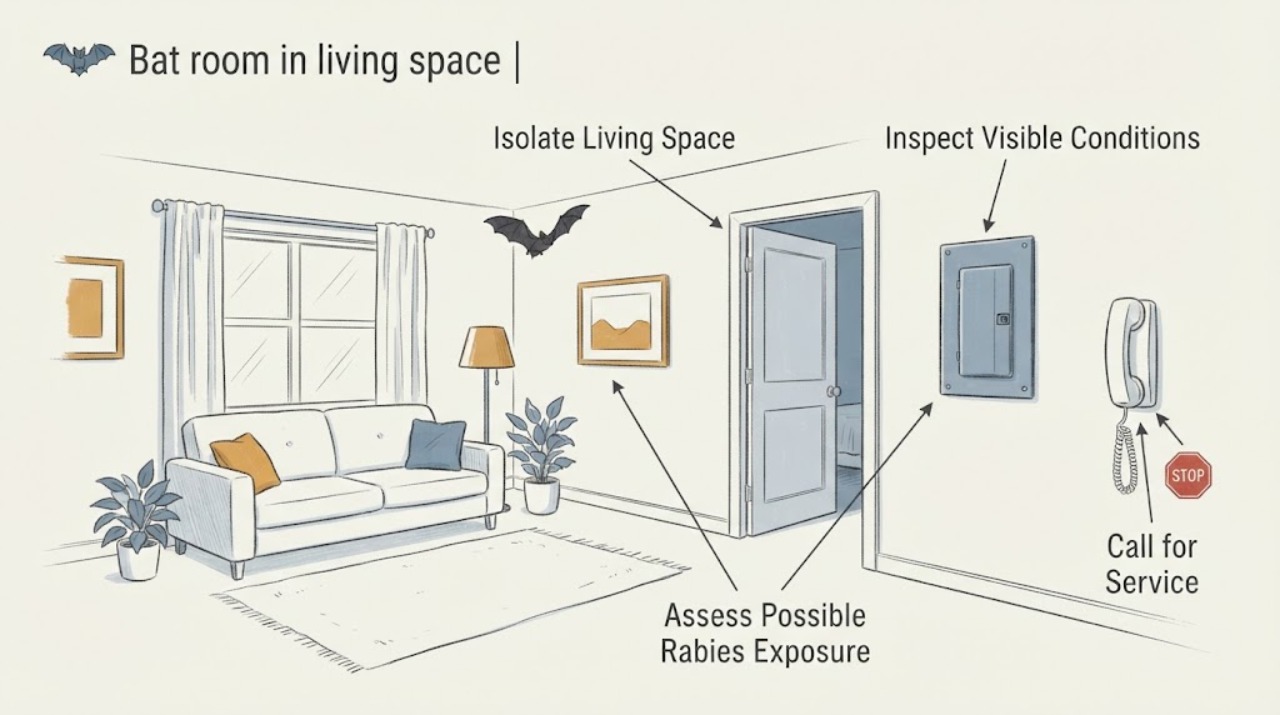
If a bat is in a living space, do not touch, chase, poison, trap, or manually capture it. Move people and pets away, close interior doors if that can be done without approaching the bat, and observe from a safe distance. If anyone was sleeping in the room, a child or pet was present, or contact cannot be ruled out, contact a health department or medical professional promptly for rabies-exposure guidance. Arrange urgent wildlife-removal service to manage the bat and inspect entry points. Do not seal an opening while a bat may still be inside, disturb droppings, or attempt a DIY exclusion.
Work through in order
Diagnostic checks
Use only checks that match the exact appliance or system and its official guide.
-
Check 1
From a safe position, move people and pets away from the room and close accessible interior doors only if doing so does not require approaching or cornering the bat.
Expected result: Record whether the room can be isolated without contact, whether the bat remains in sight, and whether anyone or any pet was already in the room.
Next step: Keep the room closed and quiet, maintain distance, and arrange urgent wildlife-removal service.
Stop if: Stop immediately if isolating the room would bring a person or pet near the bat, cause it to fly toward someone, or require handling a door or object near it.
Why this matters
Why: Isolation reduces the chance of contact and helps a wildlife professional locate the animal; it does not remove the need for exposure assessment.
-
Check 2
From outside the room or another safe location, note the bat's position and behavior without approaching, shining equipment at it, blocking its movement, or attempting capture.
Expected result: Record whether it is flying, resting, on the floor, active in daylight, unable to fly, or behaving unusually, and note the room and approximate time.
Next step: Give the observation to animal control, the health department, and the wildlife professional; do not release or relocate the bat yourself.
Stop if: Stop observing if the bat moves toward the doorway, a person or pet enters the area, or safe distance cannot be maintained.
Why this matters
Why: A bat on the floor, unable to fly, active in daylight, or unusually approachable needs prompt professional and public-health guidance; behavior cannot rule rabies in or out.
-
Check 3
From outside the room, establish whether anyone was sleeping there, whether a young child or pet was present, and whether direct contact, a scratch, a bite, saliva, or contact with eyes, mouth, or an open wound can be definitively ruled out.
Expected result: Record the people, pets, sleep status, approximate time, and any uncertain or unobserved contact; do not touch the bat or contaminated items to investigate.
Next step: Contact the state or local health department or a medical professional promptly and follow their exposure guidance; keep the bat available for professional handling and testing advice.
Stop if: Stop all household investigation and escalate urgently for any possible contact, sleeping exposure, child exposure, pet exposure, bite, scratch, or saliva contact.
Why this matters
Why: Direct bat contact, a bat in a room with a sleeping person, a young child, or uncertainty about contact requires prompt rabies-risk assessment by a health official or medical professional.
-
Check 4
From a doorway or other safe position, look for visible droppings, dusty material, stains, or a recurring roost area without entering the area, touching material, or disturbing dust.
Expected result: Record the room, approximate location, apparent amount, and whether material is concentrated or spread; do not estimate contamination by scraping or sampling.
Next step: Restrict access and request a qualified wildlife-removal or hazardous-cleanup professional; keep the material undisturbed.
Stop if: Stop if dust becomes airborne, anyone develops breathing symptoms, the area is heavily contaminated, or safe distance cannot be maintained.
Why this matters
Why: A large or dusty accumulation increases the need for specialized professional cleanup because disturbing bat droppings can create an inhalation hazard.
-
Check 5
From safe interior or exterior ground-level positions, document only visible gaps, unscreened openings, door or window conditions, and the bat's likely entry area without reaching, climbing, sealing, or opening building materials.
Expected result: Record whether the bat came from a visible opening, chimney or attic-adjacent area, damaged screen, or an unknown route, and whether more than one bat or repeated activity is present.
Next step: Share photos and the timing of activity with the wildlife professional and follow local wildlife rules and their exclusion plan.
Stop if: Stop if finding the entry point requires a ladder, roof/attic access, handling a screen, moving materials, or approaching the bat.
Why this matters
Why: A visible entry clue helps a professional plan exclusion, but sealing too early can trap bats or separate young from adults and is not a safe homeowner step.
Use your observations
Decision map
Find the observation that best matches what you see, then follow the next safe action.
-
PATH 01Next step
What you see
Anyone was sleeping in the room, a young child or pet was present, direct contact occurred, or contact cannot be definitively ruled out.
Do this next
Contact a health department or medical professional promptly for rabies-risk assessment, and keep people and pets away while arranging professional bat handling.
-
PATH 02Next step
What you see
The bat is on the floor, unable to fly, active in daylight, unusually approachable, or behaving abnormally.
Do this next
Keep distance and contact animal control, a health department, and urgent wildlife-removal service; do not attempt manual capture.
-
PATH 03Next step
What you see
Droppings or dusty roost material are visible, especially in a large accumulation.
Do this next
Restrict access and arrange specialized professional cleanup; do not sweep, vacuum, spray, scrape, or sample the material.
-
PATH 04Next step
What you see
The entry route is not visible or could only be investigated from an attic, roof, ladder, or concealed space.
Do this next
Stop investigating and let a professional identify and manage the entry and exclusion plan; do not seal an opening while a bat may be inside.
-
PATH 05Next step
What you see
The bat cannot be kept away from people or pets without approaching it, or the room cannot be safely isolated.
Do this next
Leave the area, keep others out, and request urgent professional or emergency assistance as appropriate.
Helpful context
Understand the symptom
Safety comes before removal
A bat flying in a room is a wildlife and public-health situation, not a household pest to handle by hand. CDC advises avoiding contact and contacting animal control or a health department when a bat is found in a home. Bat bites can be tiny or unnoticed, so the exposure history matters even when nobody sees a bite. Keep the room quiet and give the animal and people space while arranging professional help.
Protect the room and the people
Keep children, pets, and anyone who cannot reliably avoid contact out of the room. Do not swat at the bat, throw objects, use poison or chemicals, or try to net, hold, or carry it. Do not close a bat into a wall or seal an exterior opening while the animal may be inside. A trained wildlife professional can choose a lawful, humane exclusion and testing path.
Do not disturb droppings or nesting material
If droppings or dusty material are visible, leave them undisturbed. CDC notes that large amounts of bat droppings should be handled by specialized professional companies, and disturbing contaminated material can aerosolize Histoplasma spores. Do not sweep, vacuum, scrape, spray, or collect it as part of this observation.
Common questions
FAQ
Should I catch or release the bat myself?
No. Do not touch, trap, poison, chase, or manually capture it. Keep people and pets away and contact animal control, the health department, and a qualified wildlife professional for safe handling and testing guidance.
What if someone was asleep in the room?
Treat it as a possible rabies exposure and contact a health department or medical professional promptly. Bat contact can be unnoticed, and CDC identifies sleeping exposure and uncertain contact as reasons for immediate risk assessment.
Can I seal the opening where the bat entered?
Do not seal an opening while a bat may still be inside. A wildlife professional should plan humane exclusion and check for additional animals or seasonal restrictions.
How should I clean bat droppings?
Do not sweep, vacuum, scrape, spray, or collect droppings yourself. Restrict access and arrange specialized professional cleanup, especially for a large or dusty accumulation.
Read the exact guide
Official sources
- Clinical Screening for Rabies PEPCenters for Disease Control and Prevention · Supports urgent health-official assessment for direct bat contact, a sleeping person, a young child, or uncertain contact.
- Reducing Risk for HistoplasmosisCenters for Disease Control and Prevention · Supports leaving droppings undisturbed and using specialized professionals for large accumulations.
- Elimination and Engineering ControlsCDC National Institute for Occupational Safety and Health · Supports restricting the area, determining contamination extent professionally, and avoiding disturbance of dusty bat-dropping material.
- Preventing Rabies from BatsCenters for Disease Control and Prevention · Supports keeping distance, avoiding contact, contacting animal control or a health department, and treating unusual bat behavior or uncertain exposure seriously.
Community feedback
Share a repair observation
Share a plain-text repair observation. Accepted observations are published automatically; this page may take a moment to update.