
On this page
Start here
Quick answer
A door that is not working must first be separated into a door that will not open, will not close, will not latch, or is difficult to move. From a stable position, operate the handle normally without forcing it, observe where the door contacts the frame, and look for an uneven gap, a shifted strike, hinge-side sag, a swollen sill, damaged weatherstrip, or an obstruction. Keep an exit route usable and do not defeat a lock, pry the door, remove hardware, or climb to inspect it. A jammed or damaged only exit, cracked glass, a door that can fall, or a condition that needs frame adjustment or disassembly calls for prompt qualified door service; request urgent help when people are trapped or the opening cannot be made safe.
Before you begin
Safety first
- User checks are limited to normal gentle operation and floor-level visual observation. Do not force or pry the door, defeat locks, dismantle hinges or hardware, remove glass or trim, climb, or obstruct an exit route.
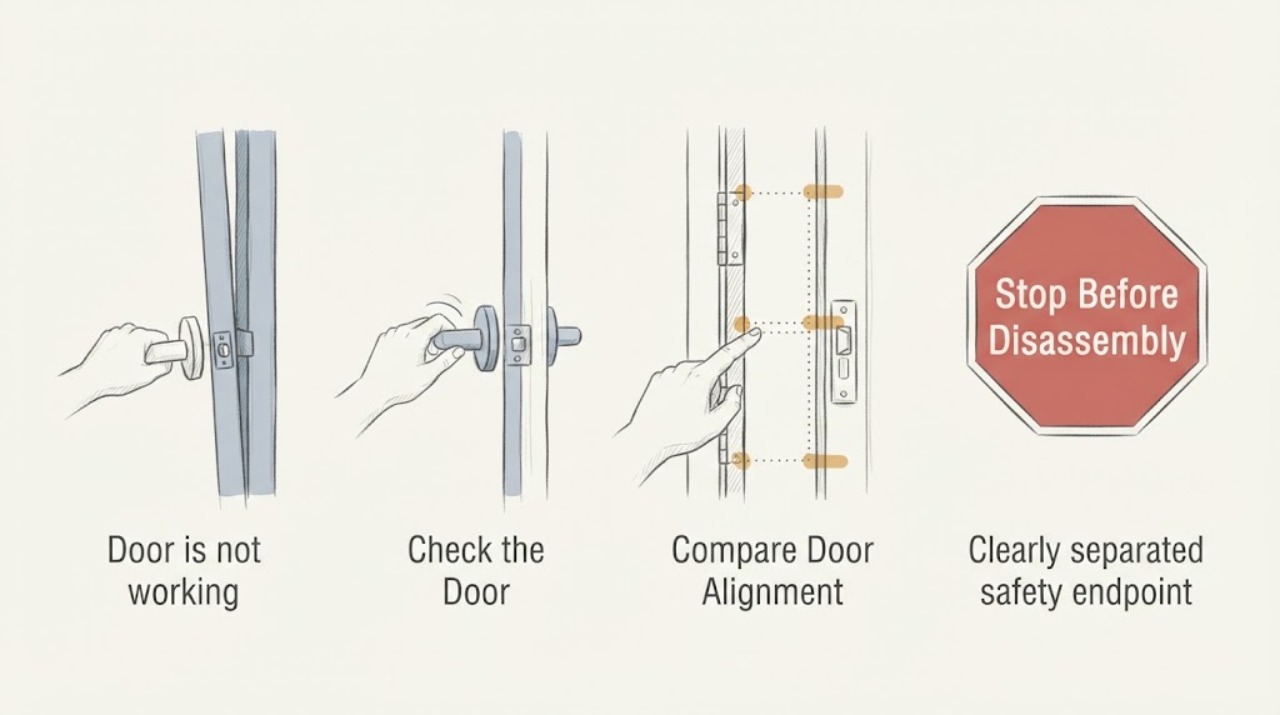
Work through in order
Diagnostic checks
Use only checks that match the exact appliance or system and its official guide.
-
Check 1
From a stable position, operate the handle, latch, and lock in their normal sequence without force and classify the symptom as will not open, will not close, will not latch, will not lock or unlock, or hard to move.
Expected result: The door moves but contacts the frame, the latch misses the strike, the handle or lock does not move, the door is stuck closed or open, or the symptom is absent during a gentle test.
Next step: Record the exact failed function and stop repeated testing; continue only with non-contact observation and arrange door service if the function does not return.
Stop if: Stop for a trapped person, a door that can fall, a blocked only exit, broken glass, sharp fragments, smoke or fire, or any need to force the handle or slab.
Why this matters
Why: A contact or latch symptom points toward alignment or hardware routing, while a handle or lock that does not move can indicate a mechanism problem. A gentle test cannot establish which part is defective.
-
Check 2
With the door in its current safe position, observe the reveal and contact points from the hinge side and latch side without removing trim or hardware; look at the top, bottom, jamb, weatherstrip, latch, and strike area.
Expected result: The gap is even, or the door hits the top or bottom first, the latch misses the strike, the jamb looks twisted, the weatherstrip is uneven or damaged, or the sill appears raised, depressed, or wet.
Next step: Photograph the contact point and provide the direction of movement and gap description to a qualified door professional; do not force the slab past the contact.
Stop if: Do not pry, kick, bend the latch, remove hinge pins, drill the frame, or adjust an unfamiliar closer or lock under load.
Why this matters
Why: An uneven reveal or contact point makes alignment, frame, sill, hinge, or weatherstrip assessment relevant. Appearance alone does not establish that shimming, realignment, or replacement is safe for this door.
-
Check 3
From floor level, inspect only the visible threshold, hinges, frame, handle, lock face, and surrounding glass for loose-looking hardware, debris, swelling, impact damage, corrosion, cracks, or water intrusion; do not dismantle anything.
Expected result: The visible area is clear and intact, or debris, swollen material, loose hardware, cracked glass, bent metal, or water damage is present.
Next step: Keep the door unloaded and controlled, document the finding, and request qualified service; remove only loose surface debris that can be reached without moving the door or hardware.
Stop if: Stop for cracked or loose glass, exposed sharp edges, unstable hardware, active water, structural movement, or any task requiring a ladder or tool on the latch, hinges, frame, or closer.
Why this matters
Why: A clear visible area leaves concealed hardware and frame conditions unresolved. Damage, swelling, loose hardware, or water can prevent safe operation and changes the repair boundary.
-
Check 4
Map whether this door is an entry, an accessible route, or an emergency exit and check from a safe position that people can reach another safe route without crossing the malfunctioning opening.
Expected result: A clear alternate route exists, the door is the only practical exit, the door is locked from the inside, or the malfunction creates a pinch, fall, security, or smoke barrier.
Next step: Keep the route clear, use a safe alternate route if available, and request urgent door service when the only route is blocked or unsafe.
Stop if: Stop for fire, smoke, a person trapped behind the door, a door that cannot be opened from the safe side, or any attempt to defeat a lock or fire-door function.
Why this matters
Why: A door defect that blocks or compromises the only route has higher urgency than an interior door with a safe alternate path. Do not trade one hazard for another by wedging or bypassing hardware.
-
Check 5
Record the door location, material and type if safely visible, failed function, opening direction, recent rain or temperature change, impact, installation, painting, hardware work, and whether the symptom changes when the door is open or closed.
Expected result: The symptom is repeatable and tied to a recent event, varies with weather or position, or has no clear pattern.
Next step: Send the timeline, safe photos, door identity, and the results of each non-invasive check to door service; do not order a part from the symptom alone.
Stop if: Do not remove a label, trim, hinge, lock, closer, or glass, and do not climb or repeatedly cycle a door that is binding or unstable.
Why this matters
Why: A repeatable contact or weather pattern helps a professional inspect the slab, jamb, sill, hinges, seal, or strike; no pattern means the mechanism or frame still needs diagnosis.
Use your observations
Decision map
Find the observation that best matches what you see, then follow the next safe action.
-
PATH 01Next step
What you see
The door is the only practical exit, cannot be opened from the safe side, traps someone, or blocks an emergency route.
Do this next
Treat the situation as urgent. Keep people away from the failure point, use another safe route only if available, and contact appropriate emergency or qualified door assistance. Do not pry, defeat a lock, or force a damaged door.
-
PATH 02Next step
What you see
The door moves but hits at the top or bottom, has an uneven gap, the latch misses the strike, or the weatherstrip is not met evenly.
Do this next
Request qualified door assessment for slab, jamb, sill, hinge, strike, closer, and weatherstrip alignment. Keep the door from being forced and do not choose a shim, screw, or replacement part from appearance alone.
-
PATH 03Next step
What you see
The frame, sill, door, hinges, lock, closer, or glass is swollen, wet, cracked, loose, bent, corroded, or otherwise damaged.
Do this next
Stop operating the door if doing so could worsen the damage or create a fall, pinch, glass, or security hazard. Arrange prompt qualified service and correct the water source before refinishing or sealing.
-
PATH 04Next step
What you see
The handle, lock, latch, closer, or hinge does not move normally even when the slab is not visibly contacting the frame.
Do this next
Do not force or dismantle the mechanism. Request door hardware service with the door type, lock state, and safe observations; a professional should determine whether the mechanism can be adjusted or needs a compatible part.
-
PATH 05Next step
What you see
The problem is limited to an interior or non-critical door, a safe alternate route exists, and there is no visible instability, glass damage, or active water.
Do this next
Keep the door out of service or clearly controlled and schedule prompt assessment. Continue documenting alignment and history without repeated cycling or invasive adjustment.
Helpful context
Understand the symptom
Name the failed door function before choosing a repair
“Not working” can describe different decisions: the slab may not swing, the latch may miss the strike, the door may close but not seal, or the lock may not release. Therma-Tru's troubleshooting guide separates opening and closing problems from weatherstrip, sill, jamb, and latch alignment. A visible contact point can guide a service inspection, but it does not prove that a hinge, strike, frame, or slab should be adjusted or replaced.
Observe alignment without forcing the door
Use the handle and latch in their normal direction from a stable standing position. Note whether the door contacts at the top, bottom, hinge side, or latch side, and whether the gap is uneven. Do not lean your body into the slab, kick it, wedge it, remove hinge pins, or pry the frame. A sudden change after rain, impact, installation, or settling is useful history for a qualified door professional.
Protect the exit while the cause is unresolved
Keep doorways, halls, and exit paths clear while service is pending. OSHA describes workplace exit routes as continuous, unobstructed paths and says doors and access routes must remain available; residential requirements may differ, but a blocked only exit is still an urgent safety problem. Do not leave a door propped in a position that prevents safe escape or creates a fall, pinch, or security hazard.
Safety boundary
Stop conditions
- Do not force, kick, pry, wedge, or repeatedly cycle a door that binds, is unstable, or can fall.
- Do not remove hinge pins, locks, closers, trim, glass, or frame hardware as a first user check.
- Do not defeat a lock, block an exit route, or leave a door in a position that creates a pinch, fall, smoke, security, or egress hazard.
- Stop for cracked or loose glass, sharp fragments, active water, structural movement, smoke or fire, a trapped person, or any need for a ladder or invasive access.
Only after diagnosis
Potential parts
- door weatherstrip
Consider only if inspection confirms the weatherstrip is missing, torn, cracked, or no longer seals evenly and the exact door system is identified.
Confirm the door manufacturer, profile, dimensions, mounting method, material, and installation requirements before ordering; a door that is out of alignment may need frame or hinge work instead.
When checks do not resolve it
Need a professional?
Request prompt qualified door service when the door remains unable to open, close, latch, or lock after safe observation, when the frame, hinges, sill, weatherstrip, glass, or hardware appears damaged, or when the symptom changes with weather or recent work. Seek urgent assistance for a trapped person, a blocked only exit, smoke or fire, a door that can fall, cracked or loose glass, active water, or structural movement. Provide the exact failed function, safe photos, contact points, door type, recent history, and whether another safe route exists.
Safety scope: User checks are limited to normal gentle operation and floor-level visual observation. Do not force or pry the door, defeat locks, dismantle hinges or hardware, remove glass or trim, climb, or obstruct an exit route.
Common questions
FAQ
What should I check first when a door is not working?
Classify whether it will not open, close, latch, lock, or move normally. From a stable position, look for where the slab contacts the frame, whether the gap is uneven, and whether the latch misses the strike. Do not force the door or remove hardware.
Does an uneven gap mean the hinges are bad?
Not necessarily. An uneven gap can involve the slab, jamb, sill, hinges, strike, closer, or the surrounding structure. Document the contact pattern and have a qualified door professional determine the cause before adjusting or replacing hardware.
Can I sand or plane a door that rubs?
Do not remove material as a first test. Rubbing may reflect frame movement, sill or jamb alignment, hinge conditions, swelling, or water intrusion; sanding can hide the cause and affect sealing. Request an assessment, especially if the door is an exit or security door.
What if the door will not latch but still closes?
Observe whether the latch reaches the strike and whether the door meets the weatherstrip evenly. Keep the door controlled and avoid forcing or bypassing the lock. A qualified professional should assess alignment and hardware before changing the strike or latch.
When is a door problem urgent?
Seek urgent help when a person is trapped, the only practical exit is blocked, the door can fall, glass is cracked or loose, smoke or fire is present, or water and structural damage make operation unsafe. Keep people clear and use another safe route only if one exists.
Read the exact guide
Official sources
- Troubleshooting GuideTherma-Tru Doors · Manufacturer-specific examples used to route observations; the reader's door construction and manufacturer's instructions control any repair.
- Troubleshooting GuidePella · A manufacturer manual example used for non-invasive symptom routing; it does not establish a repair for every door type.
- Emergency Preparedness and Response: Getting StartedOccupational Safety and Health Administration · Workplace egress reference for the safety boundary; local residential fire and building requirements may differ.
Community feedback
Share a repair observation
Share a plain-text repair observation. Accepted observations are published automatically; this page may take a moment to update.