
On this page
Start here
Quick answer
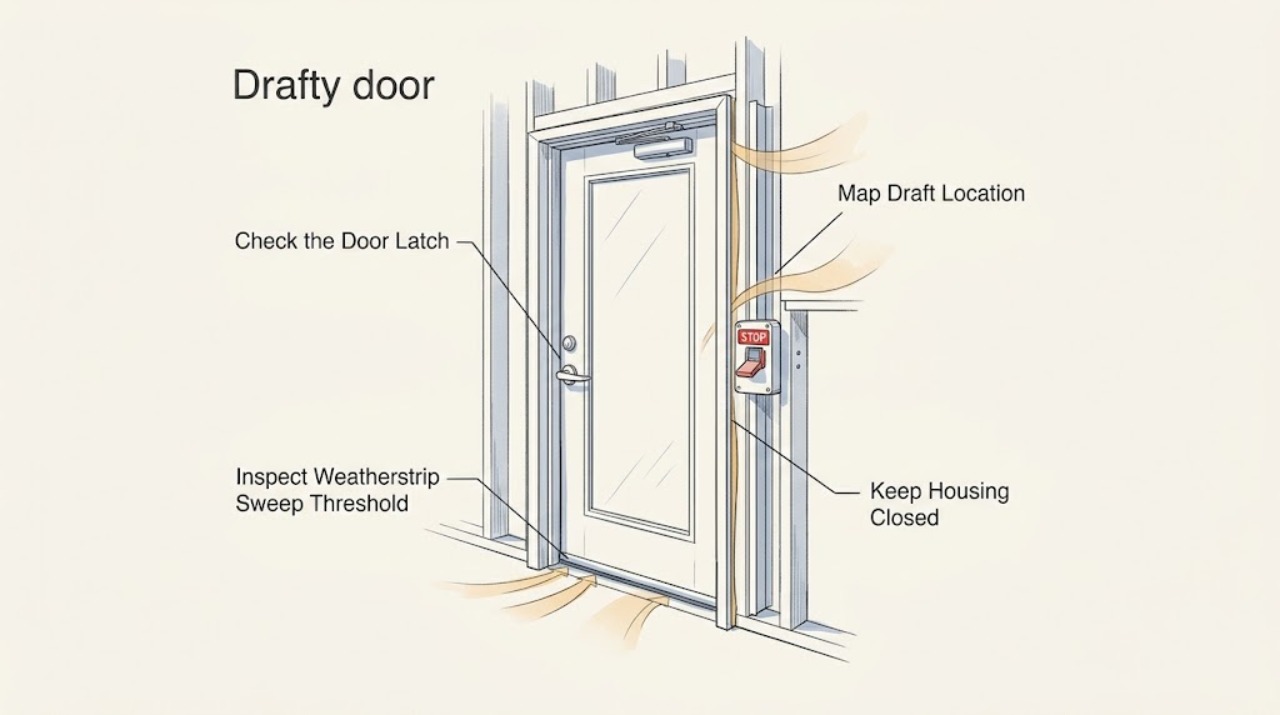
A drafty door needs a location check before you buy a replacement seal. With the door closed, identify whether air enters at the latch side, hinge side, head, bottom sweep or threshold, or around the frame where it meets the wall. A gap between the moving door and its stops points toward worn or missing weatherstripping, a sweep, threshold, or door alignment; a draft around stationary trim points toward an unsealed rough opening or frame-to-wall joint. Check that the door closes and latches without force, look for daylight, and use a paper test or gentle smoke observation only in a safe, controlled setting. Do not remove trim, cut into walls, use expanding foam near moving hardware, or cover water damage as a draft fix. Replace or adjust a seal only after confirming the door operates correctly; persistent drafts, water entry, rot, a distorted frame, or a door that will not latch needs qualified window-and-door or building-envelope service.
Before you begin
Safety first
- User checks are limited to safe standing-position observation, normal door operation, and a controlled draft-location test. A qualified professional handles door removal, frame or hardware adjustment, glass work, trim and wall opening, rough-opening sealing, flashing, rot repair, exterior or elevated access, and any suspected hazardous paint or unstable material.
Work through in order
Diagnostic checks
Use only checks that match the exact appliance or system and its official guide.
-
Check 1
With the door closed and from a stable standing position, trace the perimeter without touching moving hardware and identify where the draft is strongest: latch side, hinge side, head, meeting stile, bottom edge, threshold, or stationary trim.
Expected result: Record whether the air movement follows the contact line between door and jamb, is concentrated at the bottom corners or sweep, appears between paired doors, or comes from the frame-to-wall area. Note visible daylight, dust, insects, or outside odors at the same location.
Next step: Photograph the area and continue with the matching seal, operation, or frame/wall branch; do not cover every edge with a generic strip before identifying the path.
Stop if: Stop for loose glass, exposed sharp fasteners, unstable trim, water near electrical equipment, a moving or distorted frame, or any need to climb or remove the door.
Why this matters
Why: A moving-edge leak points toward weatherstripping, a sweep, threshold fit, or alignment. A stationary frame-to-wall leak points toward caulk, the rough opening, flashing, or concealed air sealing. The location narrows the work area but does not prove which product or repair is needed.
-
Check 2
Open and close the door using its normal handle and hinges, then observe whether it reaches the stops evenly and latches without lifting, pushing hard, rubbing, or forcing the hardware.
Expected result: Record smooth closure with even contact, a corner that closes first, a visible gap that changes as the door moves, a latch that misses, rubbing at the threshold, loose visible hardware, or an operation problem that prevents a safe closed position.
Next step: If operation is poor, request door adjustment or window-and-door service before installing thicker weatherstripping. If operation is normal, compare the leak location with the seal and threshold checks.
Stop if: Do not force the door, remove hinges, alter the strike plate, plane the door, or compensate for binding by adding a thick seal; stop if the door can fall, pinch, or no longer secure the opening.
Why this matters
Why: A closure or latch defect can leave a good seal uncompressed and may indicate hinge, strike, threshold, frame, or door movement rather than a seal-only problem. A door that closes evenly but still leaks makes the seal or frame-to-wall path more likely.
-
Check 3
Visually inspect the accessible weatherstrip around the jamb and head, the bottom sweep or door bottom, and the threshold while the door remains supported and in its normal position.
Expected result: Record missing, torn, flattened, detached, gapped, or compressed material; daylight at bottom corners; a threshold that no longer meets the door; or a seal that prevents the door from closing. Note whether the material is continuous at corners without pulling or probing it.
Next step: Measure only from a safe position if a professional or product manufacturer requests dimensions; otherwise photograph the profile and contact pattern and arrange the appropriate door service.
Stop if: Do not pry, pull, cut, glue, drill, or remove a seal as a test; stop if the threshold is loose, the floor is wet or rotten, or access requires kneeling on an unstable surface.
Why this matters
Why: Worn or missing material at the moving door perimeter supports a weatherstrip or sweep assessment. A bottom-only leak points toward the sweep or threshold. A seal that looks intact but is not contacted evenly points back to alignment or frame movement rather than an automatic replacement.
-
Check 4
Use a paper test on a clean section of the closed door seal, or observe a thin smoke trail from a safe, nonflammable draft-testing method, without placing anything near a flame, hot surface, children, pets, or combustible materials.
Expected result: A paper strip may hold firmly, slide freely, or show different results around the perimeter; a safe smoke observation may remain still or be pulled or pushed at one section. Record the exact section and repeat only enough to compare locations.
Next step: Match the result to the moving-seal or stationary-frame branch and provide the marked locations to service. Do not use incense, candles, smoke, or other heat near flammable finishes or occupants with respiratory sensitivity.
Stop if: Stop for combustion risk, fumes, asthma or respiratory irritation, uncontrolled smoke, a draft near a gas appliance or flue, or any test that requires opening a wall or removing trim.
Why this matters
Why: A loose paper strip or directed smoke at one section supports a local sealing or fit problem. Even contact around the door while a draft remains around trim points toward the frame-to-wall or rough-opening path. This test locates air movement; it does not identify a compatible product or prove a hidden gap.
-
Check 5
From inside and outside only where safely reachable, inspect the stationary frame, trim, adjacent wall, threshold, and nearby finish for staining, peeling paint, swelling, soft material, gaps, corrosion, or signs that wind-driven rain follows the frame.
Expected result: Record a dry intact joint, a visible stationary gap, water staining, damaged or soft material, failed caulk, a shifted frame, or no safe view of the rough opening. Compare the location with the draft map and note whether the symptom appears only during wind or rain.
Next step: Keep water out as a temporary measure without sealing over damaged material and arrange qualified window-and-door or building-envelope assessment when the frame, wall, flashing, or rough opening is involved.
Stop if: Do not remove trim, cut drywall or siding, inject foam, caulk over wet or rotten material, climb, or disturb suspected lead-painted surfaces; stop for unstable cladding, falling debris, or inaccessible exterior work.
Why this matters
Why: A stationary gap can require frame-to-wall or rough-opening air sealing. Water damage, rot, a shifted frame, or wind-driven rain raises the scope beyond a weatherstrip replacement and can weaken the assembly. A clean surface does not rule out a concealed rough-opening leak.
-
Check 6
Use the draft location, closure result, seal contact, weather pattern, and frame condition to choose a focused seal replacement, door adjustment, frame or wall air-sealing assessment, or broader professional inspection.
Expected result: Classify the issue as a worn moving-edge seal, bottom sweep or threshold path, alignment or hardware problem, stationary frame-to-wall or rough-opening leak, or water-damaged or unstable assembly.
Next step: Give the service provider the draft map, closure and latch result, seal photos, paper or smoke-test locations, weather pattern, and water or damage notes. Confirm dimensions, profile, material, and manufacturer fit before ordering a replacement.
Stop if: Do not remove the door, alter framing, replace glass, use expanding foam near the door, or select a part solely from the word 'drafty'; stop for a door that will not secure, rot, loose glazing, or unsafe access.
Why this matters
Why: A moving-edge classification can justify a conditional weatherstrip or sweep conversation after exact fit is confirmed. An alignment, rough-opening, water, or structural classification needs a professional scope; adding a seal may hide the defect or prevent operation.
Use your observations
Decision map
Find the observation that best matches what you see, then follow the next safe action.
-
PATH 01Next step
What you see
The draft follows the closed door-to-jamb contact line, the door closes and latches normally, and the weatherstrip is missing, flattened, torn, or not contacting evenly.
Do this next
Arrange or perform only a compatible weatherstrip assessment, confirming the door profile, jamb surfaces, dimensions, and operating clearance before ordering or installing a seal. Verify that the door still closes smoothly.
-
PATH 02Next step
What you see
Air movement is concentrated at the bottom edge or corners and the door otherwise closes and latches normally.
Do this next
Have a professional or qualified installer assess the sweep, door bottom, threshold contact, and corner seals as a set; do not stack materials that bind the door or obstruct drainage.
-
PATH 03Next step
What you see
The door rubs, misses the latch, closes unevenly, requires force, or leaves a changing gap even though the seal appears serviceable.
Do this next
Request door adjustment and hardware or frame assessment before replacing weatherstripping. Keep the opening secured and do not force, plane, remove hinges, or alter the strike as a diagnostic experiment.
-
PATH 04Next step
What you see
The draft is at stationary trim or the frame-to-wall joint, or the symptom comes with water staining, peeling finish, or wind-driven rain.
Do this next
Arrange qualified window-and-door or building-envelope assessment of the rough opening, air sealing, flashing, moisture, and damaged materials. Do not remove trim or seal over wet or rotten material as a test.
-
PATH 05Next step
What you see
The door will not secure, the frame or glazing is unstable, rot is present, access is elevated or exterior-only, or safe observations cannot localize the draft.
Do this next
Stop testing, keep people away from the opening, and call qualified service. Provide the visible condition and the exact access limitation rather than attempting removal or a hidden air-sealing repair.
Helpful context
Understand the symptom
A door can leak at the moving seal or behind the frame
Cold air at a closed door does not automatically mean the weatherstrip is worn. The leak can be at the meeting surface between the door and jamb, below the door and threshold, between a pair of doors, or around the frame where it meets the wall. Separate those locations before choosing a part: weatherstripping is for moving components, while caulk or other air-sealing work belongs at stationary joints.
Operation is part of the diagnosis
A seal that is too thick, misplaced, or installed on a misaligned door can keep the door from closing or latching. The Department of Energy job aid treats smooth operation and proper fit as part of the desired result. Check the closed door and latch from a safe position; do not force the handle, hinges, strike, or frame to make a draft disappear.
Water and rot make this more than a comfort complaint
Air can enter through the same frame or rough-opening gap that admits wind-driven rain. Peeling paint, swelling, staining, soft wood, corrosion, or a frame that has shifted can mean the seal is not the whole problem. Keep the area dry and arrange an assessment before covering the evidence or sealing over damaged material.
Safety boundary
Stop conditions
- Do not force, plane, remove, or rehang the door as a diagnostic test, and do not alter hinges or strike hardware without a defined repair scope.
- Do not remove trim, cut walls or siding, inject expanding foam, or seal over wet, rotten, unstable, or suspected lead-painted material.
- Stop for loose glass, a door that will not latch or secure, frame movement, falling debris, rot, electrical contact, or unsafe exterior or elevated access.
- Do not use candles, open flame, or uncontrolled smoke to locate a draft; stop any test that creates fumes, heat, or respiratory irritation.
- Do not order a replacement weatherstrip or sweep from the symptom alone; confirm the door type, profile, dimensions, contact pattern, and operating clearance.
Only after diagnosis
Potential parts
- door weatherstripping
Consider only when the draft follows the moving door perimeter, the door closes and latches normally, and the existing seal is confirmed worn or missing.
Match the door and jamb profile, mounting method, dimensions, material, compression, and clearance; confirm the door still closes and latches smoothly. - door bottom sweep
Consider only when safe observation localizes the leak to the bottom edge or corners and the threshold and door alignment are otherwise sound.
Match the door bottom, threshold geometry, mounting method, and clearance; do not use a sweep that binds the door or obstructs drainage. - door-frame caulk or backer rod
Consider only for a dry, stable stationary joint after water damage, rot, flashing, paint, and rough-opening conditions have been assessed.
Use a product compatible with the adjoining materials and local requirements; do not cover wet, damaged, moving, or uninspected joints.
When checks do not resolve it
Need a professional?
Call qualified window-and-door or building-envelope service when the door will not close or latch, the draft persists after a confirmed seal contact issue, the frame or wall shows water damage or rot, wind-driven rain enters, the rough opening may be unsealed, or the inspection requires trim removal, exterior access, glass work, or frame adjustment. A simple moving-edge leak may support a conditional weatherstrip or sweep replacement only after exact fit and normal door operation are confirmed.
Safety scope: User checks are limited to safe standing-position observation, normal door operation, and a controlled draft-location test. A qualified professional handles door removal, frame or hardware adjustment, glass work, trim and wall opening, rough-opening sealing, flashing, rot repair, exterior or elevated access, and any suspected hazardous paint or unstable material.
Common questions
FAQ
Does a drafty door always need new weatherstripping?
No. First locate the air movement. A draft at the moving door edge can involve weatherstripping, a sweep, threshold contact, or alignment; a draft at stationary trim can involve the frame-to-wall or rough opening. A door that rubs or will not latch needs adjustment or professional assessment before adding a seal.
What is the difference between weatherstripping and caulk?
Weatherstripping is intended for moving door components and must allow the door to operate. Caulk or other air-sealing work is for stationary joints such as a frame-to-wall gap. Do not use caulk to glue a moving door shut or seal over an unexamined water problem.
How can I locate the draft safely?
With the door closed, map the perimeter, look for daylight, and use a paper test or a controlled nonflammable draft-testing method. Avoid candles, open flames, uncontrolled smoke, and tests near combustible materials, gas appliances, or people with respiratory sensitivity.
What if the door is drafty only during rain or strong wind?
Record the weather and the exact entry point. Wind-driven rain can expose a frame, flashing, or rough-opening problem rather than a seal-only defect. Arrange qualified window-and-door or building-envelope assessment and do not caulk over wet or rotten material.
When should I stop and call a professional?
Stop for loose glass, rot, frame movement, a door that will not latch or secure, water damage, unsafe exterior access, or any need to remove trim, open a wall, adjust the frame, or work at height. Provide the draft map and photos so the professional can choose the correct scope.
Read the exact guide
Official sources
- Install Weatherstripping on an Exterior DoorU.S. Department of Energy · DOE weatherization job aid used for diagnosing visible daylight or loose fit and for the requirement that seals preserve smooth door operation; exact product and local installation requirements vary.
- Locating Air LeaksENERGY STAR, U.S. Environmental Protection Agency · General residential air-leak guidance used to frame door drafts as part of a wider envelope; it does not identify a particular door part.
- Air Sealing Doors Adjacent to Unconditioned SpacePacific Northwest National Laboratory, U.S. Department of Energy Building America Solution Center · DOE Building America guidance for exterior or unconditioned-space doors; used for distinguishing moving seals from frame, rough-opening, flashing, and moisture work.
- Conserving Energy in Older HomesU.S. Department of Housing and Urban Development · HUD homeowner energy-conservation manual used for common draft locations and causes; older or historic assemblies may need specialist assessment.
- Energy-Efficient Home Improvement Credit Insulation and Air-Sealing EssentialsU.S. Department of Energy · DOE residential air-sealing guidance used for the moving-versus-stationary seal distinction and rough-opening scope; local codes and material instructions control.
- Sealing Behind Window & Door Trim ProjectENERGY STAR, U.S. Environmental Protection Agency · ENERGY STAR residential air-sealing guidance used for locating drafts and distinguishing trim or jamb gaps; professional work may be appropriate for complex trim, hazardous paint, or concealed conditions.
Community feedback
Share a repair observation
Share a plain-text repair observation. Accepted observations are published automatically; this page may take a moment to update.