
On this page
Start here
Quick answer
A sticking door is usually an alignment, clearance, hardware, weatherstrip, threshold, or moisture-related symptom, and the location of the bind matters more than the force needed to open it. From a safe position, note whether it rubs at the top, bottom, hinge edge, latch edge, strike, sill, or weatherstrip, and whether the problem changes with humidity or season. Check visible gaps, loose or sagging hardware, paint or debris contact, and whether the latch or lock aligns without forcing it. Do not slam, kick, plane, sand, cut, pry, or remove the door as a test. Arrange qualified door or window service when the door blocks an exit, cannot latch securely, shows frame movement, has damaged glass, or remains stuck after safe observations.
Before you begin
Safety first
- The reader-level scope is gentle operation and visual observation from stable access only. A qualified professional must handle hinge removal or adjustment, strike or frame alteration, planing, sanding, cutting, glass work, structural repairs, and painted-surface disturbance.
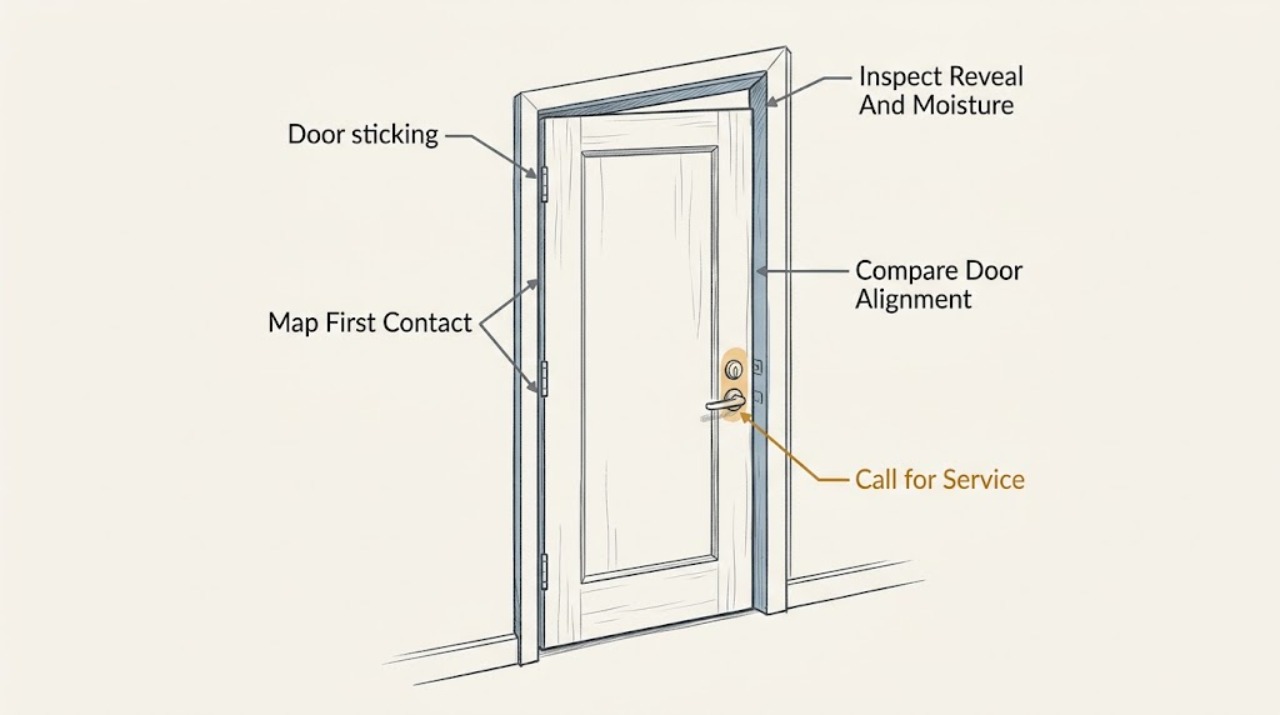
Work through in order
Diagnostic checks
Use only checks that match the exact appliance or system and its official guide.
-
Check 1
From a stable position, move the door gently through the range that is safe and identify the first place it contacts the frame, stop, threshold, sill, weatherstrip, latch, or strike; do not force it past the bind.
Expected result: Record hinge-edge, top, bottom, latch-edge, strike, sill, weatherstrip, or multiple contact points, and whether the door is merely tight or cannot open, close, latch, or lock.
Next step: Photograph the first contact and keep the door in the safest usable position. Request prompt door or window service if the opening cannot be secured, blocks an exit, or requires force to operate.
Stop if: Stop for a jammed exit, falling door, cracked glass, sharp fragments, unstable frame, trapped fingers, or any need to pry, kick, lift, or force the door.
Why this matters
Why: A single contact point narrows the inspection to clearance or alignment in that area, while several contact points or a door that cannot secure the opening suggests frame, hinge, threshold, or structural movement. Contact location does not identify the repair method by itself.
-
Check 2
With the door at rest, observe the visible gap or reveal around its perimeter and the nearby frame, trim, sill, and edge without removing paint or material.
Expected result: Note an even reveal versus a tight corner, rubbed paint, crushed finish, swelling, warping, dampness, staining, or a gap that changes after rain, humidity, or heating conditions.
Next step: Record weather and moisture timing and keep the door from being forced. Arrange qualified assessment when dampness, warping, rot, repeated seasonal binding, or frame movement is present; do not remove material while conditions are changing.
Stop if: Do not sand, plane, cut, drill, heat, pry, or remove painted or swollen material as a test. Stop if mold, rot, structural movement, or damaged glass is visible.
Why this matters
Why: An uneven reveal can be consistent with sagging, hinge or jamb alignment, or frame movement; swelling or weather-linked change points toward moisture or seasonal fit. Surface marks show contact but do not establish whether the door, frame, hinge, or threshold needs alteration.
-
Check 3
Observe the visible hinge leaves, hinge-side frame, latch, strike plate, and fasteners from ordinary standing access; gently test for obvious movement at the handle without pulling the door out of alignment.
Expected result: Record loose or protruding fasteners, a sagging door, hinge-side movement, a latch or bolt that meets one edge of the strike, or a latch that operates smoothly with the door open but binds when closed.
Next step: Take close, safe photos and ask a qualified professional to confirm alignment before tightening, shimming, replacing hardware, or altering the frame. Keep the door unsecured or use a safe alternate entrance if it cannot latch reliably.
Stop if: Do not remove hinge pins, take the door off its hinges, chisel the strike, enlarge a bolt pocket, or force a lock or latch.
Why this matters
Why: Loose or worn hinges and a sagging door can shift the latch relative to the strike; a latch that works open but binds closed points toward alignment at the strike or frame. A lock body that binds even when open points to a different hardware problem.
-
Check 4
Inspect the visible weatherstrip, door stop, sweep, sill, threshold, and track or channel, if present, for displacement, bunching, debris, damage, or a high spot; do not remove attached seals or trim.
Expected result: Note whether the door contacts the weatherstrip or sill before the latch engages, whether the seal is folded or bunched, and whether the threshold is visibly raised, loose, cracked, or damp.
Next step: Keep the area clear of loose debris and provide photos to a door or window professional. Request prompt service if the threshold affects an accessible route, causes a trip risk, permits water entry, or prevents secure latching.
Stop if: Do not cut, stretch, glue, drill, shim, or remove weatherstrip, sill, threshold, or track hardware as a trial; stop for water intrusion, unstable flooring, or broken glass.
Why this matters
Why: A seal or threshold can create tight closure independent of hinge alignment, while damaged or uneven components can change both operation and weather sealing. A visible defect makes that component worth focused service inspection but does not prove replacement compatibility.
-
Check 5
From both sides where safe, record whether the door can close, latch, and lock without lifting, pushing, pulling, or repeated attempts; document recent installation, weather, repainting, settlement, or hardware work.
Expected result: Record normal closure and secure latch versus a bolt that catches, a latch that misses, a door that must be lifted, a frame that moves, or a symptom that appeared after a recent change.
Next step: Keep an alternate route available and arrange qualified service for unreliable security, repeated binding, or any unresolved condition. Give the professional the contact location, photos, timing, and safe operating limits.
Stop if: Stop if the door is an emergency exit, cannot be secured, is falling or sagging, has damaged glass, traps a person, or needs force to move.
Why this matters
Why: A door that requires force or cannot lock securely has a functional and security consequence beyond cosmetic rubbing. Recent work or movement can change the service scope, while normal locking does not rule out a concealed or developing alignment issue.
Use your observations
Decision map
Find the observation that best matches what you see, then follow the next safe action.
-
PATH 01Next step
What you see
The first contact is at the top, bottom, hinge edge, or latch edge and the reveal is visibly uneven.
Do this next
Request qualified door or window assessment of the hinge, jamb, frame, moisture, and clearance path; do not plane or cut the door based only on the rub mark.
Why this path and its safety boundary
Why it matters: Hinge looseness, sagging, frame movement, swelling, or lost clearance is more likely than a lock-only issue.
-
PATH 02Next step
What you see
The door sticks only during damp, rainy, humid, heated, or seasonal conditions and the reveal or finish changes with those conditions.
Do this next
Document the timing and moisture evidence and schedule qualified assessment. Do not alter the door while it is damp or assume one seasonal fit represents the final condition.
Why this path and its safety boundary
Why it matters: Moisture or temperature-related swelling, warping, or movement may be changing the fit; a permanent material removal could create excessive clearance later.
-
PATH 03Next step
What you see
The latch or deadbolt operates smoothly with the door open but catches, rubs, or fails to enter the strike when the door is closed.
Do this next
Keep the door from being forced and have a qualified professional verify alignment and hardware condition before adjusting or replacing the strike.
Why this path and its safety boundary
Why it matters: The strike, frame, hinges, or door alignment is likely involved; a lock that binds when open would indicate a different hardware path.
-
PATH 04Next step
What you see
The door contacts a folded seal, sweep, stop, sill, or threshold before it closes or latches, or the threshold is visibly damaged or raised.
Do this next
Photograph the contact and request door or window service for seal, sill, threshold, and water-entry assessment; do not cut or remove the component as a test.
Why this path and its safety boundary
Why it matters: The weather-sealing or threshold path may be creating the resistance or changing the closing geometry, independent of hinge alignment.
-
PATH 05Next step
What you see
The frame moves, the door sags severely, an exit cannot be used, the door cannot latch securely, or glass, trim, or surrounding structure is damaged.
Do this next
Keep people clear, use a safe alternate route, and request prompt qualified door or window service; use emergency help for immediate entrapment or dangerous structural failure.
Why this path and its safety boundary
Why it matters: This exceeds a minor fit adjustment and may involve structural, security, egress, or injury risk.
-
PATH 06Next step
What you see
Safe observations do not identify the contact point, the door is inaccessible, or the door remains stuck after conditions normalize.
Do this next
Stop forcing the door and arrange qualified assessment with photos, timing, operating limits, and any recent work history.
Why this path and its safety boundary
Why it matters: Concealed hinge, frame, threshold, lock, moisture, or structural information is needed before a repair method or part can be selected.
Helpful context
Understand the symptom
Locate the contact before choosing a repair
Open and close the door only as far as it moves safely, then record the first contact point. A rub at the hinge edge, top, bottom, latch edge, strike, sill, or weatherstrip leads to a different inspection path. Official maintenance guidance links sticking to clearance, hinge looseness, frame alignment, swelling, sagging, and strike alignment; the symptom alone does not prove which condition is present.
Season and moisture can change the fit
If the door sticks only after rain, humidity, heating changes, or a seasonal transition, record that timing and look for swelling, warped edges, damp trim, or a changed reveal from a safe position. Schlage notes that temperature or moisture changes can temporarily affect fit. Do not remove material while the door is damp or assume a permanent adjustment is appropriate from one day of tight fit.
Security and safe access come first
A door that cannot latch or lock securely is more than an annoyance. Keep an alternate entrance available and request service when a lock bolt catches, the frame moves, the door is sagging, or the opening is an exit route. In an older painted home, sanding, cutting, or disturbing painted surfaces can create a lead-dust concern; surface alteration belongs with appropriately qualified professionals.
Safety boundary
Stop conditions
- Do not force, kick, pry, slam, lift, or remove a stuck or sagging door as a diagnostic test.
- Do not plane, sand, cut, drill, chisel, heat, shim, or alter painted door, frame, strike, threshold, or weatherstrip surfaces as a trial.
- Stop for a blocked emergency exit, falling door, damaged glass, sharp fragments, frame movement, water intrusion, rot, mold, or a lock that cannot secure the opening.
- In an older painted home, do not disturb painted surfaces in a way that can create dust; use an appropriately qualified professional for surface alteration.
Only after diagnosis
Potential parts
- door hinge set
Consider only when inspection confirms worn, loose, damaged, or unsuitable hinges are causing sagging or binding.
Confirm door weight, hinge size, mounting, finish, and exact frame and door requirements before ordering. - door strike plate
Consider only after a professional confirms that the strike or its alignment is the cause of latch or deadbolt contact.
Match the lock type, strike dimensions, hole geometry, security requirements, and frame preparation before ordering. - door weatherstrip or sweep
Consider only when the visible seal, sweep, sill, or threshold is confirmed to be damaged, displaced, or creating the sticking contact.
Match the door and frame profile, dimensions, sealing function, and installation requirements before ordering.
When checks do not resolve it
Need a professional?
Arrange qualified door or window service for persistent or worsening sticking, uneven contact that does not normalize, loose or sagging hardware, a latch or deadbolt that will not align, damaged weatherstrip or threshold, moisture or frame movement, or any door that cannot latch or lock securely. Treat a blocked exit, falling door, damaged glass, or immediate entrapment as urgent. Provide contact-point photos, seasonal or moisture timing, security behavior, visible hardware and seal condition, and recent work history.
Safety scope: The reader-level scope is gentle operation and visual observation from stable access only. A qualified professional must handle hinge removal or adjustment, strike or frame alteration, planing, sanding, cutting, glass work, structural repairs, and painted-surface disturbance.
Common questions
FAQ
Why is my door suddenly sticking?
Common paths include seasonal moisture or temperature changes, swelling or warping, hinge or frame movement, a shifted strike, or a weatherstrip or threshold that has moved. Find the first contact point and record when it changes before choosing a repair.
Should I sand or plane a sticking door?
Not as a first test. Material removal can hide an alignment or moisture problem and can leave excessive clearance when conditions change. Do not sand, plane, or cut; have a qualified professional confirm the cause and safe clearance.
What if the door closes but will not lock?
Check from a safe position whether the bolt works with the door open but catches the strike when closed. That pattern points toward alignment, hinge, frame, or strike inspection. Do not force or bypass the lock; arrange service if the opening cannot secure.
Can weatherstripping make a door stick?
Yes. A folded, displaced, damaged, or overly tight seal can contact before the latch engages, and a threshold or sweep can create similar resistance. Photograph the contact and request service rather than cutting or removing the seal.
When is a sticking door urgent?
Treat it as urgent when it blocks an exit, cannot latch securely, is falling or severely sagging, has damaged glass or a moving frame, traps someone, or requires force to operate. Keep people clear and use a safe alternate route while arranging qualified help.
Read the exact guide
Official sources
- NAVEDTRA 14045AU.S. Navy · U.S. Navy technical maintenance text used for general door-mechanics context; it is not a model-specific residential repair instruction.
- Troubleshooting GuideTherma-Tru Doors · Manufacturer troubleshooting guidance for Therma-Tru doors; use as general door-component context and follow the actual product manual for a specific door.
- How to fix a door that won’t latch.Schlage · Lock manufacturer guidance used for latch and strike diagnosis; it does not establish the correct repair for an unspecified door or frame.
- Door Needs Adjustment / Door Rubs or SticksU.S. Department of Housing and Urban Development · Federal Healthy Homes maintenance guide with door adjustment and sticking sections; its lead-safe context is especially relevant before disturbing painted surfaces, and it does not replace local repair requirements.
Community feedback
Share a repair observation
Share a plain-text repair observation. Accepted observations are published automatically; this page may take a moment to update.