
On this page
Start here
Quick answer
A glass door that sticks usually needs to be separated into a sliding-panel problem and a hinged-door problem. For a sliding patio door, first look for debris or damage in the track, an uneven gap that suggests roller misalignment, and a latch or frame that is being loaded by a skewed panel. Clean only accessible surfaces, make small manufacturer-approved roller adjustments if the hardware is designed for them, and stop if the glass is cracked, loose, the panel must be lifted out, or the frame is distorted. Do not force the glass or treat a broken roller as a reason to keep pulling harder.
Before you begin
Safety first
- User checks are limited to controlled movement, visual inspection, reachable cleaning, and a small manufacturer-documented adjustment when the hardware is designed for it. A qualified technician must lift or remove heavy glass panels, replace rollers or glazing, correct a shifted frame, alter structural hardware, or work at height.
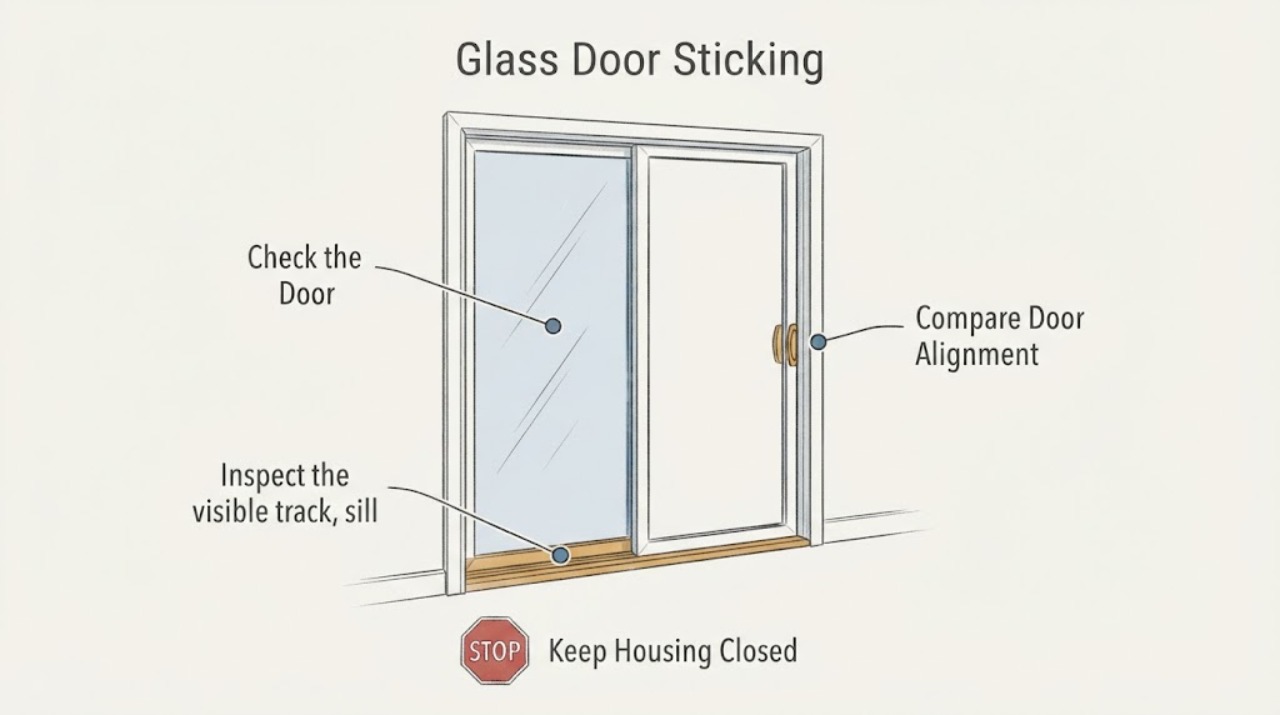
Work through in order
Diagnostic checks
Use only checks that match the exact appliance or system and its official guide.
-
Identify the door movement and exact bind point
With both hands on the handle and no one in the swing or travel path, move the door only a small amount. Decide whether it slides horizontally or swings on hinges, and note whether resistance is at the first opening movement, along the sill, near the latch side, or at the top of the frame. Do not keep pulling once the panel starts to twist or flex.
Expected result: A sliding panel drags at the bottom or has a tight corner, or a hinged panel rubs the frame or sill.
Next step: Use the sliding-track and roller checks for a horizontal panel, or the hinge/frame branch for a swinging door. If the glass itself moves in its frame, stop and use the damaged-glass boundary.
Why this matters
Why: Sliding and hinged doors require different adjustment paths. A changing gap or one-corner bind is more consistent with alignment or roller loading than with the glass itself being the operating mechanism.
-
Inspect the visible track, sill, and glass edges
For a sliding door, inspect the accessible sill track, roller path, bottom rail, side jamb, and the visible edges of the glass for grit, paint, a loose trim piece, a fallen object, or a damaged seal. Use a soft brush or vacuum only on reachable, stable surfaces; do not insert tools under the glass or scrape the panel edge.
Expected result: A removable obstruction or heavy dirt is present, or the track is clear but the panel still binds or the glass is chipped, cracked, or loose in its frame.
Next step: Remove only a loose, safe obstruction and retest gently. If the track is clear but the glass or frame is damaged, stop moving the door and arrange glazing or door service.
Why this matters
Why: Dirt or an object can obstruct a roller path, while a damaged glass edge, frame, or seal is a structural or glazing issue rather than a cleaning issue.
-
Check the panel reveal and frame alignment
Close the sliding panel only as far as it moves freely, then look at the gap between the panel and side jamb from top to bottom. For a hinged door, inspect the gap between the panel and frame at the rubbing edge. Compare the gaps without forcing the latch or pushing the glass into place.
Expected result: The gap is visibly uneven, the panel is not plumb or level, or the gap is even but the door still drags.
Next step: If the hardware has a clearly labeled manufacturer adjustment, use only that model's instructions and make one small change at a time. If the complete unit is out of square or the adjustment is inaccessible, stop and request service.
Why this matters
Why: Andersen's installation guidance treats an uneven reveal or a panel that is not plumb or level as an alignment clue. An even reveal with continued drag makes a hidden roller, track, hinge, or frame problem more likely.
-
Make one model-approved roller adjustment when applicable
Only for a sliding door whose manufacturer provides accessible roller adjusters, locate the adjustment ports or plugs at the bottom rail and follow that door's instructions. Change one side by a small increment, replace or secure any plug as directed, and check the gap and movement after each change. Do not remove the panel or loosen structural fasteners.
Expected result: The panel rises or settles into an even reveal and slides more smoothly, or adjustment does not change the bind, the screw turns without effect, or the panel becomes less stable.
Next step: Keep a successful adjustment and stop at the first sign of instability. If the door remains stuck or needs panel removal, have a qualified door technician inspect the rollers, track, and glass-panel support.
Why this matters
Why: Manufacturer guides describe roller adjustment as a way to correct panel height and alignment, but the location and direction vary by product. No response can indicate a worn roller, damaged track, or frame problem rather than a need for more force.
-
Check latch and weatherstrip loading after alignment
Once a sliding panel moves freely, close it slowly and observe whether the latch meets its receiver without lifting, pushing, or pulling the glass. For a hinged door, check whether the latch side is rubbing only when the latch is engaged. Do not force a lock that is under frame load.
Expected result: The panel closes and latches smoothly, or the latch misses, requires force, or pulls the panel out of alignment.
Next step: If the latch remains unreliable, leave the door unsecured only if the opening can be made safe by another method and arrange door-hardware service. Do not enlarge the strike opening or bend the latch as a trial.
Why this matters
Why: A latch or receiver can add resistance when the panel is not aligned, but a latch that still binds after an even reveal may need its own model-specific adjustment or replacement.
-
Decide whether the problem has reached professional scope
Stop the self-check sequence and document photos of the track, gap, frame, latch, and glass whenever the door needs lifting, the panel is loose in its frame, the frame appears bowed or shifted, the track is damaged, or the bind returns after a model-approved adjustment.
Expected result: The door is stable and improves after a safe cleaning or documented adjustment, or it remains stuck or shows damage.
Next step: Use the door manufacturer's service route or a qualified glazing/door technician. Provide the door type, location of the bind, gap observations, photos, and every adjustment already attempted.
Why this matters
Why: Cleaning and small product-specific adjustments can address an accessible obstruction or alignment issue. Heavy-panel removal, glazing, structural correction, damaged rollers, and a shifted opening require appropriate equipment and skill.
Use your observations
Decision map
Find the observation that best matches what you see, then follow the next safe action.
-
PATH 01Next step
What you see
The door is sliding, the visible track has a loose obstruction, and the glass and frame are intact.
Do this next
Remove only the safe obstruction from the reachable track, clean as the product instructions permit, and retest gently. If resistance remains, inspect the reveal and roller alignment.
-
PATH 02Next step
What you see
The sliding panel has an uneven top-to-bottom reveal or sits out of level.
Do this next
Use the exact product guide for a small roller adjustment if provided. Stop if the panel is unstable, the adjustment has no effect, or the door must be removed.
-
PATH 03Next step
What you see
The reveal is even but the door still drags, or a wheel, track, hinge, or latch appears damaged.
Do this next
Do not apply more force or order a part from the symptom alone. Arrange a qualified door technician to inspect the operating hardware and frame.
-
PATH 04Next step
What you see
The glass is cracked, chipped at a load-bearing edge, loose in the frame, or the frame is visibly distorted or shifted.
Do this next
Stop moving the door, keep people away, and arrange qualified glazing or door service. Do not tape, pry, lift, or remove the panel as a first response.
-
PATH 05Next step
What you see
A hinged door rubs the sill or frame instead of sliding on rollers.
Do this next
Use the manufacturer's hinge and frame adjustment instructions for the exact door, or arrange service if the panel is heavy, the hinges are loose, or the opening is out of square.
Helpful context
Understand the symptom
A glass door is not a single mechanism. A sliding patio door carries its glass panel on rollers in a sill track, while a hinged door moves on hinges and can rub the frame or sill. The safest diagnosis is to identify which edge binds, inspect the visible gap and track, and change one low-risk variable at a time.
Glass panels are heavy and can shatter if twisted or struck. Keep children and pets away, do not pry the panel, lift it out of the frame, remove stops, or work from a ladder as a first check. Stop for cracked or loose glass, a frame that has shifted, or a door that cannot be controlled safely.
Safety boundary
Stop conditions
- Do not force, pry, twist, strike, or lift a glass panel; do not remove stops, rollers, hinges, or the panel as a first troubleshooting step.
- Stop for cracked, shattered, loose, or fogged structural glass, a frame that is bowed or shifting, a damaged track, sharp fragments, or a door that cannot be held safely.
- Do not climb, use a ladder, work alone with a heavy panel, drill the frame, enlarge a latch opening, or use a power tool near the glass as a trial.
- Do not keep adjusting when the panel becomes unstable, the latch is under load, or a small documented adjustment does not improve the reveal and movement.
Only after diagnosis
Potential parts
- sliding-door roller assembly
Consider this category only when a technician confirms a worn, seized, or damaged roller after track cleaning and alignment checks fail.
Confirm door manufacturer, series, panel configuration, and exact roller geometry before ordering; the symptom alone does not establish fit. - sliding-door track or guide
Consider this category only when the visible sill or guide is damaged or out of tolerance and a qualified technician confirms replacement is appropriate.
Track and guide fit depends on the complete door system and opening; do not cut or modify the frame as a trial. - door latch or receiver
Consider this category only when the panel is aligned but the latch still misses or binds and the technician confirms a hardware fault.
Match the exact lock style and door series, and preserve the safety and security function during any repair. - replacement safety glass panel
Consider this category only for confirmed cracked, shattered, or structurally loose glass after a glazing professional assesses the panel and frame.
Glass type, dimensions, safety marking, frame system, and local requirements must be verified by the glazing professional.
When checks do not resolve it
Need a professional?
Arrange qualified door or glazing service for cracked or loose glass, a damaged track, broken or inaccessible rollers, a shifted or out-of-square frame, a persistent latch problem, a hinged panel that remains out of alignment, or any repair that requires lifting or removing the glass panel. Use a two-person or professional service approach for heavy panels and keep the opening controlled until help arrives.
Safety scope: User checks are limited to controlled movement, visual inspection, reachable cleaning, and a small manufacturer-documented adjustment when the hardware is designed for it. A qualified technician must lift or remove heavy glass panels, replace rollers or glazing, correct a shifted frame, alter structural hardware, or work at height.
Common questions
FAQ
Why is my sliding glass door sticking at the bottom?
Start with the accessible sill and roller path, then check whether the panel has an uneven top-to-bottom reveal. A safe cleaning or small manufacturer-documented roller adjustment may help; a damaged track, seized roller, or unstable panel needs qualified service.
Can I adjust the rollers on a sticking glass patio door?
Only if the door's manufacturer provides accessible adjustment hardware and instructions. Make one small change at a time and recheck the reveal. Do not remove or lift a heavy glass panel to reach rollers as a first check.
What if the glass door is sticking because the frame is not square?
An uneven reveal or a panel that is not plumb or level is an alignment clue. A small product-specific panel adjustment may be possible, but resetting a full opening or correcting a shifted frame is professional work.
Should I keep forcing a glass door that will not open?
No. Stop if the panel twists, the glass is cracked or loose, the frame is distorted, or the latch is under load. Keep people away and arrange qualified door or glazing service rather than prying or lifting the glass.
Read the exact guide
Official sources
- Patio Door AdjustmentsAndersen Windows and Doors · Andersen hinged and gliding patio-door maintenance, roller adjustment, panel alignment, and latch guidance
- HOW TO ADJUST SLIDING GLASS DOOR ROLLERSMilgard Windows and Doors · Milgard sliding glass door roller adjustment, even reveal, and safety precautions
- Checking Window or Patio Door Unit InstallationAndersen Windows and Doors · Andersen patio-door reveal, plumb, level, square, panel alignment, and service guidance
- Gliding Patio Door Hardware Adjustment and Replacement GuideAndersen Windows and Doors · Andersen gliding patio-door roller alignment, lock adjustment, replacement boundaries, and model identification
- Patio DoorsPella Corporation · Pella patio-door type distinction, including sliding glass panels and hinged doors
Community feedback
Share a repair observation
Share a plain-text repair observation. Accepted observations are published automatically; this page may take a moment to update.