
On this page
Start here
Quick answer
A glass shower door that will not close is commonly being stopped by hinge misalignment or sag, a panel edge touching the bottom track, an unlevel track, a folded seal, or a wrong gap at the strike or fixed panel. Do not force the glass. From a stable, dry position, identify the first contact point, inspect the glass and visible hinge hardware for damage or movement, and check that the bottom track is seated and level. Use only the adjustment and seal procedure for the exact door model; never remove a hinge, drill or cut tempered glass, or lift a heavy panel alone. Stop using the door and arrange qualified glass or shower-door service for cracks, loose hardware, glass-edge contact, a panel that is sagging, or a fault that remains after safe external checks.
Before you begin
Safety first
- This article supports ordinary-access observation and only model-authorized external adjustment. Do not force or lift the panel, remove hinges, alter tempered glass, pry the track, or disassemble loaded hardware.
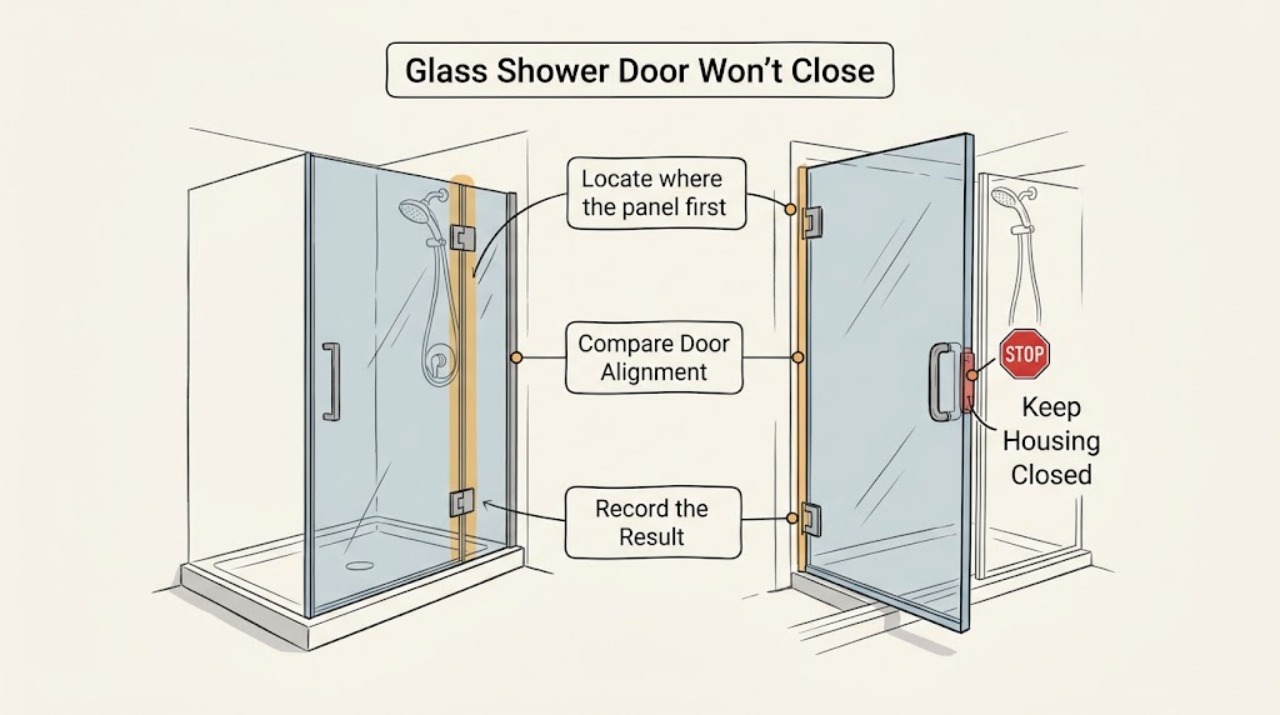
Work through in order
Diagnostic checks
Use only checks that match the exact appliance or system and its official guide.
-
Locate where the panel first stops
From a stable, dry position, move the shower door slowly toward closed only as far as it moves freely; watch the hinge side, bottom track, strike or fixed panel, and visible seals without pushing past resistance.
Expected result: Note whether the first contact is at the bottom, top, hinge side, strike side, or a seal, and whether the panel appears square with an even gap or slopes toward one corner.
Next step: Use the matching inspection below and stop if the panel binds, rocks, or requires force.
Stop if: Do not slam, lift, push through a hard stop, or place fingers at the glass edge or hinge pinch point.
Why this matters
Why: Bottom contact supports a track, threshold, or sag/alignment check. A changing top-to-bottom gap supports hinge or panel alignment. Strike-side or seal contact supports a gap, seal, or fixed-panel check.
-
Inspect the glass and visible hinge hardware
With the door stationary, use ordinary lighting to inspect both glass faces and the visible hinge or backplate for cracks, chips, edge contact, loose-looking fasteners, shifted plates, or movement where the hardware meets the glass.
Expected result: Classify the panel and hardware as intact and stable, visibly damaged, or loose/moving; note any new scraping or a gap that was not present before.
Next step: If intact and stable, continue to the track and seal checks; if damaged or moving, isolate the area and arrange qualified service.
Stop if: Do not touch a sharp or cracked edge, tighten hardware against the glass by guesswork, remove the hinge, or support a heavy panel alone.
Why this matters
Why: Damage or hardware movement can make the panel unsafe and can change its alignment. An intact, stable panel allows only the external track, seal, and model-specific adjustment checks to continue.
-
Check hinge alignment only by the exact door instructions
Compare the panel's top and bottom gaps and its bottom edge to the track; look for a door that has sagged or a hinge/backplate that has shifted. If the exact model guide permits adjustment, loosen only the specified fasteners enough for controlled movement and keep the panel supported as the guide requires.
Expected result: The panel is level and its bottom edge is parallel to the track, or one corner is low and the gap changes across the opening; record whether any fastener is loose without removing it.
Next step: Follow the exact manual's alignment sequence once, then retest gently; if the guide is unavailable or the panel cannot be safely supported, call a professional.
Stop if: Never remove hinge screws, separate the hinge from the backplate, or adjust a heavy glass panel without the required support and a second trained person.
Why this matters
Why: A sloping panel or unequal gap supports hinge or fixed-panel alignment. A level panel with no hardware movement makes track, seal, or strike clearance more likely. Hinge procedures are model-specific and over-loosening can release the panel.
-
Check the bottom track and threshold
From outside the door path, inspect the visible bottom track or threshold for debris, displacement, a raised imperfection, or a section that is not seated; use a level only from a safe position and do not pry the track or alter its mounting.
Expected result: The track is clean, seated, and level, or the panel contacts one area, the track is visibly uneven, or water and movement have changed its position.
Next step: Remove only loose surface debris without tools against the glass, then perform one gentle retest; arrange shower-door service if the track is unlevel, loose, damaged, or still contacting the panel.
Stop if: Do not drill, pry, shim, grind, cut, or reseat a track while the glass panel is unsupported.
Why this matters
Why: A door can fail to open or close properly when the bottom track is unlevel or imperfect, and panel contact with the track can damage glass or seals. A displaced or uneven track needs installation or structural assessment.
-
Check the seal and strike or fixed-panel gap
Inspect the visible bottom and side seals and the strike or fixed panel for a folded, displaced, swollen, or overlong seal, debris, or a gap that closes before the glass does; compare the arrangement with the exact model guide.
Expected result: The seal lies flat and clears the closing path, or it snags, bunches, rubs, or blocks the strike side; note whether the fixed panel or strike jamb appears shifted.
Next step: Remove only loose debris by hand and follow the model-specific seal or clamp procedure; if trimming, replacement, or fixed-panel movement is needed, use qualified service unless the exact guide explicitly authorizes the work.
Stop if: Do not cut glass, pull a seal from a loaded panel, add unapproved sealant, or force the door against the strike or seal.
Why this matters
Why: A seal or jamb that blocks the path can prevent closure even when the hinge is aligned. A shifted fixed panel or incorrect gap is an installation or adjustment issue, not a reason to force the glass.
-
Perform one controlled retest
After an allowed external adjustment or debris removal, keep the area clear and move the door through one slow open-and-close cycle without pushing past resistance; observe the panel, track, seals, and hinge throughout.
Expected result: The door closes with an even gap and no glass-to-track contact, or it still binds, reopens, scrapes, leaks, or shifts at the hinge.
Next step: Leave the door out of use and arrange qualified shower-door or glazing service when the fault remains, returns, or any damage or movement was found.
Stop if: Do not repeat forceful cycles, use the shower if the panel is unstable, or continue after glass contact, cracking, or hinge movement.
Why this matters
Why: A smooth cycle supports the corrected alignment or obstruction as the cause. Recurring binding, scraping, leakage, or movement indicates an unresolved installation, hardware, glass, or structural issue.
Use your observations
Decision map
Find the observation that best matches what you see, then follow the next safe action.
-
PATH 01Safety boundary
What you see
The glass is cracked or chipped, an edge is contacting the track, the hinge or backplate moves, or the panel has suddenly become heavy.
Do this next
Keep people away, do not use or support the panel alone, and arrange qualified shower-door or glazing service.
Why this path and its safety boundary
Why it matters: The closure fault may involve unsafe glass or loaded hardware and is no longer a routine adjustment check.
Safety stop: Do not touch damaged edges, remove hinges, or try to lift or straighten the panel.
-
PATH 02Safety boundary
What you see
The first contact is at the bottom and the panel is dragging on the threshold or track.
Do this next
Check only visible seating and level from a safe position; use the exact model adjustment procedure or call a shower-door professional if the track is uneven, loose, or the panel remains low.
Why this path and its safety boundary
Why it matters: Track seating, level, an imperfection, or hinge alignment may be preventing the panel from clearing the bottom path.
Safety stop: Do not pry, grind, shim, drill, or move the track with the glass installed and unsupported.
-
PATH 03Safety boundary
What you see
The panel is aligned but a seal, strike jamb, or fixed panel blocks the closing path.
Do this next
Compare the arrangement with the exact guide and have a qualified installer adjust or replace the seal or hardware when the procedure is not explicitly user-serviceable.
Why this path and its safety boundary
Why it matters: The gap or seal arrangement may be incorrect, displaced, or model-specific rather than a hinge failure.
Safety stop: Do not force the glass, cut tempered glass, remove a loaded seal, or add unapproved sealant.
-
PATH 04Safety boundary
What you see
The door still will not close after safe inspection and one model-authorized adjustment, or the opening, wall, track, or fixed panel appears distorted.
Do this next
Leave the door out of service and provide the model information, first-contact location, gap observations, photos, and any adjustment history to a qualified professional.
Why this path and its safety boundary
Why it matters: The cause may be installation movement, structural distortion, incompatible hardware, or a damaged component outside ordinary inspection.
Safety stop: Do not continue loosening hardware or attempt structural correction while the glass is installed.
Helpful context
Understand the symptom
Find the first obstruction without forcing the glass
A door that stops at one point gives more useful evidence than repeated force. Keep the floor dry, keep hands clear of the closing edge, and watch whether the panel is square to the opening, parallel to the bottom track, and meeting the strike or fixed panel evenly. A top or bottom gap that changes from one side to the other points toward alignment; a drag at the sill points toward track seating, level, or hinge position. The exact door instructions control any adjustment.
Treat glass and hinge damage as a stop condition
Tempered glass is strong in normal use but its edges and damaged areas need careful handling. Do not use a tool against a glass edge, try to straighten the panel by force, remove a hinge, or work underneath a heavy panel without trained help. If the glass is cracked or chipped, the hinge or backplate moves, or the door has suddenly become heavy, isolate the shower and call a qualified shower-door or glazing professional.
Safety boundary
Stop conditions
- Stop immediately for cracked or chipped glass, a sharp edge, glass-to-track contact, loose or moving hinge hardware, a suddenly heavy panel, or any panel that rocks or cannot be supported safely.
- Do not force, slam, lift alone, or repeatedly cycle a door that binds; keep people away from an unstable panel and arrange qualified shower-door or glazing service.
- Do not remove hinges, separate a hinge from its backplate, drill, cut, grind, pry, or modify tempered glass, track, seals, or structural mounting by guesswork.
- Use only the exact model's documented adjustment or seal procedure, and stop when the guide is unavailable or the work requires supporting or removing a heavy panel.
- Stop for water damage, a loose track, distorted wall or opening, or a leak that cannot be contained without disassembly.
Only after diagnosis
Potential parts
- glass door hinge assembly
Consider this category only if inspection confirms hinge movement, damage, or wear and a qualified professional identifies the hinge as the cause of the closure fault.
Confirm the exact door glass thickness, hinge orientation, mounting method, finish, and manufacturer fit information before ordering; do not select by appearance alone. - shower door bottom track or threshold seal
Consider this category only if the track or seal is visibly damaged or a professional confirms that it is causing bottom contact, leakage, or closure resistance.
Confirm the exact door system dimensions and drainage design; a replacement must not change glass clearance or trap water against the panel. - shower door strike jamb seal
Consider this category only if the visible seal or strike-side hardware is displaced, damaged, or incorrectly fitted after the door identity is confirmed.
Match the exact door system and seal profile with the manufacturer's information or a qualified installer; do not trim or force a seal against the glass.
When checks do not resolve it
Need a professional?
Arrange qualified shower-door, glazing, or installation service when glass or hinge damage is visible, the panel is heavy or unstable, the glass contacts the track, the track is loose or unlevel, the strike or fixed panel has shifted, a seal needs model-specific trimming or replacement, or the door still will not close after one safe model-authorized check. Provide the door model if known, first contact point, gap and track observations, photos, and any change that preceded the fault.
Safety scope: This article supports ordinary-access observation and only model-authorized external adjustment. Do not force or lift the panel, remove hinges, alter tempered glass, pry the track, or disassemble loaded hardware.
Common questions
FAQ
Why does a glass shower door stop before it closes?
The first contact may be a sagging or misaligned hinge, the bottom track, a seal, the strike or fixed panel, or a track that is not level. Move it slowly only to the first resistance and identify that location; do not force the glass.
Can I tighten or adjust a shower-door hinge myself?
Only follow the exact door model's documented procedure, and only when the panel can be safely supported as instructed. Do not remove hinge screws, separate the hinge from its backplate, or adjust a heavy glass panel alone.
When should I stop using the shower door?
Stop for a crack or chip, glass-edge contact, loose or moving hinge hardware, a heavy or unstable panel, a loose or uneven track, or any closure fault that remains after one safe model-authorized check. Keep people away and arrange qualified service.
Could the seal be preventing the door from closing?
Yes. A folded, displaced, overlong, or incorrectly fitted seal can block the strike side or bottom path. Inspect it without pulling a loaded panel apart and use only the exact model's seal procedure; have a professional trim or replace it when the instructions do not clearly authorize that work.
Read the exact guide
Official sources
- Pivot Shower DoorKohler Co. · Official pivot shower-door troubleshooting guide; use the installed door's exact model instructions for adjustment.
- Unlevel or Imperfect Bottom Shower Door TrackKohler Assist · Official shower-door support guidance for identifying an unlevel or imperfect bottom track; correction is installation-specific.
- Installation Guide: Pivot Shower DoorsKohler Co. · Official installation guide for specified Kohler pivot door families; safety principles apply generally, while dimensions and adjustment steps are model-specific.
- Hinge Shower Doors Installation and Care GuideKohler Co. / Sterling · Official hinge shower-door guide; exact seal and clamp details depend on the installed model.
Community feedback
Share a repair observation
Share a plain-text repair observation. Accepted observations are published automatically; this page may take a moment to update.