
On this page
Start here
Quick answer
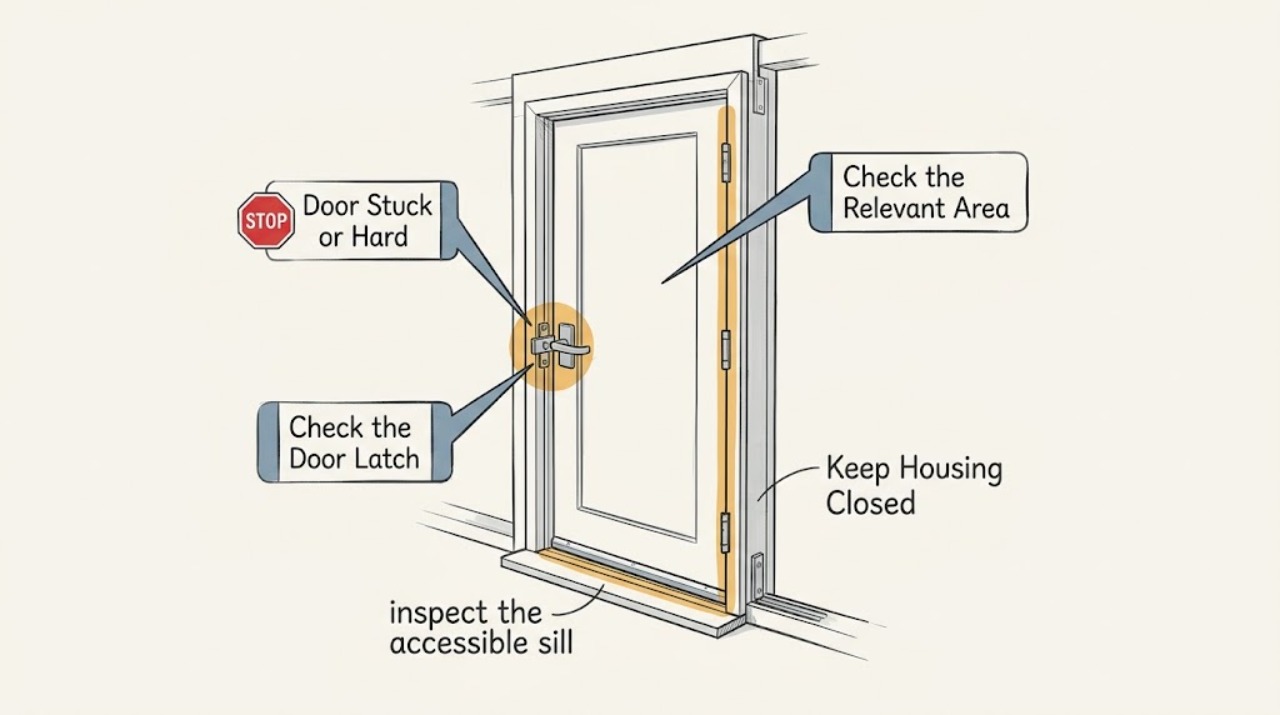
A stuck door is usually binding at the frame or sill, misaligned at the hinges or latch, obstructed in a track, or affected by a warped or moisture-damaged component. First determine whether the handle or lock is stuck, or whether the panel moves and then rubs; then inspect the visible contact point without forcing the door. A manufacturer guide may allow a small model-specific adjustment, but a door that is wedged, sagging, damaged, or unsafe to move should be left closed and assessed by a qualified door or window professional.
Work through in order
Diagnostic checks
Use only checks that match the exact appliance or system and its official guide.
-
Check 1
With the door supported by its normal position, try the handle or lock gently while watching the latch side; do not yank, ram, or lean your body weight into the panel.
Expected result: The handle or key will not move, the latch moves but the panel stays fixed, or the panel opens slightly and then contacts the frame, sill, or threshold.
Next step: Record the exact point where movement stops and continue with the matching visible inspection below; stop if the lock or panel requires force.
Why this matters
Why: A handle or key that will not move points first to lock or latch hardware; a moving latch with a fixed panel points to binding; contact at one location points to alignment, swelling, weatherstrip, or an obstruction at that location.
-
Check 2
Look along the hinge-side, latch-side, top, and bottom reveals with the door closed or only slightly open; check for a rub mark, a visibly uneven gap, loose-looking hinge hardware, or weatherstrip folded into the opening.
Expected result: The panel rubs at the top, bottom, or one side, the reveal is uneven, or no visible contact point is present.
Next step: Photograph the contact point and identify the door brand and model. Only use an adjustment procedure if the exact product guide identifies the adjustment; otherwise arrange an installer inspection.
Why this matters
Why: A localized rub or uneven reveal is consistent with a panel that is out of square, a shifted or binding hinge, a warped frame, or a displaced seal; no visible rub shifts attention toward the latch, sill, track, or concealed frame.
-
Check 3
If the door slides, inspect the accessible sill and track for leaves, grit, bent-looking track sections, or a panel that sits lower on one end; move the panel only through its normal light travel.
Expected result: Debris is visible, the panel has an uneven top-to-bottom reveal, or the track is clear and the reveal is even.
Next step: Remove only loose debris that is safely reachable with the panel stationary, then retest gently. If the reveal remains uneven, follow the exact roller-adjustment guide or call a professional; do not remove the panel as a first test.
Why this matters
Why: Debris or an uneven reveal can restrict a sliding panel or indicate roller height/alignment; a clear track with even reveal makes a latch, weatherstrip, or concealed hardware issue more likely.
-
Check 4
Check the sill, threshold, bottom sweep, and weatherstrip for a displaced seal, paint buildup, swelling, or an object caught in the closing path; look for dampness, odor, peeling paint, or discoloration around the frame.
Expected result: The bottom seal or threshold is visibly pinched or obstructed, or moisture and warping signs are present near the opening.
Next step: Remove only loose surface debris, keep the area dry, and stop using the door if the frame is soft, warped, or actively wet. Arrange a door professional and, when needed, a moisture or building-envelope assessment.
Why this matters
Why: A bottom obstruction can hold the panel against the sill, while moisture evidence raises concern about swelling, warped wood, rot, or a building-envelope issue rather than a simple latch adjustment.
-
Check 5
Identify whether the unit is a hinged patio or entry door, sliding patio door, or storm door, and gather its model label, installation guide, and any recent repair or weather event information.
Expected result: The unit type and guide are known, or the door type and hardware remain uncertain; the problem began after settling, a storm, repainting, or a hardware change.
Next step: Use the model-specific guide for a clearly identified low-force adjustment only; otherwise give the gathered details and photos to a qualified door or window professional.
Why this matters
Why: Adjustment points and safe limits are specific to the door system. A recent frame shift, coating buildup, storm, or hardware change can explain new binding, while uncertainty makes generic adjustment advice unsafe.
Use your observations
Decision map
Find the observation that best matches what you see, then follow the next safe action.
-
PATH 01Next step
What you see
The handle or key will not move, but the door panel is not visibly rubbing.
Do this next
Treat the latch or lock as the first suspect. Do not force the key or disassemble the lock; use the exact hardware guide or call a qualified locksmith or door professional.
-
PATH 02Next step
What you see
The latch moves but the panel rubs at the top, bottom, or one side, or the reveal is uneven.
Do this next
Treat alignment, hinge condition, frame movement, or weatherstrip position as the next path. Document the rub and use only a model-specific adjustment procedure.
-
PATH 03Next step
What you see
A sliding panel has debris in the track or an uneven top-to-bottom reveal.
Do this next
Clean only loose accessible debris and check the product's roller procedure. Escalate persistent unevenness rather than removing the panel or forcing the rollers.
-
PATH 04Next step
What you see
The threshold or bottom seal is obstructed, or the frame shows dampness, odor, peeling paint, swelling, or warping.
Do this next
Keep the area dry and stop using the door if the frame is soft or distorted. Arrange professional door and moisture assessment; a lock adjustment will not correct a damaged opening.
-
PATH 05Next step
What you see
The door is partly detached, glass is damaged, the lock is jammed in an occupied room, or opening it would compromise the only safe exit.
Do this next
Stop troubleshooting and obtain prompt professional help. Keep people clear of a heavy or unstable panel and do not remove hinge or closer hardware.
Helpful context
Understand the symptom
Do not treat every stuck door as a lock problem. A latch can be clear while the panel is rubbing the jamb, sill, weatherstrip, or threshold; a sliding panel can be held by debris or a changed roller setting; and a storm door can be held by its closer or bottom expander. The location where movement stops is more useful than pulling harder.
Keep the checks below to visible, low-force observations. Product designs and hinge adjustment methods differ, and a heavy door can drop if hardware is disturbed. Use the exact owner or installation guide for a confirmed model, or hand the observations to a qualified professional.
If the door is the only safe exit, the lock is jammed while someone is inside, glass is cracked, or the panel is sagging or partly detached, stop experimenting and arrange prompt professional help.
Only after diagnosis
Potential parts
- matching hinge or hinge adjustment hardware
Only relevant if the exact door guide or professional inspection confirms a worn, bent, or non-adjustable hinge is causing the rub.
Confirm the door model, hinge style, handing, fastener pattern, and load rating; a generic hinge is not assumed to fit or safely support the panel. - matching sliding-door roller or track component
Only relevant if a sliding-door inspection confirms roller wear or track damage after loose debris and alignment have been addressed.
Match the exact door system and roller dimensions or manufacturer part information; do not select by appearance alone. - matching weatherstrip or bottom sweep
Only relevant if the visible seal is displaced, damaged, or confirmed to be the contact point after frame alignment is checked.
Confirm the profile, length, attachment method, and door system before selection; a thicker seal can create new binding.
When checks do not resolve it
Need a professional?
Arrange an inspection for a door that remains stuck after loose debris is removed, has an uneven reveal or warped frame, involves a jammed lock, or cannot be safely opened without force.
Have this ready
- Provide photos of the latch side, hinge or track side, sill, contact marks, frame condition, model label, door type, and what changed immediately before the door became stuck.
Common questions
FAQ
Why is my door stuck if the lock seems to work?
The panel may be rubbing the frame, sill, threshold, weatherstrip, or track. Find the point where movement stops and compare the reveal rather than pulling harder.
Should I loosen the hinges or remove the door?
Not as a first test. Hinge designs and safe adjustment limits vary, and a heavy panel can drop or become more misaligned. Use the exact model guide or have a professional inspect it.
Can humidity make a door stick?
Moisture can be associated with swelling, warping, or rotting wood. If the frame or nearby finish is damp, discolored, peeling, or soft, address the moisture cause and arrange an assessment instead of trimming the door immediately.
What should I check on a stuck sliding patio door?
Look for loose debris in the accessible track and an uneven reveal from top to bottom. If the track is clear but the panel remains uneven or stuck, use the product's roller procedure or call a professional rather than removing the panel.
Read the exact guide
Official sources
- Patio Door AdjustmentsAndersen Windows & Doors · Andersen hinged and gliding patio door adjustment and maintenance
- TROUBLE SHOOTING GUIDEPella · Pella storm door installation and troubleshooting
- Adjust Hinges on 400 Series Frenchwood® Hinged Patio Doors, 1989 to 1991Andersen Windows & Doors · Andersen 400 Series Frenchwood hinged patio doors manufactured from 1989 to 1991
- Common Signs of Moisture ProblemsU.S. Department of Energy Building Science Education · Building moisture problem signs
Community feedback
Share a repair observation
Share a plain-text repair observation. Accepted observations are published automatically; this page may take a moment to update.