
On this page
Start here
Quick answer
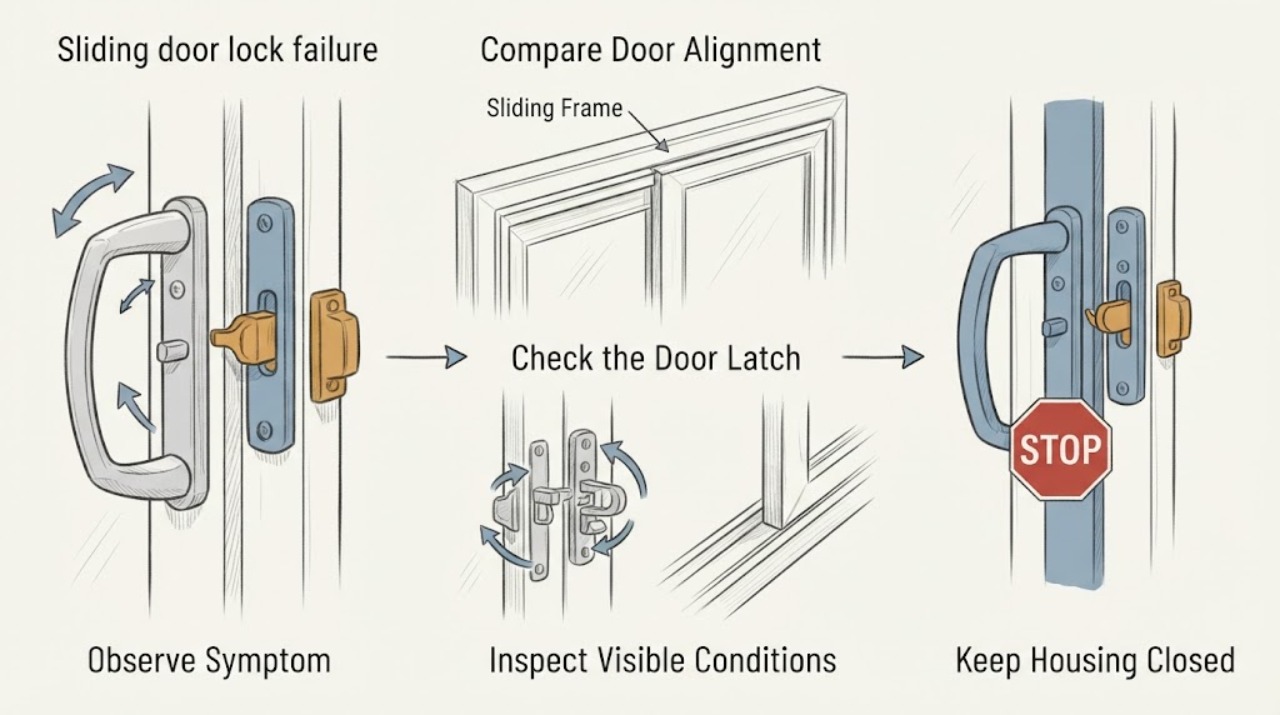
Start with safe observations: check whether the panel is fully closed and visually aligned with the jamb, whether the latch or keeper appears offset, and whether the handle or lock control moves normally without force. Note any glass damage, binding, loose hardware, or sill-track obstruction, but do not bypass the lock, remove glass or the door panel, force the handle, or follow an installation procedure. If the door cannot be secured, the glass or frame is damaged, or alignment is not obvious, keep the opening attended or otherwise protected and arrange qualified patio-door service promptly.
Work through in order
Diagnostic checks
Use only checks that match the exact appliance or system and its official guide.
-
Observe the closed panel and jamb alignment
With the door stationary, look at the gap between the moving panel and the locking jamb from inside and outside where safely accessible; note whether the panel appears fully seated, parallel, and aligned with the keeper without pushing or pulling it.
Expected result: The panel may look square and fully closed, may sit high or low relative to the jamb, may show a tapered gap, or may stop short of the closed position.
Next step: Photograph the alignment and arrange patio-door service. Do not lift, shove, slam, or adjust the panel to make the latch meet.
Stop if: Stop if the panel is cracked, loose, off its track, unstable, or requires force to reach the closed position.
Why this matters
Why: A visible offset or incomplete closure can keep the latch from meeting the keeper even when the lock itself is intact. A normal-looking alignment with a non-working lock makes a handle, latch, keeper, or internal mechanism issue more likely.
-
Compare the visible latch and keeper positions
From a safe position with the door closed, observe the visible latch or hook and the keeper opening for an offset, bent-looking part, missing cover, loose-looking fastener, or obstruction; do not remove covers, turn adjustment screws, or probe the lock.
Expected result: The latch and keeper may appear aligned, may be visibly offset, or may be obscured by damage or a loose component.
Next step: Save a close photograph from outside the mechanism's path and give it to a qualified repairer. Keep the door from being used if the latch or keeper is loose or sharp.
Stop if: Stop if observing the mechanism would require opening the lock body, removing trim, touching a sharp or loose part, or forcing the handle.
Why this matters
Why: An offset or damaged-looking interface can explain why the lock will not engage, while a clear aligned interface with no movement points toward an internal lock or handle fault. Visual position alone does not authorize adjustment.
-
Observe normal sliding and handle behavior
If the glass and frame are intact and the panel moves normally, use only the ordinary handle movement and a gentle normal slide to note whether the door binds, scrapes, stops short, or the lock control moves through its normal range; do not repeat attempts or force travel.
Expected result: The panel may slide smoothly but fail to latch, may bind near the jamb, may stop before the keeper, or the handle may feel loose, stiff, or disconnected.
Next step: Stop using the door if it binds, scrapes glass, needs force, or cannot close safely; arrange qualified patio-door service and report the exact point of resistance.
Stop if: Stop immediately for cracked glass, a loose panel, grinding, sudden resistance, a handle that may break, or any need to pull hard or repeat the cycle.
Why this matters
Why: Smooth travel with a lock-only symptom points toward the latch, keeper, handle, or internal lock. Binding or stopping short can leave the panel out of alignment and needs service before lock adjustment or replacement.
-
Inspect visible sill, frame, and security context
From outside the panel path, look at the exposed sill track and frame for visible debris, bent or damaged sections, moisture, corrosion, or a gap that leaves the door unsecured; note any already-visible product label without removing trim.
Expected result: The sill may look clear and dry, show debris or damage near the closing side, or have moisture, corrosion, or a visible gap after the lock is engaged.
Next step: Keep the opening supervised or otherwise protected with non-invasive normal household measures and contact a qualified repairer. Share the visible condition and label/model information.
Stop if: Stop if the frame or glass is damaged, the track is bent, water is entering, the panel is unstable, or inspection would require removing the door or glass.
Why this matters
Why: A track or frame condition can prevent full closure and indirectly cause a lock failure. Moisture or corrosion may indicate a longer-term door condition. A gap that remains after the lock is used is a security issue requiring prompt service.
Use your observations
Decision map
Find the observation that best matches what you see, then follow the next safe action.
-
PATH 01Next step
What you see
The door cannot be latched or locked and the opening cannot be secured by normal operation.
Do this next
Treat it as a high-priority security repair, keep the area attended or otherwise protected without bypassing the lock, and arrange qualified patio-door service promptly.
-
PATH 02Next step
What you see
Glass, frame, panel, track, or keeper is cracked, loose, bent, sharp, or unstable.
Do this next
Stop using and touching the door, keep people away, and request urgent qualified glass or patio-door service. Do not remove the glass or panel.
-
PATH 03Next step
What you see
The panel stops short, sits visibly high/low, or binds before the latch reaches the keeper.
Do this next
Do not force or adjust the panel. Arrange professional alignment and lock inspection and report where the resistance begins.
-
PATH 04Next step
What you see
The panel slides normally and appears aligned, but the handle, latch, or keeper does not engage.
Do this next
Request qualified lock/handle/keeper diagnosis. Do not bypass the lock, drill the mechanism, or select a replacement from appearance alone.
-
PATH 05Next step
What you see
The visible condition is inconclusive or the lock behavior is intermittent.
Do this next
Stop repeated testing, document the symptom and product identity, and schedule patio-door service before the lock worsens or leaves the opening unsecured.
Helpful context
Understand the symptom
A lock failure can be an alignment symptom
A sliding door lock engages only when the moving panel, latch, and keeper meet in the intended position. A panel that is not fully seated, a visible offset, a worn handle, or an obstruction can all look like a failed lock. Observation can narrow the service call, but it cannot safely substitute for model-specific repair.
Do not turn a security problem into a glass hazard
Large patio-door panels contain glass and can be heavy or unstable if moved incorrectly. Do not remove the glass, lift the panel, dismantle the lock body, drill the frame, or force a stuck handle. If the door will not secure, use normal household security measures that do not alter the door or bypass its lock while arranging service.
Record the product identity
A model or serial label can help the technician identify the correct lock, handle, or keeper. Photograph or transcribe a label only when it is already visible and reachable without opening the panel or removing trim.
Only after diagnosis
Potential parts
- sliding-door-lock
Consider a lock replacement only after a qualified technician confirms that the lock body is defective and that panel alignment and the keeper are not the cause.
Match the door series, panel material, lock geometry, handing, finish, and mounting pattern; do not infer compatibility from a similar-looking part. - patio-door-handle
A handle is conditional on diagnosis showing a broken, loose, or disconnected handle rather than an alignment, keeper, or internal latch problem.
Confirm door model, screw spacing, backset, handing, and lock interface before professional replacement. - keeper-plate
A keeper plate is relevant only if service inspection finds a damaged or incorrect keeper after confirming the panel is correctly aligned.
Keeper position and geometry are model-specific; do not move or drill the frame as a trial adjustment.
When checks do not resolve it
Need a professional?
Call promptly for an unsecured opening, cracked or loose glass, an unstable panel, frame or track damage, a sharp component, or a lock that fails intermittently. Do not wait for a full failure if the door is a primary security or weather barrier.
Common questions
FAQ
Why will my sliding patio door not lock?
The panel may not be fully aligned with the jamb, the latch or keeper may be damaged or offset, the handle may be failing, or the panel may bind before it closes. Observe these conditions without forcing or dismantling the door and arrange service.
Can I bypass a broken sliding-door lock temporarily?
Do not bypass or defeat the lock, drill the frame, or wedge the mechanism. Treat an unsecured opening as a high-priority repair and use only non-invasive normal household security measures while arranging qualified service.
Can I remove the glass or door panel to reach the lock?
No. Sliding panels can be heavy and contain glass. Do not remove the glass, panel, trim, or lock body; have a qualified patio-door professional handle access and replacement.
What information should I provide to a door repairer?
Provide the panel/jamb gap, latch/keeper alignment, handle feel, point of any binding, visible track or frame damage, whether the opening remains unsecured, and the model or serial label if safely visible.
Read the exact guide
Official sources
- Contact UsAndersen Corporation · Sliding patio-door lock or hardware failure requiring model-specific support
- Find Your Pella Serial NumberPella Corporation · Gathering model or serial information for a sliding-door lock service request
- Tips for Your Home’s Patio Door SecurityPella Corporation · Sliding patio door that cannot be securely locked
Community feedback
Share a repair observation
Share a plain-text repair observation. Accepted observations are published automatically; this page may take a moment to update.