
On this page
Start here
Quick answer
Start from the room side or another ground-level position. Confirm which window opening and screen orientation are involved, then compare the clear opening at several points with the screen frame, visible track, clips, and sill. A clear track with a straight screen frame often points to a wrong screen identity or damaged retaining hardware; measurements that vary, a bowed frame, a damaged track, persistent gaps, or any need for force points to a window or screen professional. Do not use an exterior ladder, remove window glass, force the screen, cut the frame, or disturb suspect old paint.
Work through in order
Diagnostic checks
Use only checks that match the exact appliance or system and its official guide.
-
Check 1
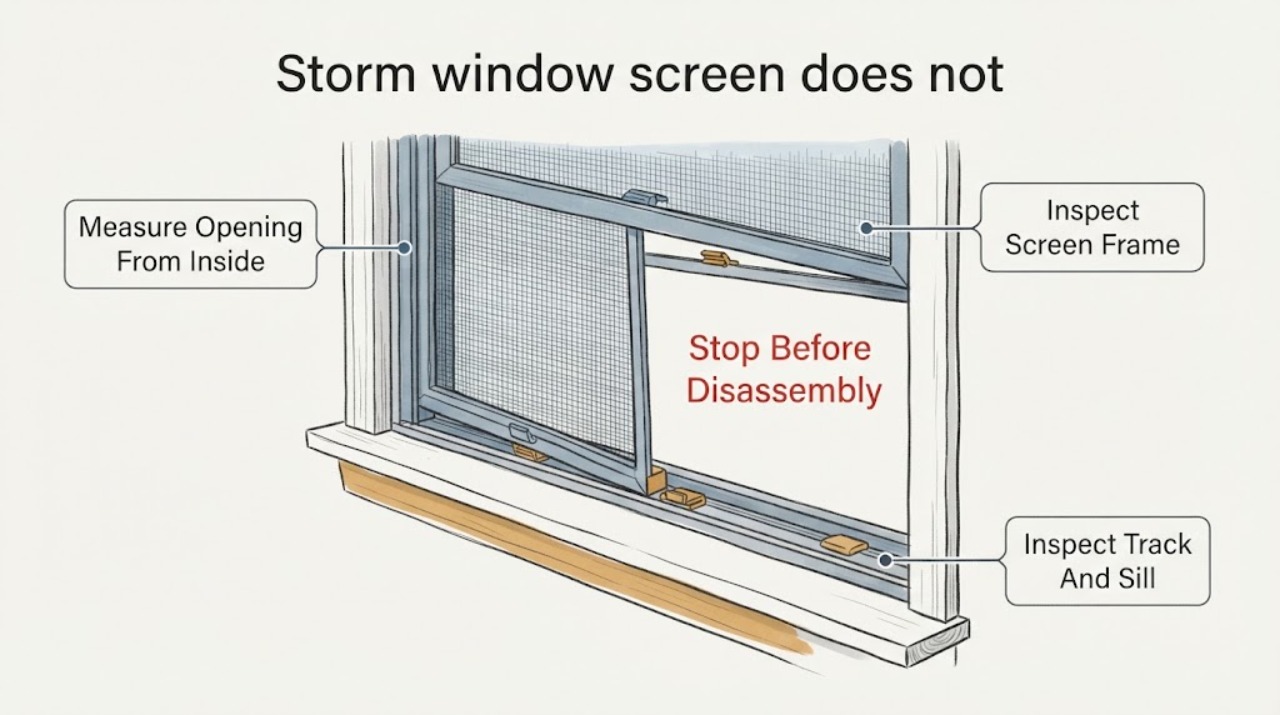
With the window closed and stable, measure the clear opening from inside or from ground level: record width at the top, middle, and bottom, height at the left, center, and right, plus the visible track depth and stop location. Do not climb, remove glass, or force the screen into the opening.
Expected result: The readings are consistent and the opening looks square, or they vary from one location to another.
Next step: Keep the measurements and a room-side photo for a professional fit check; continue only with other safe visual observations if the opening is stable and accessible.
Stop if: Stop if the only way to measure is outside the building, near an unprotected opening, or over a ladder; request professional service instead.
Why this matters
Why: Consistent readings make a wrong screen orientation, wrong window-series match, or damaged screen hardware more likely. Varying readings point toward frame, track, alignment, or seasonal movement that should be assessed before ordering a screen.
-
Check 2
If the screen is already safely accessible without force, inspect its frame from a stable surface or room side. Look at the corners, mesh or spline, clips, springs, latch tabs, and any identification marking; do not pry a stuck screen or bend the frame to make it fit.
Expected result: The frame is straight and hardware is intact, or a corner is bowed, twisted, loose, cracked, or missing retaining hardware.
Next step: Compare the screen orientation and markings with the window documentation or provide them to a window-screen professional; do not order a part until the window series and opening are confirmed.
Stop if: Stop when the screen is stuck, the frame could fall, mesh damage leaves a sharp edge, or inspection would require exterior access or glass handling.
Why this matters
Why: An intact frame with a clear opening keeps identity or orientation in the foreground. A bent frame, loose mesh, or missing clip can prevent seating and may need a matched frame or repair assessment rather than adjustment by force.
-
Check 3
From inside or ground level, inspect the visible track, channel, stops, and sill. Look for loose material, paint buildup, distortion, blocked drainage paths, or a channel that does not match the screen edge; do not scrape, drill, or alter an unknown coating.
Expected result: The channel is clear and continuous, has removable-looking surface debris, or appears damaged, painted over, distorted, or uncertain.
Next step: Photograph the track and sill without disturbing them and ask a qualified technician whether the channel is serviceable and which screen configuration belongs there.
Stop if: Stop if the track is loose, sharp, structurally damaged, or coated with material that may contain lead, or if reaching it would require a ladder or exterior work.
Why this matters
Why: A clear channel makes a screen identity or frame issue more likely. Debris may explain a partial seat, while distortion or an uncertain coating raises the risk of damaging the frame or disturbing old paint.
-
Check 4
Note when the mismatch appears and whether the gap or seating changes with temperature, humidity, or seasonal weather. Observe the screen and sash without pushing, prying, or changing window hardware.
Expected result: The screen fits intermittently or the gap changes with conditions, or it fails in the same way every time.
Next step: Give the technician the timing, locations of any gaps, and the measurement comparison so the visit can distinguish a replacement screen from an opening or track problem.
Stop if: Stop if the window or screen shifts unexpectedly, the gap exposes a fall hazard, or safe observation cannot be maintained.
Why this matters
Why: An intermittent change makes frame movement, alignment, or seasonal expansion more plausible. A constant failure keeps wrong identity, damaged frame, or damaged track in consideration.
-
Check 5
Confirm that the screen identity, measurements, frame condition, track condition, and seasonal behavior are documented and that no force, exterior access, glass removal, frame cutting, or coating disturbance is needed.
Expected result: All of those conditions are clear and the screen is stable, or any condition remains unknown or unsafe.
Next step: Use the record to request a qualified window or screen fitting service and ask for the correct assembly to be confirmed before any part is purchased.
Stop if: Stop and arrange professional service when any safety boundary is reached or the screen cannot be handled without force.
Why this matters
Why: A clear, stable record supports a model- and opening-specific fit assessment. An unknown or unsafe condition means the screen should not be treated as a do-it-yourself installation problem.
Use your observations
Decision map
Find the observation that best matches what you see, then follow the next safe action.
-
PATH 01Next step
What you see
The width or height changes across the opening, or the frame and track do not appear square.
Do this next
Treat the mismatch as an opening, alignment, or track assessment. Do not trim or bend the screen; provide the measurement pattern and room-side photos to a window professional.
-
PATH 02Next step
What you see
The screen frame is bowed or twisted, the mesh is loose, or a clip, spring, or latch tab is damaged.
Do this next
Ask for a matched screen-frame or hardware assessment after the window series and orientation are confirmed. Do not force the frame flat or substitute a part based only on appearance.
-
PATH 03Next step
What you see
The visible channel is blocked, distorted, loose, sharp, or coated with an uncertain material.
Do this next
Stop disturbing the area and request professional inspection. A track condition can prevent a correct screen from seating and may carry a coating or damage risk.
-
PATH 04Next step
What you see
The opening is stable, the track is clear, and the screen frame looks straight, but it still does not seat.
Do this next
Confirm the window series, sash arrangement, screen orientation, and any frame marking with a qualified fitter before considering a replacement screen or clip.
-
PATH 05Next step
What you see
The check requires a ladder, exterior access, glass handling, force, frame cutting, or disturbance of suspect old paint.
Do this next
Stop and arrange qualified window service; keep people away from the opening until the screen and window can be assessed safely.
Helpful context
Understand the symptom
Why a screen can appear to be the wrong size
Storm-window and combination-screen assemblies can be specific to a window series, sash arrangement, and opening direction. A screen that looks close may still have the wrong frame orientation or retaining hardware. Treat the screen identity and the opening as a matched pair rather than assuming a universal fit.
Use measurements to separate fit from frame movement
Measure only from a stable interior or ground-level position. Compare the opening at the top, middle, and bottom, and compare height at the left, center, and right. Record the visible track or stop arrangement and the screen-frame dimensions without forcing anything into place. Differences across those points can indicate a non-square opening, track distortion, or seasonal movement rather than a simple screen replacement.
Keep the check observational
A screen is not a fall-protection device. Stop if the check would require leaning outside, handling glass, prying a stuck assembly, drilling, cutting, or scraping unknown coatings. A qualified window or screen technician can identify the assembly and assess fit without turning a mismatch into window damage or a fall hazard.
Only after diagnosis
Potential parts
- screen clip
Consider this category only if a safe inspection confirms that a retaining clip is missing or damaged and the window series and screen orientation are known.
Confirm the exact window series, screen configuration, and fit information before ordering; appearance alone is not proof of compatibility. - screen frame kit
Consider this category only if the existing screen frame is confirmed bowed, twisted, or otherwise unserviceable and the opening has been assessed as stable.
Use the measured opening and exact window-series information to verify fit; do not assume a generic frame will seat in a storm-window track. - screen mesh
Consider mesh only when the frame and retaining system are confirmed sound and the problem is limited to damaged mesh rather than a size or track mismatch.
Confirm the frame construction and retaining method with a qualified fitter before selecting mesh; mesh alone will not correct a bent frame or distorted track.
When checks do not resolve it
Need a professional?
Call a qualified window or screen-fitting professional when the screen is persistently mismatched, the opening measurements vary, the frame or track is bent or damaged, gaps remain, the window series is unknown, or any inspection would require exterior access, glass handling, force, cutting, or coating disturbance.
Have this ready
- Provide the window location, inside/ground-level photos, width and height comparisons, visible track and stop arrangement, screen-frame markings, frame or hardware observations, and the temperature or season when the mismatch changes.
Common questions
FAQ
Why does a screen fit one side of a storm window but not the other?
The screen may have a directional frame, retaining tabs, or a track relationship tied to that window series. Compare the frame orientation and visible stops from inside without forcing it, then confirm the assembly with a qualified fitter.
Should I trim a screen that is slightly too large?
No. Trimming can remove the retaining edge, weaken the frame, or hide an opening or track problem. Document the opening measurements and have the exact screen configuration confirmed first.
What if the screen fits only in some weather?
Record when the fit changes and whether the gap changes with temperature or humidity. Intermittent behavior can point to frame movement or alignment rather than a simple mesh replacement, so provide that timing to a window professional.
Can a storm-window screen protect a child from a fall?
No. The manufacturer sources state that a screen will not stop a child from falling through an open window. Keep children away from the opening and use qualified service for any unsafe window condition.
Read the exact guide
Official sources
- Accessory Guide: Storm/Screen Combination UnitAndersen Windows & Doors · Supports checking window-unit type and using the applicable component configuration; it is not a universal screen-sizing guide.
- Storm/Insect Screen Combination Unit for Andersen Double-Hung WindowsAndersen Windows & Doors · Useful as a manufacturer example that screen assemblies, frame latches, tracks, and window-series identity are interdependent; this generic article does not claim the reader has an Andersen window.
Community feedback
Share a repair observation
Share a plain-text repair observation. Accepted observations are published automatically; this page may take a moment to update.