
On this page
Start here
Quick answer
For a storm window draft with wind noise, first log wind direction, gust timing, and whether the sound is a whistle, flutter, rattle, or vibration. From indoors or safe ground level, compare the storm panel, seals, frame, latches, hardware, primary window, and surrounding trim without touching or forcing them. Do not climb, remove glass or panels, use flame, smoke, hose, pressure, or impact tests, or buy a seal before the moving or leaking layer is confirmed.
Before you begin
Safety first
- Do not force, climb, reach outside, remove glass or panels, bypass a closure, test with flame, smoke, hose, pressure, or impact, or disturb loose, cracked, wet, or unstable material.
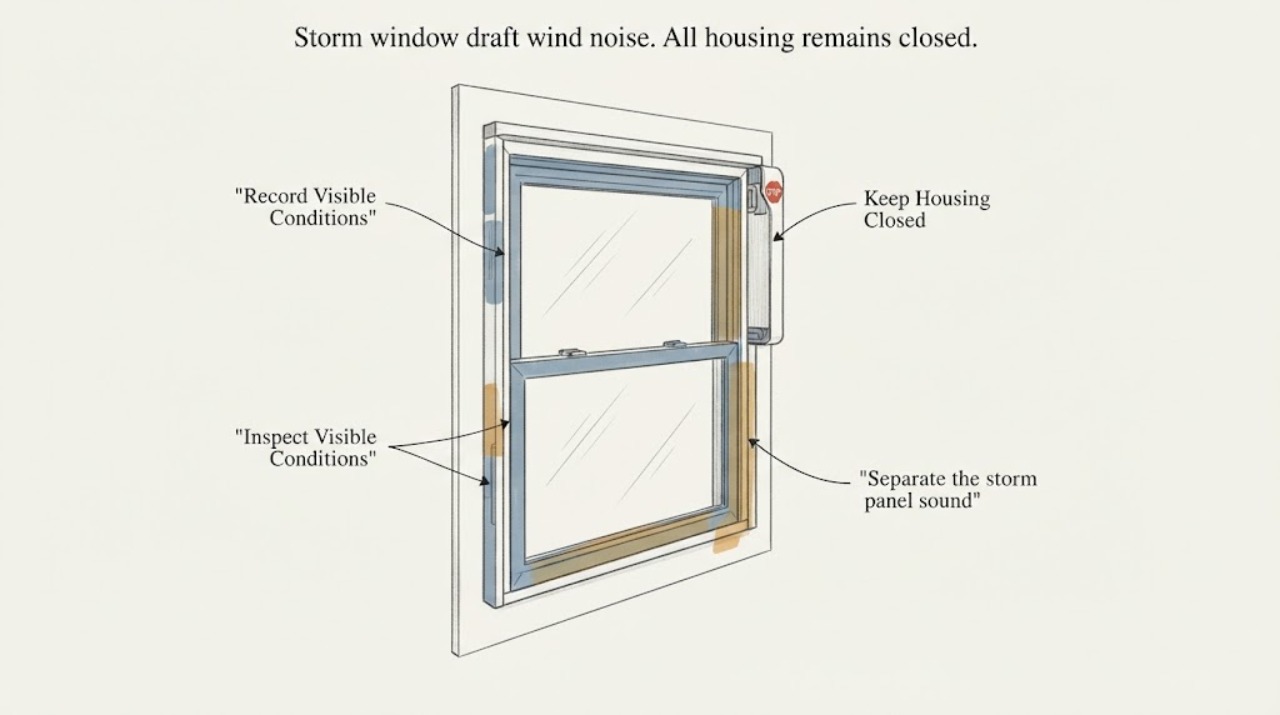
Work through in order
Diagnostic checks
Use only checks that match the exact appliance or system and its official guide.
-
Check 1
From inside and from a safe ground-level position outside, record when the storm window draft and wind noise occur. Compare the wind direction, approximate speed from a weather report, gusts, and whether the sound starts or stops with the gusts.
Expected result: Record gust-synchronous whistle, flutter, rattle, vibration, low roar, or a steady sound that does not track wind changes.
Next step: Make a dated note of wind direction, gust conditions, room, and exact timing, then continue with visual checks without forcing the window.
Stop if: Stop if the window or glass appears loose, cracked, displaced, or likely to fall, or if checking it would require a ladder, reaching outside, force, or opening an inaccessible assembly.
Why this matters
Why: Noise that tracks gusts from one direction suggests an air path or movement at the storm panel, frame, seal, or hardware; noise that persists in calm conditions may involve a loose component or the primary window instead.
-
Check 2
Look at the storm panel, its frame, perimeter seals, and visible fasteners from a stable position. Compare the noisy edge with the quiet edges and with another storm window exposed to similar wind.
Expected result: Record whether the sound is strongest at a corner, sill, meeting rail, side channel, latch, screen, or no identifiable edge.
Next step: Photograph the edge, seal, latch, and fastener condition from inside or ground level. Do not press on the panel or insert a tool to find the gap.
Stop if: Do not loosen, tighten, pry, tape over a moving panel, or handle a seal or fastener if glass is loose or the panel can shift.
Why this matters
Why: A localized gap, lifted seal, moving panel edge, or rattling fastener points toward the storm-window assembly; an even perimeter with no panel movement makes the frame, primary window, or surrounding wall path more plausible.
-
Check 3
Separate the storm panel sound from the primary window by observing both layers and the surrounding trim during the same safe wind event; note whether the interior sash, exterior storm panel, frame, or wall trim appears to move or vibrate.
Expected result: Record storm panel only, primary window only, both layers, trim or wall area, or no visible movement despite noise.
Next step: Use the layer and location in the service request, and avoid labeling a storm-window part as the cause until the professional confirms the moving layer.
Stop if: Stop if any layer shifts, glass shows a crack or chip, a sash is unlatched, or further observation would require touching, removing, or leaning out of the window.
Why this matters
Why: A panel-only flutter is a different path from a primary-window sash or frame movement. A sound at the trim or wall may indicate an opening around the window rather than a replaceable storm-window seal.
-
Check 4
Inspect the visible closure and hardware state without opening the assembly: note whether latches appear fully engaged, a channel is obstructed, a screen is loose, or a fastener is visibly missing or displaced.
Expected result: Record engaged and stable, visibly open, loose-looking, obstructed, missing hardware, or cannot safely see.
Next step: Record the exact hardware and condition for a window professional; do not force a latch, remove a screen, or substitute a fastener.
Stop if: Do not operate a jammed or loose closure, remove glazing, reach over a sill, or work at height.
Why this matters
Why: A closure or hardware observation can explain a rattle or air path, but a latch that looks closed does not prove compression of the seal or secure attachment of the storm panel.
-
Check 5
Look for related signs after wind or rain from indoors and at ground level: water at the sill, condensation, dust trails, daylight at an edge, staining, swollen trim, or damage around the primary frame.
Expected result: Record dry and clean, condensation only, active water, historic staining, dust or dirt path, daylight, trim damage, or uncertain.
Next step: Photograph the location and timing, keep the area dry and undisturbed, and request coordinated window or building-envelope service when moisture or wall damage is present.
Stop if: Stop for active water near electrical equipment, crumbling or unstable trim, mold-like growth, cracked glass, or any need to open a wall or remove window components.
Why this matters
Why: Water or wall symptoms change the task from a noise-only seal question to possible window, flashing, or wall-envelope assessment. A clean, dry interior does not rule out an air leak, but it lowers evidence of active water entry.
-
Check 6
Review the accessible history: installation or replacement date, recent storm or impact, seal or screen work, paint or renovation, and whether the sound is new, seasonal, or present in calm weather.
Expected result: Record the first occurrence, triggering weather, prior repair, and whether the same pattern repeats at the same edge.
Next step: Give the timeline, wind conditions, sound location, layer, and moisture findings to a qualified window professional before buying a weatherstrip, caulk, film, or other material.
Stop if: Do not conduct a flame, candle, smoke, pressure, hose, or impact test and do not make a temporary seal that could hide movement or trap water.
Why this matters
Why: A recent installation, impact, or seal change makes fit and hardware more plausible; a long-standing gust-only sound may be an air-leakage path; a new sound in calm weather raises concern for loose or damaged material.
Use your observations
Decision map
Find the observation that best matches what you see, then follow the next safe action.
-
PATH 01Safety boundary
What you see
The sound is a whistle or flutter that begins with gusts and is localized to a storm-panel edge, seal, or channel, with no loose glass or active water visible.
Do this next
Have a window professional confirm the panel, channel, and seal dimensions before choosing weatherstrip or rope caulk.
Why this path and its safety boundary
Why it matters: The storm-window weatherstrip or panel fit is a reasonable service hypothesis, but a visual check cannot establish the correct profile or length.
Safety stop: Do not pry the panel, pull out the seal, or apply material over a moving or wet edge.
-
PATH 02Safety boundary
What you see
The sound is a rattle or vibration at a latch, fastener, screen, or frame, and the sound changes when gusts strike one direction.
Do this next
Keep the window undisturbed and request inspection of the storm hardware, frame attachment, and primary window support.
Why this path and its safety boundary
Why it matters: A loose-looking closure or frame movement may be carrying wind load; tightening by guess can damage the frame or leave glass unsecured.
Safety stop: No force, fastener removal, panel handling, or high-access work.
-
PATH 03Safety boundary
What you see
The primary window or trim moves or sounds while the storm panel appears stable.
Do this next
Describe the moving layer and request a window or building-envelope assessment that includes the primary frame and surrounding trim.
Why this path and its safety boundary
Why it matters: The storm panel may be transmitting or masking a primary-window sash, frame, or surrounding opening problem; a storm-window seal alone may not resolve it.
Safety stop: Do not remove the storm panel, open a sash that appears loose, or reach outside to inspect the exterior.
-
PATH 04Safety boundary
What you see
The noise is present in calm weather, is new after an impact or installation, or no edge can be identified safely.
Do this next
Keep people away from the window if anything is loose-looking and arrange professional diagnosis; provide photos and the calm-weather observation.
Why this path and its safety boundary
Why it matters: The issue may be a displaced panel, frame or hardware problem, concealed gap, or damage rather than ordinary wind-driven air leakage.
Safety stop: Do not create wind or pressure, shake the window, use smoke or flame, or attempt an unverified repair.
-
PATH 05Safety boundary
What you see
Cracked, chipped, loose, displaced, or unstable glass or panel material is visible.
Do this next
Keep people clear, avoid touching the window, and request prompt qualified glass or window service; follow local emergency guidance if failure is imminent.
Why this path and its safety boundary
Why it matters: The potential falling or cutting hazard takes priority over draft or noise reduction.
Safety stop: No ladder, glass removal, taping as a structural fix, pressure test, or continued operation of a visibly unsafe assembly.
-
PATH 06Safety boundary
What you see
Water, condensation with damage, staining, daylight into the wall, or swollen trim is present after wind or rain.
Do this next
Document the rain and wind timing and request coordinated window and building-envelope assessment before applying film, caulk, or weatherstrip.
Why this path and its safety boundary
Why it matters: The window may have an air and water-management problem involving flashing, frame, or wall, so sealing only the visible storm-panel edge could trap moisture or miss the source.
Safety stop: Do not open the wall, remove trim, hose the window, or cover active water damage.
Helpful context
Understand the symptom
Use the wind and sound pattern to locate the path
Wind noise at a storm window is most useful when tied to wind direction, gust timing, and the layer that moves. A whistle or flutter at one storm-panel edge is not the same diagnosis as a rattle at the frame, a primary-window sash that vibrates, or sound coming from the surrounding trim. Record the pattern from indoors or a safe ground-level position without touching glass or forcing hardware.
Observation-only boundary
Look for visible seals, channels, latches, fasteners, moisture, daylight, staining, and trim changes, but do not remove a storm panel or open a window that appears loose. Do not climb, reach outside, use a flame, candle, smoke, hose, pressure, or impact test, or make a repair that could hide movement or trap water.
Choose material only after the layer is confirmed
Official energy guidance treats weatherstripping, storm windows, air leakage, and moisture management as related but distinct performance questions. Have the exact storm-window profile, frame, primary window, and surrounding wall checked before selecting a material or replacement.
Safety boundary
Stop conditions
- Stop for cracked, chipped, loose, displaced, or unstable glass; active water; damaged or crumbling trim; exposed energy; or any check requiring a ladder, reaching outside, force, disassembly, or opening a wall.
- Do not use flame, candle, smoke, hose, pressure, or impact tests, and do not remove panels, glazing, seals, or hardware as an experiment.
Only after diagnosis
Potential parts
- storm-window-weatherstrip
Consider only after the noisy layer and seal profile are confirmed; a frame, latch, primary window, or wall opening can produce the same sound.
Verify the complete storm-window model, revision, profile, dimensions, material, and manufacturer instructions before purchase or installation. - rope-caulk
Consider only for a confirmed, stable, dry air gap where the professional says it will not block drainage, movement, or safe operation.
Verify the complete window type, substrate, dimensions, material, and manufacturer instructions before purchase or installation. - window-film
Consider only for a confirmed glazing and comfort goal; film does not secure loose glass, repair a frame, or correct a water path.
Verify the complete window type, glazing, dimensions, climate use, and manufacturer instructions before purchase or installation.
When checks do not resolve it
Need a professional?
Call a qualified window professional when the sound persists or recurs, the moving layer is uncertain, weatherstrip or other material may be needed, or the window shows moisture, damage, loose hardware, cracked glass, or unsafe access.
Safety scope: Do not force, climb, reach outside, remove glass or panels, bypass a closure, test with flame, smoke, hose, pressure, or impact, or disturb loose, cracked, wet, or unstable material.
Have this ready
- Provide window type and model if accessible, room and layer affected, wind direction and gust timing, exact sound pattern and location, dated photos, moisture or damage findings, and the installation or impact timeline.
Common questions
FAQ
What should I listen for when a storm window makes wind noise?
Note whether the whistle, flutter, or rattle follows gusts, which edge or layer is loudest, and whether the wind direction changes it. Stay indoors or on the ground outside.
Is a worn weatherstrip always the cause?
A panel-edge whistle may involve a seal or channel, but a frame, latch, primary window, or wall opening can sound similar. Do not choose a seal by appearance alone.
Should I apply rope caulk or film immediately?
No. First identify whether the storm panel, primary window, frame, or wall path is moving or leaking, then have dimensions and material compatibility confirmed.
When is wind noise a safety issue?
Keep people away and call promptly for cracked, loose, displaced, or unstable glass; active water; damaged trim; or a window that cannot be safely observed from the floor.
What should I give a window professional?
Provide the window type, room, wind direction and gust timing, sound pattern, moving layer, visible seal or hardware condition, photos, and any rain or impact timeline.
Read the exact guide
Official sources
- Window FlashingU.S. Department of Energy Building Science Education · Supports the possibility that high-wind window problems can involve the surrounding opening and water-management layer, not only the visible storm panel.
- Storm WindowsENERGY STAR · Supports the distinction between air leakage, storm-window performance, and the need for professional installation or model-specific product criteria.
- Window Types and TechnologiesU.S. Department of Energy · Supports the relationship between storm windows, air leakage, weatherstripping, and drafts; it does not authorize ladder work or a repair on an unidentified window.
Community feedback
Share a repair observation
Share a plain-text repair observation. Accepted observations are published automatically; this page may take a moment to update.