
On this page
Start here
Quick answer
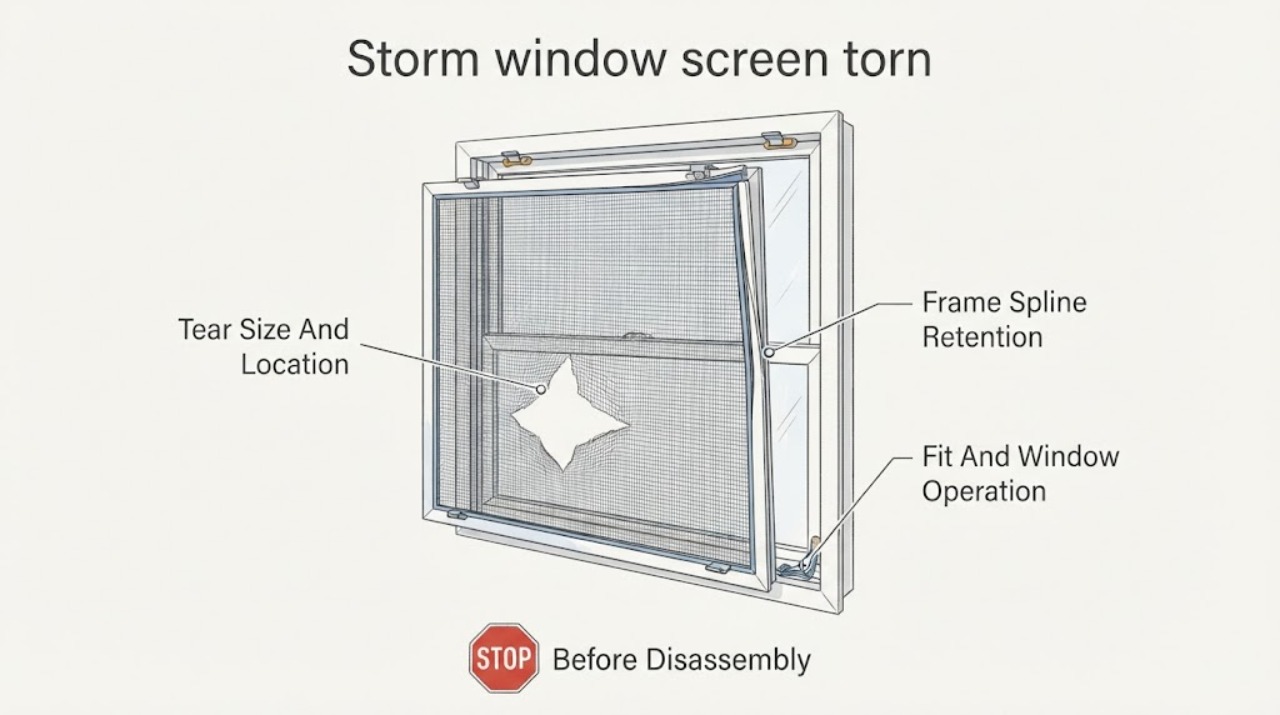
Keep the screen in place unless it releases normally from a safe interior position. Observe the tear's size and location, whether the mesh is still held by the frame or spline, whether the frame is bent or corroded, and whether the screen still sits squarely without a gap. Note insects entering, the seasonal ventilation need, and whether the window glass and latch operate normally without force. Do not climb outside, remove glass, force a screen, use sharp tools, disturb old paint or coatings, or attempt a repair while the frame is under stress. A small stable mesh defect may be a low-risk repair decision; a loose frame, sharp edge, failed fit, storm damage, or any access problem calls for a window or screen professional.
Work through in order
Diagnostic checks
Use only checks that match the exact appliance or system and its official guide.
-
Check 1
From inside the room or from stable ground, look at the screen without removing it and record the tear's location and approximate relative size using nearby frame features rather than stretching or pulling the mesh.
Expected result: Note whether the damage is a pinhole, a narrow split, a broad opening, or a section that has separated from the frame; record whether it is near a corner, edge, latch side, or center.
Next step: Take a photo from the safe side and tell a screen professional the location and scope; do not patch, cut, or tension the installed mesh during this check.
Stop if: Stop if the mesh or frame has a sharp edge, the screen is loose above a drop, glass is cracked, or observation requires exterior access or a ladder.
Why this matters
Why: A small isolated mesh defect may have a different repair scope from mesh pulled out along an edge or a tear that compromises the screen's retention.
-
Check 2
From the safe interior side, visually follow the frame perimeter and observe whether the mesh edge and visible spline or retention strip remain seated; do not press the spline, pry the frame, or use a sharp tool.
Expected result: Record whether the retention line appears continuous, pulled away, missing at a corner, wrinkled, or accompanied by a bent, split, or corroded frame.
Next step: Provide close photos and the window or screen brand and model if safely known; ask whether the complete screen or frame should be serviced or replaced.
Stop if: Stop if the frame flexes, releases unexpectedly, has a sharp edge, contains flaking old coating, or requires force to inspect.
Why this matters
Why: A retention or frame defect can let a small tear spread and can prevent a patch or mesh choice from addressing the real problem.
-
Check 3
With the screen untouched, observe whether it sits squarely in its normal track or clips and whether the window glass and latch operate through their ordinary user controls without rubbing, binding, or force.
Expected result: Record a normal fit, a visible perimeter gap, a screen that rocks or bows, a window that cannot close or latch, or a glass or frame condition that looks damaged.
Next step: Leave the window and screen in the safest normal position and request a window professional; do not remove glass or force a stuck screen or sash.
Stop if: Stop for cracked glass, a loose sash, a screen or window that may fall, an opening to a height hazard, or any control that requires force.
Why this matters
Why: A fit or window-operation problem can be more important than the mesh tear because it may involve the frame, clips, track, or window assembly.
-
Check 4
Record when insects, drafts, or loss of ventilation became noticeable in relation to the torn screen and the season, using ordinary room observation without creating a larger opening.
Expected result: Note whether insects enter through the tear, whether the affected window is needed for ventilation now, and whether the problem is limited to one screen or several.
Next step: Share the timing and use context with a screen repair provider and keep the opening closed if that is safe and practical; do not tape, cut, or handle the damaged mesh as a stopgap.
Stop if: Stop if closing the window creates a safety, escape, ventilation, or heat concern, and contact the appropriate professional or building manager.
Why this matters
Why: A location that protects a bedroom, food area, or current ventilation route may need faster service, while a small defect in a rarely used screen may be scheduled with other maintenance.
-
Check 5
From indoors or stable ground, note whether the tear followed wind, impact, a pet, or routine aging and whether the surrounding window frame shows visible moisture, corrosion, or debris; do not reach outside or disturb old coatings.
Expected result: Record a new single tear, repeated edge failure, bent frame, corrosion, storm debris, or no clear event.
Next step: Provide the history and photos to a window or screen professional, who can decide whether a screen-only service or a broader window assessment is appropriate.
Stop if: Stop if there is cracked glass, water entering the wall, structural movement, loose exterior material, or any need to inspect from a roof, ladder, or elevated exterior position.
Why this matters
Why: A storm or impact pattern can indicate frame or surrounding-window damage rather than a standalone mesh defect. Corrosion or moisture may affect replacement fit and durability.
Use your observations
Decision map
Find the observation that best matches what you see, then follow the next safe action.
-
PATH 01Next step
What you see
The mesh has a small stable tear, the frame and spline look intact, and the screen fits normally.
Do this next
Ask a screen professional whether a compatible patch or screen-only service is appropriate; do not cut or press the installed mesh.
-
PATH 02Next step
What you see
Mesh has pulled out of the retention channel, the spline is missing or loose, or the frame is bent or corroded.
Do this next
Request a screen or window professional to assess the frame and retention system; do not force the spline, remove the frame, or use sharp tools.
-
PATH 03Next step
What you see
The screen does not fit squarely, the window will not close or latch, or the sash or glass appears damaged.
Do this next
Stop operating the assembly and arrange window service. Do not remove glass or force the screen or sash.
-
PATH 04Next step
What you see
The tear followed storm impact, exterior debris, or a condition that may involve the surrounding window.
Do this next
Document the damage from a safe side and request a broader window and screen assessment; do not inspect from a ladder or outside elevation.
-
PATH 05Next step
What you see
The defect is creating immediate insect, ventilation, escape, or building-safety concerns.
Do this next
Use the safest normal window position and contact a screen professional, window service, or building manager; do not create a temporary sharp or forced repair.
Helpful context
Understand the symptom
Separate mesh damage from frame damage
A screen is a system: mesh is held in a frame, often by a flexible spline, clips, or another retention method. A small tear with a sound, square frame is a different scope from a frame that is bent, corroded, loose, or no longer seals the opening. The observation should identify which scope a professional or replacement decision needs.
Keep glass and old coatings out of the repair
The insect screen is not a reason to remove storm-window glass or reach through an exterior opening. Do not disturb old paint, dust, or unknown coatings, and do not cut or pry mesh while it is installed. If the screen does not release with normal user controls, leave it in place and request service.
Use the season and insect entry as context
A torn screen can change ventilation and insect control, but the urgency depends on the size and location of the opening, the window's role, and the household's needs. Record when insects or drafts began rather than creating an unsafe opening to test the screen.
Only after diagnosis
Potential parts
- window-screen-repair-kit
Consider this only when the tear is limited, the screen frame is sound, and a professional or the manufacturer's guidance confirms that a compatible repair is appropriate.
Confirm screen type, frame construction, retention method, and mesh material before selecting a kit; a generic kit is not proof of fit. - screen-mesh
Consider this only when the mesh damage is broad enough to require rescreening and the frame and retention channel are confirmed serviceable.
Match the frame dimensions, mesh use, visibility, durability, and retention system; professional handling is preferable if removal would require exterior access. - spline
Consider this only when the visible retention cord is missing or damaged and the frame groove is confirmed intact by a screen professional.
Spline size and profile depend on the frame groove and mesh; do not force a substitute or pry the installed screen to measure it.
When checks do not resolve it
Need a professional?
Have this ready
- Provide safe-side photos, tear location and relative size, frame and spline condition, fit and latch behavior, insect or ventilation context, storm or impact history, and any moisture, corrosion, or coating concern.
Common questions
FAQ
Can I patch a torn storm-window screen in place?
Do not patch or cut the installed screen during this check. First determine whether the frame and retention system are sound and whether the screen can be serviced safely; a professional can choose a patch, rescreen, or replacement.
What if the spline has come out?
A loose spline can mean the mesh is no longer retained or that the groove or frame has changed. Photograph it without pressing or prying, then ask a screen professional to assess the retention system.
Does a torn screen need immediate replacement?
Urgency depends on the opening, fit, season, insects, ventilation role, and window safety. A small stable tear can often be scheduled, while a loose frame, sharp edge, or window that will not latch needs faster service.
Should I remove the storm window or screen to inspect it?
No. Do not remove glass or force the screen, especially from an exterior or elevated position. Use safe interior or ground observations and arrange professional service if normal access is not clear.
Read the exact guide
Official sources
- Screen Repair Kits: Window, Door & PatioPhifer · Phifer distinguishes small patch repair from larger screen replacement and identifies mesh, spline, and a spline roller as kit components; this article keeps those choices conditional and avoids repair instructions.
- Understanding Window Screen TermsPhifer · Phifer defines mesh as woven material with openings and spline as the flexible cord that secures screening in a frame, supporting the article's mesh-versus-retention observations.
- Rescreening Andersen Patio Door Insect ScreensAndersen Windows and Doors · Andersen notes that screen construction and rescreening requirements vary by product family and directs owners to model-specific instructions or support for replacement parts.
Community feedback
Share a repair observation
Share a plain-text repair observation. Accepted observations are published automatically; this page may take a moment to update.