
On this page
Start here
Quick answer
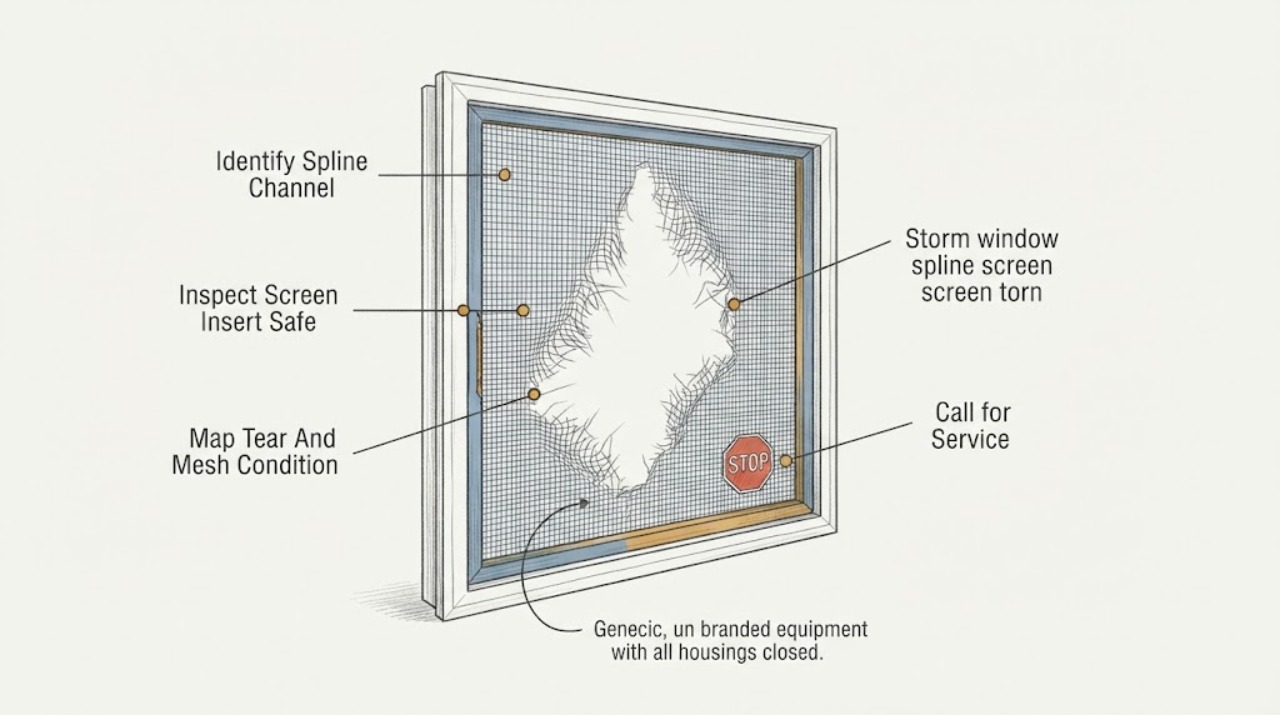
A torn storm-window screen with loose or missing spline is usually a frame-retention problem, but first confirm that the insert and glass are sound and that the panel can be handled from a stable, ground-level work position. Photograph the frame channel, spline profile, tear, corners, clips, and any bent frame without climbing or removing glass. If the storm panel is cracked, loose, difficult to remove, above safe reach, or part of a damaged window assembly, stop and arrange window service. For a removable intact screen insert, the repair decision depends on whether the mesh alone is torn or the spline channel, frame, or retaining hardware is damaged; Phifer advises matching spline to the channel and screen material rather than guessing.
Before you begin
Safety first
- This article covers safe observation and flat-surface screen evaluation only. A professional determines whether to patch, rescreen, repair the frame, or replace the assembly.
Work through in order
Diagnostic checks
Use only checks that match the exact appliance or system and its official guide.
-
Check 1
From a stable ground-level position, inspect the screen insert, storm panel, frame corners, clips, and spline groove without climbing or removing glass; photograph the torn area and any bent, cracked, or loose frame section.
Expected result: The mesh may be torn while the frame is straight, the spline may be partly out, a corner or channel may be damaged, or the glass or panel may also be cracked or loose.
Next step: Keep a damaged or loose panel out of service, record its position and hardware, and request window service when the insert or glass is not sound.
Stop if: Stop for cracked glass, a loose storm panel, sharp edges, a bent frame that will not sit securely, or any need for ladder or exterior work.
Why this matters
Why: Mesh and spline damage may be compatible with rescreening, while frame, glass, or retention damage requires a different repair and can make handling unsafe.
-
Check 2
With an intact removable insert on a flat surface only, observe whether the spline is round, flat, continuous, or missing and measure the existing groove or spline without prying a retained piece from a damaged frame.
Expected result: The spline may be present and flexible, brittle or stretched, absent on one edge, flat rather than round, or held in a channel that is damaged or hard to identify.
Next step: Record the channel and spline characteristics, compare them with the frame maker's instructions or a qualified screen professional, and avoid ordering before fit is verified.
Stop if: Stop if identifying the profile requires force, cutting near glass, removing a fixed panel, or handling a frame that cannot lie flat and stable.
Why this matters
Why: The profile and channel determine the replacement category; a similar-looking cord can be too loose, too tight, or incompatible with the mesh and frame.
-
Check 3
Lay the safe removable insert flat and inspect the full mesh perimeter, corners, and spline channel for one tear, multiple tears, sagging, corrosion, fraying, or pulled fabric; do not stretch the screen to test it.
Expected result: Damage may be limited to one small area, run along an edge, affect several sides, leave the mesh slack, or coincide with a corroded or distorted frame.
Next step: Photograph the full insert and ask a screen professional whether to patch, rescreen, or replace the panel based on mesh, channel, and frame condition.
Stop if: Stop for sharp wire, brittle metal, loose glass, a frame that shifts, or any need to bend the insert or pull hard on the mesh.
Why this matters
Why: A localized tear may suit a screen repair or rescreening decision, while edge failure, slack mesh, or frame corrosion can make a patch short-lived or unsuitable.
-
Check 4
Before any reinstallation, verify from ground level that the repaired insert's frame, clips, corners, and guides are intact and that the opening is reachable without a ladder or exterior exposure; do not force an insert into a misaligned track.
Expected result: The insert may seat squarely, bind, wobble, have missing clips, or require elevated or outside access.
Next step: Keep the opening closed by a safe alternate method and arrange window service for alignment, hardware, elevated access, or uncertain fit.
Stop if: Stop for any need to climb, lean outside, remove glass, force the frame, or work beside a cracked or unstable window.
Why this matters
Why: A square, secure insert is needed for insect protection and safe retention. Binding or wobble can indicate a wrong screen, bent frame, failed hardware, or a window problem rather than a spline problem.
Use your observations
Decision map
Find the observation that best matches what you see, then follow the next safe action.
-
PATH 01Safety boundary
What you see
Is the storm screen insert removable, intact, and flat, with damage limited to mesh or spline?
Do this next
Use the verified frame-channel and mesh information to choose patching or rescreening guidance, keeping the work on a stable surface.
Why this path and its safety boundary
Safety stop: Do not force, bend, climb, remove glass, or work on an elevated panel.
-
PATH 02Safety boundary
What you see
Is the spline channel bent, cracked, corroded, or unable to retain the screen?
Do this next
Keep the insert out of service and request a screen or window professional to evaluate rescreening, frame repair, or replacement.
Why this path and its safety boundary
Safety stop: Do not pry or reshape a damaged channel near glass.
-
PATH 03Safety boundary
What you see
Is the storm panel loose, cracked, difficult to remove, or accessible only from a ladder or outside the building?
Do this next
Stop the repair and arrange window service; keep people clear of the panel and opening.
Why this path and its safety boundary
Safety stop: Never remove storm glass, reach outside, stand on a sill, or climb for this repair.
-
PATH 04Safety boundary
What you see
Can the spline profile and channel be identified without damaging the frame or mesh?
Do this next
Verify the replacement category against the frame maker's instructions or a screen professional before selecting material.
Why this path and its safety boundary
Safety stop: Do not force an oversized cord, cut near glass, or use a guessed part that will not retain the screen securely.
Helpful context
Understand the symptom
Separate mesh damage from frame damage
Spline is the cord that holds screening in the frame groove. A torn section may be a simple rescreening issue, but a loose channel, bent frame, broken corner, failed clip, or cracked storm panel changes the job. A panel that is hard to remove can be distorted or still retained by hardware, so do not force it or work at a window height that requires a ladder.
Why spline size and material matter
Phifer's opened sizing guidance says spline diameter and frame-channel width determine fit, with some thicker screening materials requiring a different size. Its installation guide describes a flat work surface, a spline roller, straight screen fabric, and trimming outside the groove. These are general manufacturer instructions; the actual storm-window insert and frame may use a proprietary profile or retaining system.
Keep glass and elevated work out of a low-risk repair
This topic is limited to a safe, removable screen insert. Do not remove storm glass, pry a fixed window, reach outside, stand on a sill, or climb to reach a panel. If the insert cannot be placed flat and securely, a window professional can identify the frame and replace or rescreen it safely.
Only after diagnosis
Potential parts
- window-screen-repair-kit
Consider this category only when the removable insert and frame are sound and a patch or rescreening kit matches the mesh and groove.
Confirm frame dimensions, mesh material, spline profile, and safe flat-surface handling before selecting a kit. - screen-mesh
Consider this category only when the tear is beyond a suitable patch and the existing frame can safely retain new mesh.
Match mesh type, visibility or pet-resistance needs, and frame-channel fit; do not assume one mesh works with every spline. - spline
Consider this category only after the frame groove and existing spline profile are identified and the screen material is known.
Verify diameter or flat profile against the frame maker's information or a professional measurement; a similar-looking spline may not retain the mesh.
When checks do not resolve it
Need a professional?
Arrange window or screen service for cracked or loose storm glass, a bent or corroded frame, missing retention hardware, uncertain spline fit, elevated or exterior access, or an insert that will not seat securely. A sound removable insert with mesh-only damage can be evaluated as a low-risk rescreening job.
Safety scope: This article covers safe observation and flat-surface screen evaluation only. A professional determines whether to patch, rescreen, repair the frame, or replace the assembly.
Have this ready
- Window and insert location and safe-position photos
- Mesh tear pattern, spline profile, groove condition, and frame measurements
- Any cracked glass, bent frame, loose clips, corrosion, or binding
- Whether the insert can be removed and placed flat without a ladder
- Storm-window brand or model markings if already visible
Common questions
FAQ
Can I replace storm-window spline without removing the glass?
Only evaluate a removable screen insert that can lie flat safely. Do not remove storm glass or force a panel; if the screen is integrated with glass, difficult to access, or requires elevated work, arrange window service.
How do I know which spline size to use?
Identify the frame groove and existing spline profile, then match them to the screen material and frame instructions. Similar-looking spline can fit poorly, so do not guess when the channel is damaged or unidentified.
Should I patch a torn screen or replace the mesh?
A small localized tear may be evaluated for a compatible patch, while edge failure, multiple tears, slack mesh, or frame corrosion may favor rescreening or panel replacement. A professional can make the choice if the frame or retention system is uncertain.
When is a torn storm screen unsafe to handle?
Stop for cracked glass, a loose panel, sharp or corroded frame edges, missing clips, a bent insert, ladder or exterior access, or any need to force the window. Keep the opening secured and arrange window service.
Read the exact guide
Official sources
- How to Replace a Window, Door or Patio ScreenPhifer · Supports flat-surface handling, spline-groove retention, screen alignment, and the distinction between mesh replacement and frame condition; storm-window hardware may differ.
- How to Choose the Right Size of Screen SplinePhifer · Supports measuring the spline groove and accounting for screening-material differences; it does not establish fit for an unidentified storm-window frame.
Community feedback
Share a repair observation
Share a plain-text repair observation. Accepted observations are published automatically; this page may take a moment to update.