
On this page
Start here
Quick answer
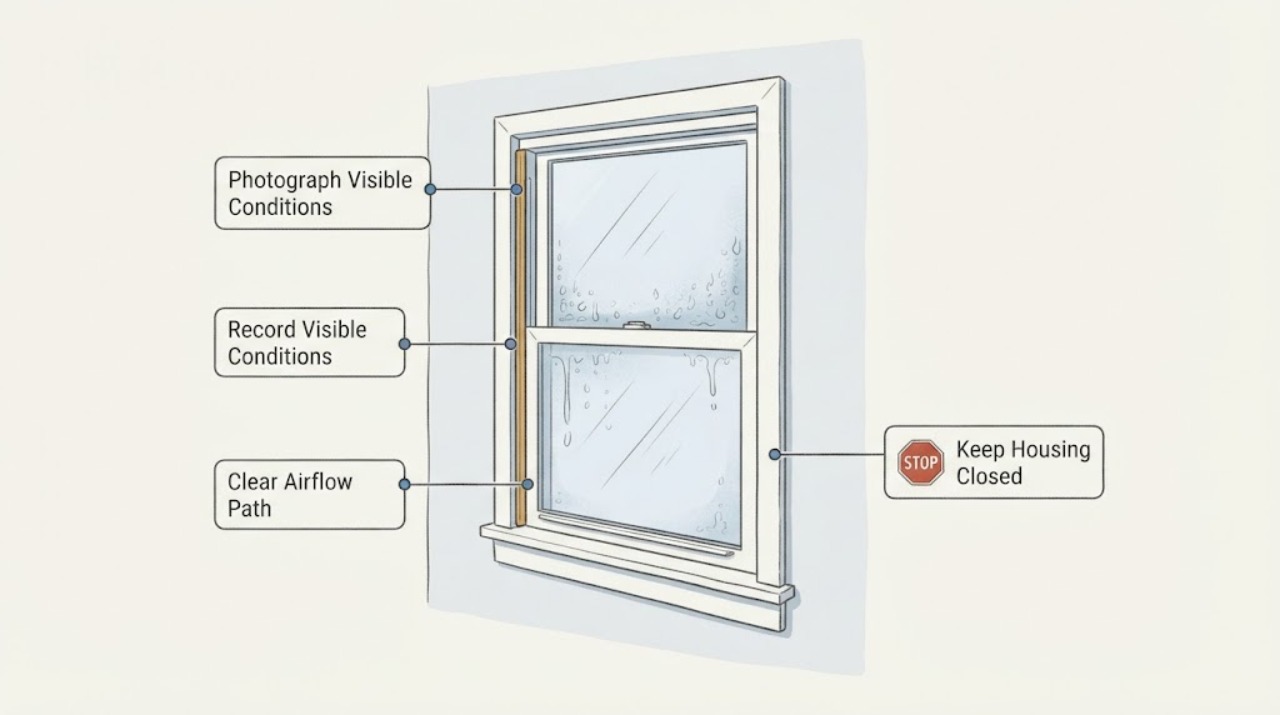
Repeated moisture at a window is not automatically a leak. First identify where the water is: on the room-side glass or frame, between insulated panes, on the outside surface, or at the sill and surrounding wall. Room-side condensation usually means humid indoor air is meeting a cold window surface; condensation between panes points to an insulated-glass seal problem; moisture that follows rain, stains the wall, or swells trim needs a water-intrusion investigation. Photograph the pattern, dry the surface, compare room humidity and ventilation conditions, and keep curtains or blinds from blocking air over the glass. Do not remove glazing, probe the wall, seal drainage or weep paths, climb to an elevated window, or disturb electrical equipment. Arrange qualified window or building-envelope service for repeated wetness, rain-related paths, fogging between panes, rot, mold, or unsafe access.
Before you begin
Safety first
- Do not climb ladders or roofs, remove glazing or trim, drill or probe the wall, spray water to reproduce a leak, block weep or drainage openings, use improvised heat against glass, or work near electrical equipment. Stop when glass or framing is cracked, loose, sharp, unstable, or inaccessible.
Work through in order
Diagnostic checks
Use only checks that match the exact appliance or system and its official guide.
-
Check 1
Map the moisture without dismantling anything: from a safe interior position, look at the room-side glass, frame, sash, sill, trim, and nearby wall; if visible from the ground, note the exterior face as well. Photograph droplets, haze, staining, peeling finish, swelling, and the exact edge where water collects before wiping it away.
Expected result: The film is on the room-side glass or frame; haze or droplets are visibly trapped between panes; water is at the sill or wall; or moisture is only on the exterior face.
Next step: Keep the photographs and record the date, temperature or weather description, room activity, and whether the window was open or closed. Move to the humidity, airflow, rain-path, or glazing branch that matches the observed plane; arrange service for water that reaches the wall, persistent trapped haze, or material damage.
Stop if: Stop if inspection would require a ladder, roof access, removing trim or glazing, touching a damaged frame, or approaching electrical equipment.
Why this matters
Why: Room-side water is consistent with humid indoor air meeting a cold surface; trapped haze suggests a glazing-unit seal condition; sill or wall wetting raises a rain or envelope path; exterior-only water can be weather-related exterior condensation. Location narrows the next check but does not by itself prove a failed seal or leak.
-
Check 2
Compare the room's moisture conditions with the timing of the wetness. If available, read a room hygrometer from its normal interface; note showers, cooking, laundry, indoor drying, occupancy, and whether kitchen or bath exhaust actually discharges outdoors. Run the existing exhaust as intended during moisture-producing activity and record whether the next comparable episode is smaller, without changing wiring or ducting.
Expected result: Wetness appears during cold weather or after showers and cooking; room humidity is elevated relative to the building or equipment guidance; exhaust is absent, ineffective, or not vented outdoors; or the window remains wet when those conditions are unchanged.
Next step: Continue documenting comparable conditions and use the building or equipment guidance for an appropriate humidity range rather than chasing a universal number. Have a qualified professional assess ventilation or the window assembly when moisture remains despite normal moisture control, or when exhaust changes require duct or electrical work.
Why this matters
Why: A repeatable connection to indoor moisture and a cold window makes surface condensation more likely. ENERGY STAR specifically identifies indoor humidity and indoor exhaust paths as controllable contributors. No change when moisture conditions are controlled makes a cold spot, airflow obstruction, glazing issue, or rain-related path more likely.
-
Check 3
Check the warm-air path around the glass from inside: note whether curtains, blinds, furniture, or a closed nearby supply register blocks air over the window, and compare an exposed section with the area behind the covering. Do not force a stuck covering or alter a heating or electrical installation.
Expected result: Droplets concentrate behind closed coverings, at lower corners, or where furniture blocks the window; the exposed glass is drier; or the whole pane is similarly wet.
Next step: Allow the window treatment to provide airflow over the glass and keep the area clear for a comparable observation. If the pattern remains, document the frame and wall condition and request a window-performance or building-envelope assessment; do not use a heater or improvised heat source against the glass.
Why this matters
Why: A localized pattern behind an obstruction makes restricted air movement and a colder local surface more likely. Uniform wetness or wetness that persists with a clear air path points back toward indoor moisture load, cold glazing or frame conditions, or another moisture source rather than one blocked section alone.
-
Check 4
Separate rain timing from indoor condensation. After ordinary rain, inspect the interior sill, lower corners, trim, and adjacent wall for a new wet line, stain, swelling, peeling finish, or musty smell; from ground level only, note whether exterior joints, sill drainage, or nearby cladding appear to direct water toward the opening. Do not spray the window, seal a drainage opening, or probe the wall.
Expected result: Moisture follows rain and leaves a path or material change; wetness occurs only in cold or humid indoor conditions; or the area stays dry after rain but becomes wet during indoor moisture events.
Next step: Keep the area dry and preserve photographs. Arrange building-envelope or window service for a rain-linked path, staining, swelling, peeling, odor, or recurring wetness; do not apply a blanket bead of sealant that could hide the path or block drainage.
Stop if: Stop immediately if the exterior check would require elevated access, disturbing cladding, or contact with a damaged or unstable window.
Why this matters
Why: A rain-linked path or damaged surrounding material makes water intrusion or an envelope detail more likely than ordinary room-side condensation. A dry rain check with an indoor-weather pattern supports surface condensation, though a concealed leak is not ruled out without a professional inspection.
-
Check 5
Inspect the glazing condition visually from inside. Look for persistent fog, droplets, or a milky band that remains between panes after the room-side surface is dry, and note failed-looking perimeter seals, loose trim, or frame deterioration without pressing on the glass or removing a gasket.
Expected result: The trapped haze remains between panes; the pane clears when the room-side surface dries; the frame or sash is deteriorated; or there is no trapped moisture and no visible damage.
Next step: Record the pane count if readily visible and provide the photographs and any readable manufacturer or installation information to a qualified glazier or window professional. Do not drill, inject, remove, or replace glazing as an ordinary-user test.
Stop if: Stop if glass is cracked, loose, sharp, or under visible stress, or if diagnosing the seal would require removing glazing or trim.
Why this matters
Why: Moisture that remains inside an insulated glazing unit is more consistent with a glazing-unit seal or component condition than with room humidity on the accessible surface. A dry interior face with no trapped haze makes that explanation less likely, while deterioration can independently allow air or water problems.
-
Check 6
Dry the accessible wet surface and monitor the same location through comparable weather. Record whether the moisture returns on the glass, at the sill, or on the wall, and whether the return follows indoor moisture activity, a temperature change, or rain. Do not use repeated wiping to conceal a stain or leave wet trim covered by a curtain.
Expected result: The glass film returns with cold or humid conditions; the sill or wall returns after rain; the wetness spreads or damages the finish; or the area stays dry after moisture and weather change.
Next step: Keep a short photo and weather log, reduce the identified moisture source when safe, and arrange professional assessment for recurring wetness, damage, odor, mold, or any unexplained return. If the issue is isolated to a removable surface film and improves with documented humidity and airflow changes, continue monitoring rather than dismantling the window.
Why this matters
Why: A repeatable surface film linked to indoor conditions supports a condensation-control path. A rain-linked or spreading return supports an envelope or plumbing investigation, and material damage or odor means the moisture problem has moved beyond a cosmetic film. A dry interval is useful evidence but does not prove the assembly is sound.
Use your observations
Decision map
Find the observation that best matches what you see, then follow the next safe action.
-
PATH 01Next step
What you see
Water is a film or droplets on the room-side glass or frame, appears in cold weather or after indoor moisture events, and is reduced when airflow and moisture control improve.
Do this next
Keep the glass exposed to room airflow, use kitchen and bath exhaust as intended, vent dryers outdoors, and track comparable episodes. Escalate if the sill or wall becomes wet, the surface remains damaged, or moisture persists despite reasonable moisture control.
Why this path and its safety boundary
Why it matters: Humid indoor air reaching a window surface below its dew point is the leading explanation. The pattern does not by itself indicate a failed window or a rain leak.
-
PATH 02Next step
What you see
The room-side surface is dry but haze or droplets remain inside the sealed space between panes.
Do this next
Have a qualified glazier or window professional identify the unit and assess repair or glazing replacement options. Do not drill or disassemble the insulated unit as a test.
Why this path and its safety boundary
Why it matters: A glazing-unit seal or related component condition is more likely than ordinary room-side condensation. Cleaning the accessible glass will not reach the trapped space.
-
PATH 03Next step
What you see
Water appears at the sill, trim, or surrounding wall after rain and leaves a line, stain, swelling, peeling finish, or musty odor.
Do this next
Keep the area dry, document the timing and damage, and arrange a qualified window or building-envelope inspection. Avoid blanket sealing or blocking drainage openings before the path is understood.
Why this path and its safety boundary
Why it matters: Water intrusion through the window, its perimeter, drainage, or adjacent wall assembly is more likely than a humidity-only explanation. The visible path may be downstream from the entry point.
-
PATH 04Next step
What you see
Condensation is concentrated behind curtains or blinds, at lower corners, or where furniture blocks air, while a more exposed section stays drier.
Do this next
Restore a clear air path for a comparable observation and continue the humidity check. Request a window-performance or envelope assessment if the whole pane remains wet or the frame and wall show damage.
Why this path and its safety boundary
Why it matters: Restricted warm-air movement is likely making that part of the glass colder. The obstruction may amplify an underlying humidity or cold-surface condition.
-
PATH 05Next step
What you see
Moisture returns despite normal ventilation and an open air path, spreads into finishes, produces odor or visible mold, or cannot be located safely.
Do this next
Stop investigating inside the assembly, dry what can be safely reached, keep people away from damaged areas, and arrange qualified window, building-envelope, or moisture/mold service. Follow the EPA or local professional guidance when damage or mold is extensive.
Why this path and its safety boundary
Why it matters: The issue is no longer a simple surface observation. A concealed leak, cold bridge, ventilation problem, glazing failure, or material damage needs a professional scope decision.
Helpful context
Understand the symptom
Start with the plane where water appears
A window can look wet for different reasons. A film on the room-side glass or frame is a surface-temperature and indoor-moisture question. Haze or droplets trapped inside a double- or triple-pane unit are a glazing-unit condition. Water at the sill, trim, or adjacent wall that tracks with rain is an envelope and drainage question. Water on the outside face during warm, humid weather can be exterior condensation. Wipe only enough to document the pattern, then dry the area and record the weather, time, and nearby moisture-producing activity before the evidence disappears.
Repeated wetness deserves a moisture-source check
Condensation is water, and repeated wetting can damage finishes and create conditions for mold or rot. A single cold-weather film may respond to better airflow and moisture control, but recurring wetness, staining, swollen wood, peeling paint, musty odor, or a rain-linked path needs a broader inspection. Keep the investigation low-risk: use ordinary interior access or a ground-level exterior view, and do not open the wall or window assembly just to look for a cause.
Keep the boundary clear
These checks do not establish a hidden flashing, glazing, or wall defect. Do not climb ladders or roofs, remove sash or glazing, drill into the frame or wall, block weep holes, spray water at the window, or work near electrical equipment to reproduce the problem. Stop and arrange qualified window, glazing, or building-envelope service when the moisture path is persistent, rain-related, damaging, moldy, or inaccessible.
Only after diagnosis
Potential parts
- window weatherstrip or sash gasket
Consider this category only when a professional or documented inspection identifies an operable-sash air-seal problem and the exact window profile is known; surface condensation alone does not prove a gasket needs replacement.
Match the manufacturer, window series, sash configuration, dimensions, and installation method. Do not substitute a generic seal that interferes with operation, drainage, or the manufacturer's design. - insulated glass unit
Consider this category only when persistent fog or droplets between panes and the unit identity have been confirmed by a qualified glazier or window professional.
Confirm opening dimensions, pane configuration, coating, spacer, safety glazing, gas-fill specification if applicable, and frame compatibility before ordering. A room-side condensation film is not enough evidence for this part. - window-and-door-rated perimeter sealant or backer material
Consider this category only after the source is confirmed as a stationary perimeter gap with sound, dry substrate and the repair detail is known; it is not a general remedy for trapped-pane fogging or a blocked drainage path.
Follow the window and wall-system instructions for sealant type, joint geometry, substrate, and movement. Preserve designed weep and drainage paths and do not fill a moving sash joint.
When checks do not resolve it
Need a professional?
Stop and arrange qualified window, glazing, or building-envelope service for moisture between panes, water that follows rain, wet or swollen trim, wall staining, peeling finish, musty odor, visible mold, cracked or loose glass, recurring wetness despite reasonable humidity and airflow control, or any inspection requiring elevated access or disassembly. Dry accessible surfaces and keep people away from damaged areas while waiting; do not block drainage paths or dismantle the window to search for the source.
Safety scope: Do not climb ladders or roofs, remove glazing or trim, drill or probe the wall, spray water to reproduce a leak, block weep or drainage openings, use improvised heat against glass, or work near electrical equipment. Stop when glass or framing is cracked, loose, sharp, unstable, or inaccessible.
Common questions
FAQ
Is condensation on a window always a leak?
No. A room-side film can form when humid indoor air meets a cold window surface, and exterior condensation can occur in warm humid weather when indoor cooling lowers the outside surface temperature. Moisture at a sill or wall that follows rain, stains materials, or causes swelling needs a separate water-intrusion investigation.
What does fogging between window panes mean?
If the room-side surface is dry but haze or droplets remain inside the sealed space, a glazing-unit seal or component condition is more likely than ordinary room humidity on the accessible surface. Photograph it and ask a qualified glazier or window professional to identify the unit; do not drill or disassemble it.
What can I do about repeated room-side condensation?
Document where it forms, dry the surface, keep curtains and blinds from blocking airflow over the glass, and manage indoor moisture. ENERGY STAR recommends venting dryers, kitchen fans, and bath fans outdoors and using fans during showers or cooking and afterward. If the wetness continues or damages the sill or wall, arrange an assessment rather than relying on wiping alone.
Should I caulk around a window that gets wet?
Do not apply a blanket bead before the moisture path is understood. A rain-linked path may involve flashing, sill drainage, or an adjacent wall, and blocking a designed drainage opening can hide or worsen the problem. A qualified professional can specify a perimeter repair only after confirming the stationary joint, substrate, and drainage detail.
When is window condensation a professional problem?
Arrange service when moisture is trapped between panes, returns after reasonable humidity and airflow checks, follows rain, reaches the wall, produces staining, swelling, peeling finish, odor, or mold, or requires a ladder, roof access, glazing removal, or wall opening. Dry what is safely accessible and preserve photographs for the technician.
Read the exact guide
Official sources
- Residential Windows, Doors, & SkylightsENERGY STAR, U.S. Environmental Protection Agency · Official residential window guidance directly addressing interior and exterior condensation and practical moisture-control measures
- Mold and Rot Brief Guide to Mold Moisture and the HomeBuilding Science Education, U.S. Department of Energy · Official building-science guidance for connecting recurring window moisture with indoor humidity, rain or envelope leakage, material drying, and professional remediation boundaries
- Purchasing Energy-Efficient Residential Windows, Doors, and SkylightsU.S. Department of Energy, Federal Energy Management Program · Official federal fenestration guidance describing how air leakage relates to drafts and condensation and how excess condensation can damage components, wall surfaces, and indoor materials
Community feedback
Share a repair observation
Share a plain-text repair observation. Accepted observations are published automatically; this page may take a moment to update.