
On this page
Start here
Quick answer
If fog, droplets, or a milky haze stays between the panes after the accessible room-side and outdoor surfaces are dry, the insulated glass seal has likely failed. Do not remove the glass or drill the pane. Document the window and have a qualified window or glass professional confirm whether the insulated glass unit, sash, or whole window should be serviced. If the moisture is only on a surface, first treat it as room humidity or outdoor dew rather than a broken seal.
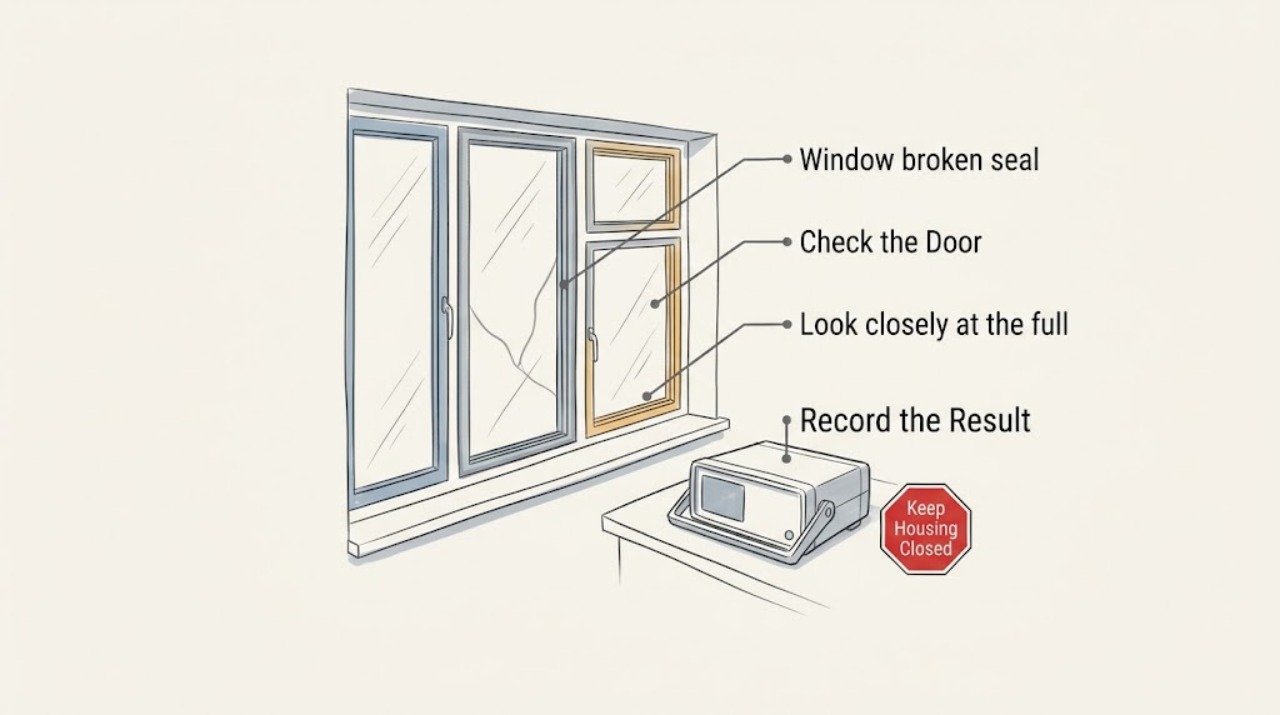
Work through in order
Diagnostic checks
Use only checks that match the exact appliance or system and its official guide.
-
Check 1
From inside the room and from ground level outside, inspect the same pane without removing trim or glass. If the accessible room-side or outdoor surface is wet, gently dry only that surface with a clean soft cloth; do not scrape or press on the pane.
Expected result: The moisture wipes away from one surface, forms only on the outdoor face in cool damp weather, or remains visible as haze or droplets between the panes.
Next step: If it remains between panes, continue documenting the unit for professional service. If it clears from a surface, record the room humidity or weather context and monitor rather than ordering a glass unit immediately.
Stop if: Stop if the glass is cracked, loose, sharp, or difficult to reach safely; keep people away and arrange professional service.
Why this matters
Why: Surface moisture is not by itself proof of a broken seal. Moisture that remains in the sealed gap is the stronger sign of insulating-glass seal failure.
-
Check 2
Look closely at the full pane and its perimeter from a safe standing position. Compare the affected window with a nearby similar window, noting a persistent milky film, droplets at the edge, discoloration, frame or sill staining, or visible cracking.
Expected result: Only the affected pane has a persistent interior haze or droplets, while the neighboring window stays clear; alternatively, the pattern is limited to the room-side edge or the frame and sill.
Next step: Photograph the affected pane and the surrounding frame, then tell the service professional exactly where the moisture sits. Do not assume a sash-lock or film will restore a failed inter-pane seal.
Stop if: Stop and request a professional assessment if staining is spreading, the wall or trim feels soft, or water is entering around the frame.
Why this matters
Why: A pane-specific haze between the glass layers supports a failed sealed unit. A room-side edge pattern or frame/sill staining can instead indicate indoor humidity, a cold bridge, or water around the opening and needs a different inspection.
-
Check 3
Note when the symptom appears and whether it changes with outdoor temperature, sun, rain, cooking, bathing, or indoor humidity. Use only an owner-accessible humidity reading if one is already available; do not remove the sash or add temporary holes.
Expected result: Condensation is short-lived and coincides with high indoor moisture or a cold surface; outdoor droplets clear with weather; or the haze persists in different weather and is visible inside the glass assembly.
Next step: Record dates, weather, room use, and which face was wet. Manage ordinary indoor moisture with normal ventilation and follow the window manufacturer’s guidance, but route persistent inter-pane moisture for service rather than trying to dry the sealed cavity.
Stop if: Stop if humidity is accompanied by active leaks, electrical equipment near water, or damage to the surrounding wall; keep clear and seek professional help.
Why this matters
Why: A timing pattern tied to indoor humidity or outdoor dew points away from a broken seal. Persistence between panes across weather conditions makes seal failure more likely, although a professional must confirm the assembly and source of any frame water.
-
Check 4
With the window left in its normal safe position, observe whether the sash closes and latches normally and whether you feel a draft at the room-side perimeter without inserting tools or forcing hardware.
Expected result: The sash closes and latches normally with no obvious draft, or it will not close, will not latch, moves unusually, or has a perimeter draft or water mark.
Next step: Include the operation result in the service request and ask the professional to assess the sash, frame, and insulated glass as a system. Do not adjust locks, remove hardware, or force the sash as a test.
Stop if: Stop operating the window if it binds, drops, rattles, has broken hardware, or cannot stay safely supported; arrange service.
Why this matters
Why: Normal operation with moisture between panes points primarily to a sealed-glass problem. A closure, sash, or frame symptom may be a separate issue that affects weather resistance and should not be diagnosed as a seal failure from appearance alone.
-
Check 5
Prepare a service record from a safe location: window room and approximate opening size, one or more clear photos, whether the symptom is between panes or on a surface, operation result, and any visible label or installation paperwork you already have.
Expected result: The record identifies a persistent between-pane symptom with no accessible model information, or identifies only a surface symptom that changes with humidity or weather.
Next step: Send the observations and photos through the approved service channel and ask what identification or site assessment is needed. Keep the existing window intact until the scope is confirmed.
Stop if: Stop the inspection if access would require a ladder, exterior reach, glass handling, trim removal, or contact with damaged or unstable material.
Why this matters
Why: A professional can use the first record to decide whether to verify a replaceable insulated glass unit, inspect the sash and frame, or address a moisture condition instead. Missing model information is a reason to measure and inspect professionally, not to guess compatibility.
Use your observations
Decision map
Find the observation that best matches what you see, then follow the next safe action.
-
PATH 01Next step
What you see
Moisture wipes off the room-side surface or appears only as outdoor dew
Do this next
Treat it as a surface-condensation or weather observation. Record indoor humidity and weather timing, improve ordinary ventilation as appropriate, and monitor for a persistent between-pane symptom.
-
PATH 02Next step
What you see
Haze or droplets remain between the panes after both accessible surfaces are dry
Do this next
Plan a qualified window or glass assessment for the insulated glass unit and related sash/frame. Provide photos, location, operation result, and any available identification.
-
PATH 03Next step
What you see
Water marks, soft trim, active leakage, or wall damage surround the window
Do this next
Stop testing and arrange prompt professional inspection of the opening and surrounding wall. Protect furnishings from water without opening the window or disturbing trim.
-
PATH 04Next step
What you see
Glass is cracked or loose, the sash is unstable, or safe access would require a ladder or glass work
Do this next
Keep people clear, do not operate or dismantle the window, and request professional service.
Helpful context
Understand the symptom
A broken seal is a loss of the sealed space between insulating-glass panes. The first decision is where the moisture is: room-side condensation can usually be wiped away, outdoor dew is weather-related, while a persistent haze or droplets that remain inside the sealed gap point to a failed insulating-glass unit. A surface symptom and a seal failure can look similar from across the room, so make the location check before planning replacement.
A failed seal does not automatically mean the entire opening must be rebuilt. Depending on the window design, age, damage, and available support, a professional may evaluate the insulated glass unit, the sash, or the complete window. Record what you can see and avoid making a glass-removal or drilling attempt based only on the appearance of fog.
Keep the check observational. Do not remove glazing beads, drill defogging holes, climb to an upper window, force a stuck sash, or handle cracked glass. Stop immediately if glass is cracked or loose, the frame is moving, water is entering rapidly, or the window cannot be left safely closed.
Only after diagnosis
Potential parts
- window insulation film
Consider this only for a confirmed surface draft or seasonal comfort issue while planning a proper assessment; it does not restore a failed seal between insulating-glass panes.
Confirm the window construction, finish, and manufacturer guidance before applying any film. - sash lock replacement
Consider this only if inspection shows a separate owner-accessible latch problem that prevents normal closure; it is not a remedy for moisture trapped between panes.
Match the window series and hardware geometry using existing documentation or professional identification; do not assume universal fit.
When checks do not resolve it
Need a professional?
Call a qualified window or glass professional when moisture persists between panes, the sash or frame will not close safely, or water damage is visible around the opening.
Have this ready
- Provide the room and window location, photos showing where the moisture sits, weather and humidity timing, whether the sash closes and latches, visible frame or sill damage, and any label or paperwork already available.
Common questions
FAQ
How can I tell whether condensation means the window seal failed?
Dry the accessible room-side surface and observe from a safe position. If haze or droplets remain visibly between the panes, a failed insulating-glass seal is likely and should be assessed professionally. Surface condensation or outdoor dew can have different causes.
Can I fix a broken window seal by cleaning or drilling the glass?
No. Do not drill the pane, remove glazing, or attempt glass work as a homeowner. A qualified professional should confirm whether the insulated glass unit, sash, frame, or surrounding opening needs service.
Does a failed seal always mean the whole window must be replaced?
Not necessarily. The appropriate scope depends on the window design, damage, age, and available replacement options. Ask a professional to evaluate the insulated glass unit and the sash and frame before choosing a complete-window replacement.
Read the exact guide
Official sources
- Condensation on windows: What causes it and how to manage itAndersen Windows · General homeowner guidance for identifying whether moisture is inside, outside, or between window panes.
- Purchasing Energy-Efficient Residential Windows, Doors, and SkylightsU.S. Department of Energy, Federal Energy Management Program · General residential fenestration guidance; performance and selection details vary by climate and product.
Community feedback
Share a repair observation
Share a plain-text repair observation. Accepted observations are published automatically; this page may take a moment to update.