
On this page
Start here
Quick answer
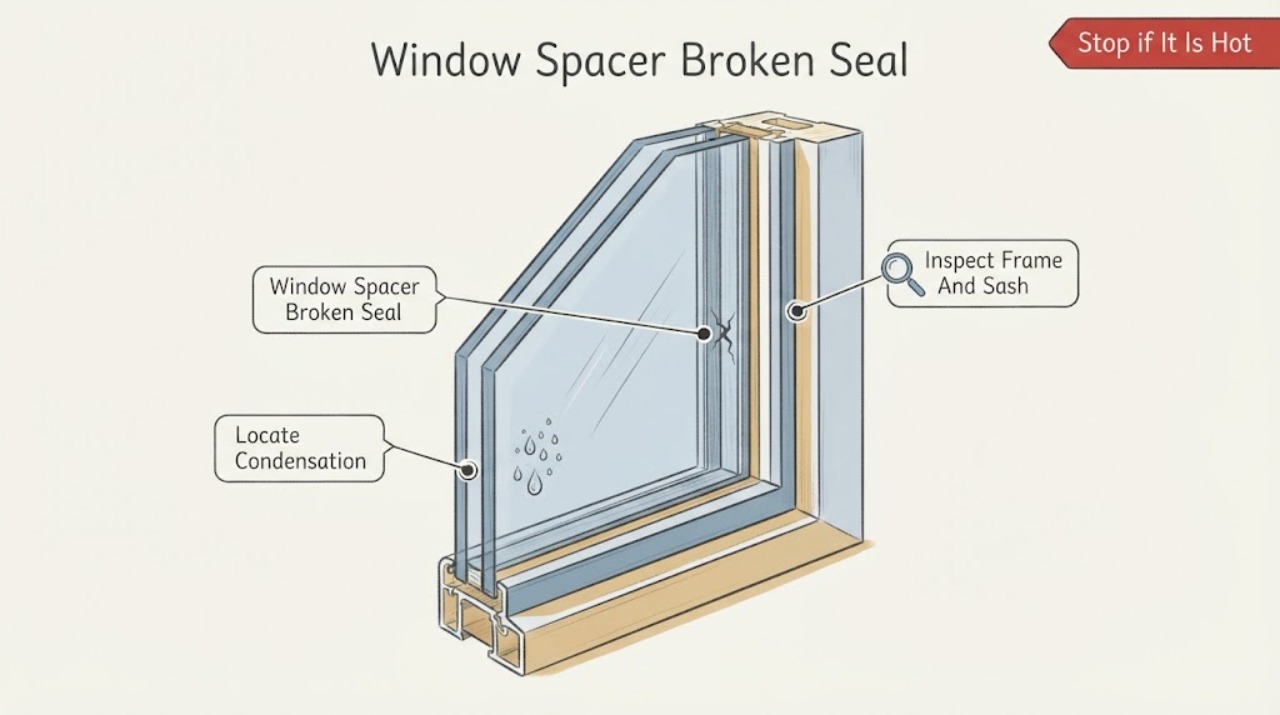
If moisture or a fixed haze is trapped between the panes of an insulated window, the spacer and perimeter seal have likely lost the sealed cavity rather than the room-side glass simply being dirty. Confirm where the moisture is, check the frame and sash for separate water damage, and then ask the manufacturer or a qualified glazing professional whether the insulated glass unit or the entire window should be replaced. Condensation only on the room side or outside has different causes and does not by itself prove a broken spacer seal.
Before you begin
Safety first
- Limit homeowner checks to accessible visual inspection, gentle surface cleaning, photographs, and records. Do not drill or cut the glass, pry out the spacer, remove glazing stops or sash parts, inject material into the cavity, climb to reach a window, or handle cracked glass.
Work through in order
Diagnostic checks
Use only checks that match the exact appliance or system and its official guide.
-
Check 1
From inside the room and from a safe exterior viewpoint, wipe the accessible room-side and outside glass surfaces with a clean, non-abrasive cloth and note whether the haze or droplets remain visibly trapped between the panes. Do not press on the glass or attempt to open the sealed edge.
Expected result: The moisture clears from an accessible surface, remains fixed in the cavity between panes, or cannot be located safely.
Next step: Photograph the location and continue with the room-side, exterior, and frame checks. If the cavity is fogged, plan a manufacturer or qualified glazing assessment rather than a cleaning repair.
Why this matters
Why: Moisture that remains between panes is consistent with a failed insulated-glass seal; moisture that wipes away is a surface condition and does not identify a spacer failure by itself.
-
Check 2
Record when the condensation appears and compare the affected window with a nearby clear window under the same conditions: after bathing or other moisture-producing activity, during cold or still weather, and after the room is ventilated. Keep curtains or blinds clear enough to observe the glass without altering the window assembly.
Expected result: Condensation is only on the room side and follows indoor humidity, only on the outside and changes with weather, or stays between the panes regardless of ventilation.
Next step: Use the matching branch instead of treating every fogged window as a broken spacer. Improve bathroom exhaust or airflow for room-side moisture, document exterior moisture without ordering replacement for that symptom alone, and request glass-unit service for cavity fogging.
Why this matters
Why: Room-side condensation makes indoor humidity, air exchange, and glass temperature more likely; exterior condensation can be a normal environmental effect; a persistent between-pane pattern remains a sealed-unit concern.
-
Check 3
Without removing trim or hardware, inspect the accessible frame, sash, gaskets, sill, and wall finish for water stains, soft or rotted material, gaps, damaged weather seals, difficult operation, or water entry after rain. Record whether the issue is limited to the glass cavity or also affects the surrounding window assembly.
Expected result: The frame and sash remain firm and operable with no nearby water marks, or there is frame deterioration, a leak path, damaged gasket, or impaired operation.
Next step: Give the photos and observations to the window supplier or qualified professional. Request separate scope and warranty checks for the glass unit and for the frame or installation when both are affected.
Why this matters
Why: A sound frame and sash can make an insulated-glass-unit replacement a reasonable scope to evaluate. Frame leaks, rot, damaged gaskets, or repeated operation problems indicate that replacing only the glass may leave the main defect unresolved.
-
Check 4
Photograph the full window and the spacer area, record the manufacturer label or other identifying mark if it is visible without disassembly, and note the pane count, operating style, approximate glass opening, and whether one or several units show the same symptom. Ask for a written assessment that distinguishes replacement glass or insulated glass unit from complete-window replacement.
Expected result: The professional can identify a compatible insulated glass unit while the surrounding frame is sound, or the unit cannot be identified or the frame has additional defects.
Next step: Check the original warranty or supplier records before authorizing work, then approve only a scope that addresses the failed sealed unit and any separately documented frame or water-intrusion problem.
Why this matters
Why: The replacement scope depends on the glass-unit construction and the condition of the frame, sash, and installation; a spacer is not a generic plug-in part that can be selected from the symptom alone.
Use your observations
Decision map
Find the observation that best matches what you see, then follow the next safe action.
-
PATH 01Next step
What you see
A haze, droplets, or persistent moisture remains between the panes after the accessible surfaces are wiped.
Do this next
Treat the symptom as a likely insulated-glass seal failure and arrange a glass-unit or window assessment.
Why this path and its safety boundary
Why it matters: The sealed cavity is no longer behaving as a dry, closed space; cleaning the room-side glass or changing indoor humidity will not restore the failed edge seal.
-
PATH 02Next step
What you see
Condensation is on the room-facing glass, clears when wiped, and increases after bathing or when ventilation is poor.
Do this next
Address indoor moisture and air movement while monitoring whether the glass remains clear between panes.
Why this path and its safety boundary
Why it matters: High indoor humidity and low air exchange can create room-side condensation even when the insulated-glass spacer and cavity seal are intact.
-
PATH 03Next step
What you see
Droplets or frost are only on the exterior surface and change with outdoor humidity, wind, sunlight, or season.
Do this next
Document the pattern but do not label it a spacer failure from exterior condensation alone.
Why this path and its safety boundary
Why it matters: Exterior dew can occur when the outside pane is cooler than humid outdoor air and can be a normal consequence of an insulating window performing its intended function.
-
PATH 04Next step
What you see
Between-pane fogging is accompanied by a soft or damaged frame, water stains, a leak path, damaged gasket, or a window that no longer operates safely.
Do this next
Stop treating the job as a glass-only replacement and request an assessment of the complete window and its installation.
Why this path and its safety boundary
Why it matters: A failed sealed unit may be only one defect; leaving a leaking or deteriorated frame in place can continue water damage and poor operation after new glass is installed.
Helpful context
Understand the symptom
A window spacer sits around the edge of an insulated glass unit and helps keep the panes separated while the seal keeps the cavity closed. When the cavity seal fails, moisture can appear where it cannot be wiped from either accessible glass surface. The visible fog is a clue about the sealed glass unit, not proof that the whole frame has failed.
The first decision is the location of the condensation: room side, outside, or between the panes. The second is whether the frame, sash, gaskets, and surrounding wall are still sound. Those two observations determine whether this is a humidity-management issue, a glass-unit replacement, or a broader window and water-intrusion assessment.
Do not drill the glass, inject sealant into the cavity, remove glazing stops, or take the sash out as a homeowner test. Glass removal and replacement require the correct unit dimensions, pane construction, safety glazing, and installation method.
Only after diagnosis
Potential parts
- replacement insulated glass unit
Consider only when moisture is confirmed between panes, the frame and sash are suitable to retain, and a qualified supplier confirms the replacement unit dimensions and construction.
Verify exact opening size, pane count, glass type, coatings, safety requirements, spacer configuration, and manufacturer or supplier fit information before ordering. - window weather seal or gasket
Consider only when inspection confirms a separate worn or damaged frame-to-sash weather seal; it does not repair moisture trapped between insulated-glass panes.
Match the window series and profile using manufacturer documentation; do not assume a generic seal will fit or correct a failed glass-unit edge seal.
When checks do not resolve it
Need a professional?
Call the window manufacturer, supplier, qualified glazing professional, or qualified window contractor when moisture is trapped between panes, the frame or sash is damaged, water enters around the opening, glass is cracked, or the diagnosis would require removing glass or operating from an unsafe height.
Safety scope: Limit homeowner checks to accessible visual inspection, gentle surface cleaning, photographs, and records. Do not drill or cut the glass, pry out the spacer, remove glazing stops or sash parts, inject material into the cavity, climb to reach a window, or handle cracked glass.
Have this ready
- Provide photos showing the condensation location, dates and weather or room conditions, manufacturer and identification details, pane count, operating style, frame condition, water marks, warranty records, and any limitations on safe access.
Common questions
FAQ
How can I tell if the window spacer seal is broken?
If haze or droplets remain trapped between the panes after the accessible room-side and outside surfaces are wiped, the insulated-glass seal is likely compromised. A professional should confirm the glass-unit scope and check the frame separately.
Is condensation on the inside of the window the same as a broken spacer seal?
No. Room-side condensation can result from indoor humidity, low air exchange, and glass temperature. It can be present while the insulated-glass cavity remains sealed.
Does exterior condensation mean I need a new window?
Not by itself. Exterior dew or frost can occur under the right outdoor conditions. Look for moisture between panes, frame leaks, or other defects before treating the window as failed.
Do I replace the whole window when the insulated glass seal fails?
Not always. If the frame, sash, and installation are sound, a replacement insulated glass unit may be an appropriate scope. Frame rot, water entry, damaged gaskets, or operation problems may justify evaluating the complete window.
Read the exact guide
Official sources
- TECHNICAL SERVICE BULLETIN Bulletin #IG01–11/21Cardinal IG Company · Residential insulating glass units with room-side, exterior, or between-pane condensation
- How to Deal with Window CondensationPella Corporation · Residential window condensation, including between-pane moisture
- Signs Your Windows Need Replacing: A Homeowner's GuidePella Corporation · Homeowner assessment of window glass, frame, operation, and water-entry symptoms
- Window FAQsPilkington · Architectural and residential window glass, including interior, exterior, and between-pane condensation
- About CondensationMilgard · Window and door glass condensation in occupied buildings
- Replacing Existing SkylightsU.S. Department of Energy Building Science Education · Glazed building openings where insulated-unit condensation and frame or gasket leaks must be distinguished; use window-specific manufacturer instructions for the actual unit
Community feedback
Share a repair observation
Share a plain-text repair observation. Accepted observations are published automatically; this page may take a moment to update.