
On this page
Start here
Quick answer
If haze remains between the panes after you wipe the room-side and exterior surfaces, the insulated glass unit may have lost its seal; cleaning will not restore it. Document whether the haze is between panes, then inspect the sash, frame, gaskets, sill, and surrounding wall from a safe position. Do not remove glass, drill the unit, force a sash, or climb unsafely. A qualified window professional should measure the unit and decide whether the IGU, sash, frame, or surrounding water-management details need work.
Before you begin
Safety first
- Do not remove glass or trim, drill the unit, cut sealants, force a sash, climb unsafely, or disturb lead, mold-like, or damaged wall material.
Work through in order
Diagnostic checks
Use only checks that match the exact appliance or system and its official guide.
-
Check 1
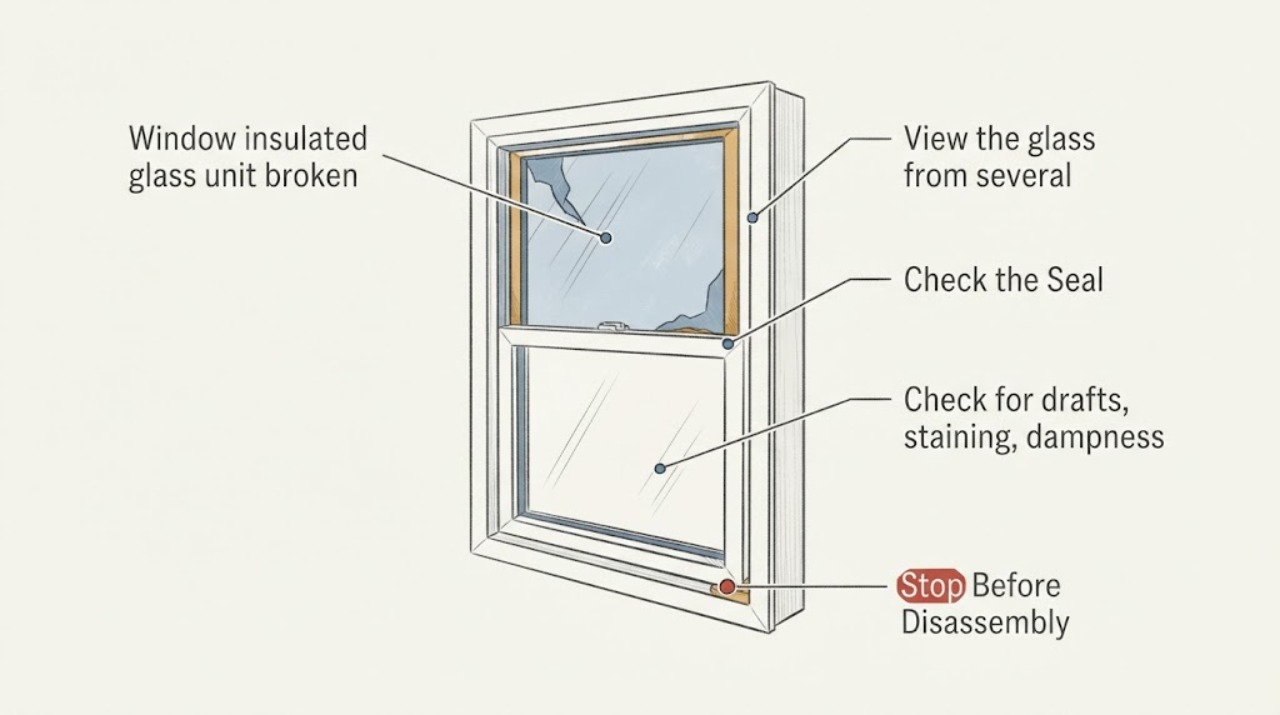
View the glass from several angles and wipe only the accessible room-side and exterior surfaces; do not press the panes or remove trim.
Expected result: Record clear glass, surface condensation that wipes away, or haze that remains between panes; note the weather, room humidity context, and time.
Next step: Photograph the same area from both sides and continue with sash, frame, and water-entry observations.
Stop if: Stop if glass cracks, flexes, has sharp edges, or is loose.
Why this matters
Why: Persistent inter-pane haze supports a failed sealed unit, while surface condensation points first to humidity and surface temperature. Neither observation provides the replacement dimensions.
-
Check 2
Inspect the sash, frame, spacer edge, gaskets, sill, and weep areas visually without removing seals or hardware.
Expected result: Look for fogging along the spacer, failed gasket, frame swelling, corrosion, blocked-looking drainage, gaps, or no visible frame damage.
Next step: Give the professional close photos and identify whether the sash opens, tilts, or is fixed; do not force a stuck sash.
Stop if: Stop if the sash moves unexpectedly, hardware is loose, or the frame is unstable.
Why this matters
Why: Frame or drainage damage can accompany a failed unit and may change the repair from glass-only replacement to sash or frame work.
-
Check 3
Check for drafts, staining, dampness, or wall damage around the opening from a stable floor position.
Expected result: Record air movement, water tracks after rain, damp sill or trim, interior staining, or no surrounding evidence.
Next step: Photograph the full opening and ask for a moisture and installation assessment before ordering glass.
Stop if: Stop if water is near electricity, the wall is soft or bulging, or mold-like material would be disturbed.
Why this matters
Why: A failed seal may be localized, but water or air leakage at the frame, flashing, or installation can require broader repair.
-
Check 4
Record the opening and sash identification only from existing paperwork or a safe visible label; do not remove beads, sash, or exterior trim.
Expected result: Note frame type, movable versus fixed sash, visible identification, and whether the original manual or invoice is available.
Next step: Give the identification and photos to a qualified professional for exact measurement and compatibility confirmation.
Stop if: Stop if measurement requires disassembly, height, or contact with glass.
Why this matters
Why: IGU thickness, spacer, coatings, and fit can vary even when two panes look identical.
-
Check 5
Create a timeline of fogging, drafts, water, weather changes, and any prior window work.
Expected result: Record gradual versus sudden change, one pane versus several, seasonal recurrence, and any prior replacement or impact.
Next step: Request a written recommendation separating IGU replacement, sash or frame repair, flashing or drainage work, and finish restoration.
Stop if: Stop and escalate for broken glass, repeated water entry, structural movement, or unsafe access.
Why this matters
Why: Patterns can indicate a localized sealed-unit issue or a broader installation, humidity, or building-movement problem; the timeline narrows professional assessment but does not prove a part.
Use your observations
Decision map
Find the observation that best matches what you see, then follow the next safe action.
-
PATH 01Next step
What you see
Haze wipes away from a surface and appears only in cold or humid conditions.
Do this next
Manage room humidity and request a condensation assessment; do not order an IGU until inter-pane failure is confirmed.
-
PATH 02Next step
What you see
Haze remains between panes with a stable frame and sash.
Do this next
Call a window professional to measure and quote sealed-unit or sash replacement; keep the unit intact until measured.
-
PATH 03Next step
What you see
The sill, frame, gasket, or wall shows water entry or swelling.
Do this next
Request a window and building-envelope assessment so the water path is corrected with or before glass replacement.
-
PATH 04Next step
What you see
Glass is cracked, loose, sharp, or the sash may fall.
Do this next
Keep people clear, avoid operating the window, and call a qualified glazing professional promptly.
-
PATH 05Next step
What you see
The unit cannot be identified or safe measurement requires disassembly or height.
Do this next
Stop DIY diagnosis and provide photographs and paperwork for professional measurement.
-
PATH 06Next step
What you see
Lead-paint, mold-like material, or electrical or wall damage is suspected.
Do this next
Stop disturbing the area and obtain the appropriate qualified assessment before window work.
Helpful context
Understand the symptom
Separate a failed IGU from ordinary condensation
Surface condensation can come from indoor humidity and temperature. Haze that stays between panes, visible spacer-edge moisture, or a milky appearance that cannot be wiped from either surface is more consistent with a sealed-unit problem, but it does not identify the replacement size.
Safe scope
Inspect from stable floor level only. Do not pry glazing beads, cut sealant, drill glass, handle cracked panes, or use a ladder as a substitute for professional access. Keep children away from loose or sharp glass.
Stop and call a professional
Stop for cracked or loose glass, a sash that may fall, water entering the wall, soft or bulging trim, unsafe height, or lead-paint concerns. Ask a trained window installer to preserve the frame, weather seal, and manufacturer requirements.
Only after diagnosis
Potential parts
- Window insulation film
Consider only as a temporary comfort measure when the unit is structurally sound and the issue is surface draft or seasonal condensation, not a failed sealed space.
Confirm film placement, window finish, ventilation, and manufacturer instructions; it does not restore an IGU seal. - Sash lock replacement
Consider only when a professional confirms the sash and frame are sound and the lock alone is loose or broken.
Match mounting pattern, sash profile, finish, and exact window model before ordering.
When checks do not resolve it
Need a professional?
Call for persistent inter-pane fogging, drafts, water entry, cracked or loose glass, unstable sash, or any measurement, glazing, height, or lead-safety concern.
Safety scope: Do not remove glass or trim, drill the unit, cut sealants, force a sash, climb unsafely, or disturb lead, mold-like, or damaged wall material.
Have this ready
- Provide inside and outside photos, the wipe-versus-inter-pane observation, frame and sash details, dimensions from paperwork, weather timeline, and evidence of drafts or water.
Common questions
FAQ
Can I wipe away a broken IGU seal?
No. If haze remains between panes after both accessible surfaces are wiped, the sealed unit may have failed and needs professional measurement.
Is every fogged window a failed seal?
No. Surface condensation can result from humidity and temperature. Confirm that the haze is between the panes before choosing replacement.
Can I drill a hole to clear the fog?
Do not drill or modify the insulated unit. It can damage the glass, coating, seal, and safety of the window.
Should I replace only the glass or the whole window?
That depends on the frame, sash, drainage, flashing, and exact unit. Ask for a written comparison after professional measurement.
What should I give the window professional?
Provide photos from both sides, dimensions from paperwork, sash and frame details, weather and water timeline, and whether the haze wipes away or remains between panes.
Read the exact guide
Official sources
- Residential Windows, Doors, & SkylightsENERGY STAR · General residential window guidance; exact IGU repair depends on the window system.
- Replacing Existing SkylightsU.S. Department of Energy Building Science Education · The page discusses skylights, but the inter-pane condensation mechanism is relevant to sealed insulated-glass units; window-specific fit still requires measurement.
- Moisture Control Guidance for Building Design, Construction and MaintenanceU.S. Environmental Protection Agency · General building moisture guidance for distinguishing a window symptom from surrounding water damage.
Community feedback
Share a repair observation
Share a plain-text repair observation. Accepted observations are published automatically; this page may take a moment to update.