
On this page
Start here
Quick answer
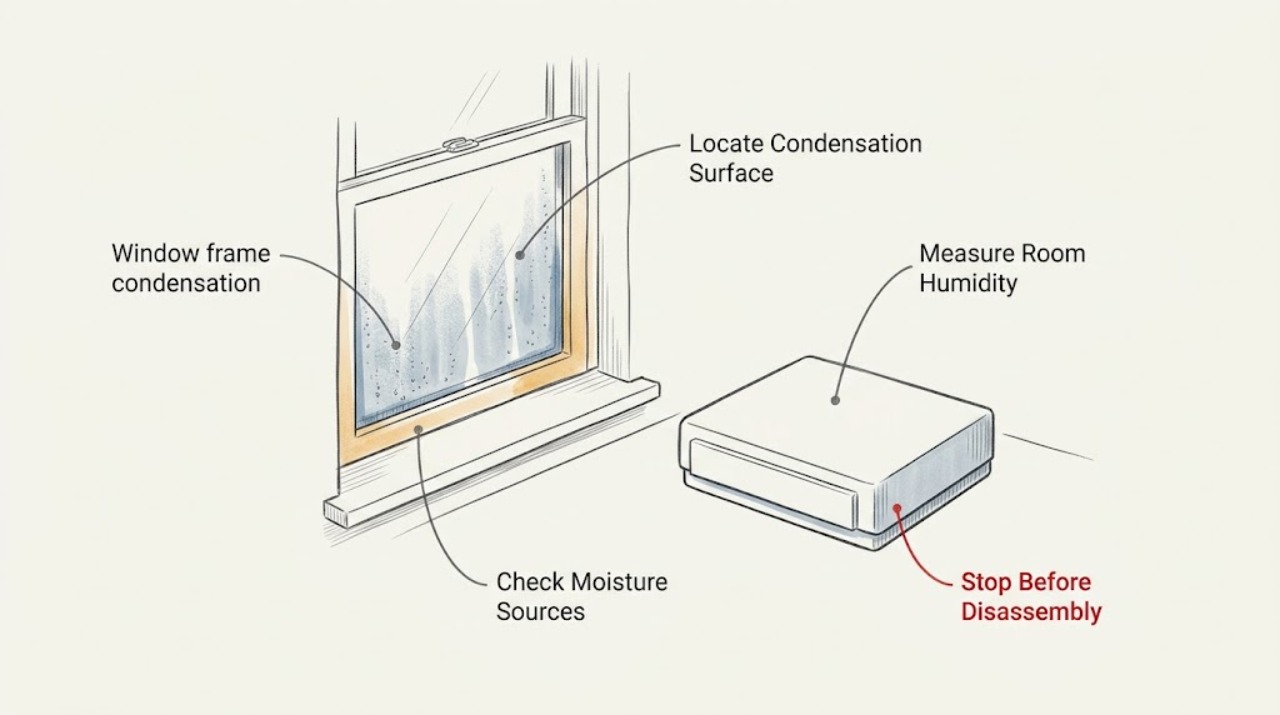
First identify where the water is: on the room side of the frame or glass, on the outside, between insulating panes, or only around the frame after rain. Room-side condensation usually means humid indoor air is meeting a cold surface; measure indoor relative humidity and check cooking, bathing, drying, ventilation, blinds, and blocked airflow. Condensation between sealed panes points to a failed insulated-glass seal rather than a room-humidity fix. Water that follows rain, stains the wall, or collects under the frame may be a leak or drainage problem. Dry the surface, document the timing and location, avoid painting or sealing over wet material, and use a window or building professional when the unit is fogged between panes, the frame is damaged, or the moisture source is not clear.
Work through in order
Diagnostic checks
Use only checks that match the exact appliance or system and its official guide.
-
Check 1
From a dry, stable position, wipe one small accessible area and photograph where moisture returns: the room-side glass, the frame or sill, the outside glass, between insulating panes, or the wall and trim around the opening. Record the weather, time of day, and whether it follows rain, heating, cooling, cooking, or bathing.
Expected result: Moisture forms on the room side, outside, between panes, or around the frame and wall; the pattern is seasonal, event-related, or persistent.
Next step: Use the location to choose the humidity, airflow, seal, or leak branch. Do not dismantle the sash or apply a sealant before the source is identified.
Stop if: Stop if the window is cracked, loose, inaccessible, above safe reach, or surrounded by wet electrical equipment, unstable trim, or visible mold.
Why this matters
Why: Room-side and exterior surface moisture usually involve temperature and humidity on the adjacent side. Fog or droplets between panes are a different symptom, while water around the frame after rain makes leakage or drainage more likely.
-
Check 2
Place a hygrometer in the affected room away from the glass, direct sunlight, a vent, and a humidifier. Record relative humidity and room temperature when condensation is present and again after the room has been used normally.
Expected result: Relative humidity is repeatedly high, is within a moderate range while the frame still wets, or the reading changes sharply after showers, cooking, laundry, or humidifier use.
Next step: Reduce the moisture source and ventilate when appropriate, then document whether the same window improves. If the room reading is reasonable but the frame stays wet, continue to the airflow, leak, and glazing checks.
Stop if: Do not place electrical measuring equipment on a wet sill or near a leaking outlet, and stop if a humidifier, dehumidifier, or wiring appears damaged.
Why this matters
Why: High or event-linked humidity supports indoor moisture as a contributor. A moderate reading with condensation confined to one cold frame or edge suggests a local cold surface, draft, installation, or insulation condition rather than humidity alone.
-
Check 3
Check whether a bathroom or kitchen exhaust fan runs during moisture-producing use and vents outdoors, whether the clothes dryer vents outdoors, and whether a humidifier, indoor clothes drying, cooking steam, or a basement moisture source is near the affected room.
Expected result: Condensation increases after a specific activity, the fan or dryer exhaust is missing or ineffective, or no obvious moisture source changes the pattern.
Next step: Use the existing ventilation as designed and follow its manufacturer instructions; arrange repair of a failed or misdirected exhaust. Do not route a dryer or combustion appliance into an attic, wall, or room.
Stop if: Stop if exhaust work requires entering a roof or wall cavity, handling combustion equipment, or altering electrical wiring or ductwork.
Why this matters
Why: An activity-linked increase makes indoor moisture a likely contributor. A missing exhaust path can keep humidity at the cold window surface; no activity link means the frame, glazing, weather, or a hidden leak deserves more weight.
-
Check 4
With the window closed normally, look for blinds, curtains, furniture, or a cold-air path that blocks warm room air from reaching the glass and frame. Compare the affected frame with a nearby window in the same room and note drafts at the edges without using a flame or opening trim.
Expected result: Condensation is concentrated behind a closed treatment or at one perimeter, a draft is felt at the frame, or several windows show the same pattern.
Next step: Allow safe air movement over the window and record whether the pattern changes. Have a window professional inspect frame-to-opening insulation and air sealing when drafts or an isolated cold perimeter persist.
Stop if: Do not remove trim, insulation, or interior finishes to chase a draft, and stop if the window or surrounding wall moves when touched.
Why this matters
Why: Blocked air movement or a local cold bridge can keep one frame below the dew point even when room humidity is not extreme. Similar wetting across many windows points more toward room conditions; an isolated perimeter pattern raises an installation or air-leak question.
-
Check 5
After a safe rainfall observation, inspect the sill, side trim, wall below the window, and nearby exterior surface for water tracks, staining, soft wood, peeling finish, or moisture that appears only after rain. Do not spray water into the assembly or remove exterior cladding.
Expected result: The wetness follows rain and tracks from the perimeter, or the condensation appears without rain and stays on a surface exposed to indoor or outdoor air.
Next step: Photograph the path and arrange a window or building-envelope professional to find the water entry and drainage route. Dry the area promptly and do not seal over wet or damaged materials.
Stop if: Stop if water reaches electrical equipment, the wall or sill is soft or unstable, or inspection would require climbing, removing cladding, or entering a wall cavity.
Why this matters
Why: Rain-linked water or damage around the opening is more consistent with a leak, flashing, drainage, or seal problem than ordinary surface condensation. A dry perimeter does not rule out a concealed leak, but it makes a humidity or cold-surface path more likely.
-
Check 6
View the glass at an angle and from both sides, without removing the sash, to determine whether fog or droplets are trapped between the panes of an insulating glass unit and cannot be wiped from either surface.
Expected result: The haze wipes from the room-side or exterior surface, or moisture remains in the sealed space between panes.
Next step: Record the sash or window label and ask the manufacturer or a window professional whether the insulated glass unit or window should be repaired or replaced. Do not drill, pry, or attempt to vent the sealed glass.
Stop if: Stop for cracked or broken glass, loose sash components, sharp edges, or any need to remove the sealed unit.
Why this matters
Why: Surface moisture can respond to humidity and temperature. Persistent moisture between panes is a manufacturer-described sign of insulated-glass seal failure and is not corrected by lowering room humidity.
Use your observations
Decision map
Find the observation that best matches what you see, then follow the next safe action.
-
PATH 01Next step
What you see
Condensation is on the room side, occurs in cold weather or after bathing/cooking/laundry, and the room humidity is elevated or the affected room lacks effective exhaust.
Do this next
Reduce the moisture source, use properly vented kitchen and bath exhaust, allow air to circulate over the window, and monitor the same frame with a hygrometer. Escalate if the frame remains wet at a reasonable humidity or damage appears.
Why this path and its safety boundary
Why it matters: Humid indoor air reaching a cold glass or frame is more likely than a failed sealed unit.
-
PATH 02Next step
What you see
One window or one frame edge wets while nearby windows are dry, room humidity is not unusually high, and a draft, blocked airflow, or cold perimeter is visible.
Do this next
Document the exact edge, keep safe airflow over the glass, and arrange a window professional to inspect the frame, opening, and air seal without covering drainage paths.
Why this path and its safety boundary
Why it matters: A local air leak, thermal bridge, frame-to-opening insulation gap, or installation condition is more likely than a whole-room humidity problem.
-
PATH 03Next step
What you see
Fog or droplets remain between insulating panes and cannot be wiped from either side, while room-side humidity changes do not clear the sealed-space moisture.
Do this next
Ask the manufacturer or window professional about an insulated-glass-unit or window replacement path after confirming the label and warranty status. Do not puncture or disassemble the unit.
Why this path and its safety boundary
Why it matters: A failed insulated-glass seal is more likely; humidity control may reduce surface condensation but will not dry a sealed cavity.
-
PATH 04Next step
What you see
Water appears after rain, tracks around the frame, leaves staining or soft trim, or persists with a musty odor or visible mold.
Do this next
Dry the accessible surface and arrange prompt window or building-envelope assessment. Do not paint over wet or moldy material; use an experienced remediation professional when damage is extensive or hidden.
Why this path and its safety boundary
Why it matters: A leak, drainage, or hidden moisture problem may be contributing; treating only the visible condensation can allow wall or frame damage to continue.
Helpful context
Understand the symptom
Start by locating the water
Condensation is not one single window failure. Moisture on the room side can form when humid air reaches a cold glass or frame surface; exterior moisture can form in warm, humid weather; and fog trapped between insulating panes is a different clue because it can indicate a failed glass seal. Water that appears only after rain or leaves a stain around the opening should be investigated as a leak or drainage problem instead of being treated as ordinary condensation.
Reduce moisture only when the pattern supports it
A hygrometer gives the room a useful baseline, but there is no single humidity number that clears every window. EPA advises keeping indoor humidity below 60 percent, ideally 30 to 50 percent, while ENERGY STAR notes that colder heating-season conditions may require roughly 30 to 40 percent to help prevent window condensation. Use the reading with the weather, room temperature, and condensation location rather than changing a humidifier or dehumidifier blindly.
Protect the frame and surrounding wall
Dry visible water promptly and record whether paint, wood, trim, or drywall is soft, stained, peeling, or moldy. Do not paint over wet or moldy material. Persistent wetness, hidden dampness, or visible mold means the moisture source needs to be fixed and may require an experienced window, building-envelope, or mold professional rather than a surface bead of caulk.
Safety boundary
Stop conditions
- Do not remove glass, sash, trim, insulation, cladding, or seal components to investigate condensation.
- Do not paint or seal over wet, moldy, stained, soft, or actively leaking material.
- Do not drill or puncture an insulating glass unit or block the window's drainage paths with caulk or film.
- Stop if the window is cracked, loose, above safe reach, surrounded by unstable material, or wet near electrical equipment.
- Use an experienced window, building-envelope, or mold professional when the moisture source is hidden, extensive, or not safely observable.
Only after diagnosis
Potential parts
- hygrometer
Consider this measuring device only when the condensation is on the room side and the next decision depends on an indoor humidity baseline.
Place it away from direct sun, vents, humidifiers, and the wet window; use its instructions and treat the reading as a room-condition check, not a diagnosis of the window assembly. - replacement insulated glass unit
Consider this category only when moisture is confirmed between sealed panes and a manufacturer or window professional confirms seal failure and the correct unit.
Match the exact window label, dimensions, glazing configuration, spacer or frame details, and installation requirements; do not order from appearance alone. - compatible weatherstripping or exterior sealant
Consider this category only after a professional confirms a worn weatherstrip or appropriate perimeter air-seal repair rather than a drainage defect, hidden leak, or failed glass seal.
Verify the window series, material, movement joint, drainage path, and manufacturer's installation instructions; do not seal over weep paths or wet damage.
When checks do not resolve it
Need a professional?
Arrange a window or building-moisture assessment when condensation remains after the room moisture pattern is addressed, is isolated to a drafty or unusually cold frame, appears between sealed panes, follows rain, damages trim or wall material, or is accompanied by mold or a musty odor. Use prompt professional help for extensive water damage, hidden moisture, cracked or loose glass, unsafe access, or water near electricity.
Common questions
FAQ
Does condensation on a window frame always mean the window is defective?
No. Room-side condensation can occur when humid indoor air meets a cold frame or glass surface, while exterior condensation can occur in warm humid weather. First identify the surface and check humidity, weather, airflow, and rain timing.
What indoor humidity should I use as a window-condensation check?
EPA advises keeping indoor humidity below 60 percent, ideally between 30 and 50 percent. ENERGY STAR notes that colder heating-season conditions may need roughly 30 to 40 percent to help prevent condensation. Use those as guidance alongside the local weather and the window pattern, not as a guarantee for every frame.
What does fogging between window panes mean?
Persistent moisture between insulating panes is a manufacturer-described sign that the glass seal has failed. It usually needs an assessment for insulated-glass-unit or window replacement; lowering room humidity will not dry the sealed space.
How can I tell condensation from a window leak?
Condensation is usually tied to the temperature and humidity on one side of the glass. Water that appears after rain, tracks from the perimeter, stains the wall, softens trim, or collects under the frame is more suspicious for leakage or drainage trouble and should be professionally assessed.
Should I caulk around a window frame that is wet?
Not before the cause is known. Caulk can conceal a leak, block drainage, or trap moisture. Dry and document the area, then have a window professional confirm whether the issue is a compatible air seal, a drainage defect, a failed glass seal, or wall damage.
Read the exact guide
Official sources
- DehumidifiersENERGY STAR · ENERGY STAR guidance for using a hygrometer, interpreting relative humidity, and managing drainage and electrical safety around dehumidification.
- Text Version of the Mold House TourU.S. Environmental Protection Agency · EPA room-by-room guidance linking window condensation to indoor humidity and distinguishing moisture, ventilation, leak, and mold clues around the home.
- Residential Windows, Doors, & SkylightsENERGY STAR · ENERGY STAR guidance explaining why window surfaces condense and how humidity, ventilation, airflow, and frame-to-opening insulation affect the pattern.
- Purchasing Energy-Efficient Residential Windows, Doors, and SkylightsU.S. Department of Energy · DOE guidance connecting window air leakage and condensation resistance with comfort, damage risk, and proper installation practices.
- A Brief Guide to Mold, Moisture, and Your HomeU.S. Environmental Protection Agency · EPA guide with practical moisture-control and condensation guidance for window and surrounding building materials.
- Frequently Asked Questions About WindowsPella · Pella FAQ confirming that persistent condensation between insulated panes indicates a failed seal and typically requires an insulated-glass or window replacement assessment.
- How to Deal with Window CondensationPella · Opened manufacturer guidance separating surface condensation from between-pane moisture and describing humidity, airflow, and seasonal patterns.
Community feedback
Share a repair observation
Share a plain-text repair observation. Accepted observations are published automatically; this page may take a moment to update.