
On this page
Start here
Quick answer
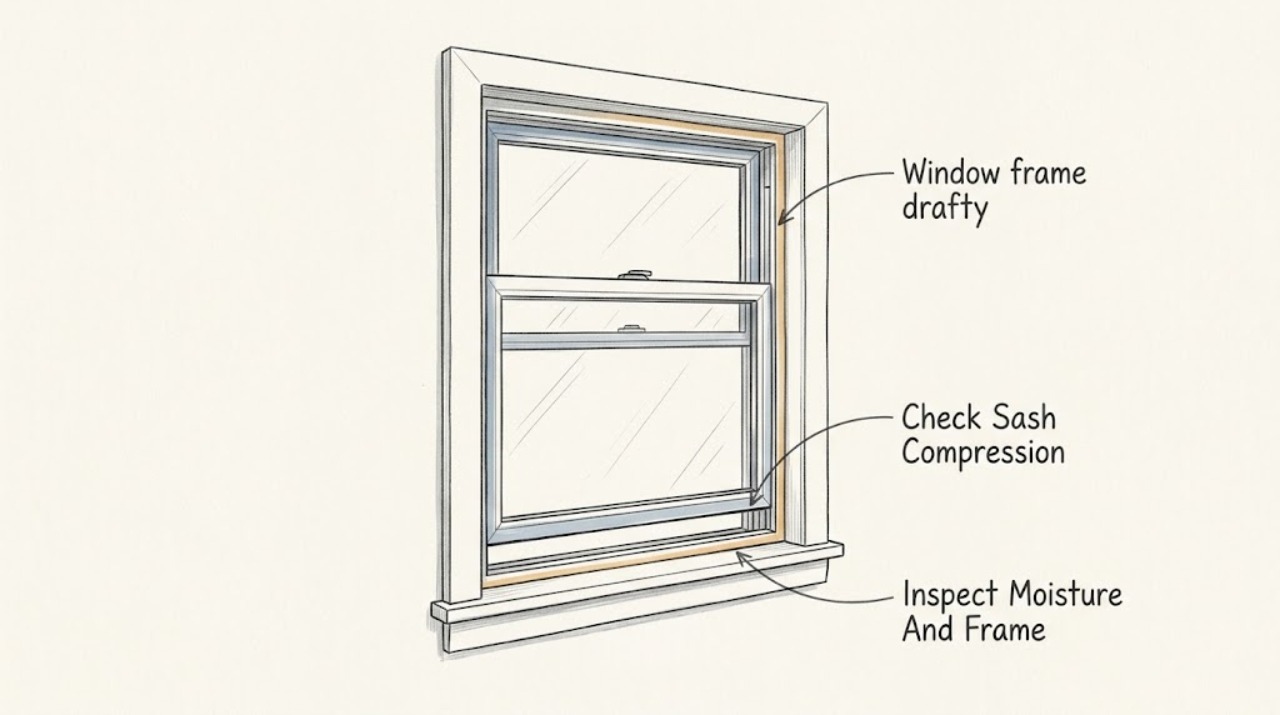
First locate where air moves around the closed window: the moving sash, the fixed frame and trim, or the nearby wall. A paper test can show whether the sash is losing compression, while a careful tissue or smoke observation can show a perimeter path; do not use an open flame. Look for gaps, peeling paint, staining, condensation, or a draft that changes when exhaust fans run. Weatherstripping may suit a sash seal, but a gap behind trim, water damage, lead-paint risk, or a window that will not close squarely needs a qualified assessment. Do not remove trim or force the window just to chase a draft.
Work through in order
Diagnostic checks
Use only checks that match the exact appliance or system and its official guide.
-
Check 1
With the window fully closed and latched in its normal position, compare a narrow tissue strip or other nonflammable indicator at the sash seam, frame corners, sill, trim-to-wall joint, and nearby wall. Test during the same outdoor conditions and do not use a candle, lighter, or other open flame.
Expected result: The indicator moves at the moving sash, only at the fixed trim or sill, at a corner or isolated gap, or not at all; note whether wind direction or an exhaust fan changes the movement.
Next step: Photograph the exact point and continue to the paper-compression and moisture checks. If the window cannot be closed or the area is unstable, stop and arrange service.
Stop if: Do not lean out, climb, remove trim, disturb damaged paint, or use flame to find a draft.
Why this matters
Why: Movement at the sash makes a weatherstrip, latch, or compression path more likely. Movement at fixed trim or the sill points more toward an installation or wall-envelope gap. No movement with cold glass or moisture makes condensation or a thermal bridge more likely than a confirmed draft.
-
Check 2
Place a single sheet of ordinary paper at several points between the closed sash and its frame, close and latch the window normally, and try to pull the paper out without forcing the latch or bending the sash.
Expected result: The paper is held firmly around the perimeter, slips easily at one section, or slips around most of the closed window; record the side and height where the result changes.
Next step: For a localized sash result, photograph the existing seal profile and identify the window manufacturer or material before considering a matching weatherstrip. For a broad or uneven result, ask a window professional to assess fit and hardware.
Stop if: Stop if the sash binds, the latch will not engage normally, glass or frame movement is visible, or the test would require prying or disassembly.
Why this matters
Why: A localized loose section supports a worn, displaced, or incomplete weatherstrip or a local compression problem. A loose result around most of the perimeter makes a broader fit, hardware, or installation issue more likely and is not proof that a generic strip will fit.
-
Check 3
From inside and from a safe exterior viewpoint, inspect the frame, sill, trim, and adjacent wall for peeling paint, staining, soft or swollen material, mold-like growth, outdoor odors, pest or dust entry, and water tracks. Do not probe or cut into wet or damaged material.
Expected result: There is clean, dry trim with a repeatable air path; condensation only on cold glass; staining or water at the sill or wall; peeling paint or soft material; or a musty odor and visible growth.
Next step: Photograph the spread and protect belongings from active water. Arrange a qualified window or building-envelope assessment for staining, softness, growth, or a persistent odor instead of covering it with caulk.
Stop if: Stop for active leakage, suspected contamination, electrical equipment made wet, crumbling paint, or any need to open the wall or remove trim.
Why this matters
Why: Dry trim with a repeatable path keeps air sealing in scope. Condensation without airflow may be a humidity or cold-surface issue. Staining, softness, peeling paint, or growth means moisture or hidden envelope damage may be involved, so a surface seal alone could trap the problem.
-
Check 4
Repeat the safe air observation once with nearby exhaust fans or a range hood off and once during ordinary operation, then record the window label, frame material, approximate age, and any previous repair that is visible without removing parts.
Expected result: The draft changes when the house pressure changes, several windows behave similarly, only this window is affected, or the model and frame material are unknown; note whether closing the interior door changes the symptom.
Next step: If multiple openings respond together, request a home energy or envelope assessment. If one window is localized, give the professional the marked air path, paper-test result, moisture photos, and identity information.
Stop if: Do not remove interior trim, disturb possible pre-1978 paint, alter combustion appliances or ventilation, or force a window that is out of square.
Why this matters
Why: A pressure-sensitive draft at several openings may be part of a wider envelope issue rather than one failed frame. A single-window result keeps the sash, trim, or installation in focus. Unknown identity makes a generic seal or replacement risky because profiles and installation details vary.
Use your observations
Decision map
Find the observation that best matches what you see, then follow the next safe action.
-
PATH 01Safety boundary
What you see
Air movement is strongest at the moving sash, the paper slips at the same perimeter section, and the frame and wall are dry with no visible damage.
Do this next
Identify the exact window profile and follow the manufacturer's repair guidance; consider a matching weatherstrip only after fit and material are confirmed.
Why this path and its safety boundary
Why it matters: A worn, displaced, or poorly compressed weatherstrip or latch-side seal is more likely than a hidden wall leak.
Safety stop: Do not glue, screw, or force an unknown strip if it prevents normal locking or operation.
-
PATH 02Safety boundary
What you see
Air movement is at the trim, sill, or wall junction, especially with visible gaps, and the sash paper test is broadly normal.
Do this next
Have a qualified window or building-envelope professional assess the gap, insulation, flashing, and water path; use only a documented material-specific repair.
Why this path and its safety boundary
Why it matters: The air path is more consistent with sealing behind trim, the rough opening, or an adjacent wall connection than with a sash weatherstrip.
Safety stop: Do not remove trim or fill a wet, damaged, or unknown cavity as a quick cosmetic fix.
-
PATH 03Safety boundary
What you see
There is little or no repeatable air movement, but condensation, staining, or a cold interior surface appears at the window.
Do this next
Track when condensation occurs, manage indoor moisture and ventilation as appropriate, and obtain a moisture or window assessment if staining, softness, or growth persists.
Why this path and its safety boundary
Why it matters: Moisture and surface temperature are more likely to explain the observation than a proven frame air leak; persistent staining may indicate a water or envelope problem.
Safety stop: Do not seal over wet material or visible growth before the moisture source is assessed.
-
PATH 04Safety boundary
What you see
Several windows or openings respond together, and the draft changes when exhaust fans or other pressure conditions change.
Do this next
Request a home energy or building-envelope assessment that can locate larger leaks and consider ventilation and combustion safety before extensive air sealing.
Why this path and its safety boundary
Why it matters: A broader air-leakage or ventilation pattern is more likely than one defective window frame; replacing one window may not remove the room discomfort.
Safety stop: Do not make broad sealing changes around combustion appliances or vents without qualified guidance.
-
PATH 05Safety boundary
What you see
The window will not close or lock, the frame is distorted, glass is damaged, paint may contain lead, there is active water or contamination, or the repair requires elevated access or trim removal.
Do this next
Stop the DIY investigation, keep people and belongings clear of the area, and arrange qualified window or building-envelope service; use urgent help for active flooding or an immediate safety hazard.
Why this path and its safety boundary
Why it matters: The job has exceeded a safe, surface-level weatherstrip check and may involve structural, moisture, material, or access risk.
Safety stop: Do not pry the sash, cut painted trim, climb, open the wall, or cover a hazard with a sealant.
Helpful context
Understand the symptom
A draft at the frame is a location problem first
The air path matters more than the room temperature alone. Air at the meeting rail or sash perimeter points toward the operable seal or latch compression. Air at the fixed trim, sill, or wall junction points toward the installation gap or surrounding wall. ENERGY STAR lists drafts around a closed window, visible trim gaps, outdoor odors, pests or dust, and peeling paint as signs worth investigating; it also notes that a poorly installed window can be drafty even when the product itself is otherwise sound.
Separate air leakage from condensation
Cold glass or a cold frame can collect interior moisture without an obvious air stream. EPA explains that condensation occurs when a surface is below the indoor air's dew point and that excessive indoor moisture can damage surrounding materials. If there is no repeatable air movement but there is water or staining, address moisture and the building envelope rather than applying a sealant blindly.
Match the repair to the diagnosed path
A replaceable weatherstrip is a conditional repair for a confirmed sash-seal or compression problem. Caulk or air sealing around fixed trim may be appropriate only when the gap, material, and paint condition are known. Removing trim can disturb old paint or expose hidden damage; ENERGY STAR specifically flags lead-paint precautions for older homes and recommends a trained professional when the work exceeds a straightforward accessible repair.
Safety boundary
Stop conditions
- Do not use a candle, lighter, or other open flame to find a draft.
- Do not pry, force, drill, cut, or remove trim when the cause, material, or paint condition is unknown.
- Do not seal over wet, soft, stained, or visibly contaminated material before the moisture source is assessed.
- Stop for damaged glass, active leakage, wet electrical equipment, suspected lead paint, unstable elevated access, or a window that cannot close or lock normally.
Only after diagnosis
Potential parts
- window weatherstripping
Consider this category only when airflow and the paper test localize the problem to a moving sash seal, the window identity is known, and the replacement will preserve normal closing and locking.
Confirm the exact manufacturer, profile, material, dimensions, and installation instructions; an appearance match is not enough. - window and trim air-sealing material
Consider this category only after a professional or documented inspection confirms a dry, accessible fixed-joint gap and identifies the correct sealant or backer material.
Confirm substrate, movement, weather exposure, paint condition, and any lead-safe or moisture requirements before selecting a material.
When checks do not resolve it
Need a professional?
Arrange service when the draft persists after a safe observation, the source is at fixed trim or the wall, the frame will not close or lock, there is staining or soft material, the identity is unknown, or the repair needs trim removal, elevated access, moisture remediation, or material-specific sealing.
Have this ready
- Photos marking the strongest air path and any staining, peeling paint, or condensation
- Paper-test results at the sash perimeter and whether airflow changes with exhaust fans
- Window manufacturer, frame material, approximate age, and visible labels
- Weather, room, and timing conditions when the draft is strongest
- Any previous repair, water event, access limitation, or suspected old paint
Common questions
FAQ
How do I tell whether the draft is at the window sash or the frame?
Test the sash seam, corners, sill, and trim-to-wall joint separately with a nonflammable tissue indicator, then use the paper test at several points around the closed sash. A sash-only result supports a weatherstrip or compression path; a fixed-trim result points toward installation or wall-envelope sealing.
Can I just caulk around a drafty window frame?
Only after confirming the gap is dry, accessible, and the correct joint and material are known. Caulk over a wet or damaged area can hide a moisture problem, and a sash leak will not be fixed by sealing the stationary trim.
What if the window is cold or wet but I cannot feel air moving?
That may be condensation on a cold surface rather than a confirmed draft. Track when it occurs and check indoor moisture and ventilation; persistent staining, softness, or growth needs a moisture or envelope assessment.
Should I remove the interior trim to find the leak?
Not as a first step. Trim removal can disturb old paint, expose hidden water damage, or require work beyond a safe inspection. Use the visible tests and photos first, then use a qualified professional for behind-trim or rough-opening assessment.
Read the exact guide
Official sources
- What are the main ways to control moisture in your home?U.S. Environmental Protection Agency · General residential moisture guidance; it does not identify the cause of an individual window draft or replace a building assessment.
- High Performing Windows or Storm WindowsENERGY STAR · General residential window replacement context; product, climate, and installation conditions must be evaluated for the actual home.
- Residential Windows, Doors, & SkylightsENERGY STAR · General residential windows guidance; the installed product's instructions and a qualified installer govern model-specific work.
- Sealing Behind Window & Door Trim ProjectENERGY STAR · General residential window and door air-sealing guidance; exact window construction and local safety requirements control.
Community feedback
Share a repair observation
Share a plain-text repair observation. Accepted observations are published automatically; this page may take a moment to update.