
On this page
Start here
Quick answer
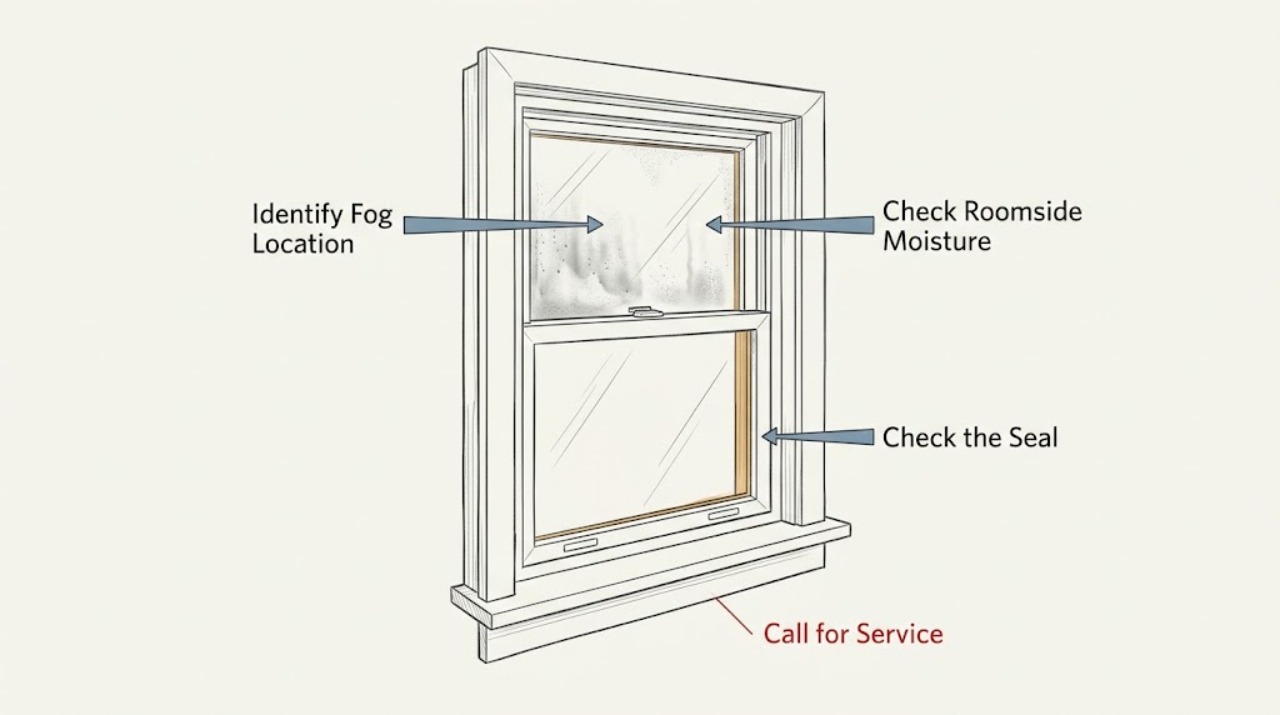
When window glass looks foggy, first determine whether the haze is on the room side, outside, or between the panes. Wipe an accessible surface and see whether the haze returns; persistent moisture between double or triple panes points to a failed insulated-glass seal and cannot be corrected by cleaning the surface. Room-side condensation usually calls for drying the sill, improving air movement over the glass, and reducing indoor moisture, while exterior condensation can occur in humid conditions without a window defect. If there is water entering the frame, rot, mold, cracked glass, failed operation, or old paint that may be disturbed, stop surface repairs and arrange qualified window or building-envelope service.
Before you begin
Safety first
- This article supports accessible surface observation, drying, normal operation checks, air-movement and moisture observations, and only a clearly suitable surface seal performed according to instructions. Glass-unit removal, glazing, frame or flashing work, trim removal, mold remediation, and lead-paint work require qualified professionals.
Work through in order
Diagnostic checks
Use only checks that match the exact appliance or system and its official guide.
-
Check 1
Look at the room side, the outdoor side from a safe position, and the visible edges of the glass; wipe only an accessible glass surface with a clean, suitable cloth and do not climb outside or disassemble the window.
Expected result: Record haze that wipes away, haze that returns on the room side, haze that appears only outside, or moisture and cloudiness visibly trapped between panes.
Next step: Continue with the matching branch: check indoor moisture for room-side condensation, note outdoor conditions for exterior condensation, or document the pane and arrange glazing or window service for between-pane moisture.
Stop if: Do not drill, puncture, pry apart, or inject anything into the glass or the space between panes; do not use a ladder or lean out of a window to inspect the exterior.
Why this matters
Why: A removable surface film is not the same as trapped moisture. Room-side or exterior haze follows temperature and humidity conditions more often, while between-pane haze points toward the insulating-glass seal.
-
Check 2
If the haze is on the room side, dry the glass and sill, look for nearby moisture sources, and check whether curtains or blinds prevent air from moving over the glass; use normal kitchen and bath exhaust and ventilation practices.
Expected result: Record condensation that clears and stays away, condensation that returns after cooking or bathing, a persistently wet sill, or no condensation after the surface is dry.
Next step: Reduce the moisture source, improve air movement over the glass, and dry wet materials. Arrange qualified service for recurring water, damaged finishes, mold, or a condition not explained by indoor humidity.
Stop if: Do not paint or caulk over wet or moldy material, block required ventilation, or hide ongoing water damage behind a curtain or film.
Why this matters
Why: Returning room-side condensation is consistent with indoor humidity and a cold glass surface, not necessarily a failed window seal. A wet sill or wall adds a possible water-damage or mold pathway that should be addressed promptly.
-
Check 3
For a multi-pane window, inspect from the room side for a persistent cloudy band, droplets, or a haze that remains after both accessible surfaces are clean; note which pane or sash is affected without removing glazing beads or trim.
Expected result: Record clear space between panes, recurring haze on one accessible surface, or moisture visibly trapped between the panes.
Next step: Photograph or document the affected pane and arrange qualified window or glazing assessment; provide the window type and any label information visible without disassembly.
Stop if: Do not drill the pane, release gas, remove spacers, pry glazing, or promise that a surface caulk will restore the insulating seal.
Why this matters
Why: Moisture trapped between insulating panes is consistent with an insulating-glass seal failure. Surface cleaning cannot remove it, and the exact remedy may be replacement of the glass unit or another model-specific window repair.
-
Check 4
Inspect the visible frame, sash, sill, trim, and nearby wall for cracks, failed caulk, soft or swollen material, peeling finish, mold, or water trails; operate the window only through its normal range without force.
Expected result: Classify the perimeter as dry and intact, a small accessible stationary gap, moisture or staining, soft or rotten material, mold, cracked glass, or a sash that binds or will not close.
Next step: Dry and document minor surface moisture; arrange qualified window or building-envelope service for water entry, rot, mold, cracked glass, a loose frame, or unsafe operation.
Stop if: Do not force the sash, remove trim, disturb suspected lead paint, seal drainage paths, or caulk over active water damage or mold.
Why this matters
Why: A dry intact perimeter supports a glass-only or surface-condensation branch. Water damage, mold, frame movement, cracked glass, or failed operation can involve drainage, flashing, structural, or safety work beyond a replacement pane.
-
Check 5
After identifying surface condensation rather than trapped moisture, improve air circulation over the glass and manage indoor moisture according to the home conditions; if the issue is a clearly accessible stationary gap, consider compatible window sealant only as directed by the product and window instructions.
Expected result: Record clearer glass and a dry sill, haze that returns despite moisture control, a seal that interferes with window movement, or ongoing water entry or between-pane fogging.
Next step: Keep the window operable and arrange qualified window or building-envelope service when the fog persists, the seal was misapplied, or frame, glazing, or installation work is needed.
Stop if: Do not seal a window shut, block weep or drainage openings, use unapproved expanding material around the frame, or continue a repair that worsens moisture or operation.
Why this matters
Why: Improvement after moisture control supports a surface-condensation cause. Persistence, impaired operation, water entry, or between-pane fogging means the assumed cause or remedy is incomplete and needs further assessment.
Use your observations
Decision map
Find the observation that best matches what you see, then follow the next safe action.
-
PATH 01Safety boundary
What you see
The fog is on the room side and wipes away, then returns with indoor moisture or cold glass.
Do this next
Dry the surface, improve air movement over the glass, and reduce moisture sources; obtain service for recurring wet walls, mold, or damage.
Why this path and its safety boundary
Why it matters: Temperature and indoor humidity are more likely than a failed insulating-glass seal.
Safety stop: Do not paint or caulk wet or moldy material or block ventilation.
-
PATH 02Safety boundary
What you see
The haze is only on the outdoor surface and appears during humid or changing weather.
Do this next
Observe whether it clears as conditions change; investigate the frame only if water entry, damage, or trapped between-pane moisture is also present.
Why this path and its safety boundary
Why it matters: Exterior condensation can occur when the outdoor glass surface reaches condensation conditions and does not by itself prove a window failure.
Safety stop: Do not climb, lean out, or alter exterior glazing to inspect or clean the window.
-
PATH 03Safety boundary
What you see
Moisture or persistent cloudiness is visibly trapped between panes of insulating glass.
Do this next
Arrange qualified window or glazing assessment for the affected glass unit or window and do not attempt a drilled or injected repair.
Why this path and its safety boundary
Why it matters: The insulating-glass seal may have failed, reducing the unit's intended barrier and visibility; surface cleaning will not reach the trapped moisture.
Safety stop: Do not puncture panes, release the gap, remove glazing, or apply surface caulk as a substitute for a sealed-unit assessment.
-
PATH 04Safety boundary
What you see
Fogging is accompanied by water entry, staining, soft material, mold, cracked glass, or a frame or sash that is unsafe or inoperable.
Do this next
Dry accessible surfaces, keep people away from unsafe glass or mold, and arrange qualified window, building-envelope, or appropriate remediation service.
Why this path and its safety boundary
Why it matters: The problem may involve drainage, flashing, frame condition, glazing, or indoor moisture and cannot be isolated to cosmetic glass haze.
Safety stop: Do not disturb mold or old paint, force the window, remove trim, or hide the damage with caulk or film.
-
PATH 05Safety boundary
What you see
The glass looks clear briefly but fog returns without a clear humidity or weather explanation, or a user-level surface measure does not hold.
Do this next
Document when and where the fog returns and arrange qualified window or home-energy service rather than layering on unverified sealants.
Why this path and its safety boundary
Why it matters: The source may be a failed seal, hidden frame gap, water-management issue, or another condition that needs a closer assessment.
Safety stop: Do not dismantle the window or continue repeated surface treatments that impair operation or hide moisture damage.
Helpful context
Understand the symptom
The location of the fog changes the diagnosis
Haze on the room-side surface, haze on the outdoor surface, and moisture trapped between panes are different observations. ENERGY STAR explains that interior condensation can occur when humid indoor air meets a cold surface, while exterior condensation can form in warm, humid conditions. Pella identifies condensation between insulating panes as a sign that the seal between the panes may have failed.
Do not treat a sealed glass unit like a dirty single pane
Cleaning the accessible glass can remove surface film, but it cannot reach moisture trapped inside an insulating glass unit. A persistent cloudy band or droplets between panes are a glass-unit or window-service question, not a reason to drill the glass or inject a product into the gap. Keep the window safe and usable while arranging an assessment.
Moisture around the frame matters as much as the view through the glass
Condensation that repeatedly wets a sill or wall can damage finishes and support mold growth. EPA recommends acting promptly to dry condensation and reduce the moisture source. Water entry, soft material, mold, or a gap at the frame can indicate a drainage, flashing, or envelope problem that a glass replacement alone may not solve.
Safety boundary
Stop conditions
- Do not drill, puncture, pry, or inject anything into glass or between panes; trapped fog requires an insulated-glass or window assessment.
- Do not use a ladder, lean outside, or remove exterior glazing to inspect or clean a foggy window.
- Do not paint or caulk over mold, wet materials, active water damage, weep openings, or drainage channels.
- If old paint may be disturbed, especially in a pre-1978 home, stop before removing trim or creating dust and obtain lead-safe guidance.
- Arrange qualified window, glazing, or building-envelope service for persistent between-pane fog, water entry, rot, mold, cracked glass, failed operation, or an unexplained recurring condition.
Only after diagnosis
Potential parts
- insulated glass unit
Consider this only when moisture is confirmed between panes and a qualified assessment identifies a failed sealed glass unit.
Confirm the exact window dimensions, pane configuration, glazing method, and manufacturer or installer requirements before selecting a replacement. - window weatherstripping
Consider this only when the fog is actually surface condensation with an independently located draft at a moving sash seal.
Confirm the window type and seal profile; weatherstripping does not repair moisture trapped between panes.
When checks do not resolve it
Need a professional?
Arrange qualified window or glazing service for moisture between panes, persistent cloudiness that does not respond to surface and moisture checks, cracked glass, failed operation, a loose or rotten frame, or water entering around the window. Use a building-envelope or moisture professional when stains, mold, hidden gaps, or drainage and flashing concerns are present. Obtain lead-safe guidance before disturbing old paint or trim in a pre-1978 home.
Safety scope: This article supports accessible surface observation, drying, normal operation checks, air-movement and moisture observations, and only a clearly suitable surface seal performed according to instructions. Glass-unit removal, glazing, frame or flashing work, trim removal, mold remediation, and lead-paint work require qualified professionals.
Common questions
FAQ
How do I tell whether fog is inside or outside a window?
Wipe the accessible room-side surface, then observe the exterior only from a safe position. If the haze remains visibly trapped between panes or returns inside the sealed space, it is not a surface-cleaning problem and needs a window or glazing assessment.
Why is there condensation on the inside of my window?
Indoor humidity meeting a cold glass surface can produce room-side condensation. Dry the glass and sill, improve air movement over the window, and reduce indoor moisture sources. Recurring water, stains, mold, or damage needs further assessment.
Can foggy glass between panes be cleaned?
No surface cleaning can reach moisture trapped between insulating panes. Persistent between-pane fog is consistent with a failed glass seal; arrange qualified window or glazing service rather than drilling or injecting the unit.
Is exterior window condensation a defect?
Not necessarily. Exterior haze can occur when humid outdoor conditions meet a cooler glass surface. Observe whether it clears as weather changes and investigate further only if there is also trapped between-pane moisture, water entry, or frame damage.
When should a professional inspect foggy window glass?
Arrange service for between-pane fog, persistent unexplained haze, cracked glass, water entry, rot, mold, a loose or inoperable frame, complicated trim, or a repair that may disturb old paint. Keep the window safe and operable while arranging the assessment.
Read the exact guide
Official sources
- A Brief Guide to Mold, Moisture and Your HomeU.S. Environmental Protection Agency · EPA moisture guidance used for safe handling of condensation and moisture-related damage around windows; it does not diagnose a particular window seal or glazing unit.
- Frequently Asked Questions About WindowsPella · Pella homeowner guidance used for general fog-location and sealed-glass triage; exact window construction and service requirements vary by product.
- Residential Windows, Doors, & SkylightsENERGY STAR · ENERGY STAR guidance used for general residential window fog and condensation triage; product instructions and local safety requirements control.
Community feedback
Share a repair observation
Share a plain-text repair observation. Accepted observations are published automatically; this page may take a moment to update.