
On this page
Start here
Quick answer
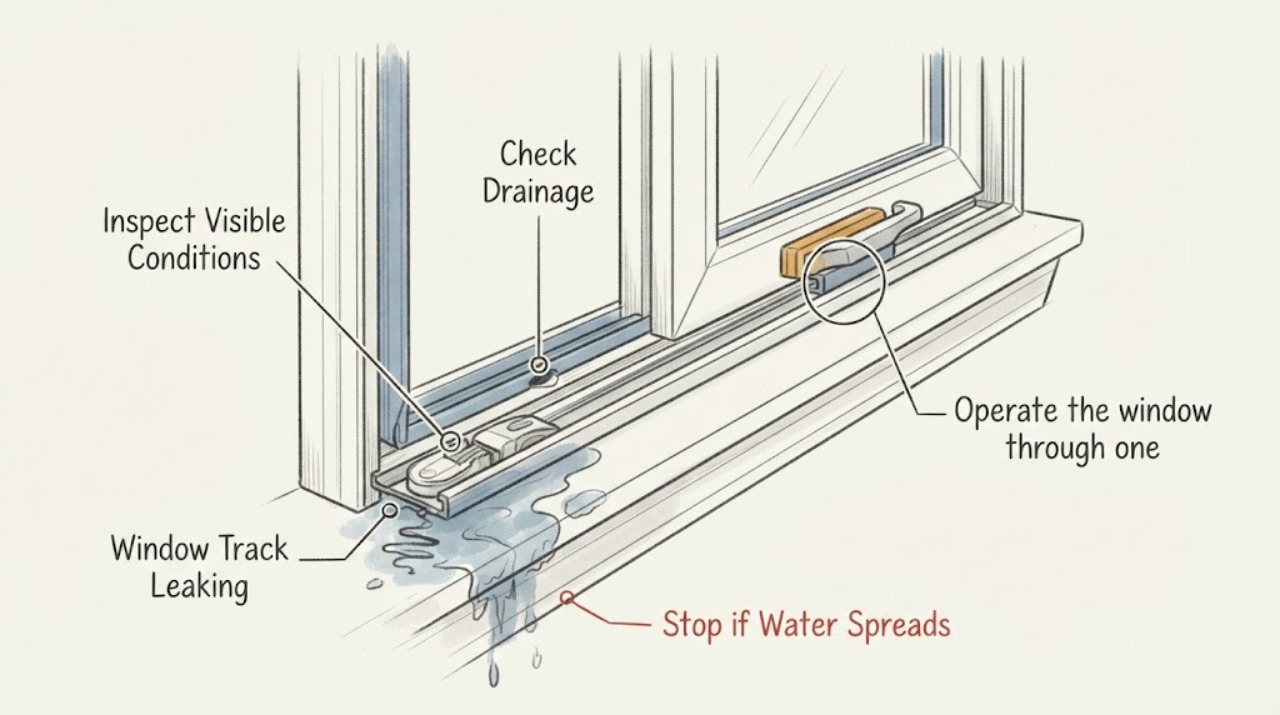
If water appears in a window track, do not assume the track itself is the source. Wipe the sill and track dry, observe during ordinary rain, and determine whether water is entering through the sash seal, collecting as intended and failing to drain through the weep openings, or arriving from the frame, trim, flashing, or wall above. Track and sill channels can collect incidental water, but their exterior drainage openings must remain clear. Clean only loose, accessible debris using the exact window instructions; do not caulk the track, plug weeps, drill the frame, or pressure-wash the unit. If water reaches the wall, the frame or glass is damaged, the sash will not close and lock, or water persists with a clear track and drainage path, stop and arrange qualified window or building-envelope service.
Work through in order
Diagnostic checks
Use only checks that match the exact appliance or system and its official guide.
-
Check 1
Wipe the glass, sash, track, sill, trim, and nearby wall dry; during the next ordinary rain, observe from a safe position and note whether water first appears at the sash edge, in the track, at a corner, under the sill, or above the window.
Expected result: Water collects in the track and moves toward an exterior opening, spills over the interior lip, enters at the sash joint, or appears first at trim or wall above the track.
Next step: Photograph the first wet point and weather conditions, then continue with the matching drain, sash, or exterior-path check; do not apply sealant yet.
Stop if: Stop for active water near electrical equipment, a loose or falling sash, cracked glass, unsafe exterior access, or a frame that moves under light pressure.
Why this matters
Why: A track that collects and drains outward may be operating normally, while interior spillover points toward a blocked drain, excessive inflow, or a level and seal issue. Water beginning above or behind trim is more likely an exterior or rough-opening path.
-
Check 2
With the window closed or opened only as the exact instructions permit, inspect the bottom track and exterior sill for visible dirt, paint, insects, sealant, or debris covering designed drainage openings; clear only loose accessible material with a soft brush or vacuum method approved for the window.
Expected result: An exterior weep is blocked, the track contains heavy debris, water drains after loose debris is removed, or the openings are clear but the track still fills or spills inward.
Next step: Restore only the documented accessible drainage condition and observe one later rain event; never enlarge, drill, or seal a weep opening.
Stop if: Stop for a blocked opening that cannot be reached safely, a need to remove the track, water near electrical equipment, or any proposal to plug or modify the drainage path.
Why this matters
Why: A blocked weep can leave collected rain in the track and allow it to overflow indoors. Clear openings with persistent filling point to excessive water entry, an installation or level problem, or an internal drainage design issue rather than a simple cleaning problem.
-
Check 3
Operate the window through one open-close-lock cycle and inspect the accessible weatherstrip, sash corners, meeting rail, and lock contact for tears, gaps, flattening, missing sections, or uneven compression; verify that the sash closes squarely without force.
Expected result: The lock does not latch, the sash is skewed, the weatherstrip is damaged or missing, one corner has a visible gap, or the sash and seal contact evenly.
Next step: Use only the exact window instructions for cleaning or adjustment; identify the series and seal profile before replacing weatherstrip, then retest operation and drainage.
Stop if: Stop if the sash drops, the lock binds, the seal prevents latching, the glass moves, or sash removal or exterior access is required.
Why this matters
Why: A track can overflow when rain enters through a poorly compressed sash joint, and an unlatched or misaligned sash may leak even with clear weeps. Even contact shifts attention to track capacity, frame drainage, flashing, or another exterior source.
-
Check 4
Inspect the interior and exterior frame, sill, trim, and corners for cracked sealant, open joints, peeling paint, staining, soft material, or water marks that continue beyond the track; do not cover exterior drainage gaps or the sill channel.
Expected result: The frame-to-trim joint is open, the sill or wall is stained or soft, the track is clean and dry between storms, or water follows the frame behind the trim.
Next step: Document the affected area and use only an accessible, manufacturer-compatible stationary-joint repair; obtain an envelope assessment when the joint is concealed or wet.
Stop if: Stop for rot, mold, wet concealed framing, lead-paint renovation risk, structural movement, or a joint that requires trim removal or exterior work.
Why this matters
Why: A stationary frame or wall gap needs air and water-management repair, not a strip packed into the moving track. Staining or soft material can indicate concealed moisture damage that surface caulk will not solve.
-
Check 5
From the ground or another safe location during ordinary rain, inspect whether a roof edge, gutter, siding joint, missing drip cap, head flashing, or failed exterior sealant directs water toward the window; compare that path with the interior first-wet point and avoid pressure-washing or spraying the unit.
Expected result: Water is directed at the window head or side, the head flashing or drip-cap area is missing or damaged, cladding sheds water behind the frame, or no exterior source is visible.
Next step: Photograph the exterior path, keep the window closed during storms when practical, and arrange qualified window or building-envelope inspection before invasive sealing.
Stop if: Stop for roof or ladder work, high wind, loose siding, concealed rot, active wall damage, or any repair that could trap water in the wall assembly.
Why this matters
Why: Excess water from above or an installation defect can overwhelm a functioning track and appear to be a track leak. A hidden flashing or rough-opening problem cannot be reliably repaired by adding surface caulk at the interior track.
-
Check 6
Arrange qualified window or building-envelope service when the track remains wet or spills indoors after safe drainage and closure checks, when glass or frame damage is present, or when the path involves flashing, rough-opening installation, concealed trim, or sash removal; provide photos and the first-wet location.
Expected result: The leak is repeatable or wind-driven, the track and weeps are clear, water reaches the wall, the frame moves, the sash cannot latch, or the glass is fogged or damaged.
Next step: Protect nearby finishes, keep the window closed and latched when practical, document rain and wind conditions, and let the professional identify the repair scope before sealing.
Stop if: Stop DIY work for active wall damage, cracked glass, unsafe sash movement, electrical contact, unsafe access, or any need to remove a heavy sash or pane.
Why this matters
Why: The remaining problem may be excessive water entry, glazing, sash alignment, frame drainage, flashing, sealant compatibility, or a concealed building-envelope defect. The visible track drip may be downstream from the true entry point.
Use your observations
Decision map
Find the observation that best matches what you see, then follow the next safe action.
-
PATH 01Next step
What you see
Water collects in the track, a designed weep opening is visibly blocked, and the track drains after loose accessible debris is removed.
Do this next
Arrange qualified service and follow the exact model guidance.
Why this path and its safety boundary
Why it matters: Keep the documented drainage openings and track clear; do not enlarge or seal the openings.
-
PATH 02Next step
What you see
Water enters through the moving sash joint or the sash does not close and lock evenly.
Do this next
Arrange qualified service and follow the exact model guidance.
Why this path and its safety boundary
Why it matters: Use exact window instructions for closure, lock, alignment, and weatherstrip identification; arrange service if operation remains abnormal.
-
PATH 03Next step
What you see
The track and weeps are clear but rain still fills or spills from the track indoors.
Do this next
Arrange qualified service and follow the exact model guidance.
Why this path and its safety boundary
Why it matters: Investigate excessive water entry, level, frame drainage, or exterior installation before applying any sealant.
-
PATH 04Next step
What you see
Water appears at trim, wall, sill framing, head flashing, or cladding rather than beginning in the track.
Do this next
Arrange qualified service and follow the exact model guidance.
Why this path and its safety boundary
Why it matters: Treat it as a stationary air and water-management or installation issue and obtain qualified assessment.
-
PATH 05Next step
What you see
Moisture is on the interior glass surface without rain-path evidence or track overflow.
Do this next
Arrange qualified service and follow the exact model guidance.
Why this path and its safety boundary
Why it matters: Check indoor humidity and room airflow; do not diagnose a track leak or replace glass from surface condensation alone.
-
PATH 06Next step
What you see
Water reaches electrical equipment, the glass or frame is unsafe, or repair requires exterior access, sash removal, or concealed structural work.
Do this next
Arrange qualified service and follow the exact model guidance.
Why this path and its safety boundary
Why it matters: Stop DIY work, protect or disconnect affected equipment only when safe, and obtain qualified urgent assistance.
Helpful context
Understand the symptom
A wet track can be normal until it cannot drain
Many operable windows collect a small amount of rain in a sill or track and route it outside. The useful question is whether the water remains in the channel, spills to the interior, or bypasses the track into the sash, trim, or wall. Record the first place that becomes wet and the weather conditions; that separates a drainage obstruction from a failed seal or exterior installation path.
Do not seal the drainage system shut
Keep designed weep holes, sill channels, and drainage openings clear. A bead of caulk across the track may stop a visible drip briefly while forcing water into the frame or wall. Avoid high-pressure water, drilling, prying, and sash removal unless the exact window instructions and safe support method are known.
Safety boundary
Stop conditions
- Water reaches outlets, wiring, or other electrical equipment.
- Glass is cracked, loose, shattered, fogged between panes, or has sharp exposed edges.
- The sash or frame moves, cannot latch, is rotten, or could fall during operation.
- A repair would block weep holes, the track, sill channels, or another designed drainage path.
- The work requires pressure washing, exterior access, a ladder, sash removal, or glass removal.
- Water intrusion has caused concealed framing damage, mold, lead-paint renovation risk, or structural concerns.
Only after diagnosis
Potential parts
- window weep cover or drainage component
Consider only when the exact window documentation identifies a damaged removable drainage component after the track and openings are confirmed as the leak path.
Match the exact window series and drainage design; never add a part that blocks or redirects the intended weep path. - window sash weatherstrip or gasket
Consider only when water enters through the moving sash joint and the existing seal is damaged or missing.
Match the exact series, operating type, profile, and orientation; verify the sash still closes and locks evenly. - window glazing gasket or insulated glass unit
Consider only when a professional confirms a failed glazing seal, damaged glass edge, or water path through the glazing assembly.
Verify exact dimensions and safe installation through qualified glazing service; do not drill or pry the pane. - drip cap, sill flashing, or compatible sealant
Consider only after a qualified assessment identifies a failed exterior water-management or installation component.
Match the window, cladding, and water-resistive-barrier instructions and preserve all designed drainage openings.
When checks do not resolve it
Need a professional?
The track remains wet or spills indoors after accessible weep, debris, and sash checks., Water enters behind trim, at the wall, head flashing, roof or gutter, or the rough opening., The sash will not close or lock, the frame moves, or the glass or glazing edge is damaged., The leak is intermittent or wind-driven and cannot be reproduced safely with ordinary observation., The repair requires exterior access, sash or glass removal, flashing, concealed drainage, or building-envelope work.
Common questions
FAQ
Is it normal for water to collect in a window track?
Some window designs collect incidental water in the sill or track and route it outside through weep openings. It is not normal for the track to spill into the room, remain blocked, or send water behind the frame; check the drainage path and the exact window instructions.
Why does my window track overflow when it rains?
A blocked weep, damaged sash seal, unlatched or misaligned sash, excessive water from above, failed flashing, or a concealed installation path can all overwhelm or bypass the track. Find where water first appears before sealing anything.
Can I caulk the inside of a leaking window track?
Do not caulk the track, sill channel, or weep openings just to stop a visible drip. That can block designed drainage and trap water in the frame or wall. Seal only an identified compatible stationary joint using the applicable instructions.
Could condensation look like a leaking window?
Yes. Moisture can form on cooler interior glass when indoor humidity is high, and that moisture may run toward the track without rain entering the window. Compare the symptom with rain, humidity, and the first-wet location before replacing a seal or pane.
When should I call a professional for a track leak?
Call when the track still overflows with clear weeps and a correctly closing sash, water enters the wall, glass or frame is damaged, the sash is unsafe, or the repair requires flashing, trim, exterior access, or sash or glass removal.
Read the exact guide
Official sources
- Winterize Windows to Keep the Cold at BayPella · Official manufacturer guidance used for accessible sash, seal, and lock checks; it is not a substitute for the assigned window's instructions.
- Window and Patio Door Maintenance TipsAndersen Windows and Doors · Official manufacturer maintenance guidance used for track water, weep openings, weatherstrip, lock, sealant, and condensation checks; exact designs vary by window.
- Window install mistakesAndersen Windows and Doors · Official manufacturer installation guidance used for diagnosing exterior water paths and escalation boundaries; it does not identify a specific window's repair detail.
- Residential Windows, Doors, & SkylightsENERGY STAR / U.S. Environmental Protection Agency · Government efficiency guidance used for condensation context, installation boundaries, and air and water leak location.
- Applying Plastic Over Windows ProjectENERGY STAR / U.S. Environmental Protection Agency · Government guidance used for locating air movement around a window; it does not justify covering a water drainage path without tracing the source.
Community feedback
Share a repair observation
Share a plain-text repair observation. Accepted observations are published automatically; this page may take a moment to update.