
On this page
Start here
Quick answer
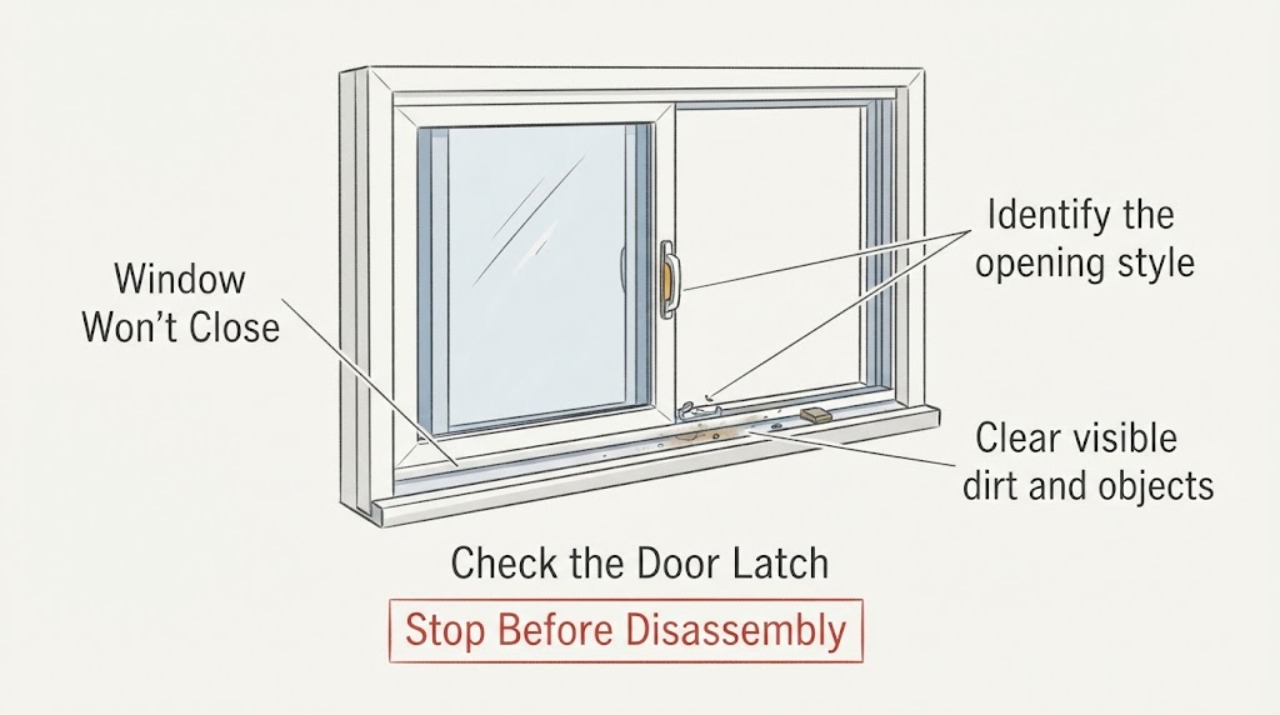
A window that will not close usually needs the opening style and exact binding point identified before any adjustment. First determine whether it is a horizontal or vertical slider, casement, or tilt-and-turn window. With the sash supported and your hands clear, inspect the accessible track, sill, frame, and latch area for dirt, an object, a displaced seal, or a restrictor that is still engaged. Use the correct handle position and gentle closing sequence for that style; never force the sash or handle. Keep the window secured and arrange qualified window service for a bent or loose track, damaged rollers or hinges, a sash that has dropped, cracked or loose glass, an unsafe opening, or a problem that remains after the accessible cleaning and operating check.
Work through in order
Diagnostic checks
Use only checks that match the exact appliance or system and its official guide.
-
Identify the opening style and the exact bind
From inside the room, note whether the window slides horizontally, slides vertically, swings outward or inward, or tilts and turns. Move it only a small amount with both hands in a stable position and identify whether resistance begins in the bottom track, a side track, a hinge, the top corner, the handle, or the latch. Do not lean through the opening or continue if the sash is unsupported.
Expected result: The sash moves along a track but stops near the end, one corner contacts first, the handle stops before the closed position, or the sash does not move safely at all.
Next step: Use the matching track, handle, or safety branch below. Keep the window in the safest secured position while investigating and arrange service if the bind is structural or cannot be observed safely.
Stop if: Stop for a loose or cracked pane, a sash that can fall, frame movement, sharp damaged hardware, or any need to reach outside.
Why this matters
Why: A track or roller obstruction is more likely when a slider stops along its travel. One-corner contact can indicate alignment, hinge, or sash support trouble. A handle that cannot reach its normal position can reflect a wrong operating sequence, latch interference, or frame movement.
-
Clear visible dirt and objects from the track
With the sash supported and the window in a safe position, inspect the accessible sill, bottom track, side channels, and frame corners for grit, paint, leaves, insects, or an object blocking the closing path. Remove only loose surface debris using a soft brush or cloth; do not use force, sharp tools, pressure washing, or an unapproved chemical cleaner.
Expected result: Debris is visibly blocking the track, the track is clean but the sash still binds, the channel is bent or damaged, or the track cannot be reached safely.
Next step: Close the window gently once after loose debris is removed only if it moves normally. Arrange qualified service for a damaged, bent, inaccessible, or persistently binding track.
Stop if: Do not pry, drill, bend, or remove the sash from the frame, and stop if cleaning would require an unsafe open-window position.
Why this matters
Why: A loose obstruction can prevent the sash from reaching the latch. A clean but binding or damaged track suggests a roller, hinge, alignment, frame, or installation issue that surface cleaning cannot correct.
-
Use the correct handle and latch sequence
If the sash is nearly closed and stable, check the exact product instructions for the handle sequence. For an outward-opening casement, the handle generally needs to be in its opening position before the sash is pulled closed; a tilt-and-turn window must be returned to its normal closed position before the handle is turned to lock. Move the handle gently and never force it.
Expected result: The window closes when the handle is repositioned correctly, the handle remains stiff or stops, or the sash and handle sequence do not match the window style.
Next step: Follow the exact product guide once and close gently. If the handle remains stiff or the latch will not engage, keep the window secured and arrange qualified service.
Stop if: Do not force the handle, bypass a lock, loosen hardware, or leave the window unsecured after a failed closing attempt.
Why this matters
Why: A wrong handle position can leave locking hardware engaged against the frame. Persistent stiffness or a mismatched sequence points to a latch, hinge, restrictor, or hardware problem rather than a track-cleaning issue.
-
Check sliders, rollers, and restrictors without disassembly
For a horizontal or vertical slider, observe whether the sash remains parallel to the frame and whether one side drags, tilts, or reaches the sill first. For a window with a child or safety restrictor, check whether the restrictor is visibly still engaged in its normal closed position, using only the product's instructions. Do not lift out the sash, release an unknown restrictor, or remove track hardware.
Expected result: The sash is tilted, one roller or side drags, a restrictor prevents the final movement, or the sash travels evenly but still will not latch.
Next step: Use the exact model instructions for a clearly identified user-operable restrictor only; arrange qualified service for uneven travel, a damaged track or roller, or any unknown hardware state.
Stop if: Do not remove a sash, defeat a child or safety restrictor, or continue with a heavy or unsupported glazed panel.
Why this matters
Why: Uneven travel can indicate a roller, guide, track, or alignment issue. A restrictor can limit opening or affect the closing sequence, but its release method is product-specific. Even travel with a failed latch points toward locking or frame hardware.
-
Check hinge-track and one-corner symptoms
For a casement or tilt-and-turn window, inspect from inside whether the sash is sitting squarely in the frame or pivoting on one corner. Look for a hinge arm or track that is visibly loose, obstructed, or displaced. Do not adjust screws, release hinge buttons, or attempt to re-square the sash unless the exact product manual provides a clear user procedure you understand.
Expected result: One corner sits out, the hinge or track is visibly damaged, the sash is square but the latch does not meet, or no hinge symptom is visible.
Next step: Keep the window closed or otherwise secured without force and arrange qualified window service for hinge, track, sash, or latch alignment. Use only confirmed model instructions for any low-risk adjustment.
Stop if: Stop for a loose sash, damaged hinge, cracked glass, falling risk, or any work that requires exterior access or removal of hardware.
Why this matters
Why: A one-corner condition can put the sash and locking points out of alignment. Visible damage or a recurring misalignment needs service; a square sash with a latch problem points toward the lock or keep rather than the track.
-
Review lubrication and cleaning limits
If the window is stiff but the track is clean and there is no damage, consult the exact manufacturer instructions for the correct track or hinge maintenance. Use only a product and amount explicitly approved for that window system; do not spray oily or harsh products into a track, seal, lock, or drainage opening. Test movement only gently after the surface is clean and dry.
Expected result: The product guide specifies a maintenance method, the window improves only briefly, the track attracts more dirt, or stiffness is unchanged.
Next step: Stop experimenting with products and arrange qualified service for persistent stiffness, recurring binding, or a track that remains contaminated or damaged.
Stop if: Do not use pressure washers, abrasive tools, harsh chemicals, penetrating oil, or lubricant as a substitute for a hardware diagnosis.
Why this matters
Why: Maintenance can reduce friction only when it matches the window design. Temporary improvement or no change suggests worn rollers, hinges, alignment, or frame movement rather than a simple dirty track.
-
Prepare a service handoff
Record the window style, room and elevation, whether it slides or swings, the exact point of resistance, photos of the track and frame from inside, handle and latch position, debris found, one-corner contact, restrictor status, recent cleaning or impact, and whether the window can be secured. Do not keep forcing the sash while waiting for service.
Expected result: The window closes normally after visible debris is removed and the correct sequence is used, or it remains binding, unsecured, damaged, or unsafe.
Next step: Use the exact product guide for routine care, or provide the record to a qualified window professional for track, rollers, hinges, sash alignment, latch, and frame inspection.
Stop if: Stop all user troubleshooting for loose or cracked glass, a falling or unsupported sash, frame movement, an unsecured opening, or any need to work outside or remove the installed window.
Why this matters
Why: A one-time accessible obstruction or sequence error has a narrow explanation. Recurring binding or an alignment, hardware, glass, or safety issue requires professional diagnosis.
Use your observations
Decision map
Find the observation that best matches what you see, then follow the next safe action.
-
PATH 01Next step
What you see
A visible object, grit, paint, or debris blocks the accessible track or frame.
Do this next
Remove only loose surface debris with a soft brush or cloth and close gently once; arrange service if the obstruction is fixed, damage is visible, or binding returns.
Why this path and its safety boundary
Why it matters: The obstruction may be preventing the sash from reaching its closed position.
-
PATH 02Next step
What you see
The handle is in the wrong position for the window style or the tilt-and-turn sash is not in its normal closed position.
Do this next
Follow the exact product closing sequence once without force; arrange service for a stiff handle, damaged latch, or recurring failure.
Why this path and its safety boundary
Why it matters: Locking hardware may be contacting the frame instead of closing normally.
-
PATH 03Next step
What you see
A slider travels unevenly, one corner contacts first, or the sash drops or drags.
Do this next
Keep the opening secured and arrange qualified window service; do not lift out the sash or bend the track.
Why this path and its safety boundary
Why it matters: A roller, guide, hinge, track, sash, or frame-alignment fault is possible.
-
PATH 04Next step
What you see
A child or safety restrictor visibly limits movement or the hardware state is unknown.
Do this next
Use the exact manufacturer's instructions only; do not defeat or remove an unknown restrictor and obtain service if the window cannot be secured.
Why this path and its safety boundary
Why it matters: The restrictor may be part of the intended operating sequence, but release is product-specific.
-
PATH 05Next step
What you see
The track is clean, the sash is square, and the window still will not latch or close.
Do this next
Stop repeated attempts and arrange qualified window service with photos and the exact bind location.
Why this path and its safety boundary
Why it matters: A lock, keep, hinge, seal, frame, or installation problem is more likely than surface dirt.
-
PATH 06Next step
What you see
The pane is loose or cracked, the sash is unsupported, the frame moves, or the opening cannot be secured.
Do this next
Keep people away, avoid further movement, and arrange qualified emergency window service.
Why this path and its safety boundary
Why it matters: This is beyond safe track maintenance and may create a fall or glass hazard.
Helpful context
Understand the symptom
Identify the window style before moving the track or handle
A horizontal slider moves sideways, a vertical slider moves up or down, a casement swings on hinges, and a tilt-and-turn window has more than one operating position. A handle sequence that is correct for one style can bind another. If the window is almost closed, look for a visible obstruction and confirm the handle is in the opening position required by the exact product instructions before pulling it closed.
Clean the accessible track without forcing the sash
Dirt, grit, paint, or a small object can stop a sash or roller from reaching its closed position. Remove only loose, visible debris from an accessible track or sill with a soft brush or cloth. Do not pry the sash, remove it from the frame, change hinge or roller settings, or apply an unapproved oil. A track that is bent, loose, corroded, or still binding after cleaning needs professional inspection.
Safety boundary
Stop conditions
- Stop for loose or cracked glass, a falling or unsupported sash, frame movement, sharp damaged hardware, or an opening that cannot be secured.
- Do not lean outside, use a ladder, work from a roof, remove the installed sash, or release an unknown safety restrictor.
- Do not pry, bend, drill, or loosen the track, rollers, hinges, latch, or frame to force closure.
- Do not use pressure washers, abrasive tools, harsh chemicals, penetrating oil, or unapproved lubricant on the track or seals.
- Arrange qualified window service for recurring binding, a damaged track or roller, one-corner contact, a stiff or unreliable handle, or a failed latch.
Only after diagnosis
Potential parts
- window roller or track guide
Consider this category only when the exact window system and professional inspection confirm uneven travel or a worn or damaged guide.
Confirm the manufacturer, series, dimensions, and track design before ordering; do not bend or replace the track based only on appearance. - casement hinge or hinge-track hardware
Consider this category only when one-corner contact or a professional diagnosis identifies a damaged or worn hinge or hinge-track component.
Confirm the exact window style and hardware position before ordering; hinge work can leave a sash unsupported and belongs to qualified service. - window latch, keep, or handle assembly
Consider this category only when the sash reaches the frame but the locking hardware will not engage after the correct operating sequence.
Confirm the exact hardware and window geometry before ordering; never force or bypass a latch or lock.
When checks do not resolve it
Need a professional?
Arrange qualified window service when the track is bent, loose, damaged, inaccessible, or still binds after visible debris is removed; when the sash is out of square, a roller or hinge is suspected, the handle or latch remains stiff, or the window cannot be secured. Use emergency window service for loose or cracked glass, a falling sash, frame movement, or an unsafe opening.
Common questions
FAQ
Why won't my window close when it is almost shut?
Check the accessible frame and track for an obstruction, then confirm the handle is in the correct opening position for your window style before closing. Do not force the sash or handle; recurring binding needs qualified service.
Can dirt in a window track stop it closing?
Yes. Grit, paint, leaves, or small objects can restrict sliding parts. Remove only loose surface debris with a soft brush or cloth, and arrange service for a bent, damaged, inaccessible, or persistently binding track.
What if one corner of the window will not close?
One-corner contact can indicate a hinge, roller, sash, or frame-alignment problem. Keep the window secured, do not re-square it or loosen hardware, and arrange qualified window service.
Should I lubricate a window track that is stiff?
Follow the exact window manufacturer's maintenance instructions rather than spraying an improvised oil. Clean the accessible track first; if stiffness persists or returns, worn hardware or alignment is possible and needs professional diagnosis.
When is a window that won't close unsafe?
Stop for loose or cracked glass, a falling or unsupported sash, frame movement, an unsecured opening, sharp hardware, or any inspection requiring a ladder or outside access. Keep people clear and arrange qualified window service.
Read the exact guide
Official sources
- Cleaning and maintenanceAnglian Building Products · Household window tracks, hinges, frames, sills, and sliding parts where dirt or unsafe access may affect operation
- Opening and closing windowsAnglian Building Products · Household windows where a wrong handle, latch, slider, or restrictor sequence may prevent closure
- TroubleshootingAnglian Building Products · Household windows that are stiff, almost closed, incorrectly positioned, or unable to close and lock
Community feedback
Share a repair observation
Share a plain-text repair observation. Accepted observations are published automatically; this page may take a moment to update.