
On this page
Start here
Quick answer
If an AEG dishwasher leaves water in the tub, start with the removable filters and visible sump area, then check the sink connection and drain hose for a blockage, kink, twist, damage, or incorrect installation. A recently installed or moved dishwasher may still have the sink trap's blanking plug in place. Disconnect power before removing the filters or pump cover, remove only accessible debris without forcing anything, and refit every cover and filter correctly. If an AEG drainage code or repeated pumping continues after these model-appropriate checks, or there is a leak, stop using the dishwasher and arrange qualified service; an unknown AEG model does not justify replacing the pump by guesswork.
Before you begin
Safety first
- This article supports model-permitted power isolation, visible filter and sump cleaning, careful accessible debris removal, visible sink/hose inspection, and one controlled retest. It does not authorize hidden plumbing, base or control access, live electrical work, safety-control bypassing, or guessed parts replacement.
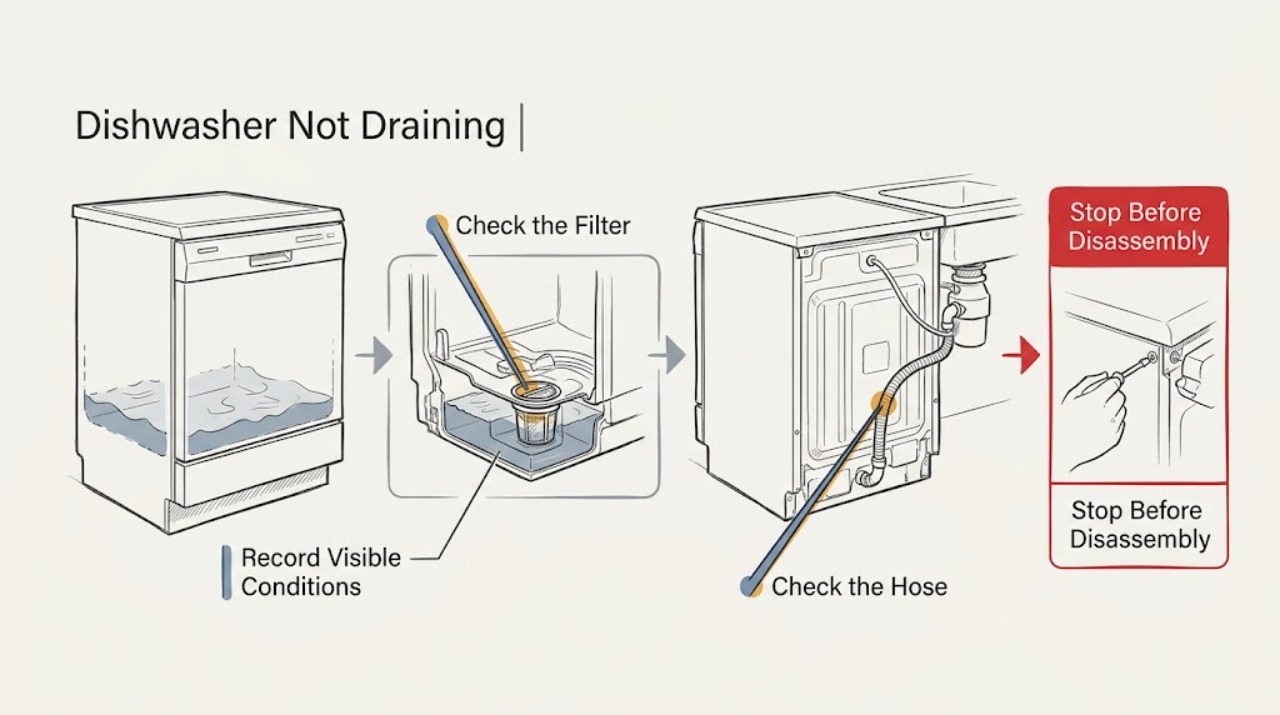
Work through in order
Diagnostic checks
Use only checks that match the exact appliance or system and its official guide.
-
Check 1
Before starting another cycle, record the water level, any display code or repeated beep pattern, whether the pump runs continuously, and whether the sink or waste connection drains normally. Do not start a cycle with a visible leak or water near electrical parts.
Expected result: Water remains across the tub, only a small amount remains around the sump, an AEG drainage code such as i20/C2/F2/AL6 or i23 is shown, the pump runs continuously, or the sink also drains slowly.
Next step: Take a photo of the display and model label, then follow the matching safe check below. If the pump runs continuously, water is leaking, or an i30/C3-style leak indication is present, shut off the water supply and power as the model guidance permits and arrange service.
Stop if: Do not reach into standing water while the dishwasher is powered, and do not keep restarting a unit that leaks, pumps continuously, or trips protection.
Why this matters
Why: Water across the tub supports a drainage problem; an AEG i20-family indication points to water drainage, while i23 guidance concerns the drain-pump cover and accessible pump area. Continuous pumping with a leak or water in the base can indicate a separate leak-protection condition, not simply a clogged hose.
-
Check 2
Switch the dishwasher off and disconnect its power as the model instructions allow. Remove the filter system, sponge out remaining water if safe, and inspect the filter, sump, and visible pump-cover area for food, plastic, glass, or other foreign material; use only finger access and the exact model's removal direction.
Expected result: The filter or sump is blocked, a foreign object is visible near the pump, the pump cover is loose or missing, or the filter and cover are clean, present, and firmly seated.
Next step: Remove only loose accessible debris, refit the pump cover and filters exactly as the model manual shows, and keep sharp debris such as glass out of bare hands. If a cover will not seat or a component is damaged, stop and arrange model-specific service.
Stop if: Do not run the dishwasher with the filter or pump cover missing, force a cover, probe the pump with a tool, or reach into an area containing sharp debris.
Why this matters
Why: A clogged filter or sump, foreign material, or a loose/missing pump cover can restrict or disrupt drainage. A clean, correctly seated filter and cover make the external drain route or an internal pump/control fault more likely; they do not prove the pump is bad.
-
Check 3
From accessible locations, inspect the sink spigot or siphon connection and the visible dishwasher drain hose for a blockage, kink, twist, crush point, or damage. If the dishwasher was recently installed or moved, check the exact installation instructions for a sink-trap blanking plug that should have been removed.
Expected result: The sink connection is blocked, the hose is bent or damaged, a blanking plug remains after installation, or the connection and visible hose are clear and correctly routed.
Next step: Clear only an accessible sink-side blockage and correct a visible hose route as the model installation instructions allow. Do not pull on a concealed hose or alter a fixed connection; use the model manual or a qualified technician when access is needed.
Stop if: Do not disconnect a pressurized or hidden connection, cut the hose, remove cabinetry, or operate with a leaking or damaged drain line.
Why this matters
Why: A blocked sink connection, restricted hose, or retained blanking plug can prevent the dishwasher from discharging even when the filter and pump area are clear. A clear route makes an internal pump, valve, wiring, or control issue more likely, but an external view cannot identify which one.
-
Check 4
After the filters, pump cover, and accessible drain route are restored, reconnect power only when the work area is dry and select a suitable drain or short cycle described by the exact AEG manual; observe the first drain phase without opening panels.
Expected result: The dishwasher drains and completes normally, drains only partially, makes an unusual pump noise, shows the same code, or begins leaking or pumping continuously.
Next step: Stop after one controlled retest if the result is abnormal. Record the code, noise, water level, and leak location and arrange qualified AEG or appliance service.
Stop if: Do not repeat cycles to force a drain, run the dishwasher with a missing cover or leak, or open the base, pump, wiring, or control housing.
Why this matters
Why: Normal draining after a cleared obstruction supports a filter, sump, pump-cover, sink connection, or hose restriction. Partial drainage, a recurring code, unusual noise, a leak, or continuous pumping indicates a remaining blockage, pump or leak-protection issue, or another model-specific fault.
Use your observations
Decision map
Find the observation that best matches what you see, then follow the next safe action.
-
PATH 01Safety boundary
What you see
The filter or sump contains food or foreign material, or the pump cover is loose or missing, and the drain route is otherwise plausible.
Do this next
With power disconnected, remove only accessible debris, refit the cover and filter exactly, then perform one model-appropriate retest. Escalate if the cover will not lock or water remains.
Why this path and its safety boundary
Why it matters: The most supported cause is a local restriction or pump-cover problem rather than an immediately proven failed drain pump.
Safety stop: Do not use tools to probe the pump, run without the filter or cover, or handle glass or sharp material carelessly.
-
PATH 02Safety boundary
What you see
The sink spigot is blocked, the visible hose is kinked or twisted, or the dishwasher was recently moved and the sink-trap blanking plug was not removed.
Do this next
Correct only the accessible connection or hose route covered by the installation instructions, then run one suitable test. If access requires moving an integrated appliance or disconnecting plumbing, call a qualified technician.
Why this path and its safety boundary
Why it matters: The external discharge path is more likely than an internal pump fault, because the dishwasher cannot send water through a restricted or closed outlet route.
Safety stop: Do not cut, stretch, or force the hose or operate a leaking connection.
-
PATH 03Safety boundary
What you see
The pump runs continuously, water is present under or around the dishwasher, or an AEG i30/C3-style indication or repeated three-beep pattern is present.
Do this next
Stop using the dishwasher, turn off the water supply and disconnect power as the AEG guidance directs, keep the area dry, and arrange qualified service to find the leak or base-water cause.
Why this path and its safety boundary
Why it matters: AEG describes this pattern as possibly involving a leak or water collected in the appliance base, with a float switch keeping the pump on. This is a leak-protection path, not a safe invitation to keep clearing the drain.
Safety stop: Do not tilt the dishwasher, open the base, bypass the float or safety control, or keep powering a leaking appliance.
-
PATH 04Safety boundary
What you see
The filters, sump, pump cover, sink connection, and visible hose are clear and correctly restored, but drainage remains partial or the same code/noise returns.
Do this next
Stop testing and provide the technician with the model, code, water level, pump sound, installation history, and checks completed. Do not order a pump or control board until diagnosis confirms the exact part and fit.
Why this path and its safety boundary
Why it matters: An internal drain-pump, wiring, control, valve, concealed hose, or model-specific installation fault remains possible; the public checks do not identify the failed part.
Safety stop: Do not open electrical or sealed components, reach behind an integrated unit, or repeatedly restart the dishwasher with standing water.
Helpful context
Understand the symptom
What the remaining water tells you
A shallow amount of water in the sump is not automatically a failed pump, but water left across the tub after a cycle is a drainage symptom. Note whether the machine makes a drain sound, whether the sink or disposer connection is also slow, and whether an error or repeated beeps are shown. An AEG i20-family message is described by AEG as a water-drainage problem; the model's own manual still controls the exact reset and access procedure.
Use the AEG model manual for access and installation details
AEG publishes drainage guidance for both integrated and freestanding dishwashers, but the accessible filter, pump-cover design, control sequence, and installation route vary by model. Record the complete model and product number before removing anything. Do not pull out an integrated dishwasher or disconnect plumbing just to reach a hidden hose unless the exact installation instructions assign that step to the user.
Safety boundary
Stop conditions
- Disconnect power and stop using the dishwasher for a leak, water near electrical parts, continuous pumping, smoke, burning smell, or a repeated protective-device trip; shut off the water supply when the model guidance directs it.
- Do not reach into the sump or pump area while powered, handle suspected glass or sharp debris with bare hands, run without a filter or pump cover, or force a cover back into place.
- Do not pull out an integrated dishwasher, disconnect hidden plumbing, open the base or control housing, bypass a float or safety control, or replace a pump by guesswork.
- Arrange qualified service when the drain route and accessible filter/pump-cover checks do not restore drainage, a code returns, the pump makes an unusual noise, or water remains after one controlled retest.
Only after diagnosis
Potential parts
- AEG dishwasher drain-pump cover
Consider this category only if the exact model uses a removable cover and inspection confirms it is missing, loose, damaged, or unable to lock after the prescribed cleaning check.
Confirm the complete AEG model and cover design; do not run the appliance without the correctly seated cover or substitute one by appearance. - AEG dishwasher drain pump
Consider this category only after qualified diagnosis confirms the drain path and pump cover are correct but the pump still fails to move water or produces the model-specific fault.
Confirm the complete model, pump specification, connector, seal, and manufacturer's fit information; a recurring drainage symptom alone does not prove pump failure. - AEG dishwasher drain hose
Consider this category only if inspection confirms the hose is damaged, crushed, or otherwise unserviceable after routing and connection checks.
Confirm the complete model, hose length and connection arrangement, installation route, and manufacturer's fit information before replacement.
When checks do not resolve it
Need a professional?
Arrange qualified AEG or appliance service when the sink connection, visible drain hose, filter, sump, and model-accessible pump cover are clear and correctly restored but water remains, a drainage code returns, the pump runs continuously, a leak is present, or the repair would require hidden plumbing, base access, electrical work, or confirmation of a drain-pump or control fault.
Safety scope: This article supports model-permitted power isolation, visible filter and sump cleaning, careful accessible debris removal, visible sink/hose inspection, and one controlled retest. It does not authorize hidden plumbing, base or control access, live electrical work, safety-control bypassing, or guessed parts replacement.
Common questions
FAQ
Why is water left in my AEG dishwasher?
Check the removable filter and visible sump area, then the sink connection and drain hose for a blockage or kink. If the dishwasher was recently installed or moved, the sink trap's blanking plug may still be present. A clear route with recurring standing water needs model-specific service.
Do I need to unplug an AEG dishwasher before checking the drain pump area?
Yes. AEG's i23 guidance starts by switching off and unplugging before removing the filters, sponging out water, and checking accessible debris near the pump cover. Follow the exact model instructions and stop if sharp debris, a loose cover, or a leak is present.
What does an AEG i20 or similar drainage code mean?
AEG describes i20 and similar C2, F2, or AL6 indications as a water-drainage problem. Check the sink spigot, filter and sump, drain-hose route, and any installation-related blanking plug using the model instructions. If the code returns, arrange service rather than assuming the pump is the failed part.
What if my AEG dishwasher pumps continuously instead of simply leaving water?
Continuous pumping with a leak or an i30/C3-style indication can involve water in the appliance base and a float switch. Stop using the dishwasher, turn off the water and power as the AEG guidance directs, and arrange qualified service. Do not tilt the machine or bypass its safety control.
Read the exact guide
Official sources
- Geschirrspüler zeigt den Fehlercode i23 an, Wasser wird nicht abgepumptAEG · Official AEG Germany support article for integrated and freestanding dishwashers. It is used for the i23-specific pump-cover and safe-access branch only; exact model instructions and language-local controls remain authoritative.
- Fix Dishwasher Not Draining | Error I20 Guide | AEGAEG · Official AEG UK support article for the listed AEG dishwasher types and drainage-code family. Hose dimensions, controls, and access vary by model and market; the exact AEG manual controls.
- Die Geschirrspülmaschine zeigt die Fehlermeldung i30 an, piept/blinkt dreimal und pumpt ständigAEG · Official AEG Germany support article for integrated and freestanding dishwashers. It is used only when the continuous-pump, leak, or i30/C3 pattern is actually observed; it is not a diagnosis for every no-drain symptom.
Community feedback
Share a repair observation
Share a plain-text repair observation. Accepted observations are published automatically; this page may take a moment to update.