
On this page
Start here
Quick answer
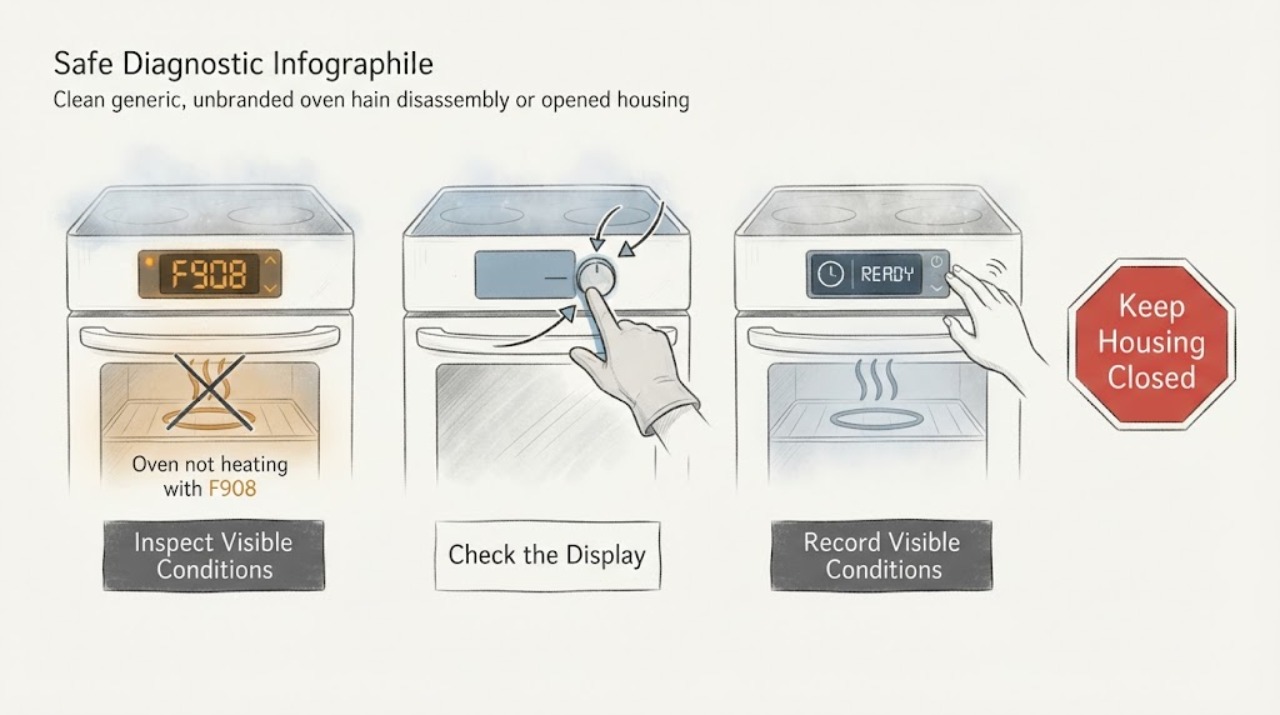
F908 is documented by AEG as an oven-system communication fault: an AEG user manual describes it as the appliance system being unable to connect with the control panel, with an off-and-on action, while AEG support pages say F-number faults require specialist investigation if they persist. The assigned oven has no complete model, so this does not prove that every platform behaves identically and the high-humidity setting is not proof of causation. Copy the complete display and rating-plate data, keep the oven off if it is hot, wet, smoking, sparking, or otherwise unsafe, and perform at most the one model-permitted power cycle only from a safe user-accessible isolator. If F908 returns or the oven still does not heat, stop using it and arrange authorised AEG service; do not enter a service mode, open the oven, test live wiring, or replace a heater or sensor by guesswork.
Work through in order
Diagnostic checks
Use only checks that match the exact appliance or system and its official guide.
-
Check 1
Leave the oven unused and, without touching a hot or wet appliance, look for smoke, a burning smell, sparks, a hot or discolored connection, damaged glass, exposed wiring, water entering the controls, or a door that is hot and locked.
Expected result: Any smoke, burning odor, spark, damaged electrical connection, water at electrical parts, damaged glass, or unsafe locked-hot-cavity condition is present.
Next step: Keep clear and isolate power only through a dry, safe, user-accessible method when possible; do not operate switches or gas controls to investigate. Arrange urgent appliance or electrical service, and use emergency services for active smoke or fire.
Why this matters
Why: This is an electrical, fire, burn, or enclosure hazard rather than a code-clearing exercise. Humidity cannot be used to downgrade these signs.
-
Check 2
Copy the display exactly, including the F, all three digits, and any adjacent symbol or message. Read the oven's complete model, product number, and serial data from the normal rating-plate location only when the cavity is cool and the door can be opened safely.
Expected result: The display is exactly F908, a similar-looking code appears, the display is blank or intermittent, or the complete model/product number is unavailable.
Next step: Photograph or transcribe the label and display for AEG support. Do not apply an F908 interpretation to F90B, F908 with another suffix, or an unconfirmed code, and do not use a manual for a different model.
Why this matters
Why: AEG's code guidance is model- and appliance-specific, and its manuals identify the rating-plate data as the information service needs. A partial series name or a visually similar code is not enough to select a remedy or component.
-
Check 3
Record the selected heating function, whether the cavity was already hot or completely cold, whether the display and touch controls responded, whether the code appeared at startup or after a humidity or steam event, and whether any other function worked before the oven stopped heating.
Expected result: F908 appears at startup, during a heating attempt, after visible condensation or a steam event, only with one function, or together with an unresponsive panel or blank display.
Next step: Keep the oven off if the code or no-heat condition remains and provide the sequence to authorised service. Do not repeatedly select heating functions or use humidity as a reason to keep testing.
Why this matters
Why: AEG's manual ties F908 to system-to-control-panel communication, but the opened sources do not establish a humidity mechanism or prove that F908 itself identifies a heater. Timing and function history help service separate a code recurrence from an independent no-heat fault.
-
Check 4
If the oven is cool, dry, free of smoke, odor, sparks, damaged glass, and a locked hot cavity, use only the model's ordinary user-accessible power-off method once; where the applicable AEG support guidance allows it, leave power off for about 30 seconds before restoring it.
Expected result: The display returns normally, F908 returns, a different code appears, the panel remains unresponsive, or the oven still does not heat.
Next step: Do not repeat the reset. Record the result and arrange authorised service for recurrence, no heat, an unresponsive display, or any changed fault. Do not enter a service mode or access the electrical installation.
Why this matters
Why: AEG documents an off-and-on action for F908 and says persistent F-number faults need specialist investigation. A code that clears once is not proof that a control, communication path, or heating function is reliable.
-
Check 5
After the oven remains off and cool, make only an external visual note of humidity context: condensation on the door or surrounding cabinetry, recent steam or wet cleaning, a damp control surface, or a normal dry environment. Do not spray cleaner, wipe moisture into the controls, or use a high-temperature programme to test the theory.
Expected result: Visible condensation or a recent steam event preceded the code, the oven is simply installed in a humid room, or no unusual moisture is visible.
Next step: Keep the appliance dry and document the timing for service. If the control surface was wet or the code recurs, leave the oven off; do not open the panel, dry it with heat, or continue operating to see whether humidity changes the outcome.
Why this matters
Why: Humidity is a contextual observation, not a confirmed cause of F908 or no heat. AEG's opened F908 material points to control-panel communication and does not provide a humidity-based user repair.
-
Check 6
Prepare a service record with the exact code, complete model and product number if available, selected function, hot/cool state, no-heat behavior, panel response, humidity observations, the single reset result, and any safety sign.
Expected result: The record confirms a recurring F908, an unresolved no-heat condition, an incomplete identity, or a one-time cleared display with normal operation.
Next step: Use AEG's authorised service route for a recurring code, no heat, or incomplete model identity. Keep the oven unused until service confirms that it is safe and functioning normally.
Why this matters
Why: The record gives the technician the platform and failure sequence needed to distinguish communication/control behavior from a separate heating, power, sensor, or door-safety problem without a dangerous home test.
Use your observations
Decision map
Find the observation that best matches what you see, then follow the next safe action.
-
PATH 01Next step
What you see
The display is confirmed as F908 on an AEG oven and the code clears after the one safe, model-permitted off-and-on check.
Do this next
Record the event and use the oven only as the complete model manual permits. Stop and request service if no heat, an unresponsive panel, or F908 returns.
Why this path and its safety boundary
Why it matters: AEG's manual allows that reset for F908, so a transient communication state is possible; the reset does not establish that humidity caused it or that the heating system is sound.
-
PATH 02Next step
What you see
F908 returns, the control panel remains unresponsive, the display is blank/intermittent, or the oven still does not heat after the one permitted check.
Do this next
Leave the oven off and arrange authorised AEG service with the exact code and rating-plate data. Do not repeat resets, enter service mode, open the oven, or perform electrical testing.
Why this path and its safety boundary
Why it matters: AEG treats persistent F-number faults as specialist-service matters, and the English manual says a faulty subsystem may be disabled when the message continues. The evidence does not identify a heater, control board, sensor, or wiring part for the missing model.
-
PATH 03Next step
What you see
The code is not exactly F908, the model/product number is missing, or a different AEG platform manual is the only available reference.
Do this next
Return to the rating plate and AEG model-support route, or arrange service with the photographed display. Do not apply F908, F21, F11, or another code's remedy to an unconfirmed display.
Why this path and its safety boundary
Why it matters: The code-to-function mapping cannot safely be transferred. F908 is documented in AEG sources, but the assigned appliance's exact model and market are not established.
-
PATH 04Next step
What you see
High humidity, condensation, or recent steam is the only unusual context and there is no exact repeatable code or model match.
Do this next
Keep the appliance dry and off until the identity and code are documented. Arrange service for persistent no heat or any F908 recurrence rather than trying to reproduce the humidity condition.
Why this path and its safety boundary
Why it matters: Humidity is not established as the cause of the no-heat condition. It may be a coincidental environmental detail or a clue for service, but it does not justify continued heating tests or an electronic diagnosis.
-
PATH 05Next step
What you see
Smoke, burning odor, sparks, a hot locked cavity, damaged glass, water at electrical parts, or another immediate hazard is present.
Do this next
Keep clear, isolate power only from a dry safe position when possible, do not operate switches or gas controls, and obtain urgent qualified or emergency help.
Why this path and its safety boundary
Why it matters: The oven must be treated as a safety incident, not as a reset or humidity problem.
Helpful context
Understand the symptom
What is established, and what is not
F908 is a real AEG oven code, but the available task identity does not include a model or product number. AEG's English manual describes the code as a control-panel communication problem, while regional AEG support pages direct users to a single restart and specialist service if the problem remains. High humidity may be relevant context if condensation or a recent steam event preceded the display, but the opened sources do not establish humidity as the cause of F908 or of the no-heat condition.
When checks do not resolve it
Need a professional?
Arrange authorised AEG service when F908 returns, the oven remains unable to heat, the panel is unresponsive, the display is blank or intermittent, the model is incomplete, or any diagnosis would require opening the appliance or testing live circuits.
Have this ready
- Provide the exact display, complete model and product number, selected function, hot/cool state, no-heat behavior, panel response, humidity context, and the result of the single permitted reset.
Common questions
FAQ
Does F908 prove that humidity caused the oven to stop heating?
No. AEG's documented meaning is a system-to-control-panel communication problem. Humidity or condensation may be useful timing information, but the opened official sources do not establish it as the cause.
Can I keep resetting the oven until it heats?
No. Use at most the one ordinary reset permitted by the applicable AEG guidance when the oven is cool and safe. If F908 returns or no heat remains, leave it off and arrange service.
Which heater or sensor should I replace for F908?
None can be selected from this code alone. The model is missing, and AEG's material describes a control-panel communication fault rather than identifying a heater or sensor. Do not buy a part or open the oven as a test.
Read the exact guide
Official sources
- AEG User Manual: Oven safety and serviceAEG UK · Official English AEG oven manual used for general safety boundaries; the manual's example model is not claimed as the assigned oven
- AEG User Manual: Oven error codes and service dataAEG · Official English AEG oven manual used for the documented F908 meaning and remedy; the assigned oven's model is not provided, so this is not asserted as its exact manual
- Oven displays error code (F and number)AEG Ireland · Regional AEG support guidance that explicitly lists F908 among oven F-number faults and directs persistent faults to specialist service
- Le four affiche le message d'erreur F908 à l'écranAEG Belgium · Official AEG Belgium F908 support page; regional language and market differ from the assigned en-US task, so it is used only to corroborate the code's electronic/service boundary, not model-specific repair
Community feedback
Share a repair observation
Share a plain-text repair observation. Accepted observations are published automatically; this page may take a moment to update.