
On this page
Start here
Quick answer
For a heat-pump air conditioner that is not heating, select Heat and set the thermostat above room temperature, clean the accessible indoor filter, check power, and allow a normal defrost cycle. Constant cold air, a thickly frozen outdoor coil, or a system that never recovers needs HVAC service.
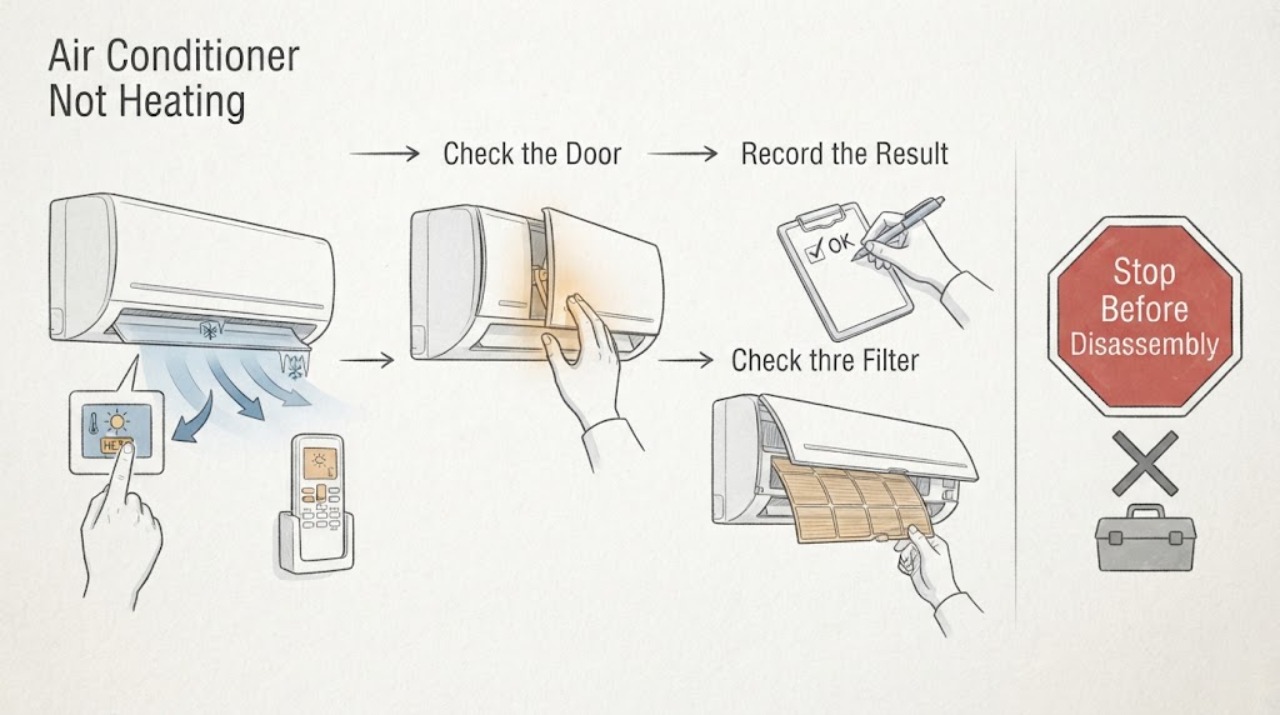
Work through in order
Diagnostic checks
Use only checks that match the exact appliance or system and its official guide.
-
Check 1
Set the thermostat and indoor unit to Heat with a setpoint above the room temperature, then wait for the unit’s normal startup delay.
Expected result: Warm air begins after the delay, or the unit stays in cooling, fan-only, or idle behavior.
Next step: Use the equipment manual for mode labels and do not force a mode change at the disconnect.
Why this matters
Why: A wrong mode or setpoint can fully explain no heat; correct settings with no warm air shift attention to airflow or system diagnosis.
-
Check 2
Clean or replace the accessible indoor filter according to the unit instructions and check that supply and return grilles are open.
Expected result: The filter is dirty or airflow remains weak, or the filter and grilles are clear.
Next step: Restore the filter before testing once more.
Why this matters
Why: A restricted indoor path reduces delivered heat; clear airflow with no heat points toward outdoor or control diagnosis.
-
Check 3
Check the indoor and outdoor breakers or disconnects without opening equipment panels.
Expected result: A breaker or disconnect is open, or both sides have power.
Next step: Reset an obviously tripped breaker once only when safe and stop if it trips again.
Why this matters
Why: A lost outdoor supply can leave a heat pump unable to heat; a breaker that trips again signals a fault.
-
Check 4
Observe whether the outdoor coil has light frost during a defrost cycle or remains heavily iced, and record the timing.
Expected result: Light frost clears during defrost, or ice remains and heat never returns.
Next step: Arrange HVAC service for persistent ice or no heat after the normal cycle.
Why this matters
Why: Temporary frost can be normal; persistent ice may indicate airflow, defrost, refrigerant, or reversing-valve trouble.
Use your observations
Decision map
Find the observation that best matches what you see, then follow the next safe action.
-
PATH 01Next step
What you see
Heat mode and setpoint are correct, power is present, and warm air returns after defrost.
Do this next
Monitor the next cycle and keep filters and grilles clear.
Why this path and its safety boundary
Why it matters: The system was in a normal startup or defrost state.
-
PATH 02Next step
What you see
Heat mode is correct but the outdoor coil stays heavily iced or the unit never produces heat.
Do this next
Turn off the heat-pump call if the manual directs and arrange HVAC service; do not scrape coils.
Why this path and its safety boundary
Why it matters: A defrost, airflow, refrigerant, or reversing-valve fault is more likely.
-
PATH 03Next step
What you see
A breaker or disconnect trips again when heating is requested.
Do this next
Leave it off and obtain qualified HVAC service.
Why this path and its safety boundary
Why it matters: An electrical or equipment fault is more likely than a thermostat setting.
Helpful context
Understand the symptom
Heat-pump systems may temporarily pause heating during defrost, so judge the symptom after the unit has had time to complete a normal cycle.
Keep the indoor and outdoor airflow paths clear. Thermostat settings and power checks are user-level; refrigerant, reversing-valve, and sealed-system work requires a qualified technician.
Only after diagnosis
Potential parts
- model-specific filter, defrost, sensor, or reversing-valve component
Consider a component only after airflow, power, and defrost observations support that diagnosis.
The symptom alone does not establish a part or refrigerant-system fault.
When checks do not resolve it
Need a professional?
Contact a qualified HVAC technician when correct Heat settings, clear filters, stable power, and a normal defrost check do not restore heat, or when the outdoor coil remains heavily iced.
Common questions
FAQ
Is frost always a sign that a heat pump is broken?
No. Carrier explains that a heat pump may frost temporarily and use a defrost cycle. Ice that remains or heating that never returns needs service.
Can I add refrigerant to make an air conditioner heat?
No. Refrigerant and sealed-system diagnosis require qualified HVAC service; first check mode, filter, airflow, and power.
Read the exact guide
Official sources
- Heat Pump Not Heating? Here’s How to TroubleshootHeat · Opened manufacturer or official support guidance; exact model details vary.
Community feedback
Share a repair observation
Share a plain-text repair observation. Accepted observations are published automatically; this page may take a moment to update.