
On this page
Start here
Quick answer
On Amana top-load washers covered by the opened Amana support guidance, a hum or whir during spin can be normal motor operation, and a hum while the washer is draining can come from the pump. First identify whether the sound occurs during spin, drain, or both, then stop the washer and check the load distribution, the four feet, hoses, and nearby objects from the outside. If the sound is new, harsh, persistent with a balanced load, or accompanied by walking, poor draining, burning smell, smoke, a leak, or a failure to complete the cycle, stop using the washer and arrange service instead of diagnosing an internal part.
Before you begin
Safety first
- Do not remove the cabinet, pump, motor, belt, control, or wiring; do not probe live components; do not hold the lid or door switch closed; and do not keep running the washer to reproduce a burning smell, leak, smoke, or severe mechanical noise.
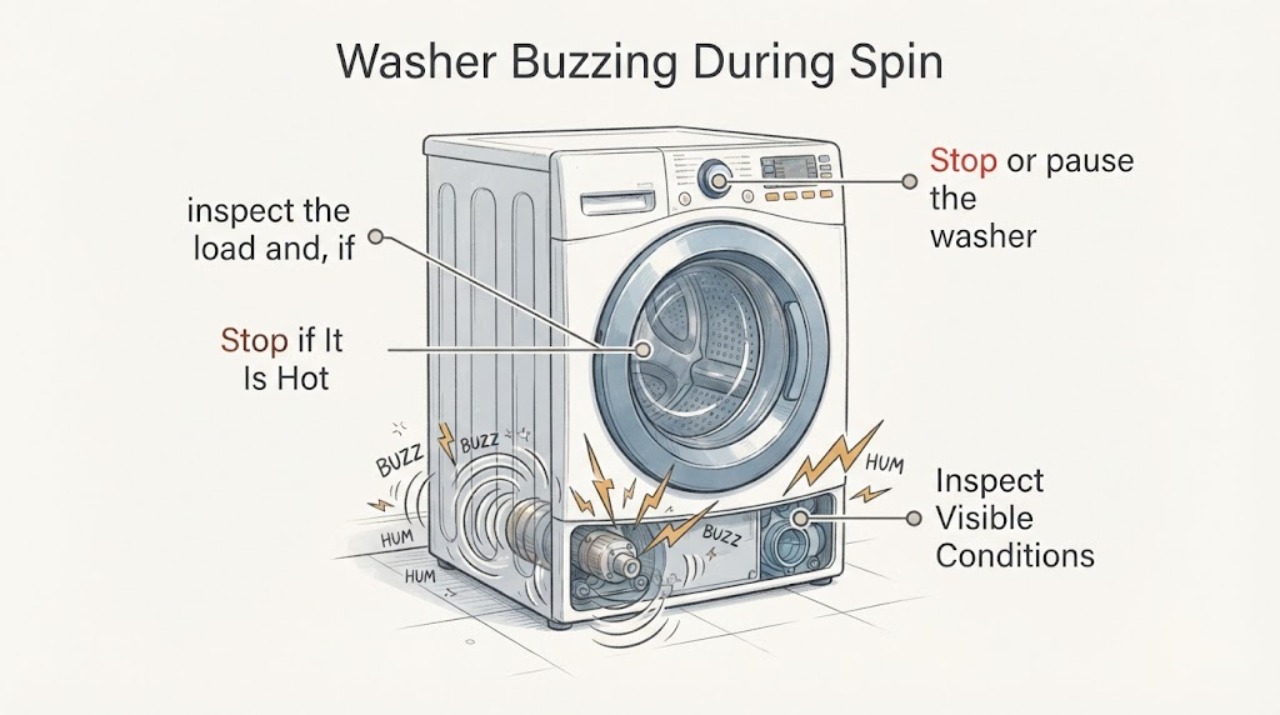
Work through in order
Diagnostic checks
Use only checks that match the exact appliance or system and its official guide.
-
Check 1
Stop or pause the washer safely and note the exact phase in which the buzzing occurs: when the basket accelerates into spin, at steady spin, during drain, or in more than one phase. Note whether the sound is a smooth hum/whir or a harsh buzz, knock, scrape, or rattle, and whether the washer walks, leaks, smells hot, or fails to finish.
Expected result: The sound is limited to motor spin-up or drain, or it is persistent across phases and accompanied by abnormal operation or a hazard sign.
Next step: For smoke, burning smell, leaking water, damaged cord, or severe mechanical noise, unplug only if it is safe to do so, close the water supply if needed, and stop using the washer. Otherwise continue with the external checks below without removing panels.
Why this matters
Why: Amana identifies motor hum/whir during spin and possible pump hum during drain as operating sounds; persistent harsh noise or a safety/functional symptom is outside that simple normal-sound explanation.
-
Check 2
With the washer stopped, inspect the load and, if the cycle is safe to resume, distribute clothes in loose heaps evenly around the agitator or wash plate. Avoid a single heavy or absorbent item and do not overload the basket.
Expected result: The buzzing or vibration is tied to a single bulky item, an uneven load, wet clothes at the end, a reduced spin, or an out-of-balance correction.
Next step: Redistribute the load and use only the load arrangement allowed by the matching manual. If the noise remains with a normally distributed load, move to leveling and external-contact checks rather than assuming a part has failed.
Why this matters
Why: Amana says an off-balance load can create spin noise and vibration, reduce spin speed, lengthen the cycle, leave clothes wet, or cause the washer to stop and attempt self-correction.
-
Check 3
Check the floor contact without opening the washer: press diagonally on the cabinet only while it is stopped and empty or safely idle, and look for rocking. Confirm that all four feet are in firm contact with the floor and that any locking nuts are secure according to the model's manual.
Expected result: The washer rocks, a foot is not firmly planted, or the noise and vibration worsen as spin speed rises; alternatively, the washer is stable and level.
Next step: Correct leveling only as described by the exact model documentation. If the cabinet is stable and the buzzing persists, do not compensate by adding weight or forcing the machine; continue to the external-contact check or service.
Why this matters
Why: Amana states that an unlevel washer or feet that do not contact the floor can make excessive noise or vibration during spin and can prevent correct spinning.
-
Check 4
Inspect around the stopped washer for external contact: drain and inlet hoses touching the rear cabinet, a drain pan or wall contact, or household items such as a broom, rack, hanger, or dustpan leaning against the machine.
Expected result: The sound matches a hose or nearby object tapping the cabinet during vibration, or there is no visible external contact.
Next step: Clear only the visible external contact and secure hoses using the model-approved restraint if one is supplied. If the sound continues with no contact, a balanced load, and a level washer, stop troubleshooting externally and schedule service.
Why this matters
Why: Amana explains that hoses can move against the cabinet and that nearby household items can rattle, especially at high spin speed; no contact makes that explanation less likely.
-
Check 5
Check the drain result without removing the pump or hoses: after the cycle's drain phase, verify whether water leaves the tub normally and whether the buzzing is limited to that drain period.
Expected result: The washer drains normally and the hum occurs only while the pump is running, or the washer leaves water, repeatedly retries, or makes an abnormal sound while failing to drain.
Next step: If draining is normal and the sound is a smooth drain hum, monitor it. If water remains, the noise is harsh or continuous, or the cycle cannot complete, stop using the washer and arrange model-specific service; do not open the pump housing.
Why this matters
Why: Amana notes that the pump may hum during drain. A drain failure or persistent abnormal sound is a functional fault that cannot be assigned to a specific pump or blockage from this no-model evidence.
Use your observations
Decision map
Find the observation that best matches what you see, then follow the next safe action.
-
PATH 01Next step
What you see
The sound is a smooth hum or whir during motor spin-up or steady spin, with normal draining, no walking, no leak, and a completed cycle.
Do this next
Monitor for a change. If the sound becomes harsh, gets louder, persists with a balanced load, or adds a performance or safety symptom, stop and use the service path.
Why this path and its safety boundary
Why it matters: Within the opened Amana top-load support scope, this pattern can be normal motor operation rather than evidence of a failed component.
-
PATH 02Next step
What you see
The washer becomes noisy or vibrates mainly when spinning a single bulky, heavy, or absorbent item, and clothes remain wet or the washer attempts to rebalance.
Do this next
Stop the cycle if it is shaking severely, redistribute the load in loose heaps, avoid overloading or a single absorbent item, and check level afterward.
Why this path and its safety boundary
Why it matters: The observed pattern fits Amana's documented out-of-balance load behavior more closely than an established internal component failure.
-
PATH 03Next step
What you see
The sound occurs while draining and the washer empties normally, with no leak or harsh mechanical noise.
Do this next
Monitor the sound and use the exact model manual if it changes. If draining slows, stops, or the noise becomes abnormal, stop and arrange service instead of removing the pump.
Why this path and its safety boundary
Why it matters: Amana says a pump may hum during drain, so the timing alone does not prove a failed pump.
-
PATH 04Next step
What you see
The buzzing persists with a balanced load and level washer, or the washer walks, leaks, leaves water, fails to complete, smells hot, smokes, or makes a grinding/metallic sound.
Do this next
Stop using the washer, keep hands and panels away from moving or energized parts, and contact Amana or an authorized appliance service provider with the full model number and symptom timing.
Why this path and its safety boundary
Why it matters: The external user checks do not explain the symptom, or a safety/performance hazard is present; the supplied topic has no model-specific evidence for naming an internal part.
Helpful context
Understand the symptom
Identify when the buzzing happens
A sound described as buzzing can have different meanings depending on the phase. Amana's support guidance says humming or whirling can occur while the motor runs during agitation or spin, while the pump may hum during drain. A noise that is actually a knock or vibration can instead track an off-balance load, a hose touching the cabinet, or an object leaning against the washer. Use the timing and the washer's behavior to choose the next safe check; do not treat the word “buzzing” as proof that a motor, pump, gearcase, or control has failed.
Keep the checks external and model-bounded
The opened Amana pages are written for its top-load washer support path, and no model was supplied for this topic. Their user-level guidance supports load distribution, leveling, hose and nearby-object checks, and service escalation. It does not establish a model-specific part diagnosis or authorize removing a pump, cabinet, belt, motor, or control. If your machine is a different Amana washer design, use its exact manual for any model-specific instructions.
Stop when the pattern is not a normal operating sound
Stop and arrange service if the washer has a burning smell, smoke, a water leak, damaged power cord, repeated failure to spin or drain, severe walking, or a harsh metallic noise that remains after the external load and leveling checks. Do not open the cabinet or test live components to identify the source. Record the full model number, cycle phase, load type, and whether the tub drains and completes the cycle so the service provider can match the correct documentation.
When checks do not resolve it
Need a professional?
Call Amana or an authorized appliance service provider when the sound persists with a balanced load and level washer, when draining or spinning fails, or immediately for a leak, smoke, burning smell, damaged cord, severe walking, or harsh metallic noise. The model number is needed before any model-specific part or repair instruction can be selected.
Safety scope: Do not remove the cabinet, pump, motor, belt, control, or wiring; do not probe live components; do not hold the lid or door switch closed; and do not keep running the washer to reproduce a burning smell, leak, smoke, or severe mechanical noise.
Have this ready
- Provide the full model number, washer type, cycle phase where the sound starts, whether the tub drains and spins, load description, whether the cabinet rocks, and any leak, smell, smoke, error, or wet-clothes result.
Common questions
FAQ
Is a buzzing or humming sound during Amana washer spin always a failed motor?
No. Amana's support guidance says motor humming or whirling can occur during spin, and a pump can hum during drain. Use timing, load balance, level, external contact, and performance to decide whether the sound is likely normal or needs service; do not diagnose a motor from sound alone.
Can an unbalanced load make an Amana washer buzz during spin?
It can create noise and vibration, reduce spin speed, lengthen the cycle, leave clothes wet, or cause a self-correction attempt. Redistribute clothes evenly, avoid a single bulky absorbent item, and verify that all four feet contact the floor.
What should I check if the buzzing happens only while the washer drains?
Amana says the pump may hum during drain. Confirm that the washer empties normally and that there is no leak or harsh sound. If it leaves water, retries, or the noise is abnormal or continuous, stop using it and arrange model-specific service rather than opening the pump.
What if the washer is level and the buzzing still continues?
If the load is balanced, hoses and nearby objects are clear, and the buzzing persists or is accompanied by walking, poor draining, a leak, burning smell, smoke, or a harsh metallic sound, stop using the washer and provide the full model number to Amana or an authorized service provider.
Read the exact guide
Official sources
- Knocking or Thumping - NoiseAmana · Opened Amana's official product-help page. It covers spin and wash noises from hoses, nearby objects, drive-mode changes, off-balance loads, and unlevel feet. It supports the external decision branches but does not establish a component diagnosis for an unidentified model.
- Use & Care GuideAmana · Opened the Amana-hosted PDF and used only its general normal-sound and leveling context. The task supplies no model, so this older guide is not treated as proof of exact-model parts, codes, or procedures.
- Humming or Whirling - NoiseAmana · Opened Amana's official product-help page. It covers humming or whirling during agitation/wash or spin as motor operation and notes that the pump may hum during drain; the page also directs unresolved cases to service. The assigned task has no model, so no exact-model part conclusion is taken from it.
- Vibration or Out of Balance loadsAmana · Opened Amana's official product-help page. It applies to top-load washer spin vibration and explains load redistribution, bulky-item limits, level feet, service escalation, and the resulting noise/performance symptoms. It is used for family-level external checks only because the assigned topic has no model.
Community feedback
Share a repair observation
Share a plain-text repair observation. Accepted observations are published automatically; this page may take a moment to update.