
On this page
Start here
Quick answer
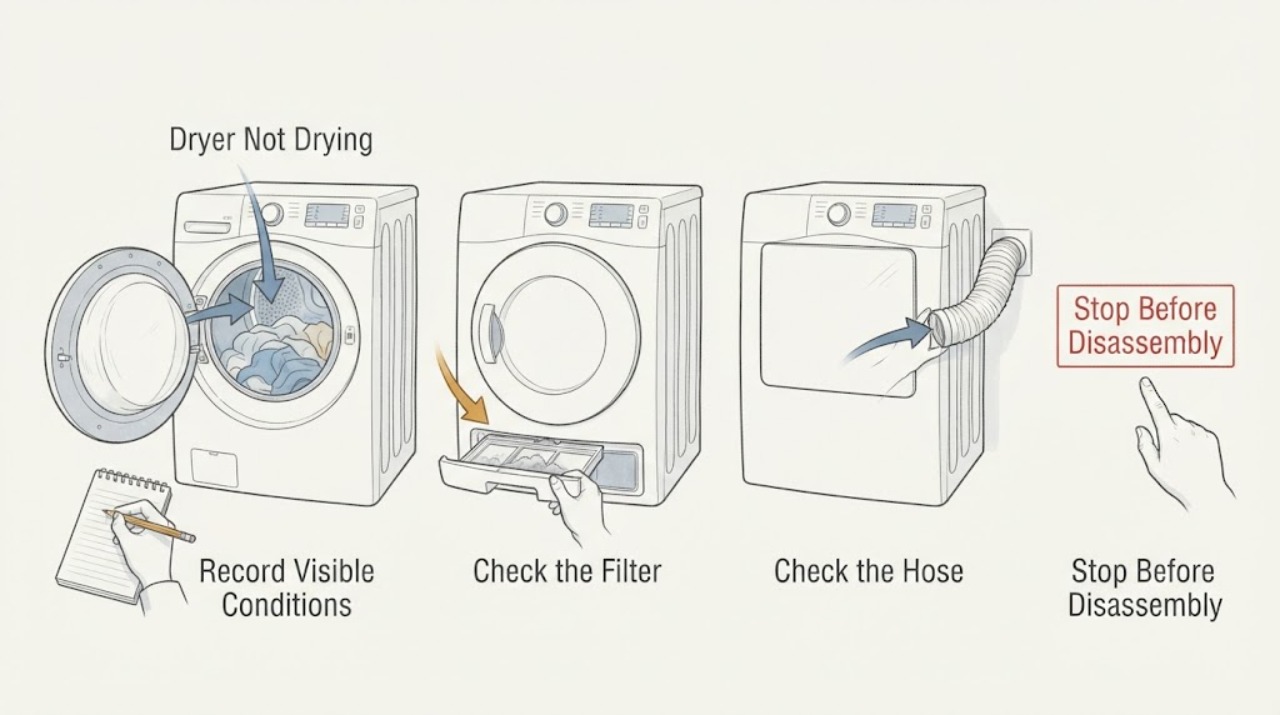
If an ASKO T208CW condenser dryer warms but the clothes remain damp, treat it first as a drying-result problem rather than assuming the heater has failed. Use a suitable Auto drying program and an appropriate load, then switch the dryer off and clean the door net filter. Empty the condensate tank and make sure any drain hose is secure, unbent, and not under tension. Keep the dryer’s air openings and surrounding room clear. If the laundry is still damp after those checks, or the dryer overheats, stops, or shows a fault, stop using it and arrange qualified ASKO service.
Work through in order
Diagnostic checks
Use only checks that match the exact appliance or system and its official guide.
-
Check 1
Record the program, dryness option, load type, and whether the drum tumbles and warms. Compare the finished load with the selected dryness level; do not add wet items while a cycle is running.
Expected result: The dryer warms and tumbles but the load is damp, the cycle ends early, or only thick and tangled items remain wet.
Next step: Separate tangled items, use a program suited to the fabric and load, and continue with the filter and condensate checks. If the drum remains cold, use the no-heat service path instead.
Why this matters
Why: The T208CW provides several Auto programs and dryness choices. A warm drum with uneven or incomplete results can reflect program, load, or moisture distribution before it indicates a heating failure.
-
Check 2
Switch the dryer off, disconnect it from power, and let hot parts cool. Remove and clean the door net filter as the manual describes, reinstall it correctly, and never operate the dryer without an intact filter.
Expected result: The filter is coated with lint or residue, damaged, missing, or already clean and intact.
Next step: Clean or replace the filter only through the model-approved route, then reassess one suitable load. If the filter is damaged or the dryer repeatedly overheats, stop and arrange service.
Why this matters
Why: ASKO’s T208CW guidance requires regular filter cleaning; a restricted filter reduces airflow and can lengthen drying or trigger overheating protection. A damaged filter is not a condition for continued use.
-
Check 3
For the condenser configuration, empty the condensate tank after the cycle and inspect the accessible drain hose if one is fitted. Make sure the hose is securely fastened, not folded, clamped, pulled, or under tension.
Expected result: The tank is full, a tank warning appears, the hose is restricted or loose, or the tank and hose are clear.
Next step: Empty the tank or restore only the accessible hose position described by the instructions, clean any spill, and run one normal test. If the tank refills unusually fast, the pump does not move water, or the warning returns, stop and call service.
Why this matters
Why: ASKO states that moisture is collected in the condensate tank and that a full tank can interrupt drying. Its installation guidance says the supplied drain hose must not be bent or under tension.
-
Check 4
With the dryer off and cool, check that the front and rear air openings are not covered by lint, furniture, a closed door, or a long-fibre carpet, and keep the surrounding room adequately ventilated. Do not move a stacked dryer alone.
Expected result: An opening or surrounding clearance is blocked, the room is hot or confined, or external airflow is clear.
Next step: Clear only external obstructions and let the dryer cool. If it still warms but leaves a suitable load damp after the filters, tank, and airflow are correct, arrange qualified diagnosis.
Why this matters
Why: ASKO installation guidance warns that limited ambient air and blocked vents can make drying take longer and says the dryer should be installed with adequate ventilation. This check does not diagnose sealed internal components.
-
Check 5
Run one supervised, model-appropriate test after the permitted cleaning and drainage checks. Record whether the load dries normally, remains damp while heat is present, or the machine stops and displays a fault.
Expected result: Drying improves, dampness persists despite warmth, or the dryer stops, overheats, or repeats a warning.
Next step: Stop using the dryer for persistent dampness, repeated overheating, a recurring warning, smoke, burning or electrical smell, or abnormal noise, and arrange qualified ASKO service. Do not open the cabinet or perform live tests.
Why this matters
Why: Improvement after filter, tank, airflow, or load correction supports an external drying-path issue. Persistent dampness or protective shutdown after those checks can involve the pump, sensor, condenser, heater control, or another internal fault that the symptom cannot identify.
Use your observations
Decision map
Find the observation that best matches what you see, then follow the next safe action.
-
PATH 01Next step
What you see
The dryer tumbles and warms, but the filter is dirty, the condensate tank is full, or the drain hose is kinked or loose.
Do this next
With the dryer off and cool, clean the filter, empty the tank, and restore only the accessible hose position described by ASKO; then run one suitable test.
Why this path and its safety boundary
Why it matters: A restricted filter or interrupted condensate path can prevent the T208CW from removing moisture efficiently even though heat is present.
-
PATH 02Next step
What you see
The dryer warms but only thick, tangled, or unsuitable loads remain damp, while the filter and condensate path are clear.
Do this next
Separate the load and choose the appropriate ASKO program and dryness setting. Avoid overloading and do not add wet laundry during a running cycle.
Why this path and its safety boundary
Why it matters: Load composition, tangling, program, or dryness selection is more likely than an absent heater.
-
PATH 03Next step
What you see
The dryer stays warm but leaves a suitable load damp after filter, tank, hose, airflow, and program checks, or it overheats or repeats a warning.
Do this next
Stop using the dryer and arrange qualified ASKO service with the model, program, load, filter and tank results, and any displayed warning.
Why this path and its safety boundary
Why it matters: The remaining possibilities include internal moisture sensing, pump, condenser, heater control, or another fault that cannot be distinguished safely from user observations.
Helpful context
Understand the symptom
Why a warm dryer can still leave clothes damp
Warmth alone does not prove that moisture is leaving the load. The T208CW is a condenser model: moisture is extracted in the condenser and collected in the condensate tank. A dirty filter, restricted air openings, unsuitable load or program, full tank, or a blocked condensate path can therefore produce damp laundry even when the drum feels warm. Internal heater, pump, sensor, and control diagnosis belongs to service.
Only after diagnosis
Potential parts
- ASKO dryer door net filter
Only consider this category if the installed filter is damaged or cannot be cleaned and the model documentation confirms the fit.
Confirm the exact T208CW model and manufacturer fit information before ordering. - ASKO dryer condensate pump or drain component
Only consider an internal drain part after the tank and accessible hose are clear but water does not move or the tank warning returns; this is a service diagnosis.
Confirm model fit and have qualified service identify the failed component.
When checks do not resolve it
Need a professional?
Arrange qualified ASKO service if the dryer remains damp after the model-appropriate filter, condensate, airflow, and program checks; if the tank refills unusually quickly or the pump does not move water; or if there is repeated overheating, a recurring warning, smoke, arcing, burning or electrical smell, abnormal noise, damaged wiring, or a need to open the cabinet or perform live electrical tests.
Common questions
FAQ
Why is my ASKO dryer warm but the laundry still damp?
On the condenser T208CW, warmth alone does not prove that moisture is being removed. Check the program and load, clean the door filter, empty the condensate tank, and check the accessible drain path and air openings. Persistent dampness after those checks needs service.
Does the ASKO T208CW use an exhaust vent to remove moisture?
The T208CW is identified by ASKO as a condenser dryer. Its installation guidance says moisture is extracted in the condenser and accumulated in the condensate tank, so inspect the tank and supplied drain path rather than assuming a household exhaust duct is the cause.
When should I stop troubleshooting?
Stop and arrange qualified ASKO service if dampness persists after the permitted filter, tank, hose, airflow, and program checks, or if the dryer overheats, stops repeatedly, shows a recurring warning, smokes, or has a burning or electrical smell. Do not open the cabinet.
Read the exact guide
Official sources
- 579599en.inddASKO · ASKO T208CW installation, condensate drainage, ventilation, and drying operation guidance
- 2 4 " DRYER — CONDENSER CLASSIC SERIES T208CW FEATURESASKO · ASKO T208CW condenser dryer model identity, Auto programs, and product features
Community feedback
Share a repair observation
Share a plain-text repair observation. Accepted observations are published automatically; this page may take a moment to update.