
On this page
Start here
Quick answer
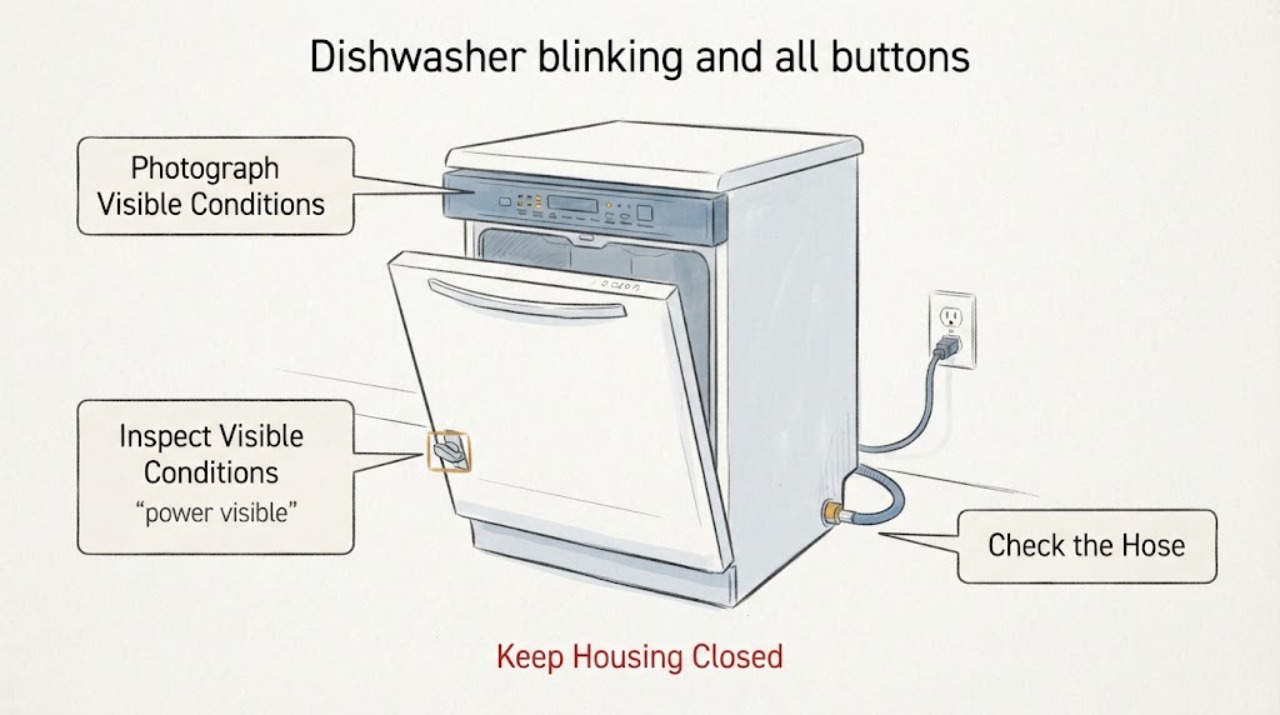
For a Beko DDT36430XIH whose lights blink and buttons do not respond, first confirm the exact model and whether the display is lit, then check household power without opening the dishwasher, confirm the water-supply tap is open, and close the door firmly until the latch engages. Beko identifies power loss, a faulty appliance fuse, an open or damaged door/latch, and a closed water supply as no-start branches. These checks do not prove a control board, neutral conductor, or door switch has failed. If the controls remain unresponsive after the external checks, or the cord, outlet, door, or latch is damaged, stop using the dishwasher and arrange an authorized service visit rather than removing panels or changing wiring.
Work through in order
Diagnostic checks
Use only checks that match the exact appliance or system and its official guide.
-
Check 1
Read the rating label and record DDT36430XIH, then note whether the display is completely dark, continuously lit, or blinking and whether any single key responds. Photograph the panel without removing it.
Expected result: The label matches DDT36430XIH and the panel is blinking or unresponsive, or the model label is missing or differs.
Next step: Keep the assigned model identity only if the label matches. Continue with external power, water, and door checks; if the label differs, use that model's own Beko support/manual path instead of applying this page's model-specific scope.
Why this matters
Why: The Beko product page confirms that DDT36430XIH uses electronic touch control and an LED display. A different model can have different control behavior, while a blinking display alone does not identify a board, neutral, or latch failure.
-
Check 2
Check household power from outside the dishwasher: look at nearby lights or another appliance, confirm the dishwasher's plug or approved connection has not been disturbed, and look for a tripped accessible breaker only if you can do so safely. Do not remove panels or probe the outlet.
Expected result: Other household power is also out; other loads work but the dishwasher display stays dark; or the display is lit and blinking.
Next step: If the home or circuit is out, address that electrical issue safely. If other loads work but the dishwasher remains dark, stop and contact a qualified electrician or authorized service. If the panel is lit or blinking, continue only with the water and door checks; do not open the control area.
Why this matters
Why: Beko says a dark display can result from a power failure and recommends checking lights and other appliances. If those work, Beko says the appliance fuse may be faulty and calls for a qualified electrician; a lit or blinking display means power is reaching at least part of the interface, but it does not identify the failed circuit.
-
Check 3
Verify the household water supply tap feeding the dishwasher is open and that other household taps provide water. Do not disconnect the inlet hose or remove an inlet valve while the controls are unresponsive.
Expected result: Household water is off or absent, the dishwasher supply tap is closed, or water is available and the tap is open.
Next step: Restore normal household water and open the dishwasher supply tap if it was closed, then try the normal controls once with the door closed. If water is available and the controls still do not respond, move to the door/latch check and service boundary rather than disassembling the inlet connection.
Why this matters
Why: Beko lists a water outage or a closed supply tap as a no-start condition. Restoring the tap addresses a documented external prerequisite; it does not prove an inlet valve or control board is defective.
-
Check 4
Close the dishwasher door firmly and listen for the latch engagement described by Beko. Inspect only the visible door edge, gasket area, and latch area for an obvious crack, obstruction, or misalignment; do not pry the latch or remove the inner door panel.
Expected result: The door closes and latches with the expected locking sound, or it will not latch, is cracked, or the latch appears damaged.
Next step: Remove only an obvious loose obstruction and close the door normally. If it will not latch or the door is cracked, stop using the dishwasher and contact an authorized service agent. If it latches but the panel remains unresponsive, do not bypass the interlock; use the final service branch.
Why this matters
Why: Beko says the dishwasher will not start when it detects the door as open and advises checking for a firm closure and locking sound. A broken or non-working latch is a service condition, not evidence that a board or neutral wire should be replaced.
-
Check 5
After the external power, water, and door checks, record whether the buttons still ignore every press, whether the display continues blinking, and whether there is a burning smell, heat damage, arcing sound, or repeated breaker trip. Do not keep cycling power, run a test with exposed wiring, or remove the console.
Expected result: The controls recover after an external correction; the controls remain unresponsive; or there is visible electrical damage, burning odor, arcing, or a breaker trip.
Next step: If the panel remains unresponsive or any hazard sign appears, stop using the dishwasher and isolate power only by the normal household disconnect if safe. Arrange authorized service and provide the exact model, the blinking behavior, power observations, water-tap state, door-latch result, and any damage. Do not guess at a control board, neutral conductor, or door-switch replacement.
Why this matters
Why: A recovered control response points to the corrected external prerequisite, not a confirmed component repair. Beko says a continuing no-start condition may be a technical problem and directs the owner to an authorized service agent. Damage, odor, arcing, or trips add an immediate safety stop.
Use your observations
Decision map
Find the observation that best matches what you see, then follow the next safe action.
-
PATH 01Next step
What you see
The DDT36430XIH display is dark while nearby lights or another appliance are also without power.
Do this next
Restore household power through the normal safe process. If the circuit will not hold or the dishwasher remains dark after other loads work, use a qualified electrician or authorized service.
Why this path and its safety boundary
Why it matters: The symptom is consistent with a household or circuit power outage, not a proven dishwasher control failure.
-
PATH 02Next step
What you see
Nearby power works, but the dishwasher display remains dark or the accessible connection appears damaged.
Do this next
Stop at the external check and contact a qualified electrician or authorized service. Do not remove the junction-box or control-panel covers.
Why this path and its safety boundary
Why it matters: Beko says the appliance fuse may be faulty when other household electrical loads work; the source does not identify which internal electrical part has failed.
-
PATH 03Next step
What you see
The water-supply tap is closed or household water is unavailable.
Do this next
Restore the supply safely and make one normal start attempt with the door latched. If all buttons remain unresponsive, continue to service rather than opening the inlet system.
Why this path and its safety boundary
Why it matters: A documented water-supply prerequisite is missing, so the no-start symptom cannot yet be used to diagnose the controls.
-
PATH 04Next step
What you see
The door will not latch, the locking sound is absent, or the visible door/latch area is cracked.
Do this next
Do not bypass or force the latch. Stop using the appliance and arrange authorized service for the door/latch inspection.
Why this path and its safety boundary
Why it matters: Beko says the dishwasher will not start when it detects an open door and directs a non-working latch to authorized service.
-
PATH 05Next step
What you see
Power, water supply, and door closure are normal, but every key remains unresponsive and the lights continue blinking.
Do this next
Stop user troubleshooting and request authorized service with the model and symptom record. Keep the dishwasher closed and do not perform live electrical tests or wiring changes.
Why this path and its safety boundary
Why it matters: The opened official guidance supports treating this as a possible technical failure, but it does not prove a control board, neutral conductor, or switch diagnosis.
Helpful context
Understand the symptom
Confirm the DDT36430XIH before interpreting the lights
Beko identifies DDT36430XIH as a tall-tub dishwasher with electronic touch control and an LED display. The product page confirms the model identity and lists a 120 V, 60 Hz supply, but it does not define the reported blinking pattern as a fault code. Treat the lights and unresponsive buttons as a symptom to document, not proof of a failed board, door switch, or neutral connection.
Use external checks before considering service
Beko's no-start guidance begins with power, water supply, and door closure. Those checks are appropriate for this exact dishwasher because they do not require removing the toe-kick, control panel, junction-box cover, or door skin. A display that is dark, a household power problem, a closed supply tap, or a door that does not latch changes the next safe step without identifying an internal component.
Do not turn a blinking symptom into a wiring repair
The opened Beko support article does not authorize testing live terminals, swapping control-board wires, bypassing a door interlock, or diagnosing a loose neutral from blinking lights. If external checks do not restore a response, Beko classifies the remaining case as a possible technical problem and directs the owner to an authorized service agent.
When checks do not resolve it
Need a professional?
Contact an authorized Beko service agent when the dishwasher remains unresponsive after the external power, water-supply, and door-latch checks, or immediately if the door or latch is damaged. Use a qualified electrician for a circuit or appliance-fuse concern. Stop using the dishwasher for burning odor, arcing, heat damage, or repeated breaker trips, and do not open the console or change wiring.
Common questions
FAQ
Does blinking on a Beko DDT36430XIH prove that the control board is bad?
No. The Beko product page confirms that this model has electronic touch controls and an LED display, but the opened Beko no-start guidance does not assign this reported blinking symptom to a particular board or wire. Check external power, water supply, and door closure, then use authorized service if the controls remain unresponsive.
What should I check if the dishwasher display is dark?
Check whether nearby lights or another appliance also lost power. Beko says a power outage can leave the display unlit; if other loads work, it says the appliance fuse may be faulty and recommends a qualified electrician. Do not remove the dishwasher panels to investigate the connection yourself.
Can I bypass the door switch or rewire a neutral connection to make the dishwasher respond?
No. The official Beko guidance says the door must close and latch and sends a non-working latch or continuing technical problem to authorized service. It does not authorize bypassing an interlock, changing wiring, or testing energized terminals.
Read the exact guide
Official sources
- How to fix a dishwasher that won’t startBeko · Official Beko support guidance used for external power, water-supply, door-latch and authorized-service branches; it does not define a DDT36430XIH blinking code or authorize internal electrical repair.
- DDT36430XIH: Tall Tub Stainless Dishwasher, 14 place settings, 45 dBa, Top Control with Pocket HandleBeko · Exact model identity and product-control scope for DDT36430XIH; the page identifies electronic touch control, LED display, 120 V/60 Hz supply and overflow safety.
Community feedback
Share a repair observation
Share a plain-text repair observation. Accepted observations are published automatically; this page may take a moment to update.