
On this page
Start here
Quick answer
Yes, a burning smell after a blender spill is a reason to stop using it until you establish that the liquid stayed in the removable jar and never reached the motor base, vents, cord or plug. Unplug it from a dry position without touching a wet energized appliance, and do not run another cycle to see whether the smell clears. CPSC warns against touching wet appliances that remain plugged in; Blendtec's official care guidance says to unplug before cleaning, never use a water jet on the base, never submerge the motor, and never remove the base cover. Some Vitamix models can emit a burning smell during thermal overload, but that brand-specific explanation does not prove a wet, unspecified blender is safe. Clean only removable parts as the exact manual allows, keep a possibly wet base out of service, and arrange qualified service if liquid reached the base or the smell persists, returns, or is accompanied by smoke, sparks, a hot cord, a trip or abnormal noise.
Work through in order
Diagnostic checks
Use only checks that match the exact appliance or system and its official guide.
-
Check 1
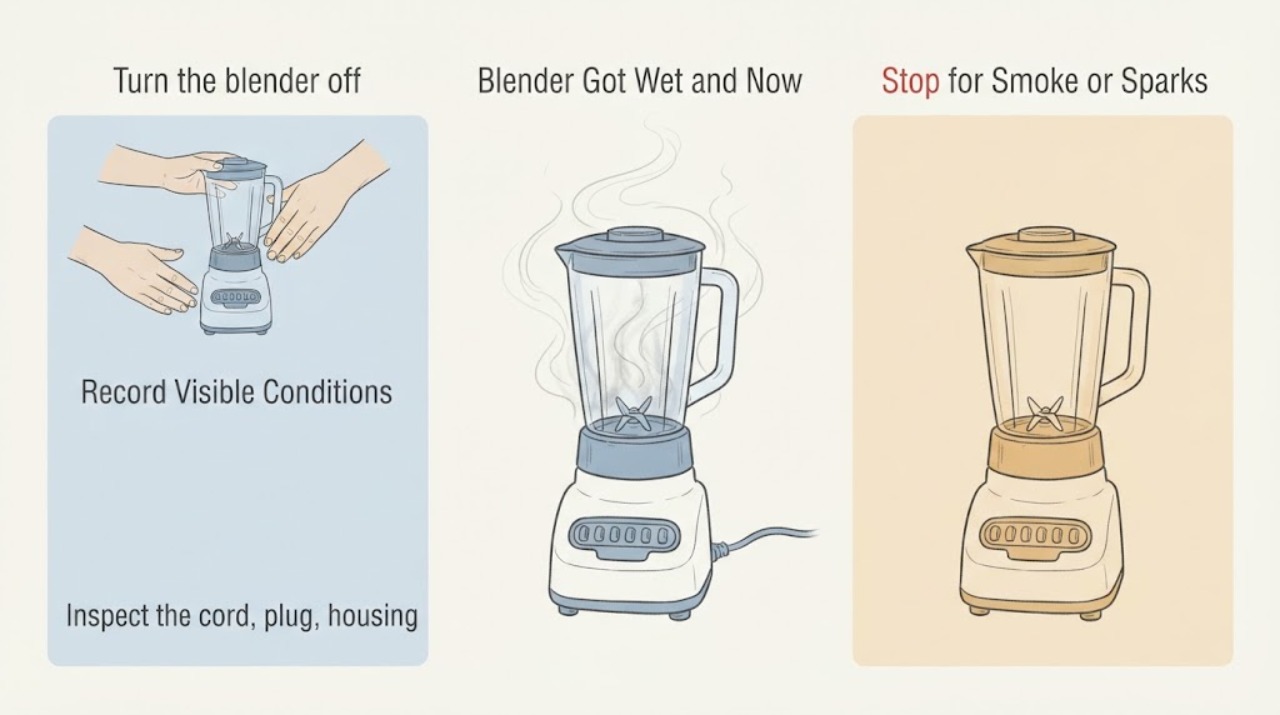
Turn the blender off and disconnect power from a dry position only if the plug and surrounding surface can be reached without touching liquid. Do not touch a wet blender that remains plugged in and do not run another cycle.
Expected result: The base, plug or counter is wet; the appliance is dry except for the removable jar; or power cannot be safely disconnected without contact with water.
Next step: Keep clear of unsafe water and use the home's safe disconnect only if necessary; otherwise obtain qualified help. Once disconnected, keep a base that may have been penetrated by liquid out of service.
Why this matters
Why: A wet energized appliance can present shock and fire hazards. The location of the liquid determines whether this is a removable-part cleaning issue or a potentially water-damaged electrical appliance.
-
Check 2
With power disconnected, inspect externally and record whether the spill stayed in the jar or reached the jar underside, drive area, motor-base vents, controls, cord or plug. Do not open the base or probe openings.
Expected result: Liquid stayed in the removable jar, liquid reached or may have reached the motor base, or the path cannot be determined.
Next step: Clean and dry removable parts only as the exact manual permits. For any base exposure or uncertainty, do not re-energize the blender and arrange qualified inspection.
Why this matters
Why: A contained jar spill can follow the jar's cleaning instructions; liquid at the base, vents, controls or plug creates an electrical service boundary. An uncertain path cannot be treated as dry.
-
Check 3
After unplugging, inspect the cord, plug, housing and vents for scorching, deformation, residue, smoke staining or a damaged conductor. Wipe only accessible exterior surfaces using the exact model's instructions; do not spray, submerge or use a water jet on the base.
Expected result: There is visible damage, residue at the base, a hot or damaged cord/plug, smoke staining, or no visible external damage.
Next step: Stop use and arrange service for any damage, residue, cord/plug issue or uncertain base exposure. Do not open the housing to search for the source of the odor.
Why this matters
Why: Visible damage or residue supports keeping the unit out of service, but a clean exterior does not prove that liquid did not enter the electrical assembly. Blendtec expressly prohibits water jets, submersion and base-cover removal.
-
Check 4
Record whether the burning smell began immediately after the spill, only under a thick load, or on every attempted use, along with any smoke, spark, abnormal noise, motor stall or circuit trip. Do not perform repeated test runs.
Expected result: The smell persists or returns, occurs with no load, follows base exposure, or is accompanied by smoke, sparks, heat, noise or a trip; alternatively, the spill was confined to the jar and the base remained dry.
Next step: Keep the blender off and contact the manufacturer's qualified service route for persistent or unexplained odor and any water exposure. Only if the exact manual confirms a dry, model-specific overload scenario should its cooling guidance be followed; do not generalize it to this unspecified blender.
Why this matters
Why: Vitamix documents overload-related odor for its own models, but odor after water exposure or without a documented overload may indicate an unresolved electrical, motor or drive issue. The symptom alone cannot identify a component.
Use your observations
Decision map
Find the observation that best matches what you see, then follow the next safe action.
-
PATH 01Next step
What you see
Liquid reached, may have reached, or cannot be ruled out at the motor base, vents, controls, cord or plug.
Do this next
Do not plug it in or open the housing; arrange evaluation by qualified appliance or electrical service according to the manufacturer and local safety guidance.
Why this path and its safety boundary
Why it matters: This is possible water-damaged electrical equipment. Drying the outside does not establish that internal electrical parts are safe to re-energize.
-
PATH 02Next step
What you see
The spill was confined to the removable jar or lid, the motor base and plug stayed dry, and there is no visible base damage.
Do this next
Clean and dry the removable parts as documented, inspect the base externally, and use the manufacturer's instructions or service route before any cautious return to operation. Stop if the odor returns.
Why this path and its safety boundary
Why it matters: The removable parts may be cleanable under the exact model manual, but the burning odor still needs an explanation and should not be dismissed after a spill.
-
PATH 03Next step
What you see
The exact manual identifies a dry, model-specific overload condition and the odor occurred only during a documented heavy blend, with no spill reaching the base.
Do this next
Follow only the exact manual's cool-down instruction once, then contact service if the smell persists, recurs, or the machine does not recover. Do not keep testing a blender that may have been wet.
Why this path and its safety boundary
Why it matters: Some models, including Vitamix models, document a thermal-overload smell, but that explanation is brand- and model-specific and does not prove the present blender is safe.
-
PATH 04Next step
What you see
Smoke, sparks, scorching, a hot or damaged cord/plug, a circuit trip, abnormal noise or a burning smell without a documented dry overload is present.
Do this next
Keep the blender disconnected and away from combustible material, do not reset and retest repeatedly, and obtain qualified service or manufacturer evaluation.
Why this path and its safety boundary
Why it matters: The event is an electrical or mechanical stop-use condition, and the symptom does not identify a safe user repair or replaceable component.
Helpful context
Understand the symptom
Stop the motor before investigating the spill
A spill changes the response to a burning smell. Turn the control off and unplug the blender from a dry position if you can do so without touching water or a wet plug. Do not reach through liquid, lift a wet base while it is connected, or run the blender again to test the odor. CPSC warns against touching wet plugged-in appliances, and the electrical boundary is more important than determining whether the smell is from an overload or damaged component.
Separate the removable jar from the motor base
Once power is safely disconnected, record where the liquid went: inside the jar, on the outside of the jar or blade assembly, on the centering area, through a vent, under the base, or onto the cord and plug. A jar and lid may have a cleaning method in the exact manual, while a motor base is an electrical assembly. Blendtec's official guidance allows an unplugged base to be wiped with a damp cloth but prohibits a water jet and submerging the motor; do not treat that brand-specific surface-cleaning note as permission to dry or reuse an unspecified base that may have been penetrated by liquid.
Do not explain away the odor as normal overload
Vitamix documents burning odor during motor overheating or overload and directs the owner to turn power off and allow the machine to cool. That is a Vitamix-specific explanation for a dry machine under a heavy load; it does not establish that water did not enter this blender or that its insulation and controls are safe. If the odor began after the spill, treat the timing as a service clue and keep the model-specific manual and warranty/service route available.
Keep the base closed and document the failure
Do not remove the motor-base cover, probe energized parts, bypass a switch, or use a hair dryer or other heat source inside the base. Write down the blender's full model, what liquid spilled, where it landed, how long before the smell appeared, whether the motor slowed or stopped, and whether there was smoke, a spark, a tripped circuit or a hot cord. Blendtec's safety manual sends a damaged or malfunctioning unit to qualified service and says the base is not user-serviceable.
When checks do not resolve it
Need a professional?
Arrange manufacturer-authorized or otherwise qualified appliance service if liquid reached or may have reached the motor base, vents, controls, cord or plug; if the burning smell persists or returns; or if there is smoke, a spark, a hot/damaged cord, abnormal noise, a stall or a circuit trip. Provide the full model and serial information, liquid type and spill location, timing of the odor, and any visible or electrical symptoms. Do not remove the base cover, test energized wiring, bypass a safety switch, or choose a motor, control or drive part from the smell alone.
Common questions
FAQ
Is a burning smell after a blender spill normal?
Do not assume it is normal. Some Vitamix models document a burning smell during motor overload, but that explanation does not clear an unspecified blender after liquid exposure. Keep it unplugged until the spill location and the exact manufacturer's guidance or service assessment are clear.
Can I dry the blender base and try it again?
Do not re-energize a base that may have been penetrated by liquid merely because the outside feels dry. CPSC recommends professional evaluation before using wet appliances, and Blendtec prohibits submerging the motor, using a water jet or removing the base cover.
Can I wash the motor base in the sink?
No. The motor base is an electrical assembly. Blendtec's official care instructions limit base cleaning to an unplugged external wipe and prohibit a water jet or submersion; use the exact manual for the actual brand and model.
What information should I give service?
Give the full model and serial information, what liquid spilled, where it reached, when the odor started, whether the motor stalled, and whether there was smoke, sparking, unusual heat, noise or a circuit trip. Do not diagnose or order a part from the odor alone.
Read the exact guide
Official sources
- Use & CareBlendtec · Official Blendtec care page used as a manufacturer example for separating jar cleaning from motor-base cleaning. It is not a universal procedure or proof of compatibility with the unspecified blender.
- CPSC Urges Flood Victims to Take Steps to Prevent CO Poisoning, Electrocution, Explosion and FiresU.S. Consumer Product Safety Commission · Government safety guidance used for the stop-use and do-not-touch boundary when an electrical appliance is wet and plugged in. It does not diagnose this blender or authorize internal repair.
- Blendtec Commercial Blender Safety and Operating ManualBlendtec · Official Blendtec manual used only for the explicit manufacturer safety boundary: do not operate in liquid, do not remove the base cover, and send damaged or malfunctioning units for qualified evaluation. It does not establish the model or condition of this blender.
- Frequently Asked QuestionsVitamix · Official Vitamix FAQ used only to show that some Vitamix models associate burning odor with motor overheating/overload and direct power-off/cool-down. It is explicitly not applied as a diagnosis or reset procedure for an unspecified wet blender.
Community feedback
Share a repair observation
Share a plain-text repair observation. Accepted observations are published automatically; this page may take a moment to update.